• Susan Cummings — The Person Who Signed BioShock, Borderlands, and XCOM
    Sep 22 2026

    Susan Cummings co-founded the 2K Games label at Take-Two, where in a two-year window she signed BioShock, Borderlands, XCOM, and The Darkness, and pulled Civilization out of Atari one week after her first call with Firaxis. She is a Rockstar alum, co-founder of Tiny Rebel Games and Fictioneers, and today the co-founder and CEO of 10six Games, building the AI-forward roguelite YOU vs Zombies. In this re:Play, Greg Off traces thirty years of deal-making, platform pivots, and what "finding your rock band" really means.

    In this episode:

    • Intellivision, Utopia, and Don Daglow as the first game and a lifelong friend
    • A Boston recruiting job, a "book of multimedia companies" in 1995, and a first cold call to Al Lowe at Sierra
    • Ed Fries and a Microsoft lunch before Xbox existed — "Microsoft still has more money than you do"
    • The Sam Houser meeting at her San Francisco apartment in 1997 that led to Rockstar Games
    • Moving to New York a few months after GTA3 shipped — and what the "best and worst" years at Rockstar actually cost
    • The eye of Sauron turning to GTA, and why every competitor's attempt to clone it failed
    • The birth of the 2K Games label — the pressure to be something that wasn't only Rockstar
    • Borderlands verbally pitched at E3 as "Pandora's box" and "Halo meets Diablo"
    • BioShock signed on a GameSpot article and a long friendship with Ken Levine
    • The 50/50 IP co-ownership structure — and why Susan and Ryan Brant were the first to write it into the contract
    • The Civilization acquisition — first Friday call to Jeff Briggs, $20 million check to Atari the following week
    • XCOM as a freebie thrown in at the last second — the story Atari now hates telling
    • The Oblivion distribution deal — a $60 million guarantee they earned back in the first week
    • The "third-game rule" — why the magic tends to arrive on the third title in a series, and why publishers keep trying to skip it
    • Leaving Take-Two — the reset with her husband and creative partner Lee, and starting Tiny Rebel Games
    • 10six Games — a seven-person team in Wales building YOU vs Zombies
    • The design of YOU vs Zombies — human-authored art, story, systems, and level design, with generative AI as the customization layer
    • The honest read on AI in games — roughly 90% of developers using it, most afraid to say so, and Steam's disclosure requirement as an unintended scarlet letter
    • The renaissance argument — why the next few years at the small-team end may look more like a renaissance than a reduction

    Links & References

    Susan Cummings on LinkedIn — https://www.linkedin.com/in/susanicummings/

    10six Games — https://www.10sixgames.com/

    YOU vs Zombies on Steam — https://store.steampowered.com/app/4224660/YOU_vs_Zombies/

    Tiny Rebel Games — https://www.tinyrebelgames.com/

    Rockstar Games — https://www.rockstargames.com/

    2K — https://www.2k.com/

    Mehr anzeigen Weniger anzeigen
    1 Std. und 26 Min.
  • Michael Rubinelli — Business Models Are Extinction Events
    Sep 1 2026

    In this episode of re:Play, Greg Off sits down with Michael Rubinelli — a 30-year veteran of the publisher and platform side of the games business. Across EA, THQ, Midway, Capcom U.S.A., Playdom, Disney, Kixeye, WAX, and now Tyranno Studios, Michael has been the person deciding which games get made, on which platforms, under which business models.

    From a video-game rental side hustle at 24, to a mock company letterhead that got him into CES, to an EA job offer in December '91 on Tony La Russa Baseball, Michael traces the whole arc — Madden's early franchise years, a Midway VP seat alongside arcade veterans Mark Turmell, Ed Boon, John Tobias, and Eugene Jarvis, running Capcom U.S.A. through a business-model inflection, joining Playdom in early 2010, overseeing Marvel Avengers Alliance, the Disney acquisition, a Facebook-to-mobile transition at Kixeye, an Australian public-company CEO seat, WAX, and finally Tyranno Studios as CGO — where he is working with Richard Garfield on Dirty Dealing, a heads-up card battler set in 1974 Chicago.

    In this episode:

    • Wading into the deep end — the David Bowie quote that shaped a 30-year career philosophy
    • Finding his place on Madden — the pass-interference exploit and the field-goal bug he caught before ship
    • The arcade masters who taught him to earn the next coin in sixty seconds
    • Marvel Avengers Alliance — and why a JRPG-shaped Marvel game worked on Facebook
    • The signature framework: why platform and business-model transitions are extinction events
    • Capcom, Konami, Sunsoft, Hudson Soft — who made the jump and who didn't
    • Scratch: The Ultimate DJ — the game he calls his favorite that never shipped
    • Playdom, the free-to-play mental unlock, and being a "cultural czar" through Disney
    • Kixeye as a cautionary tale about missing a transition
    • Player ownership, the "off ramp," and where Web3 gaming fell short
    • Tyranno Studios, Dirty Dealing, and a lean studio around Richard Garfield's design

    Recorded in-studio at Off Base's Berkeley studio on July 22, 2026, this is a candid conversation about a career built on deliberate discomfort — and one line from Michael that anchors the whole thing: "Making games I look at as a calling, not really a job."

    Links & References

    • Michael Rubinelli on LinkedIn — https://www.linkedin.com/in/michael-rubinelli-gaming/
    • Tyranno Studios — https://www.tyranno.io/
    • Electronic Arts — https://www.ea.com
    • Midway Games — https://en.wikipedia.org/wiki/Midway_Games
    • Capcom U.S.A. — https://www.capcomusa.com/
    • Playdom — https://en.wikipedia.org/wiki/Playdom
    • Marvel Avengers Alliance — https://en.wikipedia.org/wiki/Marvel:_Avengers_Alliance
    • Scratch: The Ultimate DJ — https://en.wikipedia.org/wiki/Scratch:_The_Ultimate_DJ
    Mehr anzeigen Weniger anzeigen
    1 Std. und 39 Min.
  • Charlie Rosen — Building the Great Video Game Songbook
    Sep 8 2026

    In this episode of re:Play, Greg Off sits down with Charlie Rosen — the Broadway orchestrator, three-time Grammy winner, and Tony Award recipient behind what he calls "the great video game songbook." With 13 Broadway credits including the Tony-winning Some Like It Hot, five 8-Bit Big Band albums and a sixth in progress, and Grammy wins for arrangements of Kirby Super Star and Super Mario, Charlie has spent the last decade making the case, one arrangement at a time, that video game music belongs in the canon.

    From a three-year-old with perfect pitch at the piano in the San Fernando Valley, to a Berklee bass scholarship, to Broadway at 17 as a pit musician on 13 the Musical, to a 2017 Kyoto vacation that ended with a shamisen lesson in Tokyo and the seed of The 8-Bit Big Band, Charlie traces the whole arc — the pit-musician years that taught him what school could not, the interior-designer theory of arranging that travels from Broadway to a 45-piece jazz session, the 2022 Grammy for "Meta Knight's Revenge" co-arranged with Jake "Button Masher" Silverman, the 2025 Grammy for "Super Mario Praise Break" with Brian Carter and Matthew Whitaker, and a working list of composers he considers foundational to the songbook — Koji Kondo, Nobuo Uematsu, Yoko Shimomura, David Wise, Michiru Yamane, and Koichi Sugiyama.

    In this episode:

    • Kyoto, a 300-year-old instrument shop, and the shamisen lesson that started a band
    • Kazushi Okimasa's ensemble Famicoto — the gifted album that flipped a switch on the flight home
    • The signature framework: video game music is not a genre, it's a delivery vehicle, like a Broadway musical
    • The interior-designer theory of arranging — keep the character of the house, knock down a wall, refresh the palette
    • The dramaturgical seed — why every arrangement should be describable as a spoken sentence
    • 13 the Musical, 2008 — how a composer's unusual ask put a 17-year-old in his first Broadway pit
    • Same musician on Broadway and on the 8-Bit Big Band — how one skill set covers both careers
    • The 2022 Grammy for "Meta Knight's Revenge" — the third-ever Grammy moment for video game music, after Baba Yetu and the Journey score
    • The 2025 Grammy for "Super Mario Praise Break" — authenticity, not parody, and why the gospel arrangement of Mario earned its place
    • Who Charlie considers foundational to the video game songbook right now
    • Album six preview — Dragon Quest, Hades, Chrono Trigger, and Baka Mitai from the Yakuza series
    • His re:play answer — the one game he wishes he could wipe from his memory and play again for the first time

    Recorded remotely between Off Base's Berkeley studio and Charlie's studio in New York, this is a conversation about a career built in parallel — two careers, actually — and one line from Charlie that anchors the whole thing: "Video game music itself is treated as a genre, but it's not really a genre. It's a delivery vehicle, as is a Broadway musical."

    Links & References

    Charlie Rosen — http://www.charlierosen.com/

    The 8-Bit Big Band — https://www.the8bitbigband.com/

    Charlie Rosen on Wikipedia — https://en.wikipedia.org/wiki/Charlie_Rosen_(musician)

    Famicoto (Kazushi Okimasa's ensemble) — https://www.famikoto.net/

    Mehr anzeigen Weniger anzeigen
    1 Std. und 6 Min.
  • How a Cafeteria Dinner Became Indie's Global Discovery Engine
    Aug 18 2026

    Justin Woodward has spent 14 years helping independent game developers find the audiences, press, platform partners, and publishing relationships that can change a project’s trajectory.

    In this episode of re:Play, Greg Off sits down with the founder of The MIX, co-founder of Interabang Entertainment, and founder of XPerience Studios to trace the journey from an art-school kid in San Diego making his own comic-book characters and action figures, to a $30-an-hour contractor at THQ’s Incinerator studio, to one of the people who has helped create real visibility for independent games.

    From Super Comboman and an early video game Kickstarter to the GDC 2012 dinner in IGN’s cafeteria that became The Media Indie Exchange, Justin shares the lessons, mistakes, mentors, and persistence behind a career built around giving great games a chance to be seen.

    Greg and Justin discuss the origins of The MIX, the line around the building that proved the event had found an audience, the evolution from physical showcases to live broadcasts, and the 2020 pivot that brought the Guerrilla Collective together when the industry needed a new way to reach players.

    In this episode:

    • How Justin’s art-school beginnings and homemade action figures led him toward games
    • The $30-an-hour contractor lesson at THQ’s Incinerator studio
    • Super Comboman, early Kickstarter, and building Interabang Entertainment
    • The IGN cafeteria dinner that became The MIX
    • Why relationships with press, platforms, publishers, and peers matter
    • The Guerrilla Collective and the shift to online showcases
    • Why community remains essential when hundreds of games launch every day
    • What Justin looks for when curating games for The MIX
    • The Legend of Zelda: A Link to the Past and Final Fantasy VI as Justin’s re:Play answers

    Links & References

    The MIX — https://mediaindieexchange.com

    Justin Woodward — https://www.linkedin.com/in/justinwoodward/

    re:Play Podcast — https://replaypodcast.com

    Greg Off’s Substack — https://gregoff1.substack.com

    Mehr anzeigen Weniger anzeigen
    1 Std. und 27 Min.
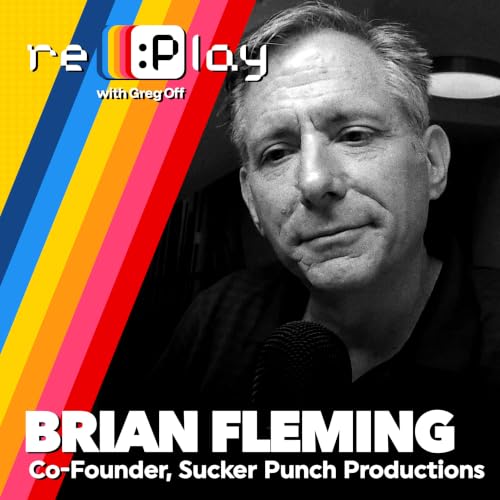
  • Brian Fleming — 28 Years, Four Consoles, One Studio
    Aug 11 2026

    Brian Fleming co-founded Sucker Punch Productions in 1997 with five colleagues from Microsoft and spent the next 28 years helping build one of PlayStation’s most celebrated first-party studios.

    In this episode of re:Play, Greg and Brian trace the full Sucker Punch story, from self-funding Rocket: Robot on Wheels and nearly losing it all, to Sly Cooper, inFAMOUS, and the studio’s acquisition by Sony.

    Brian shares how a few paragraphs about the Mongol invasion of Tsushima sparked Ghost of Tsushima, why the studio embraced a new protagonist for Ghost of Yōtei, and what nearly three decades inside the PlayStation ecosystem taught him about creative autonomy, taking creative risks, and leading a studio through multiple console generations.

    They also discuss Brian’s decision to step down after 28 years, making room for a new generation of leadership, the relationship between Sucker Punch, Naughty Dog and Insomniac, and why his advice to his younger self is simple: just ship games.

    Plus, Brian reveals the game that changed his idea of what was possible: Metal Gear Solid.

    Links & References

    • Sucker Punch Productions: suckerpunch.com
    • Sucker Punch on X: @SuckerPunchProd
    • Game File / Steven Totillo: gamefile.news
    • re:Play: replaypodcast.com
    • Greg Off’s Substack: gregoff1.substack.com
    Mehr anzeigen Weniger anzeigen
    1 Std. und 27 Min.
  • Mark Nash — From 15 Years at Blizzard to a New Indie Publisher in 18 Months
    Jul 28 2026

    Mark Nash spent 15 years at Blizzard Entertainment before helping build Humble Games into one of indie gaming's most respected publishing platforms. He later founded the Black Game Developer Fund, supporting underrepresented creators across the industry. Then, on July 23, 2024, the entire Humble Games team was laid off. Eighteen months later, Mark returned as the co-founder and COO of Balor Games, helping redefine what modern indie publishing can be.In this conversation, recorded remotely on Riverside, Greg Off and Mark trace that journey—from a pre-YouTube World of Warcraft machinima that landed him a job at Blizzard, to launching the world's first 24-hour gaming livestream, growing Humble Games into a publisher supporting more than 50 studios, and navigating one of the industry's most talked-about shutdowns before rebuilding from the ground up.They also explore the future of indie publishing, why community remains the most powerful marketing tool in games, the role publishers should play in supporting developers, and Mark's "train stations, train tracks, and trains" framework for building lasting game IP across multiple forms of media. Along the way, they discuss leadership, resilience, diversity initiatives, Game Pass, BitSummit, and what it takes to build sustainable studios in today's industry.The conversation closes with Mark's reflections on rebuilding after adversity, the lessons he'd pass on to aspiring founders and publishing leaders, and the games that continue to inspire his thinking today.For game developers, publishers, studio leaders, founders, and anyone interested in the future of indie games, this is an essential conversation about resilience, community, and building the next generation of game publishing.About re:Play:Long-form conversations with the people who built the games industry—peer to peer, not press to talent. Hosted by Greg Off.Find Mark Nash:https://www.linkedin.com/in/marknash/Learn more about Balor Games:https://balorgames.comFind re:Play:https://replaypodcast.comSubscribe to the re:Play Substack:https://gregoff1.substack.com

    Mehr anzeigen Weniger anzeigen
    1 Std. und 12 Min.
  • Raph Koster — The Puddle, the Splat, and the Droplets
    Jul 21 2026

    Raph Koster has spent more than three decades shaping the way we think about games, virtual worlds, and player behavior. As the lead designer of Ultima Online and creative director of Star Wars Galaxies, he helped define the MMORPG genre and pioneered many of the systems that still influence game design today. He is also the author of the industry-defining book A Theory of Fun for Game Design, a work that has shaped generations of developers. Today, through Playable Worlds, Raph continues exploring how online worlds can become deeper, more meaningful, and more sustainable for the players who inhabit them.In this conversation, recorded in-studio at Off Base, Greg and Raph dive into the fundamentals of great game design—why games are fundamentally about learning, the psychology behind why players find systems engaging, and how timeless design principles continue to outlast every technological shift. They explore the evolution of virtual worlds, the lessons the industry has forgotten, and why building meaningful player experiences remains the hardest challenge in game development.They also tackle one of the biggest questions facing the industry today: artificial intelligence. Rather than focusing on hype, Raph explains where AI can genuinely improve game development, where it falls short, and why the future belongs to developers who understand design fundamentals first and technology second. Along the way, they discuss procedural generation, player agency, emergent gameplay, online communities, and why creating believable virtual societies remains one of the industry's greatest unsolved problems.The conversation closes with Raph's reflections on decades spent designing worlds for millions of players, the lessons he would pass on to the next generation of developers, and his re:Play picks that continue to inspire his thinking about games today.For game developers, designers, studio leaders, and anyone fascinated by the future of interactive entertainment, this is an essential conversation with one of the industry's most influential thinkers.About re:Play: Long-form conversations with the people who built this industry—peer to peer, not press to talent. Hosted by Greg Off.

    Find Raph: https://www.raphkoster.com

    Find Playable Worlds: https://www.playableworlds.comF

    ind re:Play: replaypodcast.com

    Substack: gregoff1.substack.com

    Mehr anzeigen Weniger anzeigen
    1 Std. und 31 Min.
  • Jack Buser — From Dolby to the Living Game
    Jul 14 2026

    Jack Buser has been on the bleeding edge of the games industry for nearly 30 years. He joined Dolby Laboratories straight out of the University of Illinois and made it his mission to push Dolby surround sound out of cinema and into games, landing Dolby Digital on PlayStation 2, GameCube, and the original Xbox. In 2008 he joined Sony Interactive Entertainment to run PlayStation Home — the first console-based virtual world, which grew past 40 million users and became the first console microtransactions platform. He went on to help launch PlayStation Plus and build PlayStation Now, the original "Netflix of games." In 2014 he left Sony for a role he couldn't be told about in advance — what would become Stadia — and today he's the Global Director for Games, Strategic Industries at Google Cloud, leading Google's global games initiative with all ten of the biggest game companies in the world plus countless indies.

    In this conversation, recorded in-studio at Off Base, Greg and Jack cover the full arc — the synth-engineer dream that led to Dolby, hosting Dolbycast before podcasts were a thing, the GDC 2008 call from the great Carter Lipscomb that pulled him into PlayStation Home, the 40-million-user live service that existed before the term "live service" did, the "instant game collection" aha moment behind PlayStation Plus, and the leap to Google in 2014 that Jack still calls the hardest professional decision of his life.

    They also dig into where Google Cloud sits with the industry in 2026 — the Iron Man suit metaphor for AI in game development (with a shout to Adam Boyes and Mark Stanley), the Capcom + Gemini announcement about saving 30,000 hours a month in human toil debugging, the 10.6 / You vs. Zombies AI character system, Square Enix's Chatty Slammy companion in Dragon Quest Online, Sony AI's Sophie in Gran Turismo, and the term Google coined for what's coming next: the Living Game. Jack argues this is the biggest transformation in game design he has seen since the 2D-to-3D transition in the late '90s, and unpacks why "the train has left the station" for studio leadership.

    The conversation closes on the retro side — the chunky game room with 22+ consoles from Fairchild Channel F to PS5 Pro (all RGB-modded or HDMI-converted, running through a Hydra SCART switcher and a RetroTink 4K into a Sony 4K projector), the original Asteroids and Ms. Pac-Man cabinets in his living room, and Jack's re:Play answer: PlayStation Home, DOOM 2016, and Espgaluda.

    For game developers, studio leadership, anyone tracking AI in production, and anyone who wants the long view of the industry from someone who has been three steps ahead of it for 30 years — this one is essential listening.

    About re:Play: Long-form conversations with the people who built this industry — peer to peer, not press to talent. Hosted by Greg Off.

    Find Jack: linkedin.com/in/jackbuser

    Find Google Cloud for Games: cloud.google.com/solutions/games

    Find re:Play: replaypodcast.com ·

    Substack: gregoff1.substack.com

    Mehr anzeigen Weniger anzeigen
    1 Std. und 15 Min.