• Fifty-Five and Still Running – The Story of Joe Sr.
    Oct 30 2025

    🎙️ Episode Title: Fifty-Five and Still Running – The Story of Joe Thomas Sr., the Oldest Player in Division I Football
    📅 Podcast: Record Breakers: College Football Legends

    How far would you go to chase the dream you thought had passed you by?

    What if you were fifty-five years old…
    Your knees ache. Your back reminds you of every mile.
    You’ve worked a lifetime, raised a family, watched your children achieve the things you once dreamed of — and yet, there’s still something inside you that whispers: you’re not finished.

    In this inspiring, emotional, and unforgettable episode of Record Breakers: College Football Legends, we dive into one of the most extraordinary true stories in NCAA history — the day Joe Thomas Sr., a 55-year-old father, construction worker, and college student, took the field for South Carolina State University and became the oldest player ever to appear in a Division I football game.

    This is not a story about stats. It’s a story about heart.
    About defying time, expectation, and even biology itself.


    🎧 Record Breakers: College Football Legends is more than a sports podcast — it’s a journey through the extraordinary stories that define the soul of the game.
    Because sometimes, the greatest records aren’t the ones written in the stat books…
    They’re the ones written in the human heart.

    📱 Follow Record Breakers: College Football Legends on Spotify, Apple Podcasts, and YouTube.

    🎧 New episodes every week — because Records can be broken but legends never die!

    Mehr anzeigen Weniger anzeigen
    8 Min.
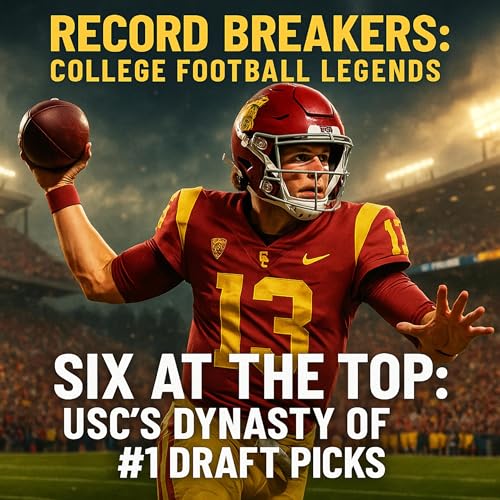
  • Six at the Top: USC’s Dynasty of #1 Draft Picks
    Oct 23 2025

    From smoke-filled hotel rooms to roaring Las Vegas draft stages — this is the story of how the NFL Draft was born, and how one powerhouse college turned it into a dynasty.

    In this epic deep-dive episode of Record Breakers: College Football Legends, we travel back to 1936 — to the Ritz-Carlton Hotel in Philadelphia — where nine team owners gathered around a corkboard, armed with nothing but intuition, a typewriter, and a desperate plan to save professional football from collapse. What began as a simple “player selection meeting” in a dimly lit room would evolve into one of the most-watched events in American sports: the NFL Draft.

    At the center of that first draft stood Jay Berwanger, a halfback from the University of Chicago. He was college football’s golden boy, the first-ever Heisman Trophy winner, the player every team wanted — and the man who would make history as the first NFL Draft pick. Yet, in a twist that still shocks historians, Berwanger never played a single down in the pros. Instead, he chose business and aviation over football, leaving behind a legacy that would shape how the sport balanced money, fame, and fate forever.

    From Berwanger’s decision, the draft was born — and so was the dream that one name, one card, one moment could change everything.

    Decades later, no program would seize that dream more often than the University of Southern California — the USC Trojans — a football factory built beneath palm trees and spotlight glare, where Hollywood showmanship meets gridiron dominance. No other college in history has produced more No. 1 overall draft picks. Six Trojans. Six eras. Six stories of greatness.

    🏈 Ron Yary (1968) — The first offensive lineman ever taken No. 1 overall. A quiet mountain of power who anchored USC’s 1967 national championship team and built the Minnesota Vikings’ dynasty through four Super Bowl runs.

    🏈 O.J. Simpson (1969) — The Juice. A comet in cardinal and gold, the Heisman winner whose 64-yard run against UCLA became legend. The first player to rush for 2,000 yards in a 14-game NFL season. A story of brilliance and infamy, forever tied to football’s golden age.

    🏈 Ricky Bell (1977) — The warrior. A workhorse who carried Tampa Bay out of the basement and into the playoffs. His tragic battle with dermatomyositis cut his life short at 29, but his courage and grit remain immortal in Trojan lore.

    🏈 Keyshawn Johnson (1996) — The voice. Bold, brash, unstoppable. “Just Give Me the Damn Ball.” The receiver who brought swagger to New York and leadership to Tampa Bay’s Super Bowl champion team.

    🏈 Carson Palmer (2003) — The comeback king. USC’s Heisman-winning quarterback who resurrected the Trojans, rebuilt the Bengals, and later led the Arizona Cardinals to the brink of the Super Bowl.

    🏈 Caleb Williams (2024) — The future. A modern Heisman magician whose creativity and arm talent redefined quarterback play at USC, becoming the sixth Trojan to go No. 1 overall — breaking the all-time college football record.


    This is not just a story about football. It’s about legacy, leadership, and the pursuit of greatness — the same pursuit that began when a desperate owner in 1936 tried to fix a broken league with a revolutionary idea.

    From Jay Berwanger’s uncashed contract to Caleb Williams’ red carpet moment — the draft is the story of American ambition itself.

    So strap in for a ride through 90 years of history, heroism, and heartbreak.
    This is the story of how the NFL Draft began —
    and how USC came to rule it.

    🎧 Listen now to “Six at the Top: USC’s Dynasty of #1 Draft Picks” — only on Record Breakers: College Football Legends.

    #CollegeFootball #USC #NFLDraft #SportsHistory #RecordBreakersPodcast #HeismanTrophy #TrojanNation #FootballLegends


    Mehr anzeigen Weniger anzeigen
    14 Min.
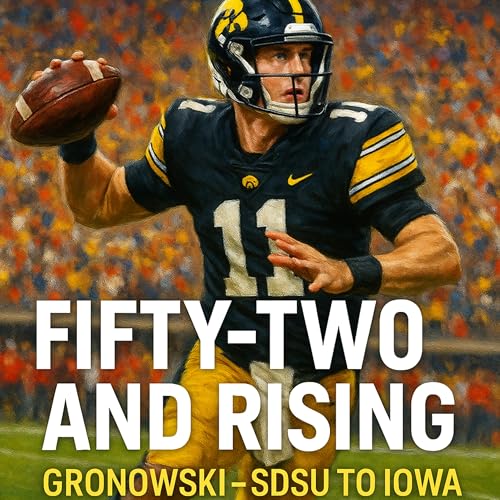
  • Fifty-Two and Rising: Gronowski - SDSU to IOWA (2020–2025)
    Sep 26 2025

    Episode Description:

    From the chaos of a pandemic spring to the roar of Kinnick Stadium under the lights, Mark Gronowski has done something no quarterback in college football history has ever achieved: fifty-two wins, and counting. This episode of Record Breakers: College Football Legends takes you on a deep, cinematic journey through one of the most remarkable careers the sport has ever seen, exploring how Gronowski rose from the fields of South Dakota State to the heart of the Big Ten at Iowa, and how his name now stands alone in the record books.

    We begin in 2020, when college football felt broken and fragile. The COVID-19 pandemic reshaped schedules, postponed seasons, and forced young quarterbacks like Gronowski into uncharted territory. As a true freshman in the spring of 2021, he led South Dakota State all the way to the FCS title game — only to see his night, and his knee, collapse on the first drive. That crushing injury might have ended most careers. For Gronowski, it became the crucible that forged a champion.

    By 2022, he returned with resilience and fire, guiding the Jackrabbits to their first-ever national championship, toppling powerhouse North Dakota State on the biggest stage. He won the game’s MVP honors, proving he was more than just a comeback story — he was the new face of FCS football. The following year, he went even further, capturing the Walter Payton Award as the top offensive player in the division and leading SDSU to a second straight national title, again walking away with MVP honors. Two championships. Two MVPs. A national player of the year award. And a growing stack of wins that demanded respect.

    But the story didn’t end in Brookings. In January 2025, Gronowski transferred to Iowa. Some wondered if his success at the FCS level would translate to the Big Ten. It didn’t take long for him to answer. On opening day, he matched Kellen Moore’s FBS record of 50 wins. A week later, he tied Cullen Finnerty’s all-division record of 51. And then came win number 52, the victory that put him alone at the top — the winningest quarterback in Division I history.

    To understand Gronowski’s achievement, we place him in context with the legends who came before. Cullen Finnerty at Grand Valley State, who went 51–4 and won three national championships in Division II. Kellen Moore at Boise State, whose 50–3 record and flawless precision turned the blue turf into a national stage. Colt McCoy at Texas, who carried the weight of an empire with 45 wins under the brightest spotlight in the sport. Each one defined an era. Each one set what felt like an impossible ceiling. Until Gronowski climbed higher.

    Along the way, we explore the shifting landscape of college football from 2020 to 2025: the rise of the transfer portal, the explosion of NIL deals, the seismic shifts of conference realignment, and the expansion of the College Football Playoff to 12 teams. Through it all, one thing remained constant — Mark Gronowski just kept winning.

    This is not just a record. It’s a story of resilience, adaptation, and quiet excellence. Gronowski’s career proves that winning travels. It doesn’t matter if you’re playing under the frosty skies of Brookings or in front of 70,000 fans in Iowa City — the habits of a champion translate anywhere. His leadership, precision, and poise under pressure have made him the quarterback of an era defined by change.

    Join us for this unforgettable ride across two programs, two divisions, and one unshakable truth: in college football, legends aren’t built on statistics alone. They’re built on Saturdays. And nobody has ever stacked more of them than Mark Gronowski.

    Record Breakers: College Football Legends brings you closer to the greatest records, the greatest players, and the unforgettable stories that define the history of the game.

    Mehr anzeigen Weniger anzeigen
    32 Min.
  • Forty-Seven Straight: Oklahoma’s Unbreakable Streak, 1953–1957
    Sep 24 2025

    Episode Description

    From October 10th, 1953, until November 16th, 1957, one college football team achieved the unthinkable. The Oklahoma Sooners, led by legendary head coach Bud Wilkinson, won forty-seven straight games—establishing a record that has stood for nearly seventy years and may never be broken. This episode of Record Breakers: College Football Legends dives deep into the most extraordinary streak in college football history, exploring every season, every star player, and the cultural backdrop of the 1950s that made this run so unforgettable.

    In this epic, journey, we set the stage with the college football landscape of the early 1950s. This was a time before playoffs, before modern scholarship limits, before television contracts ruled the sport. The game was raw, regional, and deeply tied to community pride. Against this backdrop, Bud Wilkinson built a dynasty in Norman, Oklahoma, transforming the Sooners into the standard-bearer for excellence. Wilkinson’s system, based on discipline, precision, and the innovative Split-T offense, turned his players into a machine that opponents simply could not stop.

    We walk through each year of the streak in detail, beginning with the 1953 season and the pivotal October loss to Notre Dame—the defeat that ignited the fire. From that moment forward, Oklahoma would not lose again for more than four years. We relive the closing stretch of 1953 as the Sooners bounced back with resilience, then follow them through the undefeated march of 1954. We dive into the 1955 season, where Tommy McDonald emerged as a superstar, Jerry Tubbs provided steady leadership, and the Sooners claimed a national championship capped off by an Orange Bowl triumph over Maryland.

    The 1956 season brought even greater glory, with Oklahoma repeating as national champions. McDonald won the Maxwell Award, Tubbs finished as Heisman runner-up—a rare feat for a lineman—and Clendon Thomas and Bill Krisher solidified their places in Sooners lore. That year, Oklahoma extended the streak into the forties, winning with margins so wide that fans and writers alike began to wonder if anyone could ever stop them.

    And then came 1957. With Clendon Thomas leading the backfield and Wilkinson’s system still running at full speed, the Sooners pushed their winning streak all the way to forty-seven games. They dismantled opponents week after week, earning headlines across the country. But on November 16th, fate brought them full circle. Against Notre Dame—the very team that had last beaten them in 1953—Oklahoma’s streak came to a stunning end in Norman, as the Irish walked away with a 7–0 victory.

    This episode also explores the cultural atmosphere of college football in the 1950s. The crowds, the marching bands, the growing influence of television, the pride of the Big Seven Conference—all of these elements form the tapestry around the streak. We take time to examine why this record has never been broken, even by dynasties like Miami in the 1990s, USC in the early 2000s, or Alabama under Nick Saban. Scholarship parity, transfer rules, national recruiting battles, and the playoff system all make a repeat of Oklahoma’s streak nearly impossible in the modern era.

    This isn’t just the story of a number. It’s the story of how Bud Wilkinson became a coaching legend, how players like Tommy McDonald, Jerry Tubbs, and Clendon Thomas etched their names into history, and how the Oklahoma Sooners became synonymous with dominance. It’s the story of a dynasty that rose from the heartland and ruled college football for four full years without faltering once.

    Record Breakers: College Football Legends brings you the stories behind the numbers, the legends behind the records, and the history that continues to inspire fans decades later. Settle in for a deep dive into Oklahoma’s forty-seven straight, the unbreakable streak that still defines college football’s golden age.

    Mehr anzeigen Weniger anzeigen
    39 Min.
  • Ten Picks in Berkeley – UCLA’s Defensive Masterpiece, 1978
    Sep 23 2025

    Episode Description:

    On October 21st, 1978, inside Memorial Stadium in Berkeley, California, the UCLA Bruins delivered one of the most jaw-dropping defensive performances in college football history. In a game that has never been forgotten — and a record that still stands more than four decades later — UCLA intercepted the California Golden Bears ten times. Ten interceptions in a single game. Add in two fumbles, and Cal turned the ball over twelve times, as the Bruins cruised to a 45–0 shutout.

    This episode of Record Breakers: College Football Legends takes you deep into that unforgettable Saturday. We rewind the clock to 1978, set the stage with the college football world of the late 70s, and put you right in the middle of a game where the Bruins didn’t just play defense — they suffocated their opponent until there was nothing left.


    But this episode is more than a box score. We take you behind the helmets and headsets:

    • The story of Terry Donahue, UCLA’s 34-year-old head coach, still early in his career but already laying the foundation to become the winningest coach in Bruins history.

    • The rise of Kenny Easley, the rangy free safety whose instincts and leadership made him one of the greatest defensive backs of his era — and a future Pro Football Hall of Famer.

    • The moment of glory for Brian Baggott, whose two pick-sixes in one game turned him into an unsung hero of college football lore.

    • The struggles of Rich Campbell, Cal’s sophomore quarterback, whose bad day in 1978 did not define him, as he later became a first-round NFL Draft pick.

    • The debut season of Roger Theder, who inherited a program in transition and suffered one of the toughest losses in Cal history.

    We also take time to explore the broader context of 1978 college football. Alabama’s Bear Bryant was chasing another championship. USC, led by Charles White and Anthony Muñoz, would go on to claim the national title. Joe Montana was already proving himself as “Joe Cool” at Notre Dame. Billy Sims was dazzling fans at Oklahoma, en route to a Heisman Trophy. Against that backdrop, UCLA’s defense carved their own chapter of history, proving that even in a season dominated by powerful offenses, defense could still steal the show.


    Record Breakers: College Football Legends is your home for the greatest moments in the sport’s history. Every episode is a deep dive into the stories behind the stats — the players, the coaches, the atmosphere, and the legacy of records that stand the test of time.

    So press play. Relive the chaos. Experience the shutout. And remember: sometimes, legends aren’t made in touchdowns. Sometimes, they’re made in interceptions.

    Episode Title: Ten Picks in Berkeley – UCLA’s Defensive Masterpiece, 1978

    Podcast Title: Record Breakers: College Football Legends


    Mehr anzeigen Weniger anzeigen
    12 Min.
  • The Season of 2,628 Yards - 1988
    Sep 22 2025

    🎧 Spotify Episode Description

    Record Breakers: College Football Legends presents:
    “Barry Sanders: The Season of 2,628 Yards- 1988”

    In the fall of 1988, college football witnessed something so electrifying, so unstoppable, so otherworldly, that more than three decades later, the record still stands untouched. This is the story of Barry Sanders’ Heisman-winning season at Oklahoma State, when he rushed for an NCAA-record 2,628 yards in just 11 games — a record that has never been broken.

    In this marathon episode of Record Breakers: College Football Legends, we take you on a continuous, narrator-style journey back to that unforgettable season. No outlines. No segments. Just one flowing story that captures the magic, the context, and the legend of Sanders’ historic run.

    We set the stage with the world of college football in 1988 — a time when the Big Eight was a gauntlet, Nebraska and Oklahoma were kings, Notre Dame was on its way to a national championship, and offenses lived and died by the run. Then we move into the backstory of a quiet, undersized running back from Wichita, Kansas, who spent two years waiting behind Thurman Thomas before exploding onto the national scene with a season no one thought was possible.

    We relive the games, one by one. From his first start against Miami of Ohio… to a 304-yard explosion versus Tulsa… to back-to-back 300-yard games against Kansas State and Kansas… to the heartbreaking Bedlam loss to Oklahoma… to the cold afternoon in Ames where he broke the Big Eight record… and finally, to the surreal Tokyo Dome showdown against Texas Tech, where Sanders broke Marcus Allen’s all-time record with a Heisman freshly in his pocket. Forty-four carries. 332 yards. Four touchdowns. A new all-time mark: 2,628 rushing yards in a single season.

    But this isn’t just about numbers. We break down the system that allowed Sanders to thrive under head coach Pat Jones and offensive coordinator Larry Coker. We look at how quarterback Mike Gundy and wide receiver Hart Lee Dykes balanced the offense. We spotlight the offensive line that gave Sanders the creases he needed to make magic. And then, we slow down to analyze how Sanders ran — the vision, the balance, the cuts, the patience, and the artistry that made him the most dangerous open-field player college football has ever seen.

    From the Holiday Bowl encore — 222 yards and five touchdowns that didn’t even count in the official record books — to Sanders’ humble acceptance of the Heisman Trophy, to the larger legacy he left at Oklahoma State and later with the Detroit Lions, this episode is a three-hour immersion into greatness.

    We explore why this record has never been broken and may never be. The modern game doesn’t allow one running back to carry this kind of workload. Offenses are pass-heavy, stars are rotated and protected, and defenses are too fast and too deep. To match Sanders, a back would have to average nearly 240 rushing yards per game for an entire season. That’s not just unlikely — it’s almost impossible. Which is why 2,628 stands as college football’s Everest.

    This is more than a record. It’s a story. A legend. A season that belongs in the pantheon of all-time sports achievements.

    So whether you’re a die-hard Oklahoma State fan, a lover of college football history, or simply someone who wants to hear about one of the greatest athletes who ever lived, sit back and relive the story of Barry Sanders’ season of 2,628.

    Because some records are just numbers.
    But some records… are forever.

    Mehr anzeigen Weniger anzeigen
    20 Min.
  • Run DMC: 321 in Fayetteville
    Sep 19 2025

    Episode Description:

    On November 3rd, 2007, under the bright lights of Razorback Stadium in Fayetteville, Arkansas, fans witnessed one of the greatest single-game performances in SEC history. Darren McFadden — nicknamed “Run DMC” — delivered a masterpiece against Steve Spurrier’s South Carolina Gamecocks, rushing for a staggering 321 yards on 34 carries, throwing for a touchdown, and leaving defenders gasping in his wake. It wasn’t just a game; it was a moment of football immortality.

    In this episode of Record Breakers: College Football Legends, we dive deep into the story behind that night. From the build-up of the 2007 Arkansas season to the legacy of McFadden’s Wild Hog formation, we relive every snap, every cutback, and every burst of speed that defined his legendary performance. We’ll explore the background of Darren McFadden, his journey from Little Rock to Heisman finalist, and the incredible supporting cast that made the Razorbacks’ offense nearly unstoppable: Felix Jones, Peyton Hillis, Jonathan Luigs, and a bruising offensive line that controlled the trenches.

    We’ll take you through the game drive by drive, quarter by quarter, highlighting the swings of momentum and the resilience of both teams. You’ll hear how Arkansas built a commanding lead, how South Carolina clawed back with a furious second-half surge, and how the crowd in Fayetteville erupted when McFadden broke free for the run that sealed the victory. Along the way, we’ll analyze how the Wild Hog formation reshaped offensive football, eventually inspiring the NFL’s Wildcat craze, and why McFadden’s versatility made him one of the most dangerous players of his era.

    This episode also places McFadden’s achievement in the wider context of SEC history. His 321 yards tied the conference’s single-game rushing record, first set by Vanderbilt’s Frank Mordica in 1978 against Air Force. For decades, Mordica’s number had stood as a monument, untouched even by legends like Herschel Walker, Bo Jackson, and Emmitt Smith. On that November night in 2007, McFadden not only matched Mordica’s mark — he stamped his name into the SEC’s lore forever.

    We’ll reflect on the legacy of Darren McFadden: a two-time Heisman runner-up, a three-time All-American, and a player whose style — upright, powerful, yet impossibly smooth — made him a nightmare for defenses and a hero for Razorback fans. We’ll revisit the turbulent end of Houston Nutt’s Arkansas tenure, the ripple effect of that season across the SEC, and how McFadden’s greatness continues to define Razorback football to this day.

    So whether you remember that night vividly, or you’re hearing this story for the first time, get ready to relive one of the most electrifying performances college football has ever seen. This isn’t just about numbers on a stat sheet. This is about the emotion of the game, the clash of styles between Spurrier and Nutt, the sound of 70,000 fans erupting in unison, and the sight of Darren McFadden sprinting into history.

    Keywords to help new listeners find this episode: Arkansas Razorbacks, Darren McFadden, Run DMC, South Carolina Gamecocks, Steve Spurrier, Houston Nutt, Felix Jones, Peyton Hillis, Jonathan Luigs, Razorback Stadium, SEC records, college football history, single-game rushing record, 2007 college football season, Wild Hog formation, Wildcat offense, Heisman finalists, legendary performances, Arkansas vs South Carolina 2007, NCAA rushing records.


    Mehr anzeigen Weniger anzeigen
    33 Min.
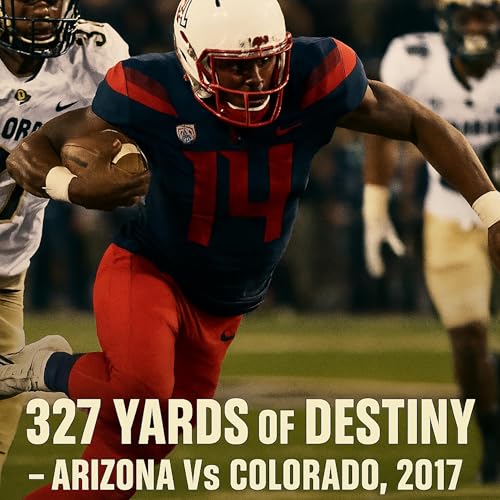
  • 327 Yards of Destiny – Arizona Vs Colorado, 2017
    Sep 9 2025

    Episode Description

    On October 7th, 2017, under the bright lights of Folsom Field in Boulder, Colorado, college football fans witnessed something that had never been done before. A sophomore quarterback, not even the starter when the night began, came off the bench and ran himself straight into the record books. Arizona’s Khalil Tate didn’t just have a good game — he authored one of the most jaw-dropping performances in college football history.

    In this episode of Record Breakers: College Football Legends, we relive the incredible night when Tate rushed for 327 yards on just 14 carries, scoring four rushing touchdowns and throwing for another. His explosive runs of 58, 28, 47, and 75 yards left Colorado defenders gasping for air and set a new FBS single-game rushing record for a quarterback — a mark that still stands today.

    But this story isn’t just about Tate. It’s about the duel across the field. Colorado’s hometown hero Phillip Lindsay carried the ball an astonishing 41 times for 281 yards and three touchdowns, setting his own program record for rushing attempts in a single game. Two players, two different styles, one unforgettable clash that turned an otherwise ordinary Pac-12 matchup into a legendary shootout.

    Over nearly three hours of storytelling, we take you drive by drive, possession by possession, and moment by moment through this wild night. We explore the background of Arizona head coach Rich Rodriguez, the architect of the spread-option offense that gave Tate the stage to shine, and Colorado coach Mike MacIntyre, the rebuilder who had guided the Buffs to a Pac-12 South title just a season before. We look at how Tate’s emergence electrified Arizona’s season, earning him four consecutive Pac-12 Offensive Player of the Week awards — something no one in the league had ever done before.

    You’ll hear about Khalil Tate’s journey from Inglewood to Junípero Serra High School, where he developed the speed and instincts that made him a nightmare for defenses. We revisit RichRod’s earlier days with Pat White and Steve Slaton at West Virginia, showing how Tate became the perfect successor to that lineage of dual-threat quarterbacks. We dive into Phillip Lindsay’s underdog story, from his ACL tear in high school to his relentless rise at Colorado and later to his historic Pro Bowl rookie season with the Denver Broncos.

    We don’t just talk stats — we bring you the emotion of the night. The roar of the Colorado crowd when Lindsay scored. The stunned silence after Tate’s 75-yard breakaway. The look on RichRod’s face as he realized his system had just found its perfect match. And the exhaustion, the disbelief, the raw pride on both sidelines when the game ended, Arizona victorious 45–42, and history permanently altered.

    Most importantly, we step back and ask: what does this record mean? Where does it stand in the larger story of college football? We compare Tate’s night to legends like Jordan Lynch, Denard Robinson, Vince Young, Michael Vick, and Lamar Jackson. We talk about how quarterback rushing evolved from a trick play to a central weapon of modern offenses. And we reflect on why records like this matter — because they remind us of the nights when the game feels larger than life, when the impossible suddenly looks easy, and when one player’s performance becomes immortal.

    Whether you’re an Arizona Wildcats fan, a Colorado Buffaloes fan, a Pac-12 diehard, or just someone who loves the drama of college football, this episode will transport you back to that unforgettable Saturday in Boulder. A night when 327 yards of destiny were written into the record book.

    Listen now, relive the runs, the duel, and the legacy of Khalil Tate’s record-breaking masterpiece in Record Breakers: College Football Legends

    Mehr anzeigen Weniger anzeigen
    57 Min.