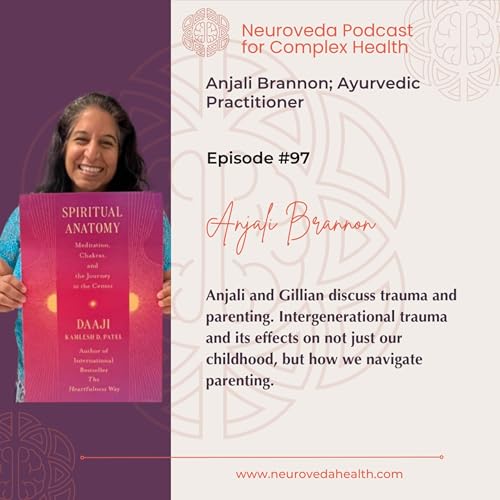
• #97 Anjali Brannon: Ayurvedic Practitioner discusses Trauma & Parenting
    Oct 24 2025

    Summary

    In this episode of the Neuroveda podcast, host Gillian Ehrlich and guest Dr. Anjali Brannan delve into the intricate relationship between parenting and trauma. They explore various techniques for somatic trauma resolution, the importance of heartfulness meditation, and how Ayurvedic principles can guide parenting practices. The conversation emphasizes the significance of intuition, the integration of Ayurveda with allopathic medicine, and the healing potential of the mind-body connection. The episode concludes with a discussion on the importance of being aware of health implications, such as nickel allergies in medical treatments.

    Takeaways

    Parenting and trauma are intricately related and cannot be separated.

    Somatic trauma resolution helps individuals process and heal from past traumas.

    Heartfulness meditation can significantly improve mental clarity and emotional well-being.

    Intuition plays a crucial role in parenting and decision-making.

    Ayurvedic principles can guide healthier parenting practices.

    Integrating Ayurveda with allopathic medicine can enhance patient care.

    The body has an innate ability to heal when it feels heard and understood.

    Practicing gratitude can shift family dynamics positively.

    Awareness of health implications, such as nickel allergies, is essential in medical treatments.

    Meditation and mindfulness can help reduce trauma and improve communication.


    Bio: Anjali is a 2001 graduate of the acclaimed Ayurvedic Institute's Advanced Studies and Clinical Program (Gurukula) with world-renowned Ayurvedic physician Dr. Vasant Lad where she studied for 3 years.

    She is also trained and skilled in Somatic Trauma Resolution, Lymph Drainage, Craniosacral therapy, hands-on Brain therapy, Fluid Articular Release for the joints, Arvigo Maya Abdominal Therapy, Polarity Therapy, LIIFT, Synergy Yoga and Dance.

    Anjali volunteers as a teacher of Heartfulness Meditation whose system she has been practicing since 1994, and teaching since 2000. Anjali has also been the featured guest on several different TV & radio shows on health. Her practice has been part of the University of Cincinnati’s Alternative Medicine Rotation for Family Practice Medical Residents at the Clinton Memorial Hospital where medical students would observe her in her work to understand more about complementary medicine. She has also been an Ayurvedic panelist for a Masters Capstone project at the prestigious Brown University.

    Since 2001, Anjali has had an active Ayurvedic practice and has been teaching classes in Ayurveda. She is the Director of the skilled team at the Ayurveda Natural Health Center in Dayton, Ohio.


    Mehr anzeigen Weniger anzeigen
    59 Min.
  • #96 Vinita Prachi Murarka; Ayurvedic Doctor, Waldorf educator, and transformational guide
    Oct 9 2025

    Summary

    In this episode of the Neuroveda podcast, host Gillian Ehrlich engages with Ayurvedic doctor and Waldorf educator Vanita Prachi Mararca to explore the principles of Waldorf education, its unique approach to child development, and the integration of spirituality and culture in learning. They discuss the importance of nurturing the head, heart, and hands in education, the role of nature in fostering resilience, and the critiques of Waldorf education. The conversation also touches on the traditional Gurukula system of education in India and concludes with Vanita's upcoming book release.

    Prachi Healing is excited to give a special offer on her signature packages for Neuroveda clients to receive the benefits of integrative Ayurvedic practice for families and children. $50 off of Agni Radiance, and $100 off of Soma Radiance packages for Neuroveda podcast listeners.

    Use code NEUROVEDA50 and NEUROVEDA100

    Takeaways

    Waldorf education focuses on holistic child development.

    The head, heart, and hands are integral to learning.

    Cultural relevance in education is crucial for identity.

    Mirror stories help children see themselves in narratives.

    Window stories provide insight into diverse experiences.

    Nature plays a vital role in child development.

    Waldorf education emphasizes creativity over consumerism.

    The teacher-student relationship is foundational in learning.

    Gurukula education fosters deep connections with teachers.

    Community involvement is essential in a child's education.

    Bio:

    Vinita Prachi Murarka is an Ayurvedic Doctor, Waldorf educator, and transformational guide who bridges medicine, education, and spirituality. Born in India and raised in the United States, she later returned to India to immerse herself in Vedic sciences, gurukula education, and esoteric wisdom traditions. With over a decade of experience in integrative health and education, she brings a unique lens on how Waldorf education nurtures child development—socially, emotionally, and physiologically. Vinita is the founder of Matre Sofia, an organization dedicated to soul-centered parenting and holistic family well-being. A storyteller, writer, and curriculum developer, she translates ancient traditions into practical approaches for modern families and health practitioners alike. She currently lives between Hawaii and Colorado, consulting, teaching, and guiding others in aligning health, learning, and wholeness.


    Mehr anzeigen Weniger anzeigen
    57 Min.
  • #95 Dr. Jon Berner discusses his unique lens to reimagining how we treat complex mental health conditions with both precision and humanity.
    Sep 25 2025

    Summary

    In this episode of the Neuroveda podcast, host Gillian Ehrlich engages with Dr. John Berner, a Harvard-trained psychologist and neuroscientist, to explore the intricate relationship between mind and body in the context of mental health. They discuss the limitations of traditional medical silos, the importance of cellular communication, and the role of hormones in health. Dr. Berner introduces the concept of intersectionality in psychiatric treatment, emphasizing the need for personalized approaches. The conversation also delves into innovative treatments like rapamycin and the significance of understanding cellular interactions through advanced technologies.


    Takeaways

    Mind-body medicine should not separate mental and physical health.

    The shift from Newtonian to quantum thinking is crucial in medicine.

    Cellular communication is a localized and complex process.

    Hormones play a central role in coordinating bodily functions.

    Understanding evolutionary constraints can inform health practices.

    Intersectionality is key in treating mental health conditions.

    Rapamycin shows promise in extending lifespan and improving health.

    Eavesdropping on cellular conversations can enhance treatment strategies.

    Innovative technologies can measure cellular responses effectively.

    Biology is complex and cannot be simplified into binary categories.


    Bio

    Dr. Jon Berner, a Harvard-trained psychologist, UCLA-trained neuroscientist and physician, and University of Washington–trained psychiatrist. With over 25 years in clinical practice, his work bridges rigorous neuroscience, psychiatry, and compassionate patient care. Dr. Berner’s publications span from the cognitive effects of cocaine and memory in schizophrenia to pioneering treatments with ketamine, rapamycin, and novel metabolomic approaches for mood and pain disorders. He brings a unique lens—uniting neural networks, biochemistry, and clinical psychiatry—to reimagine how we treat complex mental health conditions with both precision and humanity.


    Mehr anzeigen Weniger anzeigen
    56 Min.
  • #94 Kendyl Morris discusses; hypnotherapy, conscious conception, and breathwork
    Sep 10 2025

    Kendyl Morris is an Advanced Clinical Hypnotherapist, Certified Integrative Medicine Health Coach, and Fertility Coach with over a decade of experience helping individuals, couples, and groups navigate their paths toward inner transformation and holistic well-being. With a deep understanding of the intricate mind-body connection, Kendyl specializes in helping clients regulate stress through tailored, evidence-based approaches that meet their unique needs.

    Agenda:

    1. There are 3 specialties that you have: hypnotherapy, conscious conception, and breathwork: what’s your unifying factor here? What have been your influences for your work?
    2. Let’s break down each, one by one:
      1. Hypnotherapy:
        1. What is this?
        2. Why would a person do this? What kind of benefits do you see?
        3. What’s a session like? How often are sessions recommended? What are the cadence options? (like weekly x 6 wks vs once/ month, etc).
        4. How is this different from regular therapy and how would you recommend to juxtapose it with ongoing traditional therapy?
        5. Will you make a person sqwack like a chicken? Just kidding. What I meant to say is, is everybody hypnotizable?
        6. How does this work telehealth, like over the internet? Can anybody in the US/ abroad access your services?
        7. What are the costs & how do people access you?
      2. Conscious Conception:
        1. omg- the two things that would change the world we know from public health would be to increase equity & invest in the first 1000 days of life. Tell us about your program.
        2. Why is it so important to conceive consciously?
        3. Does the man really play any role in the health of the pregnancy/ infant?
        4. What if you are already well into your pregnancy & learn about your services? How early should somebody seek out your services?
        5. What are the costs & how do people access you?
      1. Breathwork: why does breath work matter?
      1. What is it doing physiologically inside of us?

        1. Why are there so many different kinds of breath work?
        2. What kind(s) have you been trained in?
        3. What kind(s) do you teach?
        4. How do you recommend people use breathwork in their pantheon of interventions/ practices? Daily/ periodic/ seasonal/ etc?
        5. Are there specific conditions or situations for which you recommend the breathwork that you teach?
        6. How come sometimes people report getting more anxious when they do breath work? What do you recommend to help them?
        7. What are the costs & how do people access you?


    Mehr anzeigen Weniger anzeigen
    52 Min.
  • #93 Khairul Bhagwandin discusses her unique aesthetic approach
    Aug 25 2025

    We are so excited to have Khai join our clinic!

    Khairul Bhagwandin, EAMP, LAc—Seattle Met’s Top Acupuncturist for 2022, 2023 and 2025.

    She offers expert care in facial rejuvenation, focusing on fine lines, wrinkles, hyperpigmentation, acne, rosacea, scar reduction and hair loss
    She brings a deeply integrative aesthetic approach that blends the best of Traditional Chinese Medicine with modern regenerative techniques including cosmetic acupuncture, micro‑needling, RF microneedling and tailored herbal and topical therapies

    Bio: In her clinical work, Khai Bhagwandin has a Masters in East Asian Medicine from Bastyr University, which includes herbalism training as well as a licensed massage therapist. She specializes in holistic and regenerative beauty, offering treatments that support the body’s innate healing systems. She has been named a Seattle Met Top Acupuncturist three years and is currently launching her own herbal skincare line, Khairul Holistic Beauty, blending Traditional Chinese Medicine with hyperlocal ingredients sourced from her family farm in Southwest Washington. Outside of her practice, Khai lives life adventurously—snowboarding, mountain biking, climbing, and fire dancing—as well as making music with her band. She is also the founder of The Change Collective, an organization she launched in 2021 to advocate for marginalized communities in snow sports.

    Agenda:

    1. I know as much about aesthetics as I do about, say, space travel, which is to say I see other people doing it & don’t understand it. Talk to us about a natural & healthy approach to beauty that isn’t tabloid-driven. What is it to be beautiful?

    2. And what does this mean treatment-wise? What makes a beauty treatment ’natural’ or ‘healthy’ vs a non-healthy beauty treatment? (this is a question about ingredients, products and interventions that might ‘hurt’ you but look good temporarily vs deep beauty).

    3. Walk us through the range of beauty services that you offer, from simplest that is just the relaxation, to the most in depth series of treatments. What do you do in these visits & how are they structured/ scheduled/ personalized per client?

    4. How do you pick the products you use? What do you avoid?

    5. Tells us how you got interested in beauty & aesthetics?

    6. Tell us about the rest of your knowledge base and training- acupuncture, pain management.

    7. How does this square with your activism streak?

    8. What other projects are you working on? What’s your latest passion interest?

    Mehr anzeigen Weniger anzeigen
    52 Min.
  • #92 Tania Dempsey, MD: All About Vector Borne Diseases
    Jul 31 2025

    Agenda:

    1. What is Lyme Disease? What are the co-infections?

    2. What is special or unique about these infections' vs any other infection, like the common cold?

    3. Talk to us about the testing for these organisms. Why is it so confusing? Is there actually accurate testing?

    a. Borrelia: FISH for all (but not available for all) but for: borrelia, borrelia genus for cousins, TBRF borrelia myomoti, hermensi, found in other regions

    b. Babesi: FISH with all the strains or just otocoli

    c. Bartonella henselae: FISH. At least 46-48 species, 13 can infect humans, only bits of testing.

    d. T-Lab for FISH. Igenex also does some FISH testing.

    e. To fill other holes: Vibrant TBP, Galaxy specific for bartonella

    4. Talk to us about treatment. Let’s start with antibiotics & then move outwards- what’s the approach here with antibiotics?

    a. Are antibiotics always needed?

    b. Do anti-viral for anti-fungal have a role here?

    c. What about ancillary treatments like disulfiram? Are there others like this?

    d. What about mitochondrial supports, detox, and binders?

    e. What about nutritional supports?

    f. What about diet, lifestyle & the mind?

    5. Where does chronic Lyme sit in the pantheon of other chronic infections like Long-COVID & EBV & Strep with PANS/ PANDAS? How much does treatment overlap for these diseases?

    6. How much do environment (personal microbiome, community, environmental toxicity) & genetics contribute to the risk for developing or persisting chronic infections? How do you best like to assess or treat this?

    7. Let’s talk politics for a moment: Why won’t many conventional clinicians recognize or treat chronic Lyme?

    8. What’s up & coming in the Lyme world research & education-wise? Tell us about ILADS!

    9. Where can folks find you & more about your practice?

    https://drtaniadempsey.com/


    Bio: Dr. Tania Dempsey, MD, ABIHM is a world-renowned expert in complex, multisystem diseases. As founder of the AIM Center of Personalized Medicine, in Purchase, NY, Dr. Dempsey uses functional and integrative medicine to get to the root cause(s) of illness and to help find the path to optimum health. Her extensive knowledge and experience with Mast Cell Activation Syndrome, Mold, and Lyme and other Vector-Borne Diseases, has propelled her to the forefront of the medical community as a recognized and trusted speaker, researcher, advocate, and physician.

    Dr. Dempsey is Board-Certified in Internal Medicine and Integrative and Holistic Medicine. She received her MD degree from The Johns Hopkins University School of Medicine and her BS degree from Cornell University. She completed her Internal Medicine Residency at NYU Medical Center.

    She was recently elected to the Board of Directors of ILADS (International Lyme and Associated Diseases Society). She is also a member of the U.S. ME/CFS Clinician Coalition, the American Academy of Ozonotherapy, and ISSWSH (International Society for the Study of Women’s Sexual Health).

    She is an accomplished international speaker, writer and thought leader and has 8 peer-reviewed articles in the medical literature. Her latest endeavor is cohosting the new podcast, Mast Cell Matters.

    At the heart of Dr. Dempsey’s work is a commitment to patients who’ve long gone unheard.

    Mehr anzeigen Weniger anzeigen
    44 Min.
  • #91 Dr. Jessy Dhanjal: What is Oxidative Stress?
    Jul 16 2025

    Bio:

    Dr. Jessy Dhanjal, ND is a licensed Naturopathic Doctor in California. He earned his Doctorate in Naturopathic Medicine from Bastyr University in San Diego and holds a Bachelor of Science in Biological Sciences from the University of California, Davis. During his time at UC Davis, he participated in the Emergency Medicine Research Associate Program at the UC Davis Medical Center, gaining early clinical experience in the emergency department.

    Dr. Dhanjal has pursued advanced training in Functional Medicine through the Institute for Functional Medicine. His clinical interests include primary care with an emphasis on cardiometabolic health, autoimmune conditions, gastrointestinal health, and detoxification strategies for environmental toxin exposure.

    Currently, Dr. Dhanjal serves as a Clinical Lab Educator at Vibrant Wellness, where he supports healthcare providers in understanding and applying advanced diagnostic testing to enhance patient outcomes.

    He believes deeply in the body’s innate ability to heal and is committed to helping patients restore and maintain optimal health.

    Summary

    In this episode of the Neuroveda podcast, Gillian Ehrlich and Dr. Jessy Dhanjal delve into the complex topic of oxidative stress, exploring its definition, causes, and implications for human health. They discuss the balance between free radicals and antioxidants, the role of oxidative stress in chronic diseases, and how genetics and lifestyle factors influence oxidative stress levels and advanced testing methods for measuring oxidative damage and the importance of personalized treatment strategies to mitigate oxidative stress and promote overall health.


    Takeaways

    Oxidative stress is an imbalance between free radicals and antioxidants.

    Free radicals are normal byproducts of metabolism and play essential roles in immune defense.

    Chronic oxidative stress is linked to various diseases, including cardiovascular disease and neurodegeneration.

    Genetics can affect how well the body handles oxidative stress and detoxification.

    Lifestyle factors such as diet, sleep, and exercise can influence oxidative stress levels.

    Advanced testing can provide insights into oxidative damage and guide treatment strategies.

    Glutathione is a key antioxidant that helps neutralize free radicals.

    Oxidative stress can be both harmful and beneficial, depending on its levels and context.

    Personalized interventions based on genetic testing can optimize health outcomes.

    Monitoring oxidative stress markers can motivate patients to adhere to treatment plans.


    Mehr anzeigen Weniger anzeigen
    49 Min.
  • #90 David Rakel MD- Talks about the Doctor-Patient connection
    Jun 26 2025

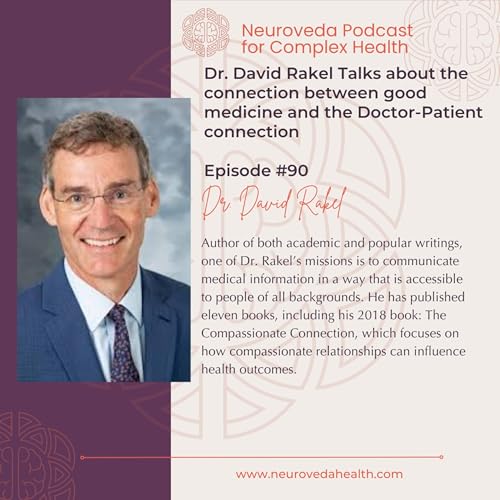
    Dr. David Rakel Talks about the connection between good medicine and the Doctor-Patient connection


    Bio: David Rakel, MD is professor and chair of the University of Wisconsin Department of Family Medicine and Community Health. Rakel joined DFMCH faculty in 2001. He founded the integrative health program (now known as the Osher Center for Integrative Health at University of Wisconsin-Madison) and received the Gold Foundation’s Leonard Tow Humanism in Medicine Award, the school’s highest honor for excellence and compassion in care. His team worked with more than 50 clinical systems within the Veterans Health Administration to implement changes to make care more personalized, proactive, and patient driven.

    An author of both academic and popular writings, one of Rakel’s missions is to communicate medical information in a way that is accessible to people of all backgrounds. He has published eleven books, including the Textbook of Family Medicine, Current Therapy, and Integrative Medicine, as well as peer-reviewed research on the impact of measures such as mindfulness meditation and the power of the therapeutic encounter. His 2018 book The Compassionate Connection focuses on how compassionate relationships can influence health outcomes.

    AGENDA:

    1. This podcast today is about good medicine being rooted in the doctor-patient connection. Let’s start with your study on the common cold, including the unexpected twist, which makes me cry nearly every time I tell your story.

    2. Why is the patient-doctor connection so important? What is ’the clinician effect’ and its non-specific influences on health?

    3. What does the research say about this? What research should we be seeking to understand and amplify this effect further?

    4. What is the bare minimum we need to recreate this in a patient-doctor visit today? What would the ideal scenario be? Talk to us about some innovations in primary care delivery.

    5. What are the examples in which you see this working well in the world today? What’s happening in the Functional Medicine world? What’s been the transformation that’s happened in the VA? Where else?

    6. What advice to you give patients seeking to connect with their busy doctors? What advice to you give to clinicians, new & old, who yearn or ache for this but aren’t sure how to make it happen?

    7. Let’s end on an optimistic note- what are some truths and magic that you’ve seen come out of an intact patient-doctor connection?

    Mehr anzeigen Weniger anzeigen
    58 Min.