Neuroveda Podcast for Complex Health Titelbild

Neuroveda Podcast for Complex Health

Neuroveda Podcast for Complex Health

Von: Gillian Ehrlich
Jetzt kostenlos hören, ohne Abo

Nur 0,99 € pro Monat für die ersten 3 Monate

Danach 9.95 € pro Monat. Bedingungen gelten.

Über diesen Titel

Certified in Ayurveda and Functional Medicine, Nurse Practitioner Gillian Ehrlich, DNP, ARNP, IFMCP interviews guests who dive deeply into the nuances of medicine with the goal of inspiring you to persistently heal in the face of inevitable challenge across the lifespan. This is about ancient & cutting-edge understanding of disease processes and treatments just as much as it is about food, lifestyle, nature, culture, and politics.Gillian Ehrlich Hygiene & gesundes Leben
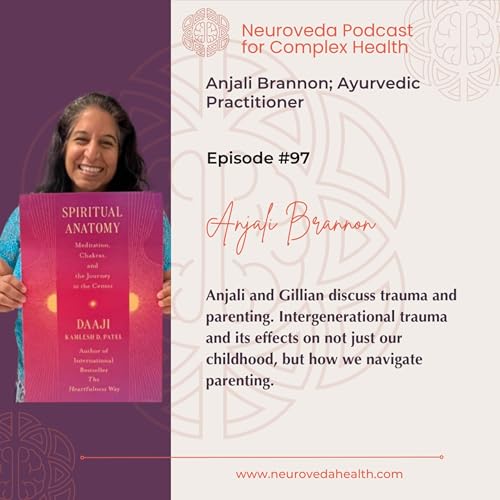
  • #97 Anjali Brannon: Ayurvedic Practitioner discusses Trauma & Parenting
    Oct 24 2025

    Summary

    In this episode of the Neuroveda podcast, host Gillian Ehrlich and guest Dr. Anjali Brannan delve into the intricate relationship between parenting and trauma. They explore various techniques for somatic trauma resolution, the importance of heartfulness meditation, and how Ayurvedic principles can guide parenting practices. The conversation emphasizes the significance of intuition, the integration of Ayurveda with allopathic medicine, and the healing potential of the mind-body connection. The episode concludes with a discussion on the importance of being aware of health implications, such as nickel allergies in medical treatments.

    Takeaways

    Parenting and trauma are intricately related and cannot be separated.

    Somatic trauma resolution helps individuals process and heal from past traumas.

    Heartfulness meditation can significantly improve mental clarity and emotional well-being.

    Intuition plays a crucial role in parenting and decision-making.

    Ayurvedic principles can guide healthier parenting practices.

    Integrating Ayurveda with allopathic medicine can enhance patient care.

    The body has an innate ability to heal when it feels heard and understood.

    Practicing gratitude can shift family dynamics positively.

    Awareness of health implications, such as nickel allergies, is essential in medical treatments.

    Meditation and mindfulness can help reduce trauma and improve communication.


    Bio: Anjali is a 2001 graduate of the acclaimed Ayurvedic Institute's Advanced Studies and Clinical Program (Gurukula) with world-renowned Ayurvedic physician Dr. Vasant Lad where she studied for 3 years.

    She is also trained and skilled in Somatic Trauma Resolution, Lymph Drainage, Craniosacral therapy, hands-on Brain therapy, Fluid Articular Release for the joints, Arvigo Maya Abdominal Therapy, Polarity Therapy, LIIFT, Synergy Yoga and Dance.

    Anjali volunteers as a teacher of Heartfulness Meditation whose system she has been practicing since 1994, and teaching since 2000. Anjali has also been the featured guest on several different TV & radio shows on health. Her practice has been part of the University of Cincinnati’s Alternative Medicine Rotation for Family Practice Medical Residents at the Clinton Memorial Hospital where medical students would observe her in her work to understand more about complementary medicine. She has also been an Ayurvedic panelist for a Masters Capstone project at the prestigious Brown University.

    Since 2001, Anjali has had an active Ayurvedic practice and has been teaching classes in Ayurveda. She is the Director of the skilled team at the Ayurveda Natural Health Center in Dayton, Ohio.


    Mehr anzeigen Weniger anzeigen
    59 Min.
  • #96 Vinita Prachi Murarka; Ayurvedic Doctor, Waldorf educator, and transformational guide
    Oct 9 2025

    Summary

    In this episode of the Neuroveda podcast, host Gillian Ehrlich engages with Ayurvedic doctor and Waldorf educator Vanita Prachi Mararca to explore the principles of Waldorf education, its unique approach to child development, and the integration of spirituality and culture in learning. They discuss the importance of nurturing the head, heart, and hands in education, the role of nature in fostering resilience, and the critiques of Waldorf education. The conversation also touches on the traditional Gurukula system of education in India and concludes with Vanita's upcoming book release.

    Prachi Healing is excited to give a special offer on her signature packages for Neuroveda clients to receive the benefits of integrative Ayurvedic practice for families and children. $50 off of Agni Radiance, and $100 off of Soma Radiance packages for Neuroveda podcast listeners.

    Use code NEUROVEDA50 and NEUROVEDA100

    Takeaways

    Waldorf education focuses on holistic child development.

    The head, heart, and hands are integral to learning.

    Cultural relevance in education is crucial for identity.

    Mirror stories help children see themselves in narratives.

    Window stories provide insight into diverse experiences.

    Nature plays a vital role in child development.

    Waldorf education emphasizes creativity over consumerism.

    The teacher-student relationship is foundational in learning.

    Gurukula education fosters deep connections with teachers.

    Community involvement is essential in a child's education.

    Bio:

    Vinita Prachi Murarka is an Ayurvedic Doctor, Waldorf educator, and transformational guide who bridges medicine, education, and spirituality. Born in India and raised in the United States, she later returned to India to immerse herself in Vedic sciences, gurukula education, and esoteric wisdom traditions. With over a decade of experience in integrative health and education, she brings a unique lens on how Waldorf education nurtures child development—socially, emotionally, and physiologically. Vinita is the founder of Matre Sofia, an organization dedicated to soul-centered parenting and holistic family well-being. A storyteller, writer, and curriculum developer, she translates ancient traditions into practical approaches for modern families and health practitioners alike. She currently lives between Hawaii and Colorado, consulting, teaching, and guiding others in aligning health, learning, and wholeness.


    Mehr anzeigen Weniger anzeigen
    57 Min.
  • #95 Dr. Jon Berner discusses his unique lens to reimagining how we treat complex mental health conditions with both precision and humanity.
    Sep 25 2025

    Summary

    In this episode of the Neuroveda podcast, host Gillian Ehrlich engages with Dr. John Berner, a Harvard-trained psychologist and neuroscientist, to explore the intricate relationship between mind and body in the context of mental health. They discuss the limitations of traditional medical silos, the importance of cellular communication, and the role of hormones in health. Dr. Berner introduces the concept of intersectionality in psychiatric treatment, emphasizing the need for personalized approaches. The conversation also delves into innovative treatments like rapamycin and the significance of understanding cellular interactions through advanced technologies.


    Takeaways

    Mind-body medicine should not separate mental and physical health.

    The shift from Newtonian to quantum thinking is crucial in medicine.

    Cellular communication is a localized and complex process.

    Hormones play a central role in coordinating bodily functions.

    Understanding evolutionary constraints can inform health practices.

    Intersectionality is key in treating mental health conditions.

    Rapamycin shows promise in extending lifespan and improving health.

    Eavesdropping on cellular conversations can enhance treatment strategies.

    Innovative technologies can measure cellular responses effectively.

    Biology is complex and cannot be simplified into binary categories.


    Bio

    Dr. Jon Berner, a Harvard-trained psychologist, UCLA-trained neuroscientist and physician, and University of Washington–trained psychiatrist. With over 25 years in clinical practice, his work bridges rigorous neuroscience, psychiatry, and compassionate patient care. Dr. Berner’s publications span from the cognitive effects of cocaine and memory in schizophrenia to pioneering treatments with ketamine, rapamycin, and novel metabolomic approaches for mood and pain disorders. He brings a unique lens—uniting neural networks, biochemistry, and clinical psychiatry—to reimagine how we treat complex mental health conditions with both precision and humanity.


    Mehr anzeigen Weniger anzeigen
    56 Min.
Noch keine Rezensionen vorhanden