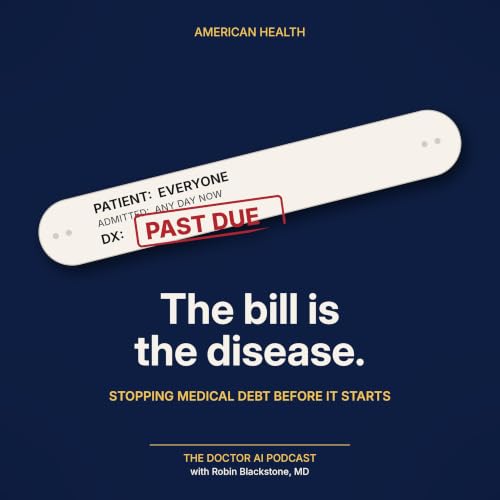
• Stopping Medical Debt Before It Starts
    Oct 22 2026

    Kentucky recently spent $2.5 million to erase more than $100 million in medical debt for 46,000 people. For every family receiving a letter saying an old balance is gone, that relief is real. But canceling a bill is not the same as repairing the conditions that created it.

    In this episode, Dr. Robin Blackstone examines what medical-debt cancellation changes, what two large randomized studies found—and what they did not. She looks at credit reporting, uneven access to relief, Medicaid coverage, hospital financial assistance, fair billing, and why preventing debt may accomplish more than purchasing it after the damage is done.

    This is not an argument against canceling medical debt. Governors and philanthropists are right to relieve the debts they can reach. It is an argument for going further: keeping people insured, making financial assistance automatic, improving billing protections, and creating a clear national rule for medical debt and credit.

    Read the accompanying American Health article and explore the sources and graphics:

    Mehr anzeigen Weniger anzeigen
    17 Min.
  • Heard, Not Believed. What We Owe Each Other: Respect
    Oct 20 2026

    Shalon Irving was a CDC epidemiologist who died three weeks after giving birth, after weeks of reporting symptoms her family says were dismissed. Her credentials made no difference. This episode is about the respect owed to everyone simply because they are a person, and how our establishment withholds it while demanding the earned kind for itself. Plato’s Zeus sends respect and justice to all, not to a skilled few. LeeAnne Walters proves Flint’s water is poisoned with a kitchen faucet and self-taught chemistry. A new elite replaces diplomas with fortunes and keeps the disrespect. And AI, which could return people’s standing by letting them read their own records and understand their own options, could just as easily become the newest credential. OpenEvidence, now used daily by most American physicians, is already closed to the person whose life is at stake.

    Read the full piece, with sources, on Substack:

    https://robinblackstone.substack.com/p/heard-not-believed

    Robin L.P. Blackstone, MD, is the founder of Blackstone Health, the H4 Alliance and the H4 Alliance Trust; author of Doctor AI and American Health: Who Gets Paid, from which she receives royalties; principal investigator of the Doctor AI evaluation program; and a board member of VivaMed.

    Mehr anzeigen Weniger anzeigen
    13 Min.
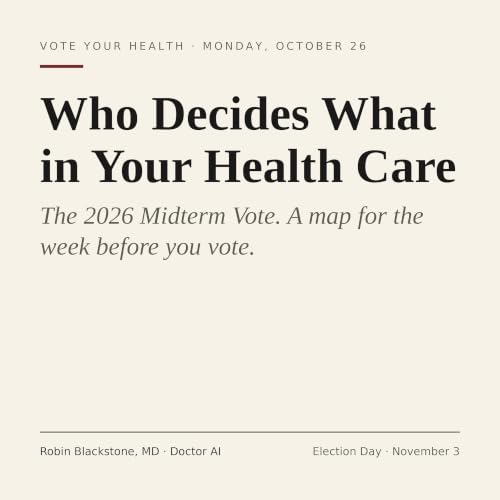
  • Who Decides What in Your Health Care: The 2026 Midterm Vote
    Oct 26 2026

    The first of four pieces before Election Day, November 3.

    Most of what will happen to your health in the next four years will be decided by people on the ballot, or by people they appoint. This is the map: five terms defined plainly (uninsured, Medicaid expansion, medical board, scope of practice, billing code set); the federal layer (Congress, the President and the agencies he appoints: CMS, FDA, NIH); the state layer (governor, legislature, medical board, insurance commissioner, attorney general); what cities actually run; and the official count of what is on the ballot: 36 governors, 35 Senate seats, 435 House seats, 88 of 99 state legislative chambers, 30 attorneys general, 4 insurance commissioners.

    Chapters: The definitions · The federal layer · The state layer · And your city · What is on the ballot November 3 · Where I stand.

    This week: Tuesday, your state, one page for each of the fifty; Wednesday, seven questions to ask anyone who wants your vote; Thursday, five gifts the public already paid for.

    Robin Blackstone, MD, is a surgeon and the author of Doctor AI and American Health: Who Gets Paid. She is not a member of any party, is not raising money, and nobody paid for this piece. She has conflicts of interest like everyone in this field: she founded the companies and the charity that carry this work, and she writes books about it. None of them profit from how you vote.

    Full text with every figure and its source: robinblackstone.com/whodecides The week before the vote: robinblackstone.com/voteyourhealth Get each piece by email: robinblackstone.substack.com

    #VoteYourHealth #AlreadyPaidFor #FirstOpinion

    Mehr anzeigen Weniger anzeigen
    15 Min.
  • American Lives, American Health - Testing with AI Can Do
    Oct 5 2026

    Nearly one in three American adults used an AI chatbot for health information or advice in the past year. They did not wait for medicine's permission. They are tired of waiting.

    On September 30, six of the nation's largest physician organizations, including the American College of Surgeons, issued a joint statement warning against claims that AI outperforms physicians. In this episode, surgeon and former president of the American Society for Metabolic and Bariatric Surgery Dr. Robin Blackstone responds with a different question: what does each contributor to a health decision, human or digital, actually add?

    In this episode:

    • Why Nobel Prize–winning work on creative destruction explains medicine's reaction to AI
    • What Deep Blue's 1997 match against Garry Kasparov reveals about a different kind of intelligence
    • How surgery earned public trust by agreeing to be measured
    • Why physicians and nurse practitioners cannot be the engine of continuity, and what burnout data shows
    • What this year's trials of AI in real care actually found
    • Why where you live should not decide the care you can expect
    • Four commitments for leadership that cannot wait

    Read the full article with references: [Substack link]

    Disclosures: Dr. Blackstone is the founder of Blackstone Health, the H4 Alliance, and the H4 Alliance Trust; author of Doctor AI and American Health: Who Gets Paid (receives royalties); principal investigator of the Doctor AI evaluation program; and serves on the board of VivaMed.

    Mehr anzeigen Weniger anzeigen
    22 Min.
  • Doctor AI: The Intelligence Layer of Health 4.0 | Part Three
    Oct 1 2026

    Health—not healthcare—is the destination.

    In Part Three of the Doctor AI series, Robin L.P. Blackstone, MD, defines the intelligence layer required for Health 4.0. Doctor AI should not simply accelerate more visits, tests, procedures and transactions. It should connect evidence to the individual through access, continuity, precision and earned trust.

    The measure is whether people can stay healthy, recognize disease earlier, reach the right care in time and know what happens next. These are not product features. They are requirements for a system organized around health.

    Mehr anzeigen Weniger anzeigen
    26 Min.
  • Automating What’s Broken Won’t Fix Healthcare | Doctor AI, Part Two
    Sep 30 2026

    Can artificial intelligence fix healthcare—or will it simply make a broken model faster?

    In Part Two of the Doctor AI series, Robin L.P. Blackstone, MD, examines the difference between automation and transformation. AI can reduce clerical burden, accelerate information flow and improve workflows. But if the underlying system remains fragmented, transactional and rewarded for activity rather than outcomes, technology may only industrialize the problem.

    The question is not merely where AI belongs in healthcare. It is what the system should be designed to accomplish—and whether AI changes the person’s health trajectory.

    Mehr anzeigen Weniger anzeigen
    11 Min.
  • The Standard of Care | Doctor AI, Part One
    Sep 29 2026

    When does failing to use capable AI fall below the standard of care?

    In Part One of this Doctor AI series, Robin L.P. Blackstone, MD, examines why the “standard” of care is anything but uniform. Medical evidence may be national, but laws, local resources and access can change across a state line—and the usual pathway may still be wrong for the individual person.

    Through examples including inflammatory breast cancer and postpartum preeclampsia, she asks what Doctor AI must do when medical evidence, law, availability and safety point in different directions. The goal is not to make inequity more efficient. It is to recognize when the common pathway fails, name the conflict honestly and bring the best available medical intelligence to every person.

    Mehr anzeigen Weniger anzeigen
    14 Min.
  • The Cheapest Care We Refuse to Cover
    Sep 28 2026

    The cheapest care we refuse to cover is often the care that could have changed what came next.

    Teeth, eyes and ears reveal what happens when health risk crosses benefit silos—and no one owns the trajectory. Robin L.P. Blackstone, MD, examines how hearing, oral health and vision affect cognition, metabolic control, mobility, independence and safety; why a referral is not a pathway; and what accountable ownership should look like in Health 4.0.

    Read the companion article on Substack: https://robinblackstone.substack.com/p/teeth-eyes-ears-health-infrastructure?r=cxjfx&utm_campaign=post-expanded-share&utm_medium=web

    Mehr anzeigen Weniger anzeigen
    13 Min.