Folgen

  • Sydney to San Antonio: the race to get a robot to a world-first clinical trial | Vexev
    Oct 20 2026

    Dr Eamonn Colley and Dr John Carroll met as PhD researchers more than a decade ago. Together they focused on understanding how blood moves through the body, and how tracking changes in vasculature could help predict, and potentially prevent, heart attacks and strokes. Today, they are co-founders and co-CEOs of Vexev, a Sydney medtech startup whose medical device scans the blood vessels of the arm in 3D.

    In 2024, when Vexev locked in a clinical trial for their device in San Antonio, the device wasn’t yet ready, but with a dwindling runway the date couldn’t be shifted. What followed was a race to get their device ready, through safety checks, and shipped to the US with the Vexev team in tow. They made key updates to the device’s algorithm just days before the start of the trial. Once the trial started, the hardware and software were locked, so there was no going back.

    In this conversation with Kate Glazebrook, Eamonn and John tell the story of an overnight drive to Melbourne to make a last minute safety check, why they wrang a sumo wrestling club asking for help, how the pair approach their co-CEO working relationship, and plenty more.

    Mehr anzeigen Weniger anzeigen
    1 Std. und 19 Min.
  • Can Australia move up the AI value chain? These founders think so. | Springboards & Celeris
    Oct 13 2026

    Could Australia build a frontier AI model to rival OpenAI or Anthropic? If it’s a competition of scale and raw compute, certainly not any time soon. But two Australian founders think there’s another angle: smaller, specialised models built to be the best at a specific thing.

    Pip Bingemann co-founded Springboards, an AI platform for advertising and marketing teams that is optimised for creativity and novelty. Jesse Clark founded Celeris, which is focused on speed: LLMs that can respond in milliseconds, with utility in use cases that benefit from real-time responsiveness. Both companies started by building applications then went on to train their own AI models, and both leverage advancements in open-source AI technologies.

    Jensen Huang, CEO of NVIDIA, described the AI industry as a five-layer cake, with raw energy at the bottom, and AI models and applications at the top. Both of the founders in this episode are vying for a bigger slice of that AI cake, and if Australia is able to successfully compete at those top levels, the potential upside is huge.

    Tom Humphrey, Partner at Blackbird, is the guest host for this episode, and speaks with Pip and Jesse about what it takes to actually train an AI model, how open-source and open-weight models are changing the AI landscape, and why Australia developing its own AI models could be important for national security.

    Springboards: https://springboards.ai

    Celeris: https://celeris.ai

    Mehr anzeigen Weniger anzeigen
    1 Std. und 20 Min.
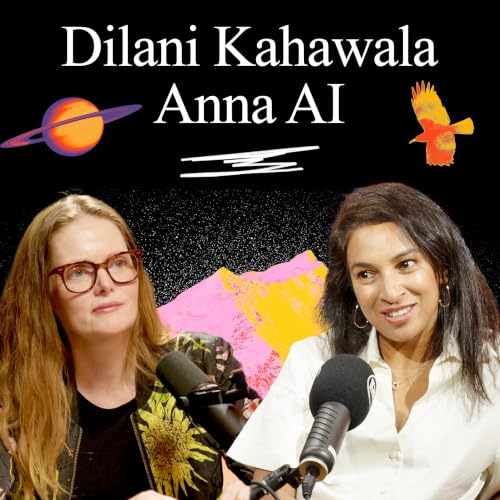
  • The former physicist building an AI assistant for parents | Dilani Kahawala, Anna AI
    Oct 6 2026

    Dilani Kahawala has three kids, a partner with a busy job in tech, and a startup to run. At the dinner table, with twenty minutes to get the kids fed, all too often she’d be thinking about what goes in tomorrow’s lunchboxes and planning logistics for the week ahead, rather than simply being present with her kids. That’s the mental load that Anna, the AI assistant for parents, was designed to carry.

    Dilani path to co-founding a startup was a winding one. She got a PhD in theoretical physics, before deciding physics and academia moved too slowly for her tastes. Following a stint at McKinsey, and working product roles at Etsy, Meta and Atlassian, she co-founded a company and developed Braid, an AI powered tool designed to help software teams with project management. After deciding Braid didn’t have product market fit, the team went through a period of rapid exploration, experimenting with eight or nine different product ideas in a five month period. After gaining strong early traction, Anna was the idea that stuck.

    In this episode, Kate Glazebrook sits down with Dilani about the decision to move away from using frontier models in favour of open source AI models, how the Anna team internally leverage AI agents “up the wazoo”, the surprising fact that most of their users eschew the Anna app in favour of communicating with Anna directly in messaging apps, and why Dilani isn't too worried about OpenAI launching a parent product.

    Mehr anzeigen Weniger anzeigen
    1 Std. und 16 Min.
  • He was a surgeon. Now he’s CEO of a robotics startup | David Bell, Remedy Robotics
    Sep 29 2026

    As a cardiac surgery trainee in Sydney, David Bell saw how much a stroke patient’s chances of recovery depended on their postcode. If they lived in Sydney and got treatment quickly, their chances of recovery could be 75-80%. But in much of the developing world where treatment options were often far more limited, it could be as low as 10%.

    Today, David is cofounder and CEO of Remedy Robotics, a startup with the goal of making endovascular surgery – the catheter-based treatment for strokes like these – available to anyone who needs it, wherever they live. The need is enormous: stroke is the world's second leading cause of death and a leading cause of disability, and every hour of delay makes it less likely a patient will live independently again. Yet only about 3% of the world has access to the kind of care that lets patients not just survive a stroke, but get back to something like normal life.

    Remedy Robotics have built a robot that is designed to be operated by a surgeon remotely. The aim is that a specialist in Sydney could one day treat a stroke patient in Suva. Remedy has already run the first fully robotic endovascular procedure in a human, as well as procedures on four patients fully remotely, in Toronto.

    In this episode, Kate Glazebrook sits down with David to talk about his experience going from surgeon to startup founder, the nuanced details about how hospitals decide which technology to invest in, how remaining in stealth caused Remedy Robotics some challenges when it came to recruiting talent early on, and plenty more.

    Mehr anzeigen Weniger anzeigen
    56 Min.
  • If you can imagine it, you can probably build it | OpenAI's Satya Tammareddy and Rowena Westphalen
    Sep 22 2026

    Once a technology gets good enough, the only real ceiling left is what you can imagine for it. Satya Tammareddy and Rowena Westphalen watch OpenAI's models improve week by week, and work closely with organisations implementing AI across multiple industries. In their view, the hard part isn't the limits of the tools. It's the pace. Even people working at the frontier can't quite get their bearings before the next model lands. No wonder everyone else feels like they're chasing something that keeps moving. The upside, they'd argue, makes the vertigo worth it. If you can dream it, you can probably build it now.

    Satya leads OpenAI's go-to-market across Australia and New Zealand. Rowena leads Applied AI Architecture, whose forward deployed engineers build inside a customer's business rather than handing over a finished product.

    From moving beyond traditional software implementations to embedding forward-deployed engineers directly inside teams, Rowena and Satya share front-line insights from working alongside some of Australia and New Zealand’s most ambitious organisations. Whether you are a founder scaling internal tools or an executive rethinking your company's core value chain, this conversation offers a practical roadmap for navigating the pace of modern AI development.

    Mehr anzeigen Weniger anzeigen
    1 Std. und 2 Min.
  • Why the future of intelligence is both open and closed. Baseten’s Mudith Jayasekara and Charlie O'Neill
    Sep 15 2026

    This week Kate hands over the mic to Saron Berhane, who leads Blackbird's deep tech programme. She was recently in San Francisco and sat down with two Australians who had to move to the Bay Area to do the sort of work they wanted to do. Which is both their personal experience and one of their main arguments in this episode. Australia's problem in AI isn't compute. It's that the smartest people here go into quant trading or get on a plane, and nobody has built them a reason to stay.

    Baseten is where they landed. It's an AI infrastructure and production-grade inference platform, the layer that lets engineering teams deploy, scale and optimise machine learning models. Sydneysider Tuhin Srivastava co-founded it, and it recently raised a$1.5B Series F led by Altimeter Capital, Conviction Partners, Blackbird and Spark Capital.

    Mudith Jayasekara and Charlie O'Neill are Baseten's Co-Heads of Model Training. Before that they founded Parsed, a mechanistic interpretability lab that Baseten acquired. Mudith trained as a doctor. Charlie started in law and philosophy and wanted to study English literature. Neither took the path you'd draw if you were designing someone to run model training at a company like this, and both think that's the point.

    The conversation is wide-ranging and deeply technical. Saron takes them through what's actually happening inside the open source ecosystem right now, which is stranger and more hopeful than the usual framing allows. Sitting underneath all of it is one question. When everything difficult gets commoditised, what's left? The training recipe is now roughly the same everywhere. Post-training has gone from a specialist problem to something a small team can attempt. The friction on running an experiment has mostly gone. What's left is taste, and having enough of the right people in one room.

    Mehr anzeigen Weniger anzeigen
    1 Std. und 19 Min.
  • The company OpenAI and Google call when a user is in a crisis: Elliot Taylor, Founder of Throughline
    Sep 8 2026

    Content note: this episode discusses suicide, self-harm and family violence. Support details are at the bottom of these notes.

    Before Elliot Taylor was a tech founder, he spent fifteen years sitting with people on the worst days of their lives. He ran community homes. He had kids sleeping on his couch after they’d been kicked out of their homes. His place became a safe house for people leaving violent relationships. And the longer he did it, the clearer it got that the model he was working inside couldn't reach the scale the problem was actually at.

    So he went looking for a more scalable way to have impact, and to his own surprise he founded a startup.

    Throughline builds the infrastructure that connects people to the right mental health or online harm support the moment they go looking for it. Someone tells ChatGPT they don't want to live anymore. Someone searches Google for a way out of a violent relationship. Throughline is the layer that gets them to a real service in their own country and their own language, one that's actually open when they call.

    In this episode, Kate asks what he's learned building a company in a place most founders would never think to look. They get into why fear, rather than any shortage of services, is what stands between a person and help. How you experiment when being wrong isn't an option. What it's like building product while the laws that govern it are still being drafted around you. And how you look after a team who spend their days reading the hardest things people write.

    Elliot's ambition is to build the biggest mental health intervention the world has ever seen.

    If you need support: Lifeline 13 11 14 (Australia), 1737 call or text (New Zealand), 1800RESPECT 1800 737 732 (Australia, family and sexual violence).

    Mehr anzeigen Weniger anzeigen
    1 Std. und 11 Min.
  • Canva's first Chief Algorithms Officer on what the data misses - with Nirmal Govind
    Sep 1 2026

    Nirmal Govind has spent thirty years trying to predict human behaviour, and he keeps finding the edges of it.

    He joined Netflix when the company still had two original shows to its name, and over the decade that followed his work spread into almost every corner of the business: the engineering that makes a video start playing the moment you hit play, the quality checks on content arriving from studios, and eventually the data behind what a company spending twenty billion dollars a year should actually make. He is now Canva's first ever Chief Algorithms Officer.

    One of the things his team ran was a test on artwork. Each time a new show launched they would put a batch of different images in front of viewers to see which one made people stop and click, and internally, colleagues would call it in advance. These were people who had spent years studying what audiences do, and they had strong instincts about what would land. Most of the time they were wrong. Human taste, it turns out, is not something you get much better at guessing just because you have watched it closely for a long time.

    Kate and Nirmal spend a good while in that territory, in the places where the data runs out. There is a lovely example of a director who chose to open the second episode of a show by continuing a battle scene from the first, with no titles and no credits, just straight back into it. Twenty minutes in, the opening credits finally rolled, and the team watched a wave of people leave in the middle of the episode. Obvious in hindsight. Credits mean an ending, and the audience took the hint.

    In this episode, Kate talks with Nirmal about what a Chief Algorithms Officer actually does all day, why an algorithm should let you finish a two-minute job and leave, what happened when he asked an AI tool to size up an opportunity and the answer came back three times off, and plenty more.

    Mehr anzeigen Weniger anzeigen
    1 Std. und 1 Min.