Folgen

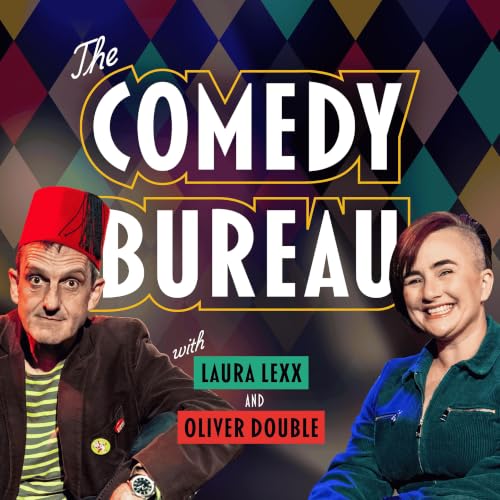
  • The Comedy Bureau...launching 25th September 2025!
    Sep 1 2025

    The Comedy Bureau launches Thursday 25th September at 7pm (UK time) with its first three case files. Academic Oliver Double and comedian Laura Lexx begin their investigations with an impossible question… Who was the first stand up comedian? From there they move out into even murkier waters… what is a joke and why do humans laugh?

    The Comedy Bureau is a warm, insightful look into all facets of comedy. Covering the history and development from the days of Variety and Vaudeville performance right up to the practicalities of being a working comedian in the present day. It’s an essential show for all fans of history and comedy.

    e5bb03ef6465c5295bd86df61a20218143213c78

    Mehr anzeigen Weniger anzeigen
    3 Min.
  • Case File 1: Who Was The First Stand Up Comedian?
    Sep 25 2025

    In the very first episode of The Comedy Bureau, stand-up comedian, author and podcaster Laura Lexx poses comedy academic Olly Double an impossible question. It sounds simple when you ask it... who was the first stand up comedian? But, as Olly passionately and carefully explains – there's no way to answer because stand-up comedy didn't leap out of the ether fully formed as an entertainment format.

    Olly puts forward five candidates for first ever stand up comedian and meticulously explains why each one could be considered such. Laura then forces him to choose... which one would he pick as the first ever stand up comedian?

    The Comedy Bureau is a new show dreamed up by Laura Lexx – a supreme comedy nerd with fifteen years’ experience as a stand up comedian. Her career really began at The University of Kent where a professor named Oliver Double introduced her to the world of comedy and the potential for stand-up as more than just for her entertainment. Fast forward to 2025 and the two have teamed up to explore the real intricacies of the world of comedy. From the history to the science to the sociology to the just plain interesting – The Comedy Bureau will be covering it all.

    If you have any questions you think would be interesting to pose to us here at The Bureau, please don't hesitate to get in touch. You can comment on our social media pages or send us an email at TheComedyBureauTeam@gmail.com

    Thanks for watching – don't forget to like, subscribe and share these episodes.


    Our sources for this episode were:

    • Judith Yaross Lee (2006), 'Mark Twain as a Stand-Up Comedian', The Mark Twain Annual, no. 4, pp.3-23.

    • Joe Laurie Jr. (1931), 'Monologists', Variety, 29 December, p.22.

    • The Stage (1904), 'Death of Dan Leno', 3 November, p.16.

    • Peter Quince (1917), 'Stage Gossip', The Yorkshire Evening Post, 10 November, p.3.

    • Jay Hickory Wood, 'Dan Leno' Methuen & Co (1905)

    • Rafe (1954), 'The Hunger i, Frisco', Variety, 4 August, p.53.

    • Mort Sahl (1958), At Sunset [LP], USA: Fantasy Records.


    Laura mentions in this episode the wonderful Kate Lucas, you can check her out at www.katelucascomedy.co.uk or on social media @katelucascomedy


    Follow us on instagram @The.Comedy.Bureau to see Olly's postcards in more detail.


    Podcast cover art by Adam Richardson


    Artwork for The Comedy Bureau is by Matthew Grant at Tiny Worlds Workshop @tinyworldsworkshop.


    Our video editor and credit sequence designer is Lucas Orme.


    Music was devised and performed by Olly Double.


    Huge thanks to the whole team at Podspike for invaluable advice and help launching and marketing the show.


    All media enquiries via Julian Hall textualhealingpr@gmail.com

    Mehr anzeigen Weniger anzeigen
    32 Min.
  • Case File 2: What Is Laughter?
    Sep 25 2025

    Welcome back to the office of The Comedy Bureau, here you will find Reader in Popular Performance and Comic History Olly Double, alongside comedian and author Laura Lexx. They are the employees at The Comedy Bureau – a department in The University of Niche Interests where the analysis of all things comedy takes place in meticulous detail.

    In this episode Olly and Laura are focusing on a simple question with an extremely complicated answer… what is laughter?

    Laughter is such a fantastic feeling that we pay strangers to make us do it. Laughter is so intoxicating that when someone causes you to do it you like them more, if not begin to love them in some cases.


    But what is it? Why do humans do it? Do we know why we like it? And, are we alone in doing it?


    In this episode we explore the three leading humour theories – superiority, release and incongruity as well as discussing evolution of laughter. We then move on to dissecting some of Laura’s current stand up jokes to look at why we are laughing in each joke.


    If you have any thoughts or subjects for future episodes you can email us at TheComedyBureauTeam@gmail.com


    Our Sources for the research for this episode were:

    • Robert Provine (2000), Laughter: A Scientific Investigation, London: Penguin.

    • John Morreall (1987), The Philosophy of Laughter and Humor, Albany, NY: SUNY Press.


    If you would like to watch Slinky, the show which Laura shared extracts from then you can join her mailing list here to be notified of when it’s available:

    https://www.lauralexx.co.uk/mailing-list


    Podcast cover art by Adam Richardson


    Artwork for The Comedy Bureau is by Matthew Grant at Tiny Worlds Workshop @tinyworldsworkshop.


    Our video editor and credit sequence designer is Lucas Orme.


    Music was devised and performed by Olly Double.


    Huge thanks to the whole team at Podspike for invaluable advice and help launching and marketing the show.


    All media enquiries via Julian Hall textualhealingpr@gmail.com

    Mehr anzeigen Weniger anzeigen
    39 Min.
  • Case File 3: What Is A Joke?
    Sep 25 2025

    Welcome back to The Comedy Bureau! In the third episode, Laura and Olly open the doors of the office just in time for Laura to pose Olly another impossible question… what is a joke?!

    Laura and Olly first met at The University of Kent where Laura studied stand up comedy under Olly’s tutelage. Now, 20 years later they are reunited to examine the gory details of the world of comedy. Even when there might not be a definitive answer.

    First off Olly and Laura explore some traditional jokes to look at the ways they are structured. Then they explore intentionality to see if the real soul of a joke is in the purpose of the sentence.


    In this episode they analyse jokes from the Roman period to Shakespeare to the modern day stand-up routine to see if there are any definitive rules and regulations that truly define a joke.


    What is a joke?

    • Geoff Rowe (2021), All Puns Blazing: The Best British Knockout Jokes, Ebury Press

    • Jimmy Carr and Lucy Greeves (2006), The Naked Jape, London: Michael Joseph.

    • Dan Compton (2010), A Funny Thing Happened on the Way to the Forum, London: Michael O'Mara Books.

    • James Orchard Halliwell (1844), Tarlton's Jests and News Out of Purgatory, London: Shakespeare Society.

    • Lewis and Faye Copeland (eds.) (1940), 10,000 Jokes, Toasts & Stories, Garden City, NY: Garden City Books.

    • Robert Orben (1946), The Encyclopedia of Patter, New York: Louis Tannen.

    • Robert Orben (1951), One-Liners, New York: D Robbins.

    • Robert Orben (1951), Comedy Technique, New York: Louis Tannen.

    • Robert Orben (1963), If You Have to Be a Comic, Baldwin Harbor, NY: Orben Publications.


    Comedians Laura mentions in this episode:

    Dinesh Nathan @dineshnathancomedian

    Gary Delaney @garydelaneycomedian

    Andy Askins @AndyAskins

    Paul F Taylor @paulyftaylor


    Podcast cover art by Adam Richardson


    Artwork for The Comedy Bureau is by Matthew Grant at Tiny Worlds Workshop @tinyworldsworkshop.


    Our video editor and credit sequence designer is Lucas Orme.


    Music was devised and performed by Olly Double.


    Huge thanks to the whole team at Podspike for invaluable advice and help launching and marketing the show.


    All media enquiries via Julian Hall textualhealingpr@gmail.com

    Mehr anzeigen Weniger anzeigen
    33 Min.
  • Case File 4: Are Women Funny?
    Oct 2 2025

    Welcome back to the cosy offices of The Comedy Bureau. Staffed by comedian Laura Lexx and academic Olly Double, it’s the go to place for all the comedy discussions and analysis you could ever want.

    This week, in their most provocatively titled episode to date Laura and Olly explore the rage-inducing issue of women in comedy. As a stand up comedian, Laura is often forced to deal with people who, for their own personal reasons, cannot find women funny. Unfortunately, Olly isn’t a therapist and so can’t fix them. Instead, what they aim to do in this episode is bust the myth that female inclusion in comedy is somehow a new thing. Olly gives Laura a brilliant rundown of the history of women in comedy from the days of Vaudeville and Variety up to the Alternative Comedy explosion of 1979.

    Female involvement in comedy seems to have fluctuated over the last century and a half and Olly and Laura discuss here various explanations for how and why that happens. Olly talks Laura through the female power houses of the Variety stage including the likes of Suzette Tarry, Nelly Wallace and Marie Lloyd.

    When comedy moves to Working Men’s Clubs things take a bit of a dip for female representation but Olly finds examples like Marti Caine. Names you may be more familiar with include Pauline Melville, Victoria Wood and Jenny Eclair in a rich tour of all the ways women have helped shape the British history of comedy.

    Our Sources for the research for this episode were:

    • Zoe Williams (2020), 'Interview: Jenny Eclair: " Menopause gave me incandescent rage. It was like a superpower"', The Guardian, 28 June https://www.theguardian.com/stage/2020/jun/28/jenny-eclair-menopause-gave-me-incandescent-rage-it-was-like-a-superpower

    • John Fisher (1973), Funny Way to Be a Hero, London: Frederick Muller


    Laura mentions Harriet Dyer in this episode, and Harriet can be found on Instagram at @harrietdyercomedy


    Podcast cover art by Adam Richardson


    Artwork for The Comedy Bureau is by Matthew Grant at Tiny Worlds Workshop @tinyworldsworkshop.


    Our video editor and credit sequence designer is Lucas Orme.


    Music was devised and performed by Olly Double.


    Huge thanks to the whole team at Podspike for invaluable advice and help launching and marketing the show.


    All media enquiries via Julian Hall textualhealingpr@gmail.com

    Mehr anzeigen Weniger anzeigen
    41 Min.
  • Case File 5: Funny Peculiar or Funny HaHa?
    Oct 9 2025

    Welcome back to the offices of The Comedy Bureau, staffed by comedian Laura Lexx and tame historian and comic lecturer Olly Double!

    This week Laura and Olly decide to knuckle down and really focus on something that keeps rearing its head during their discussions of other aspects of comedy… comic theory. Why are things funny? What is funny? What is humour EXACTLY?

    Now, it’s sort of another one of those impossible questions to answer and so Olly has the task of describing some of the popular comic theories to Laura. Even trying to describe all the theories would be a vaguely impossible task and so we have narrowed it down to just three options…

    In this first episode of a three-part series on comic theory they focus in on Incongruity Theory. We’ve been kind to you in the first four episodes but this is where the show takes a hard turn down Nerd Avenue and then proceeds at a cautious 20mph all the way to Detail House.

    We begin our comic theory exploration series with Koestler’s theory of bisociation and discuss how a lot of jokes revolve around using two planes of idea and then merging the two for a point of laughter. In the next two episodes in our comic theory series we will be looking at the Relief Theory and the Superiority Theory so don’t miss those coming up in the next few weeks.

    In this episode our sources were:

    • Koestler, Arthur (1970) “The Act of Creation”, Pan McMillan

    • Morreall, John (1987), The Philosophy of Laughter and Humor, Albany, NY: SUNY Press

    • Carroll, Noel (2014), “Humour a Very Short Introduction”, Oxford University Press


    Comedians Laura mentioned in this show are:

    Paul F Taylor - @paulyftaylor


    Podcast cover art by Adam Richardson


    Artwork for The Comedy Bureau is by Matthew Grant at Tiny Worlds Workshop @tinyworldsworkshop.


    Our video editor and credit sequence designer is Lucas Orme.


    Music was devised and performed by Olly Double.


    Huge thanks to the whole team at Podspike for invaluable advice and help launching and marketing the show.


    All media enquiries via Julian Hall textualhealingpr@gmail.com

    Mehr anzeigen Weniger anzeigen
    34 Min.
  • Case File 6: Is It a Relief To Laugh?
    Oct 16 2025

    This week, The Comedy Bureau team continue their mini series looking at popular comic theories. Last week they explored Incongruity, and this week they move on to Relief Theory (sometimes called Release Theory).

    The offices have an oniony scent this week due to some delicious sandwiches (shout out to Lavash in Brighton) but that doesn’t stop Oliver Double and Laura Lexx getting nerdy. They begin with Kant, and work through several theories of the purpose and physiology of laughter. From Kant, Freud and other philosophers and psychologists right through to modern day academics. They discuss laughter as a fluid running through the body, as an oscillation of the gut and as the answer to all of our structural racism issues.

    Today’s episode ends with a discussion between Laura and Olly on the nature of jokes as a tool to boost agreement or dissension in groups. Is joking used to lance complicated feelings and stop bad feelings spilling out into the world or are they in actual fact for binding people and reinforcing a world view? Do we use laughter to dispel feelings that have been building up that could otherwise come out in harmful behaviour, or is it actually the complete opposite?

    The sources we used in this episode are:

    • John Morreall (1987), The Philosophy of Laughter and Humor, Albany, NY: SUNY Press.

    • Martin, Steve “a Comic’s Life: Born Standing Up”, (2008) Simon & Schuster Ltd

    • Freud, Sigmund (1976) The Pelican Freud Library Vol 6, “Jokes and their Relation to the Unconscious”, Penguin Books Ltd

    • Comedy Studies, Volume 3, Issue 1 (2012) - “Max Miller Plays With Freud’s Obstacle: Innuendo and performance technique in variety comedy” Oliver Double

    • Jacobson, Howard (1997) “Seriously Funny: From The Ridiculous to the Sublime”, Penguin Books Ltd"


    Podcast cover art by Adam Richardson


    Artwork for The Comedy Bureau is by Matthew Grant at Tiny Worlds Workshop @tinyworldsworkshop.


    Our video editor and credit sequence designer is Lucas Orme.


    Music was devised and performed by Olly Double.


    Huge thanks to the whole team at Podspike for invaluable advice and help launching and marketing the show.


    All media enquiries via Julian Hall textualhealingpr@gmail.com

    Mehr anzeigen Weniger anzeigen
    43 Min.
  • Case File 7: Why Do We Laugh at Others?
    Oct 23 2025

    Finishing up our mini-series in Comic Theory, this week Laura and Olly turn their attention to Superiority Theory.

    This is the idea that people laugh because the stimulus made them feel better than or good in some way. They enter the chat with a brief discussion on status, particularly in double acts between a higher status straight man and a lower status funny guy.

    Then we move on to the theorists and philosophers and we head right right back all the way to the words and explanations of Aristotle, Hobbes, Lorenz and Mintz as we explore the theory that laughter is inherently about superiority or aggression. Do we laugh to feel better about ourselves in comparison to others? Or, perhaps, in comparison to how we felt moments before the joke? Is all joking necessitated on a status imbalance and where does modern comedy fit in?

    Laura and Olly round off this week’s chat with an analysis of Punching Up and Punching Down – a look at the importance of aiming your joke, no matter the subject, in the right direction.

    We hope you have enjoyed these three episodes on joke theory, next week we will be moving on to a new subject, but nonetheless remaining very much in the weeds.

    Subscribe now so you never miss an episode. See you then!

    Our sources for this episode are:

    • John Morreall (1987), The Philosophy of Laughter and Humor, Albany, NY: SUNY Press.

    • Lorenz, Konrad (1966), “On Aggression”, Taylor & Francis Ltd

    • Carroll, Noel (2014), “Humour a Very Short Introduction”, OUP Oxford

    • Quirk, Sophie, (2018), “The Politics of British Stand-Up Comedy - The New Alternative”, Palgrave Studies in Comedy, Springer Nature Switzerland

    • Barbara, Rashi & Chilana, Richa (2022), “Punching Up in Stand-Up Comedy - Speaking Truth to Power”, Routledge India Mintz,

    • Lawrence E. (1985), “Standup Comedy as Social and Cultural Mediation”, American Quarterly"


    Podcast cover art by Adam Richardson


    Artwork for The Comedy Bureau is by Matthew Grant at Tiny Worlds Workshop @tinyworldsworkshop.


    Our video editor and credit sequence designer is Lucas Orme.


    Music was devised and performed by Olly Double.


    Huge thanks to the whole team at Podspike for invaluable advice and help launching and marketing the show.


    All media enquiries via Julian Hall textualhealingpr@gmail.com


    podfollow.com/the-comedy-bureau

    Mehr anzeigen Weniger anzeigen
    31 Min.