Folgen

  • The Deportation Plan Broke So the Bombs Came Out
    Mar 1 2026

    In Season 10, Episode 5 of The Chris Abraham Show, I lay out a theory for why Donald Trump pivots to Iran. This isn’t an episode about Iran’s internal politics so much as it’s an episode about incentives, momentum, and what happens when a leader needs an economic and narrative engine and the preferred domestic plan hits a wall.

    About a year ago, I wrote a Substack post arguing that Trump’s big idea wasn’t necessarily invading countries abroad. It was building a domestic “make work” machine: a deportation industrial complex that functions like a WPA-style spending and jobs program aimed squarely at his base. The concept is simple. You hire huge numbers of border and enforcement personnel. You expand detention capacity. You contract transportation at scale. You staff security, logistics, medical care, legal processing, and due process. You build an entire support economy around that infrastructure, the way towns and services cluster around major prison facilities. It becomes a trillion-dollar domestic momentum project, and the people most willing to take those jobs are the people who already support the project politically.

    In my view, that domestic plan ran into heavy friction: legal constraints, moral outrage, intense media framing, and constant resistance that made it hard to run at full scale. But the need for momentum doesn’t disappear. The spending machine still wants to move, midterms still loom, and a president who thinks like a businessman and a showman still wants a lever to pull.

    So the pivot becomes familiar Plan B: international escalation. Bombing campaigns, expensive munitions, replacement orders, contractor logistics, reserve activation, and the revived atmosphere of terrorism fears and proxy-war paranoia. Whatever you think of the policy merits, this kind of activity reliably drives procurement cycles and absorbs attention. It can also seize the news cycle and reset the political conversation when other stories are dominating.

    I also talk about spite as a governing emotion: the “you made me do it” logic that abusers use, repurposed into politics. The subtext becomes, if you had let me run my domestic war economy, I wouldn’t be doing this overseas. Now watch what you forced.

    This is a short episode, but it’s the analysis I needed to say out loud after listening to reporting that treated the outcome as shocking. I don’t think it’s shocking. Incentives plus ego plus a hunger for momentum can point in a very predictable direction.

    Deportation Industrial Complex Goes Full DWOT

    The Deportation Gold Rush

    The Deportation Industrial Complex: America’s New WPA

    The Deportation New Deal: Escalation's Inevitable Path

    Start With the Criminals, End With Everyone

    Trump's Spite War

    Mehr anzeigen Weniger anzeigen
    11 Min.
  • Media Capture, Populism, and the NPR Trust Problem
    Mar 1 2026
    • The Ellisons Prepare to Expand Their Media Empire
    • The Century-Long Capture of U.S. Media

    In Season 10 Episode 4, Chris Abraham swerves away from the day’s obvious headlines and instead reacts to an On the Media segment on WAMU about “media capture” and the role of public broadcasting in a healthy democracy. He frames himself as an NPR/WAMU lifer with a complicated relationship to the institution: nostalgic for the old public-radio mix, aware of how it shaped him, and also increasingly allergic to how it can feel like a status-enforcing machine rather than a shared civic utility.

    Chris challenges a core assumption embedded in a lot of “flawed democracy vs. healthy democracy” talk. When institutions praise certain countries as “strong democracies,” he argues they often mean something closer to “compliant,” “high-trust,” and “aligned with approved messaging.” In his view, populist dissent, cultural resistance, and “opting out” are treated less like legitimate democratic feedback and more like a pathology to be managed, which makes the word “democracy” feel like branding instead of description.

    He contrasts the U.S. with European public-media models, not to romanticize them, but to point out why they sometimes enjoy broader buy-in: they deliver visible, practical value, including educational programming that feels like a public good. Chris argues that if public media in the U.S. reliably felt like Mr. Rogers energy, it would be harder to politically defund. When it feels like it exists to scold, dunk, or run a permanent moral emergency about half the country, it triggers backlash in a society already wired to distrust “the man” at every level.

    Using a driving metaphor, he describes American politics as a fight over the steering wheel. When institutions respond to populism by steering harder into elite signaling and cultural escalation, the reaction on the right becomes more forceful and more desperate, because people feel they’re holding a fake wheel while someone else drives. That trust breakdown, he argues, is the real accelerant. He also warns that open institutional defiance of elected power can invite a predictable counter-response: aggressive executive action, tightened compliance expectations, and a “find the receipts” mentality that punishes slow-walking and internal resistance.

    Chris ends with a mix of dark humor and personal texture. He calls the last decade a mutual “FAFO era,” where both sides have learned hard lessons about power, incentives, and overreach. Then he closes the episode in classic Chris fashion: weather report, coffee, library plans, ongoing Meshtastic tinkering, a quick health update, and a reminder that the next mission is getting back to fighting shape.

    Mehr anzeigen Weniger anzeigen
    26 Min.
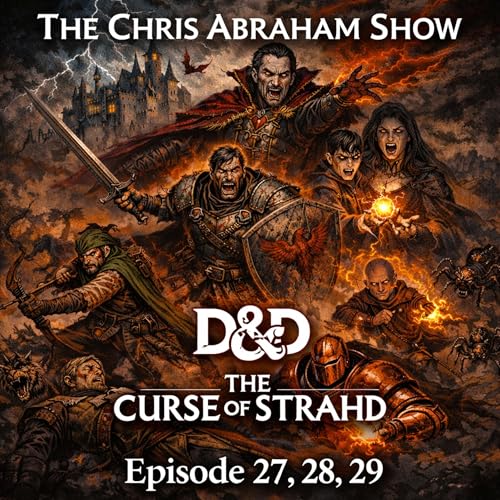
  • The Ravenloft Dinner That Broke Everything Episode 27 28 29
    Feb 27 2026

    Welcome back to The Chris Abraham Show. This episode collects Sessions 27 28 and 29 of our Dungeons and Dragons campaign The Curse of Strahd and turns them into one continuous descent into Castle Ravenloft.

    If you are not a D and D person, here is the simple setup. Our small band of adventurers is trapped in Barovia, a mist locked valley ruled by Strahd von Zarovich, an ancient vampire lord with the patience of a spider and the manners of a king. We have been trying to protect Ireena Kolyana from him, recover the Amulet of Ravenkind, and stay alive long enough to do something that matters. Recently we failed to retrieve that amulet in Vallaki, lied to Ireena’s brother Ismark to keep him from charging into a suicide mission, and then finally had to admit the truth. Ireena was taken by Strahd.

    So when the invitation arrives, we accept it. Dinner at Ravenloft. Polite. Civilized. Completely insane.

    On the road, Barovia reminds us that travel is never just travel. Revenants on a skeletal horse ambush the party and an ogre zombie joins the slaughter. Ismark is dropped in the chaos and only survives because Urihorn rides in on his mountain lion and drags him back from the edge. The undead die laughing with a promise that they will meet us again.

    Then the castle welcomes us. An unmanned coach. A swaying drawbridge over a gorge. Doors opening by themselves. Rahadin, Strahd’s chamberlain, arriving with a choir of invisible screams. A banquet hall glittering with chandeliers and a feast laid out like a joke.

    Strahd plays the gracious host and then reveals the knife. Ireena enters. So does Yeska, a young altar boy we once tried to keep safe. Both are vampires now. And Ireena is wearing the Amulet of Ravenkind, the holy artifact we lost and desperately needed. The room goes cold in the way only a story can go cold when you realize the villain has been moving pieces you did not even know were on the board.

    From there, we start exploring Ravenloft and the castle starts teaching us its rules. Vampire spawn watch from the walls. A ruined chapel dares us to touch what should not be touched. Secret passages lead to trapped rooms. A captive accountant named Lief sits chained to a desk keeping Strahd’s books like bureaucracy is also immortal. A maid begs to be rescued. A centuries old portrait shows Ireena as if she has always been here.

    And then the traps get personal. A coffer releases a green gas that drops party members without a fair fight. An animated suit of red armor hunts like a machine and kills Ismark. When we wake later, the castle has rearranged the scene. Bodies are missing. The fire relights itself. Evidence disappears. A bell summons spiders. Burning webs threatens to burn the whole structure down. A tub of blood erupts with a screaming figure and then the blood is gone like it never existed.

    Finally, a dusty dining room offers one last bait. A wedding cake explodes. And Strahd arrives not as a man in a cape, but as a pressure in the air, an invisible silhouette reaching for us.

    This is the Ravenloft arc where hospitality becomes horror, where grief becomes motion, and where the castle itself feels like the weapon.

    Cast and characters
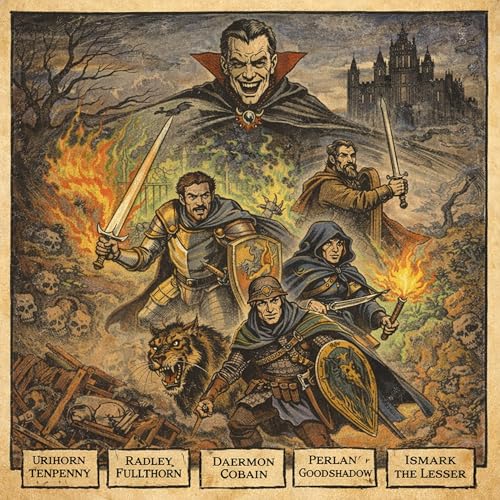
    Chris as Radley human Eldritch Knight
    Sean D as Urihorn Tenpenny halfling Beastmaster with a mountain lion
    Cary as Perlan Goodshadow halfling Monk
    Trip as Daermon Cobain elf Arcane Trickster
    DM Sean S

    If you enjoy gothic horror fantasy, actual play storytelling, and campaigns that refuse to let anyone feel comfortable, you are in the right place.

    Mehr anzeigen Weniger anzeigen
    1 Std. und 10 Min.
  • Session Twenty-Six: The Wachter House, a Basement of Skeletons, and the Point Where Vallaki Became Hostile Territory
    Jan 28 2026

    Session Twenty-Six picks up at a moment where survival has stopped feeling temporary. By now, the party understands that Barovia doesn’t reset between victories. Vallaki, once a place to rest and resupply, has become hostile ground. We’re no longer visitors. We’re trespassers.

    The objective is narrow and urgent: recover the Amulet of Ravenkind. Losing a relic capable of harming vampires in Strahd’s domain isn’t a setback. It’s a liability. Lady Fiona Wachter, newly installed as Vallaki’s burgomaster, is the most likely person holding it. Her family predates Strahd’s rule, and in Barovia, old families tend to survive by making old bargains.

    We enter her house through the basement. That alone says something about how this campaign has shifted.

    The cellar looks ordinary until it isn’t. Eight skeletons tear themselves out of the dirt floor, remnants of people who likely believed Vallaki was safer than the road. The fight is quick and decisive. What would have been a near-death struggle earlier in the campaign is handled with efficiency. Not confidence. Experience.

    Radley, the human fighter, has fully settled into his role as an Eldritch Knight. Early in the campaign he relied on armor and luck. Now he holds ground deliberately, mixing blade work with defensive magic. Urihorn, the halfling ranger who no longer casts a shadow, controls distance and terrain, his connection to his animal companion reinforcing a steadiness Barovia hasn’t yet taken from him. Daermon, the arcane trickster, turns positioning and timing into damage. Perlan, the monk newly arrived to the valley, already fights like someone who understands that hesitation gets you killed here.

    After the skeletons fall, we notice something worse than the combat itself: signs of frequent foot traffic worn into the dirt. A wall rotates, revealing a hidden chamber. Five chairs sit around a pentagram. No bodies. No ritual in progress. Just evidence that this house hosts meetings, not accidents.

    That’s Lady Wachter’s real danger. Not sudden violence, but organization.

    Outside the house, the tension shifts from combat to consequence. Ismark, burgomaster of Barovia Village and brother to Ireena, presses us for answers we’ve been avoiding. Until now, we’ve lied to him about his sister’s fate. Not out of cruelty, but because the truth in Barovia doesn’t bring closure. It brings reckless action.

    The lie collapses anyway.

    Radley carries that moment harder than most. He’s now the only survivor of his original party. Everyone else from those early days is dead. Burned. Taken. Left behind. He isn’t still alive because he’s exceptional. He’s alive because he adapted.

    At the end of the session, the party reaches Level 7.

    Mechanically, this is a meaningful step. Fighters gain stronger combat options. Rogues and monks become harder to pin down. Spellcasters unlock deeper resources. Everyone gains resilience and flexibility.

    Narratively, the level-up marks something quieter: we’re no longer reacting. We’re preparing.

    Session Twenty-Six doesn’t end with a win. It ends with clarity. Vallaki is compromised. Lady Wachter is entrenched. Strahd is still ahead of us.

    And whatever comes next won’t be handled politely.

    In Barovia, that’s progress.

    Mehr anzeigen Weniger anzeigen
    1 Std.
  • Green Fire on Mount Ghakis: Death, Deceit, and the Slow Collapse of Heroes in Barovia
    Jan 15 2026

    Barovia does not kill you all at once.
    It lets the mountain do the arguing.

    Sessions Twenty Four and Twenty Five began with the kind of fragile optimism that only survives when everyone is too tired to argue with it. We had stew at the Wizards of Wine. We had candles. We had a plan. Urihorn had no shadow, having traded it for a mist-token in one of Barovia’s quiet, transactional horrors. Nobody liked that, but nobody said no. That is how corruption enters a party. It doesn’t knock. It waits for exhaustion.

    Urihorn returned from the woods riding a mountain lion. Not summoned. Bonded. As if nature itself had decided he was still worth something. We left the winery and headed for Mount Ghakis, following a Tarokka prophecy that had been gnawing at us for weeks. The Amber Temple waited above the clouds. So did whatever it takes from you.

    At Tsolenka Pass, we found green fire burning in a gatehouse, an unnatural barrier that incinerated anything that touched it. Beyond it stood a lonely tower and a narrow bridge swallowed by fog. It looked like a checkpoint designed by something that hates hope.

    Two vrocks descended from the sky. Vulture demons with wings like funeral banners. Their screams stole our breath. Their spores stole our bodies. The fight was brutal and fast and unfair.

    Traxidor, our cleric, fell.

    No speech. No miracle. Just a body on cold stone while the wind kept moving.

    We cremated him in the green flame because there was nowhere else to put the dead on a mountain that eats people.

    We turned back.

    On the road to Barovia Village, we tried to save a young woman being taken to Castle Ravenloft. We attacked the guards. We cut her loose. And then the cart ran downhill. Too fast. Too heavy. It went off the road and took her with it. Good intentions do not stop physics in Barovia.

    In the village, we found water instead of wine and a new companion, Perlan Goodshadow, a monk with sense enough to listen when the world tells you it is dangerous. We lied to Ismark about his sister Ireena because telling him the truth would have killed him faster than Strahd ever could.

    He insisted we return to Vallaki.

    The guards wouldn’t let us in, so we climbed the walls like criminals, because that is what heroes become here. We slipped into Lady Wachter’s estate through the basement and were met by rising skeletons. We destroyed them quickly. Not because we were strong. Because we were changed.

    Behind a rotating wall, we found a hidden chamber. Five chairs. A pentagram. A room waiting for a meeting we were not meant to attend.

    Barovia keeps receipts.
    And we are starting to owe it things.

    That is where these sessions ended. Not with victory. With a door opening into something patient and hungry.

    And the worst part is that none of us is surprised anymore.

    Mehr anzeigen Weniger anzeigen
    1 Std. und 1 Min.
  • Becoming an Always-On Meshtastic Router by Accident
    Dec 29 2025

    I didn’t come to Meshtastic with a plan.

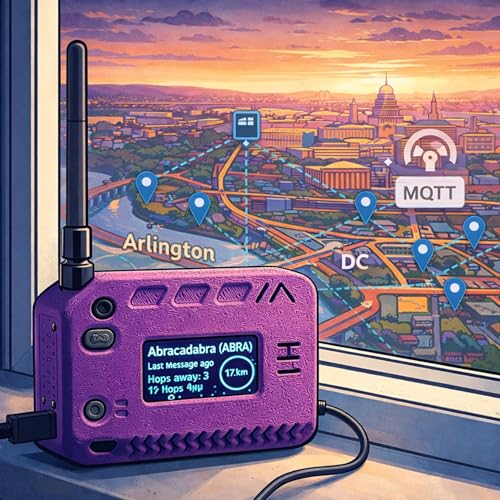
    I bought a cheap purple device off Etsy for about fifty-five dollars because I’d heard the word a few times and vaguely understood it meant LoRa mesh messaging. I wasn’t a prepper. I’m not a ham. I didn’t have a scenario in mind. The buy-in was low enough that curiosity won.

    I live on the 8th floor in Arlington Heights, with windows facing southeast. From that height, there’s a clear line of sight over a golf course and across low-rise terrain toward the Gaylord MGM. That’s not a metaphor or a thought experiment. It’s just geography. If you’re going to put a radio somewhere, elevation and openness matter.

    So I plugged it in and turned it on.

    At first, it behaved like a gadget. I paired it with my phone. Sent a few test messages. Watched nodes appear and disappear. It worked, which was reassuring, but nothing about it felt consequential. Traffic was sparse. Most activity looked like people checking in, not routing through.

    I left it on.

    That turned out to matter more than anything I did deliberately.

    Over time, it became clear that Meshtastic doesn’t reward interaction. It rewards presence. Nodes that come and go don’t contribute much beyond their own visibility. Nodes that stay up quietly start to matter in ways that aren’t obvious from the app.

    Eventually, I changed the device role from node to router. Not out of altruism, but because the device was stationary, wall-powered, and well-placed. Letting it sleep made no sense. A sleeping radio with good placement is just wasted capacity.

    That’s where the friction started.

    Router mode changes how the device behaves. Power management becomes aggressive. Bluetooth access becomes opportunistic instead of persistent. From the phone’s perspective, it feels unreliable. From the network’s perspective, it’s doing exactly what it should.

    There was a stretch where Bluetooth access felt broken. It wasn’t. The control plane was sleeping while the radio stayed active. Once I connected over USB and adjusted the settings with that in mind, the behavior made sense. Deep sleep off. Bluetooth given more patience. The display left on, because power wasn’t scarce.

    Once that was done, the device became boring.

    And boring is the goal.

    Around the same time, the local Arlington / MeshDC area started showing more consistent LongFast traffic. More ACKs. More multi-hop messages. Nodes sticking around instead of flickering in and out. Not because of anything I personally changed, but because more devices were staying online, placed well, and allowed to just exist.

    I chose the handle ABRA. Originally short for Abraham. That felt too personal. Now it’s Abracadabra, which fits better. I connected the node to MQTT so it appears on the global map, which is still quietly astonishing. A little purple radio in a window, visible via the modern web, routing messages it doesn’t need to read.

    Most of the coordination, discussion, and culture happens elsewhere anyway. Discord. Reddit. The meta layer. The mesh itself just moves packets.

    What I learned wasn’t radio theory or emergency planning. It was simpler.

    Meshtastic works best when you stop treating nodes like personal devices and start treating them like infrastructure. Infrastructure doesn’t demand attention. It needs uptime, placement, and restraint.

    I didn’t set out to build anything. I just left something on in a good place.

    Everything else followed.

    Mehr anzeigen Weniger anzeigen
    52 Min.
  • S10E2 Deportation Industrial Complex Goes Full DWOT
    Dec 27 2025

    This episode of The Chris Abraham Show is an unscripted, exploratory monologue that circles a single question from multiple angles: what happens to large war-oriented systems when they no longer have an obvious external war to fight?

    Rather than arguing for or against specific policies, this episode looks at structure, scale, and inertia. For much of modern American history, war has functioned not only as foreign policy but as an organizing principle for labor, industry, logistics, and federal spending. The Global War on Terror normalized enormous budgets, standing emergency authorities, and sprawling institutional ecosystems that extended far beyond the battlefield. Those systems trained people, built careers, created regional dependencies, and locked in expectations about what “normal” government capacity looks like.

    As external wars become harder to sustain politically and strategically, the question is not whether those systems disappear, but where they go. In this episode, immigration enforcement is examined not primarily as a moral or partisan issue, but as a systems problem. At scale, mass deportation and detention require transportation networks, facilities, staffing, courts, legal processing, medical care, procurement, and coordination across multiple layers of government. Structurally, it begins to resemble other national mobilization efforts the United States has undertaken during periods of crisis.

    The episode introduces the idea of a “deportation industrial complex” to describe the interlocking public and private systems that emerge around large-scale enforcement. This is not presented as a conspiracy or a claim of intent, but as an observation about how large bureaucratic systems behave once they are built. Any apparatus of that size creates economic, political, and institutional incentives for its own continuation, much like the prison system or defense contracting before it.

    From there, the conversation turns to the concept of a Domestic War on Terror, or DWOT, as a descriptive framework rather than a declared policy. The logic that governed the Global War on Terror did not vanish when foreign interventions slowed. It internalized. Categories of risk, emergency elasticity, and extraordinary authorities begin to operate inside national borders, often framed as administrative rather than military. The machinery remains largely the same; the theater changes.

    The episode also explores how protest, resistance, and public opposition interact with enforcement systems. Rather than assuming resistance always slows expansion, it looks at how visibility and escalation can sometimes become part of the feedback loop that sustains additional capacity. This dynamic is discussed without assigning blame, focusing instead on how systems respond to pressure.

    Throughout the episode, real-time statistical queries are used to contextualize fear, risk, and public perception, not to reach definitive conclusions but to illustrate how narratives form around numbers.

    This is not a call to action or a warning. It is an attempt to describe a recurring pattern in American governance: large systems tend to persist, normalize, and adapt rather than shut down. Temporary measures become permanent. Emergency budgets become baselines.

    Recorded as Season 10, Episode 2 of The Chris Abraham Show, this episode is intentionally exploratory and reflective, meant to be heard as a thinking-out-loud session rather than a polished argument.


    Mehr anzeigen Weniger anzeigen
    2 Std. und 3 Min.
  • S10E01 Uncle Chris Gives an Update
    Dec 22 2025

    After a long hiatus from live, human-voiced podcasting, Chris Abraham returns with the unofficial kickoff to a new season of The Chris Abraham Show. Call it Season 10, or just call it “one more than whatever came before.” This episode is less a formal broadcast and more a fireside check-in. No hot takes yet. No grand thesis. Just Uncle Chris catching up, taking inventory, and letting listeners back into the workshop.

    Chris opens by reflecting on a year spent experimenting with AI-assisted writing and audio. Substacks fed into NotebookLM. Podcasts assembled more like orchestration than performance. He likens himself to a Renaissance painter running a studio: sketch the idea, let the assistants fill in the canvas, then obsessively revise until it feels true enough to sign. It sparked conversations, which felt like a win, even if the whole thing occasionally resembled “DJ Slop.”

    From there, the episode turns personal. One week post-second ablation, Chris reports that his heart is finally humming along in sinus rhythm after a long struggle with atrial fibrillation. The first procedure failed and took the wind out of his sails, contributing to weight gain, lethargy, and a general retreat from movement. This time feels different. Better sleep. BiPAP nights. The cautious hope of eventually shedding some medications. The slow return to walking, cycling, kettlebells, and the familiar ritual of getting back in the saddle, literally and figuratively.

    Fitness and body discipline weave through the episode, including a rueful confession: Chris once tattooed a kettlebell on his hand as a motivational Hail Mary… and then promptly stopped lifting. Future tattoo ideas may include a Concept2 logo and the muted horn from The Crying of Lot 49, because symbolism apparently works better than guilt.

    Work life is steadier. SEO, Google Business Profile recoveries, and AI-adjacent consulting are keeping the lights on. But the real joy lately lives in the nerd margins. Chris dives deep into decentralized systems, inspired by Ghost in the Shell, particularly the sentient blue tanks that sync their “souls” to a server. That idea metastasized into a home-rolled infrastructure project: seven identical Lenovo ThinkPads running Linux Mint, all synchronized via a cloud droplet using Syncthing. Not a backup. A living sync mesh. Every laptop a node. Every document everywhere.

    That fascination with nodes and meshes extends into the physical world via Meshtastic. Chris recently deployed a LoRa-based radio node, ABRA (short for Abracadabra), hanging from an eighth-floor Arlington window, quietly strengthening a local, license-free mesh network. No voices. No feeds. Just short messages hopping node to node, old-school and strangely comforting. It’s part prepper tech, part early-internet nostalgia, part philosophical itch scratched.

    Elsewhere in the ecosystem: Mastodon survives for now at abraham.su, rescued at the last minute despite the .su clock ticking toward 2030. Micro.blog joins the stack under chrisa.micro.blog and ChrisA.org. Digital homesteading continues.

    Chris also shares the unexpected joy of joining a long-running Dungeons & Dragons campaign, Curse of Strahd, playing a stubborn Eldritch Knight named Radley, refusing to read the manual, and delighting in chaos alongside a group of grizzled old nerds on Discord. Dice are rolled. Plans go sideways. Everyone survives, mostly.

    The episode closes with quieter notes: a growing devotion to the Gospels, nightly Episcopal Compline prayers, the simple rhythm of rereading rather than rushing ahead. A Powerball ticket purchased. Gym plans deferred. Kettlebells waiting. A rowing machine sulking upright in the corner.

    This isn’t a manifesto. It’s a temperature check. A reintroduction. Uncle Chris is back, heart steadier, systems syncing, curiosity intact, and ready to spend the rest of the year talking through the small things before returning to the big ones.

    Mehr anzeigen Weniger anzeigen
    32 Min.