The Chris Abraham Show Titelbild

The Chris Abraham Show

The Chris Abraham Show

Von: Chris Abraham
Jetzt kostenlos hören, ohne Abo

Über diesen Titel

tl:dr: Just a 55-year-old cisgender white male mansplaining his own self-importance. But good. Full Summary: The musings of Chris Abraham as he aspires to know the world and himself while getting healthy, losing weight, becoming fit, and running his small business while living in South Arlington, Virginia. Walk with him a while and see what's up.Chris Abraham
  • The Deportation Plan Broke So the Bombs Came Out
    Mar 1 2026

    In Season 10, Episode 5 of The Chris Abraham Show, I lay out a theory for why Donald Trump pivots to Iran. This isn’t an episode about Iran’s internal politics so much as it’s an episode about incentives, momentum, and what happens when a leader needs an economic and narrative engine and the preferred domestic plan hits a wall.

    About a year ago, I wrote a Substack post arguing that Trump’s big idea wasn’t necessarily invading countries abroad. It was building a domestic “make work” machine: a deportation industrial complex that functions like a WPA-style spending and jobs program aimed squarely at his base. The concept is simple. You hire huge numbers of border and enforcement personnel. You expand detention capacity. You contract transportation at scale. You staff security, logistics, medical care, legal processing, and due process. You build an entire support economy around that infrastructure, the way towns and services cluster around major prison facilities. It becomes a trillion-dollar domestic momentum project, and the people most willing to take those jobs are the people who already support the project politically.

    In my view, that domestic plan ran into heavy friction: legal constraints, moral outrage, intense media framing, and constant resistance that made it hard to run at full scale. But the need for momentum doesn’t disappear. The spending machine still wants to move, midterms still loom, and a president who thinks like a businessman and a showman still wants a lever to pull.

    So the pivot becomes familiar Plan B: international escalation. Bombing campaigns, expensive munitions, replacement orders, contractor logistics, reserve activation, and the revived atmosphere of terrorism fears and proxy-war paranoia. Whatever you think of the policy merits, this kind of activity reliably drives procurement cycles and absorbs attention. It can also seize the news cycle and reset the political conversation when other stories are dominating.

    I also talk about spite as a governing emotion: the “you made me do it” logic that abusers use, repurposed into politics. The subtext becomes, if you had let me run my domestic war economy, I wouldn’t be doing this overseas. Now watch what you forced.

    This is a short episode, but it’s the analysis I needed to say out loud after listening to reporting that treated the outcome as shocking. I don’t think it’s shocking. Incentives plus ego plus a hunger for momentum can point in a very predictable direction.

    Deportation Industrial Complex Goes Full DWOT

    The Deportation Gold Rush

    The Deportation Industrial Complex: America’s New WPA

    The Deportation New Deal: Escalation's Inevitable Path

    Start With the Criminals, End With Everyone

    Trump's Spite War

    Mehr anzeigen Weniger anzeigen
    11 Min.
  • Media Capture, Populism, and the NPR Trust Problem
    Mar 1 2026
    • The Ellisons Prepare to Expand Their Media Empire
    • The Century-Long Capture of U.S. Media

    In Season 10 Episode 4, Chris Abraham swerves away from the day’s obvious headlines and instead reacts to an On the Media segment on WAMU about “media capture” and the role of public broadcasting in a healthy democracy. He frames himself as an NPR/WAMU lifer with a complicated relationship to the institution: nostalgic for the old public-radio mix, aware of how it shaped him, and also increasingly allergic to how it can feel like a status-enforcing machine rather than a shared civic utility.

    Chris challenges a core assumption embedded in a lot of “flawed democracy vs. healthy democracy” talk. When institutions praise certain countries as “strong democracies,” he argues they often mean something closer to “compliant,” “high-trust,” and “aligned with approved messaging.” In his view, populist dissent, cultural resistance, and “opting out” are treated less like legitimate democratic feedback and more like a pathology to be managed, which makes the word “democracy” feel like branding instead of description.

    He contrasts the U.S. with European public-media models, not to romanticize them, but to point out why they sometimes enjoy broader buy-in: they deliver visible, practical value, including educational programming that feels like a public good. Chris argues that if public media in the U.S. reliably felt like Mr. Rogers energy, it would be harder to politically defund. When it feels like it exists to scold, dunk, or run a permanent moral emergency about half the country, it triggers backlash in a society already wired to distrust “the man” at every level.

    Using a driving metaphor, he describes American politics as a fight over the steering wheel. When institutions respond to populism by steering harder into elite signaling and cultural escalation, the reaction on the right becomes more forceful and more desperate, because people feel they’re holding a fake wheel while someone else drives. That trust breakdown, he argues, is the real accelerant. He also warns that open institutional defiance of elected power can invite a predictable counter-response: aggressive executive action, tightened compliance expectations, and a “find the receipts” mentality that punishes slow-walking and internal resistance.

    Chris ends with a mix of dark humor and personal texture. He calls the last decade a mutual “FAFO era,” where both sides have learned hard lessons about power, incentives, and overreach. Then he closes the episode in classic Chris fashion: weather report, coffee, library plans, ongoing Meshtastic tinkering, a quick health update, and a reminder that the next mission is getting back to fighting shape.

    Mehr anzeigen Weniger anzeigen
    26 Min.
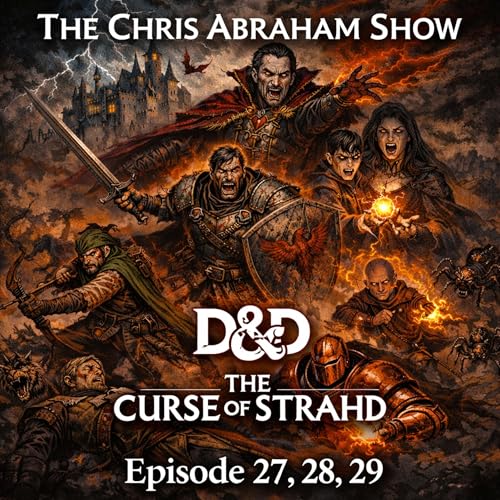
  • The Ravenloft Dinner That Broke Everything Episode 27 28 29
    Feb 27 2026

    Welcome back to The Chris Abraham Show. This episode collects Sessions 27 28 and 29 of our Dungeons and Dragons campaign The Curse of Strahd and turns them into one continuous descent into Castle Ravenloft.

    If you are not a D and D person, here is the simple setup. Our small band of adventurers is trapped in Barovia, a mist locked valley ruled by Strahd von Zarovich, an ancient vampire lord with the patience of a spider and the manners of a king. We have been trying to protect Ireena Kolyana from him, recover the Amulet of Ravenkind, and stay alive long enough to do something that matters. Recently we failed to retrieve that amulet in Vallaki, lied to Ireena’s brother Ismark to keep him from charging into a suicide mission, and then finally had to admit the truth. Ireena was taken by Strahd.

    So when the invitation arrives, we accept it. Dinner at Ravenloft. Polite. Civilized. Completely insane.

    On the road, Barovia reminds us that travel is never just travel. Revenants on a skeletal horse ambush the party and an ogre zombie joins the slaughter. Ismark is dropped in the chaos and only survives because Urihorn rides in on his mountain lion and drags him back from the edge. The undead die laughing with a promise that they will meet us again.

    Then the castle welcomes us. An unmanned coach. A swaying drawbridge over a gorge. Doors opening by themselves. Rahadin, Strahd’s chamberlain, arriving with a choir of invisible screams. A banquet hall glittering with chandeliers and a feast laid out like a joke.

    Strahd plays the gracious host and then reveals the knife. Ireena enters. So does Yeska, a young altar boy we once tried to keep safe. Both are vampires now. And Ireena is wearing the Amulet of Ravenkind, the holy artifact we lost and desperately needed. The room goes cold in the way only a story can go cold when you realize the villain has been moving pieces you did not even know were on the board.

    From there, we start exploring Ravenloft and the castle starts teaching us its rules. Vampire spawn watch from the walls. A ruined chapel dares us to touch what should not be touched. Secret passages lead to trapped rooms. A captive accountant named Lief sits chained to a desk keeping Strahd’s books like bureaucracy is also immortal. A maid begs to be rescued. A centuries old portrait shows Ireena as if she has always been here.

    And then the traps get personal. A coffer releases a green gas that drops party members without a fair fight. An animated suit of red armor hunts like a machine and kills Ismark. When we wake later, the castle has rearranged the scene. Bodies are missing. The fire relights itself. Evidence disappears. A bell summons spiders. Burning webs threatens to burn the whole structure down. A tub of blood erupts with a screaming figure and then the blood is gone like it never existed.

    Finally, a dusty dining room offers one last bait. A wedding cake explodes. And Strahd arrives not as a man in a cape, but as a pressure in the air, an invisible silhouette reaching for us.

    This is the Ravenloft arc where hospitality becomes horror, where grief becomes motion, and where the castle itself feels like the weapon.

    Cast and characters
    Chris as Radley human Eldritch Knight
    Sean D as Urihorn Tenpenny halfling Beastmaster with a mountain lion
    Cary as Perlan Goodshadow halfling Monk
    Trip as Daermon Cobain elf Arcane Trickster
    DM Sean S

    If you enjoy gothic horror fantasy, actual play storytelling, and campaigns that refuse to let anyone feel comfortable, you are in the right place.

    Mehr anzeigen Weniger anzeigen
    1 Std. und 10 Min.
Noch keine Rezensionen vorhanden