Folgen

  • What is HR bold enough to become?
    Sep 28 2026
    In this episode of Starbold Signals, Jeremy Ames sits down with Enrique Rubio, founder of Hacking HR, for a provocative conversation about AI, technology, and the rapidly changing role of HR. Enrique shares why he believes HR professionals are becoming builders -not just users of technology - and why the future will require HR to get exceptionally good at the things humans uniquely do while learning to orchestrate people, AI, and technology together. But embracing AI also means owning its consequences. Jeremy and Enrique explore the tension between innovation and responsibility, the need for stronger guardrails around AI, and why HR leaders have an obligation to speak up when technology creates risks for employees or society. Ultimately, the conversation comes back to a bigger opportunity: using AI not simply to make HR faster or more efficient, but to elevate the human experience of work. Can AI help create workplaces where people have more time for creativity, empathy, connection, meaning, and mastery of their craft? That may be one of the biggest opportunities - and responsibilities - HR has ever faced. Topics include:• Why Enrique created Hacking HR• How AI is turning HR professionals into builders• What work should remain uniquely human• Human + AI orchestration• The risks and consequences of unchecked AI• HR’s responsibility to “see something, say something”• AI regulation and responsible innovation• Using technology to elevate the human condition at work• What HR could become over the next five years
    Mehr anzeigen Weniger anzeigen
    30 Min.
  • Leading Through the Storm: Lessons from Bombs, Bacon, and Bankruptcy
    Sep 1 2026
    What can business leaders learn from bombs, bacon, bankruptcy...and even waterboarding? In this episode of Starbold Signals, Jeremy Ames sits down with leadership expert and author Henry J. Evans to explore what it really takes to lead when the stakes get high. Drawing on Henry’s extraordinary experiences in national security, counterterrorism, and business, they unpack why trust beats coercion, why vulnerability may be a leader’s greatest tool, and why the person with the most expertise isn’t always the person who should lead in a crisis. They also tackle the increasingly blurry line between AI and human intelligence, the danger of allowing technology to make the “last mile” of critical decisions, and how leaders can prepare before disruption becomes an emergency. The goal isn’t simply to survive the storm...it’s to build an organization capable of thriving because of how it responds to it. Leading Through the Storm: Lessons from Bombs, Bacon, and Bankruptcy is a conversation about courage, trust, judgment, and knowing when leadership means stepping forward...and when it means getting out of the way.
    Mehr anzeigen Weniger anzeigen
    25 Min.
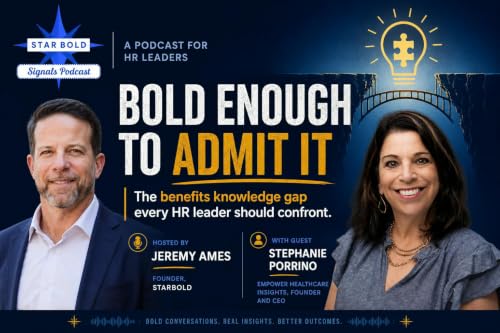
  • Bold Enough To Admit It - the benefits knowledge gap every HR leader should confront.
    Jun 29 2026
    How much does your HR team really know about benefits strategy - and are you bold enough to admit when there's more to learn? In this episode of Starbold Signals, Jeremy Ames sits down with Stephanie Porrino, Founder & CEO of Empower Healthcare Insights, for an honest conversation about one of HR's biggest blind spots. They explore why benefits have been treated as an administrative function instead of a strategic business driver, how fear and overreliance on brokers can limit innovation, and what HR leaders can do to take ownership of healthcare strategy. Through real-world stories of bold leadership, cost containment, and life-changing employee outcomes, this episode challenges HR professionals to rethink benefits as a competitive advantage - for their organizations and the people they serve.
    Mehr anzeigen Weniger anzeigen
    25 Min.
  • State of Emotions
    Jan 19 2026
    In this episode of Signals, published on MLK Day, host Jeremy Ames reflects on a noticeable emotional undercurrent shaping today’s workplaces—one marked by fatigue, guardedness, and a growing insistence on separating “business” from the realities people bring with them. He explores how that separation often breaks down in practice, particularly as employees continue to experience—and in some cases endure—racially charged behavior, bias, and inequitable treatment that cannot simply be left at the door. The episode examines the tension leaders feel between maintaining neutrality and acknowledging that emotions, identity, and lived experience are already embedded in organizational life. Jeremy argues that ignoring these signals doesn’t reduce risk—it displaces it, often onto the very people with the least power to absorb it. Using his four-point framework, he connects these emotional signals to broader patterns in leadership behavior, culture, and decision-making. The episode ultimately challenges listeners to consider whether emotional distance is truly professionalism, or just avoidance dressed up as discipline.
    Mehr anzeigen Weniger anzeigen
    6 Min.
  • Not a Stop Sign: Keeping Equitable Momentum, Live from HR Tech
    Sep 25 2025
    In Episode 3 of Signals, recorded live from the HR Technology Conference 2025, host Jeremy Ames welcomes industry leader Maren Hogan, CEO of Red Branch Media. Together they dive into the shifting landscape of diversity, equity, and inclusion (DEI)—once at the forefront of HR strategy but now facing setbacks. Maren shares her creative approach to sustaining progress through the RESIST framework (Resource Excellence and Strategic Innovation Systems Training), designed to help HR professionals continue vital DEI work despite shrinking budgets and organizational pushback. This candid conversation blends metaphor, marketing savvy, and a call to courage—reminding us that progress isn’t a stop sign, but a challenge to keep moving forward.
    Mehr anzeigen Weniger anzeigen
    11 Min.
  • Rage Against the Machine: Organizational Courage & Psychological Safety
    Sep 24 2025
    This 16-minute panel episode of Signals explores the critical intersection of organizational courage and psychological safety with guest Angela Cheng-Cimini, CHRO at Chronicle of Philanthropy. Host Jeremy Ames dives deep into why courage is the missing corollary to psychological safety—and why it matters for leaders, employees, and organizations navigating transformation. Key Takeaways Psychological safety ≠ “say anything” — it’s about risk-taking without fear of judgment. Courage is the individual’s responsibility; a safe environment isn’t enough without action. Leaders must model courage; employees rarely leapfrog leadership in risk-taking. Organizational courage should be an evergreen skill, not a crisis-only tool. Bottom-up change is possible but requires intention, respect, and sometimes personal risk. Courage done right is intentional, compassionate, and tied to organizational health. Important Time Stamps 00:30 — Why Jeremy chose Rage Against the Machine as the episode theme 02:00 — Angela on the corollary of psychological safety and courage 04:15 — Defining psychological safety vs. the misconception of “no rules” 06:40 — Courage as the next step: swim lesson metaphor 09:30 — Leaders modeling courage and bottom-up change dynamics 12:10 — Timing courage: when to push for change 14:00 — Courage as an evergreen capability organizational courage, psychological safety, leaders, employees, environment, risk, change, speak up, transformation, agency
    Mehr anzeigen Weniger anzeigen
    21 Min.
  • Signals Trailer: Meet Jeremy Ames
    Sep 7 2025
    In the debut of Signals, host Jeremy Ames shares why he launched this new podcast at the intersection of people, culture, and technology. From his 20 years in HR and people management to the bold shift he’s making now, Jeremy lays out the vision for the show: short and sharp four-minute takes, longer 16-minute deep dives, and signals submitted by leaders like Angela Cheng-Cimini of the Chronicle of Philanthropy. In this first episode, Jeremy reflects on the challenge of organizational courage, the need for psychological safety, and why “speaking truth to power” is the perfect way to begin.
    Mehr anzeigen Weniger anzeigen
    4 Min.