• Finding Your Voice - Sheral DeVaughn
    Oct 9 2026
    Dwayne Smith and Rudy Davis talk with brand voice and brand messaging strategist Sheral DeVaughn, whose career spans radio, wine and spirits, and brand coaching. Sheral shares how her path shaped a practical framework for helping people find a voice that feels human, credible, and distinct. This episode centers on leadership, personal branding, and why the best communicators do not talk at people - they talk with them. Sheral also reflects on radio history, Prince’s creative genius, and the way labels can limit both people and organizations.Key topicsIn this episode, Sheral shares how she got into radio as a child, with a hairbrush microphone, Wolfman Jack, and Casey Kasem as early inspirations.She explains how growing up in rural Minnesota shaped her refusal to accept the idea that girls could not do radio.Sheral shares how she broke into radio in Shreveport, Louisiana, including her first big morning-show opportunity at age 23.She describes meeting Prince Rogers Nelson (Prince) in high school and why she considers him one of the most creative people she's ever known.Sheral explains how Prince controlled his artistic process, insisted on excellence, and fought to give artists more power over their work.She talks candidly about being hired for a morning show role that wasn't what she expected, and how trying to fit someone else’s script hurt her performance.She shares how being fired eventually pushed her toward stronger self-awareness, better branding, and a clearer understanding of her own value.In the wine and spirits industry, she explains how asking clients what they wanted helped her grow territory and succeed without being told the “right” way to do it.She introduces her brand strategy approach, rooted in audience knowledge, relatability, human connection, and consistent showing up.Sheral discusses the VIP method - visibility, impact, profitability - and why the human element comes first.Dwayne and Rudy connect the conversation to leadership, especially the difference between talking at people and talking with them.The discussion closes with Sheral’s definition of shifting the power balance: drop the labels, trust your own voice, keep showing up, and stop giving other people power over your self-image.Timestamps00:00 - Introduction to Sheral DeVaughn and the radio roots behind the conversation 01:52 - How Sheral got the radio bug as a kid with Wolfman Jack and Casey Kasem 03:09 - College radio, Shreveport, and landing her first major morning-show role 05:18 - Meeting Wolfman Jack and the reality of voice versus image in radio 07:12 - What Prince was like creatively and why every room in his house was part of the art 10:52 - Radio fear, early pressure, and being assigned a role that did not fit 12:58 - Getting fired, being told she had “zero talent,” and surviving the non-compete 15:08 - Working with Les Acre and learning to build a show by being herself 16:11 - Finding the hook, developing “Sheral on the Air,” and studying what listeners actually wanted 17:39 - Beating Steve Harvey and Tom Joyner by focusing on connection and storytelling 18:05 - Moving into wine and spirits and applying the same audience-first approach 20:00 - Losing her voice, rebuilding confidence, and discovering a repeatable personal template 22:18 - Why great leaders talk with people instead of talking at them 24:21 - AI, the human element, and avoiding the “beige pillow effect” 25:20 - Why personal branding starts with the real person behind the title 27:18 - The VIP method: visibility, impact, profitability 29:17 - Why labels limit success and how to push through them 31:05 - The power of consistency: quit all you want, just don’t stop 33:03 - Sheral’s definition of shifting the power balance 34:06 - Closing thanks and invitation to return Resources and LinksHere are Sheral’s main links:Website: speakingwithsher.comLinkedIn: linkedin.com/in/speakingwithsherAnd her other pages:Book: The Frog in Your ThroatPodcast: Cocktails and ConspiraciesInstagram: instagram.com/speakingwithsherThis podcast is for informational and entertainment purposes and does not constitute an attorney-client relationship or legal advice. The views expressed by guests don't necessarily reflect those of the host(s).
    Mehr anzeigen Weniger anzeigen
    38 Min.
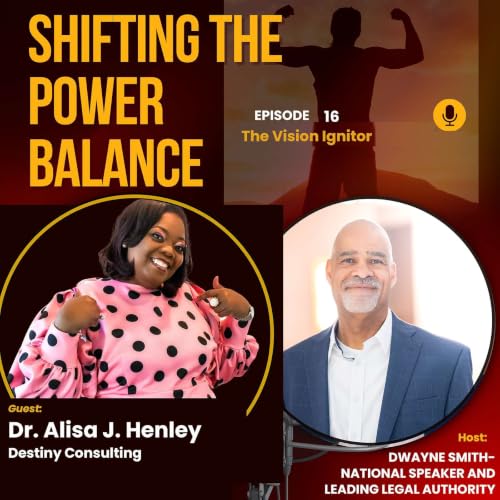
  • The Vision Ignitor - A Conversation with Dr. Alisa J. Henley, Ph.D
    Aug 31 2026
    EPISODE SUMMARYIn this episode of Shifting the Power Balance, host Dr. Dwayne Smith sits down with Dr. Alisa J. Henley — PhD in Industrial Psychology, founder of Destiny Consulting, and the creator of the Vision Ignitor® coaching brand. Dr. Henley takes us from her childhood as the youngest of five girls raised by a single mother in St. Louis, through the mentors who shaped every turn of her journey, to her launch of Destiny Consulting in 2004 and the building of three distinct organizations that serve leaders, individuals, and faith-based communities. Along the way, she breaks down the difference between inspiration and activation, shares what it actually looks like when power is out of balance inside organizations, and reveals the unfinished vision she is still chasing — including a TED Talk, a global leadership academy, and stages in 25 countries. This is a conversation that refuses to stay on the surface. EPISODE TIMESTAMPS[0:00] Intro — Shifting the Power Balance theme and show open[0:20] Guest Introduction — Host Dr. Dwayne Smith introduces Dr. Alisa J. Henley — her PhD, Destiny Consulting, books, and their personal connection through Dr. Andrea Dixon-Seahorn[1:31] In Her Own Words — Alisa defines who she is: "I am a person who is called to not only rebuild people, but to rebuild organizations, especially leaders"[2:13] The Vision Ignitor® Brand — How a stranger in an elevator — who recognized Alisa as "the Vision Ignitor lady" — sparked a trademarked brand and a life's calling[3:34] Origin Story: St. Louis Roots — Growing up in poverty with a single mother; the leadership lessons she absorbed before she ever knew she was learning them[4:53] Her Mother's Legacy — Alisa shares the loss of her mother in 2024 and how she channels that grief into momentum — "My mother would want me to keep moving"[5:15] The Magnet School Turning Point — How a friend's offhand suggestion led Alisa to a magnet school, then a military high school, then college — and how a guide appeared at every turn[7:40] What She'd Tell Her Younger Self — "Do not put limits on yourself" — and the story of secretly enrolling in her PhD program so no one could talk her out of it[9:30] Host Connection Moment — Dr. Dwayne Smith shares his own experience earning an EDD at 46, and the bond that creates between two late-blooming doctors[9:55] Launching Destiny Consulting — The story that started at 19 with a guest speaker in a college class; two years moonlighting while employed full-time; then the 30-day notice that changed everything[12:30] Three Organizations, One Mission — The through-line connecting Destiny Consulting, Vision Ignitor, and The Sunshine Organization: strategic planning, leadership development, and vision ignition[13:57] Inspiration vs. Activation — "You can get information and never apply it — but if you get the information and apply it, that's how you become transformed"[15:01] Coaching Transformation Stories — Two clients whose lives changed: a woman who left her full-time job and now earns as much working half the hours; another planning her exit date a full year in advance[17:46] Why She Writes Books — Books as lifelong resources — and why she'd choose a book over coaching notes if she had to choose one[20:17] When Power Is Out of Balance — The three levels of leadership (strategic, tactical, operational) and what happens when they collapse into each other — burnout, turnover, dysfunction, and the loss of trust[23:32] The Deep-Dig Closing Question — What is still unfinished in Dr. Alisa J. Henley? Her answer: a TED Talk, a leadership development academy, and stages in 25 countries before she's done[25:44] Host Wrap-Up & Closing Words — "That's what happens when a conversation refuses to stay on the surface."[26:18] Outro — Subscribe and contact information KEY QUOTES FROM THIS EPISODE"Information plus application equals transformation."— Dr. Alisa J. Henley, on what sets her apart as a speaker and coach "Every time it was time for my life to make a turn, there was somebody there guiding me through the turn."— On the mentors who appeared at every pivot in her journey "Do not allow other people to project their limits on you — because that will slow you down in life."— What she would tell her younger self "I didn't even tell anybody — not even my mother — I was almost done with one class before I told anyone I was in school."— On secretly enrolling in her PhD program to protect her own vision "You have a leader living below his or her leadership privileges."— On what power imbalance looks like inside organizations "When that time comes, I want to make sure that everything in me is born out."— On her unfinished vision and the goals she is still chasing CONNECT WITH DR. ALISA J. HENLEY• Website & Coaching: https://dralisaj.com...
    Mehr anzeigen Weniger anzeigen
    27 Min.
  • Advocating For Dads Part II - David Pisarra
    Aug 17 2026
    Episode Overview In Part II of this conversation, family law attorney David Pisarra delves deeper into the power dynamics that fathers face in and out of the courtroom. David breaks down why the power imbalance often starts before a dad says a single word to a judge, how cultural narratives about "deadbeat dads" shape court outcomes, and what internal tools men need to stay grounded when everything is falling apart. He introduces the concept of the "accusation audit," explains how language shifts, such as moving from "my child" to "our child," can reshape a judge's perception, and shares why presumptive 50/50 custody is the single legal reform he believes would change family court overnight. The episode closes with a rare, unguarded reflection on what 25 years of this work has cost David personally — and why he keeps doing it.POWER IN THE COURTROOM0:00 — Podcast intro 0:19 — Host welcomes David Pisarra back for Part II0:39 — Where does the power actually sit when a father walks into court for the first time?0:50 — David: "Usually with mom" — she arrives with an encyclopedia; he arrives wanting access to his kids1:11 — The role of revenge and high-conflict custody battles in fueling family court proceedings1:46 — Why demonstrating any anger in court can be instantly weaponized against a fatherCULTURAL NARRATIVES & THE DEADBEAT DAD MYTH2:16 — How the "deadbeat dad" and "absent father" narratives follow men into court2:39 — David's reality check: 70–80% of divorces are straightforward; high-conflict cases are the exception3:03 — The stat that reframes everything: 80% of divorces are filed by women3:37 — Judges do see through the narrative — and the deadbeat dad is not the majority3:50 — "I've had many men tell me: I would pay double if I could see my kids more"INTERNAL POWER — STAYING GROUNDED UNDER PRESSURE4:00 — How David coaches one-on-one clients: "Your job is to sit there. Stone face. No emotion."4:26 — Dad's Law School VIP program: preparing self-represented fathers for what's coming4:40 — The "accusation audit" — Chris Voss / Never Split the Difference applied to family court5:03 — Real example: the NASA engineer, 23 drug tests, and responding to false accusations with evidenceKEEPING THE CHILD AT THE CENTER5:37 — Why David rewrites declarations to center the child's perspective, not the father's grievance6:01 — The language shift from "my child" to "our child" and what it signals to a judge6:26 — Why David now tries to avoid guardian ad litem and minors' counsel6:45 — The triangulation problem: how a narcissistic or BPD parent can co-opt a guardian ad litemWHY DAVID BUILT DAD'S LAW SCHOOL7:00 — "Dad is nothing but a Thanksgiving turkey being carved up" — the financial gauntlet fathers face7:27 — The cost breakdown: child support, anger management, batterers' intervention, monitored visitation, spousal support — all at once8:59 — David gets thousands of requests for help a year and can't help everyone for free9:21 — The middle ground: online courses in custody action plans, discovery, evidence, contempt9:47 — "If I can teach a dad to write a decent declaration and use his text messages in court, maybe I can get him more time with his kids"10:01 — The starfish story — "I can't save them all, but I can save this one"THE 125,000-DAD COMMUNITY10:25 — Who is David's social media community? Dads trapped in the family court nightmare10:43 — "Every other weekend isn't enough to raise a child or be a father figure"11:05 — The messages David receives that keep him going: "I was going to kill myself, but I won in court"11:20 — Why family law can make you cynical — and why David fights that pullDWAYNE'S PERSONAL STORY — WHEN CO-PARENTING WORKS11:45 — Dwayne shares his parents' divorce and the long-term impact on his family12:09 — Dwayne's blended family: he and his stepson's father now have beers together; both families co-parent around the grandkids12:53 — "We've done a disservice to our kids — not mom's fault, not dad's fault, holistically"13:19 — Schools, churches, and courts taking on burdens they weren't designed forSYSTEMIC CHANGE — THE ONE REFORM THAT WOULD CHANGE EVERYTHING14:47 — The erosion of personal responsibility globally — and children paying the price15:01 — David's warning: before you marry a woman who has a child, watch how she treats that child's father15:47 — The one thing David would change: presumptive 50/50 custody16:04 — States already doing it: Missouri, Florida, Kansas — and the result is fewer divorces and less acrimony16:39 — Dwayne's real-world 50/50 experience: two-on/two-off/five-on schedule; now all four parental figures share grandkid birthday parties17:44 — How the presumption of 50/50 removes the "I win, you lose" ...
    Mehr anzeigen Weniger anzeigen
    24 Min.
  • Advocating For Dads - David Pisarra
    Aug 9 2026
    The following episode description has been created with the assistance of AI. Episode OverviewWhat happens when a father walks into family court feeling invisible, outmatched, and terrified of losing his children? In this episode of Shifting the Power Balance, host Dwayne Smith sits down with David Pisarra — family law attorney, fathers' rights advocate, and founder of Dad's Law School — for a candid conversation about the power dynamics inside the family court system.This is Part 1 of a two-part conversation. Part 2 will drop in a couple of weeks. About the GuestDavid Pisarra — Family Law Attorney & Founder, Dad's Law SchoolDavid Pisarra is a family law attorney based in Santa Monica, California, with over 25 years of experience representing fathers in divorce, child custody, and parental alienation cases. In 2021, David founded Dad's Law School — an online education platform and coaching community that equips fathers with the legal knowledge, courtroom skills, and emotional tools to fight for their children, with or without an attorney. TimestampsIntroduction0:20 — Show Introduction & Guest Bio Dwayne introduces David Pisarra and frames the episode's central question: Why do so many fathers enter the family court system powerless — and what does it take to change that? David's Background & Origin Story2:00 — Growing Up in Northern California David grew up in Orinda, CA (East Bay, outside Oakland/San Francisco).2:15 — St. John's College — The Great Books Education Why David chose a small liberal arts school in Annapolis, Maryland. 3:12 — Landing in Los Angeles & Law School A summer working in his brother's law office turned into three years — then law school at the University of West Los Angeles.4:02 — Becoming a Family Law Attorney — Not by Choice David's partner pushed for family law while David wanted business law. Word spread fast at networking events and his calendar filled with family law cases. 5:00 — Narrowing the Practice to Men After going "crazy" doing general family law, David realized he liked certain clients and not others. Boys on the right, girls on the left — and Men's Family Law was born.5:10 — The Shift That Led to Dad's Law School About 10 years ago, David noticed men getting "chewed up by the mission creep of domestic violence law" Dad's Law School launched in 2021. Representing Dads — While Fighting for Kids6:41 — Holding Both Realities: The Client & The Child Dwayne asks how David advocates for dad without losing sight of the child's best interest.7:08 — Dad's Role vs. Dad's Time It's not so much dad's time — it's your role as a parent. What 25+ Years in Family Court Has Taught Him8:27 — The View from the Courtroom David's frank assessment of what he sees: a lot of carnage — and a lot of people fighting for their ego instead of their children.9:04 — How Family Court Cases Break Down 15% of court cases account for virtually all the damage.10:31 — The Good He's Seen "Men generally step up. They generally want to provide for their families and their kids." 11:09 — The Uphill Battle The majority of engaged fathers are fighting a court system that is, in David's words, "definitely not skewed in their favor. Is This a California Problem — or a Global One?11:33 — Dwayne Asks About Geography: Is the alleged bias David sees specific to California's legal culture?11:53 — David's Answer: The Laws Are Mostly the Same The nuance or interpretation differs coast to coast, but the statutory framework is largely similar. 12:32 — A Global Crisis David reports hearing from lawyers and litigants in New Zealand, Australia, South Africa, the Czech Republic, Canada, the UK, and Brazil — all experiencing the same systemic failure to support fathers in family court. Does Money — or Lawyer Quality — Determine Outcomes?13:21 — Dwayne's Question: Does a Better Lawyer = Better Outcome for Dad? Drawing a parallel to medicine: does who you hire determine how you do?14:04 — David's Counterintuitive Answer "Not so much." A mediocre lawyer walking in with a mother who can cry on cue will more easily beat an experienced attorney representing a father. Helping Dads Tell Their Story in Court14:48 — The Storytelling Problem Dwayne asks what it actually means to help a dad tell his story effectively.15:00 — Why Dads Don't Know What to Say When a dad walks in and says 'I'm a great dad, give me 50% custody,' that won't cut it against a mother with an encyclopedia of documentation.15:18 — The Kid Inventory The centerpiece of David's book: 123 questions about what a father knows about his child .16...
    Mehr anzeigen Weniger anzeigen
    25 Min.
  • More Than A Coach Part II - Vonn Webb
    Jul 26 2026
    This Episode Description was completed with the support of AI. EPISODE 13More Than a Coach — Part IIHost: Dwayne Smith | Co-Host: Rudy Davis | Guest: Vonn WebbRuntime: 34:10EPISODE OVERVIEW Part II of the conversation with Coach Vonn Webb goes to the places Part I only hinted at. Dwayne Smith and Rudy Davis pick up with Vonn's memories of playing alongside Michael Jordan, then turn the conversation to NIL, player branding, and the real economics of college athletics — before arriving at the moment that changed Vonn's life forever. On May 10, 2022, Vonn received a call from the Clark County Coroner's Office in Las Vegas. His son Taelin — a record-breaking athlete with NFL aspirations — had died from accidental fentanyl poisoning. In this episode, Vonn shares Taelin's story in full: the basketball-to-football transition, the injuries, the pain medication, the one bad pill. And out of that grief, the founding of the Stay Shaded Foundation — whose mission is to make sure no parent has to get that call. TIMESTAMPS 0:00 — Show Intro & Theme "Power and control is a lifelong struggle for each of us."0:33 — Welcome Back — Recap of Part I Dwayne recaps Vonn's credentials and invites listeners who missed Episode 12 to go back.1:35 — The Michael Jordan Story Vonn was in an All-Star game with MJ. What do you say sitting next to Michael Jordan in the training room? Vonn figured it out — and Jordan never let him forget it.3:29 — "Set Screens." — On Jordan's Competitiveness Game time, Jordan pulls Vonn aside: "All I want you to do is set screens." Rudy: "Vonn, you were the same way at Fifth Street Park."5:29 — Setting the Stage: NIL & the Supreme Court Ruling Dwayne frames the NIL landscape — the 2021 Supreme Court decision, endorsement deals, social media income, Texas Tech's billionaire booster, and the critics who call it pay-to-play recruiting.6:42 — Is NIL Really Empowering Athletes? Vonn: "I think it's a little of both." Athletes earn billions for the NCAA — they deserve to get paid. But right now it's the Wild Wild West, with no real regulation and the power sitting with agents and handlers.8:41 — "If You Don't Have the Money, You Don't Have the Honey" Vonn on the haves and have-nots in college sports: players chase schools with the money. Most of them aren't going pro — they're trying to get financially secure.9:03 — The Uncomfortable Truth: College Football & Revenue Dwayne raises the controversy: 90% of college athletic revenue comes from football. What does it mean that football — largely played by poor and minority kids — subsidizes every other program on campus?10:22 — Vonn Responds: Earn It or Accept It "If you're not earning it, I don't know how you can have issues with how much is being paid out." The programs generating the money have earned the right to drive the bus.12:00 — How NIL Changes Player Development Vonn: "You have them for a year if they're pretty good." The transfer portal means development isn't what it used to be. Kids will leave if they can get paid more elsewhere.12:50 — Deion Sanders Understood It First Everybody has a brand. Deion taught his kids that. What should an 18-year-old athlete with real NIL potential know that nobody is telling them?13:27 — "It's About We, Not Me" — But Not Anymore Vonn's answer: today's system teaches kids, parents, and agents to maximize individual value. He doesn't like it — but he understands it. He draws the line at branding that pulls focus away from performance.15:00 — When Sports Meet Business Rudy connects NIL to the corporate world — you've had a personal brand your whole career, athletes just didn't get paid for it. Vonn shares his work with Athletes to Business, training players to interview and land Fortune 500 jobs.16:04 — The Call No Parent Ever Wants Rudy gently transitions: Vonn got a call not long ago that no parent wants to get. It was about his son Taelin. Rudy gives Vonn all the space he needs.17:06 — Taelin Webb: The Athlete, the Son, the Dream Vonn coached Taelin his senior year of high school after Taelin begged him to take the job. 6'10"-6'11" high jumper. 23-24 foot long jumper. 45" vertical. Set an unofficial world record in kneeling box jumps. Always trying to outdo his dad.19:43 — Basketball to Football: The Victor Cruz Effect Taelin watched an ESPN special on Victor Cruz and called Vonn: "Pops, I think I want to do something different." Vonn called three college football contacts. Southern Utah responded first. Taelin made all-conference as a cornerback.21:45 — Injuries, Pain Medication & the Slide Nobody Saw Injuries on the field led to prescription pain medication. After football, still training for Canada (the NFL wanted more film), Taelin began self-medicating. Coaches had no idea. Family had no idea.22:43 — May 10th, 9:48 AM The call ...
    Mehr anzeigen Weniger anzeigen
    34 Min.
  • More Than A Coach Part I - Vonn Webb
    Jul 12 2026
    EPISODE OVERVIEWThis is the first of a two-part episode. Dwayne Smith and co-host Rudy Davis sit down with Rudy's friend — Vonn Webb, a 1981 Junction City High School graduate who went on to become one of the most decorated high school basketball coaches in the state of California: two CIF state championships, an 85% winning percentage, and a hand in developing NBA players like Chris Jeffries and Deshaun Stevenson. Vonn also served as an assistant coach in Division I programs, including Wyoming, UC Riverside, and Fresno State, and co-directed Jalen Green's elite AAU program. Part I traces Vonn's journey from the wrestling mats and basketball courts of Junction City, through injury and perseverance in college, to building a dynasty at Washington Union High School. The conversation delves into NIL, the transfer portal, the motivations of today's athletes, and the mentors who shaped all three men. Part II — coming next — delves deeper into Vonn's most personal chapter: the loss of his son, Taelin, and the founding of the Stay Shaded Foundation. TIMESTAMPS 0:00 — Show Intro & Theme "Power and control is a lifelong struggle for each of us."0:33 — Welcome & Episode Introduction Dwayne and Rudy set the stage 1:02 — Why This Episode Is Personal Dwayne reveals the Junction City connection between Rudy and Vonn.1:30 — Introducing Vonn Webb Rudy walks through Vonn's credentials: 2 CIF titles, 85% win percentage, NBA player development, Division I coaching, and Jalen Green's AAU program.2:22 — Growing Up in Junction City Vonn shares stories about his uncle Rico Webb, childhood friendships, and the coaches who first shaped him.3:13 — From Wrestler to Baller Vonn was a state-level wrestler — but his friends played basketball. He switched sports freshman year, and Coach Gibson wasn't happy about it.4:55 — The Coach Who Made Him Fall in Love With the Game Mike Copemeyer — junior high teacher and coach — worked with Vonn the way trainers do today, long before training was a thing.6:40 — Larry Dixon & Upward Bound: The Mentor Who Changed Everything Larry Dixon opened the gym, enrolled Vonn in Upward Bound at Kansas State, and gave him direction when he needed it most. Vonn's grandmother told him that if he was going to college, he'd need a scholarship.7:47 — Junction City as a Life Advantage Rudy asks whether growing up in a military town — with its diversity and transience — gave them a unique edge. Vonn: "A hundred percent."8:59 — The Winding Road to College Broken ankle the night before the season opener. Recruitment dried up. Neosho County, then a walk-on at Kansas State. Then a back injury that sidelined him for nearly three years.13:14 — Western New Mexico & the Football Detour A coach spots Vonn in a men's pickup game and offers him a scholarship. Vonn winds up as an all-conference football player at a school he discovered by accident.14:42 — From Player to Coach: The Transition Vonn turned down pro opportunities in Canada (football) and Australia (basketball) to start teaching and coaching in Fresno. He was always a captain — student council, JROTC, Komo Mantas president — so leadership was never a leap.17:22 — Building Champions at Washington Union High School Vonn opens the gym on weekends, brings in NBA players (including Rod Higgins), and builds a culture from scratch. First year: 31–1, state championship. Two titles in four years. Never lost a league game.23:27 — More Than Wins: The Kids Who Mattered Most Vonn reflects on the student-athletes who never made the NBA — Keith Skanya, Maurice Moore — who became great fathers, businesspeople, and coaches. Former players reach out every Father's Day and birthday. His wife calls it a blessing and a curse.26:50 — Are Kids Different Today? The Frank Martin Quote Dwayne raises Frank Martin's famous quote: "Kids haven't changed. It's the adults who changed." Vonn responds directly — and talks about parents who stopped holding kids accountable.29:10 — Power in Sports Today: NIL, Money & the Transfer Portal Vonn breaks down who has power in college sports now. The Power Four schools are back in control. Mid-majors used to compete by developing overlooked talent — that edge is gone. The best players follow the money.31:10 — How Do You Motivate an Athlete Who's Already Getting Paid? Vonn Dwayne and Rudy unpack the coaching challenge of NIL — when you can't bench a paid player without hurting your own team, accountability gets complicated. "That's part of the reason coaches have gotten out of the game."34:16 — Preview of Part II & Closing Dwayne closes Part I ...
    Mehr anzeigen Weniger anzeigen
    36 Min.
  • Advocating with Compassion - Kim Benjamin - Attorney/Entrepreneur
    Jul 6 2026
    Episode OverviewIn Episode 11 of Shifting the Power Balance, host Dwayne Smith and co-host Rudy Davis sit down with Kimberly J. Benjamin — founder and managing attorney of Benjamin Law Firm, LLC, one of Missouri's most respected criminal defense and DUI attorneys. Kim brings more than two decades of trial experience, a faculty role at the Trial Lawyers College (TLC), and a reputation for fiercely compassionate advocacy. This conversation explores her path from government service to founding her own firm, what drives her in the courtroom, and how she shifts the power balance for clients facing the criminal justice system.Timestamped Show Notes - with AI assistance. Note: Timestamps are approximate Opening (0:00 – 5:00)0:00 Cold Open 0:30 Disclaimer — "The content of this podcast is for informational purposes only and does not constitute legal advice or create an attorney-client relationship."1:30 Show Overview — Dwayne frames the central theme of the episode: what it means to advocate with both power and compassion in the criminal justice system. Guest Introduction (5:00 – 9:00)5:00 Welcoming Kim Benjamin — Dwayne introduces Kim Benjamin — founder of Benjamin Law Firm, LLC, criminal defense attorney, DUI law expert, and national speaker.6:00 Kim in Her Own Words — Kim shares a brief personal introduction and what drew her to the law.7:30 The Title 'Advocating with Compassion' — Discussion of why compassion is not a weakness in the courtroom — and why Kim believes it is her greatest strength as a trial lawyer. Life & Career Background (9:00 – 18:00)9:00 University of Missouri & Early Interests — Kim reflects on her dual-degree path in Political Science and Speech Communication/Psychology and how those disciplines shaped her approach to persuasion and advocacy.11:00 George Washington University Law School — Kim discusses her decision to attend GWU Law in Washington, D.C. and what the experience taught her about legal rigor.13:00 Life in Washington — Pentagon & FCC — Kim recounts her early post-law-school years working at the Department of Defense and the Federal Communications Commission and what she learned from operating within large government institutions.15:30 The Turn to Criminal Defense — A pivotal moment: Kim explains what drew her away from government work toward criminal defense — and specifically the Missouri State Public Defender's office.17:00 Rising to District Defender — Six years in the public defender system, rising to District Defender. Kim reflects on the pressure, volume, and human weight of that work. Founding Benjamin Law Firm (18:00 – 26:00)18:00 The Decision to Launch — Kim talks about founding Benjamin Law Firm, LLC in 2002 — what inspired it, what scared her, and what gave her confidence to take the leap.20:00 Building a Practice from the Ground Up — The early years: client development, reputation-building, and establishing herself as a go-to DUI and criminal defense attorney in Missouri.22:00 Rudy's Questions — Entrepreneurship Lessons — Co-host Rudy Davis asks Kim about the business side of running a law firm and the lessons she learned as an attorney-entrepreneur.24:00 Becoming a National Voice — Kim discusses her work with the Trial Lawyers College (TLC) and the NCDD and how teaching trial advocacy nationally changed her own practice.Compassionate Advocacy in Practice (26:00 – 35:00)26:00 What Compassionate Advocacy Actually Looks Like — Kim breaks down how she prepares for and connects with clients who are facing some of the worst moments of their lives.28:00 The Courtroom as Power Arena — Kim on why she loves trials — and why she believes the courtroom is precisely where the power balance can be shifted for the client.30:00 DUI Law & Science — A deep dive into Kim's specialty: the intersection of DUI law and forensic science, and why understanding the science gives her clients a better chance.32:00 Missouri Ethics Commission — Kim discusses her Governor-appointed role on the Missouri Ethics Commission and what public service means to her beyond the courtroom.34:00 Rudy's Follow-Up — Client Empowerment — Rudy asks Kim how she ensures clients understand what is happening in their own cases — and how she gives them a voice in the process.Shifting the Power Balance (35:00 – 40:36)35:00 What 'Shifting the Power Balance' Means to Kim — Kim reflects on the podcast's title and how it defines her entire philosophy as a defense attorney: being the equalizer for people who feel powerless against the system.37:00 Advice for the Next Generation of Advocates — Kim shares what she tells young lawyers and law students about how to build a career that combines professional excellence with genuine human care.38:30 The Power ...
    Mehr anzeigen Weniger anzeigen
    41 Min.
  • The Power of Connection - A Conversation with Kim McGownd
    Jun 18 2026
    Episode 10 — The Power of ConnectionGuest: Kim McGownd | Consultant & Connector, KDM Partner Solutions LLCRuntime: 26 minutes 49 seconds EPISODE DESCRIPTIONWhat does it really mean to be a connector — and how can the right introduction at the right moment change everything?In this episode of Shifting the Power Balance, host Dwayne Smith sits down with Kim McGownd, Founding Partner of KDM Partner Solutions LLC and one of Kansas City's most strategically generous connectors. Kim takes us from the discipline of competitive gymnastics in small-town Missouri, to pioneering the natural pet food industry, to pressing 'reset' at 40 and building a firm rooted in trust, intentionality, and the quiet power of relationship.Kim and Dwayne explore the critical difference between networking and genuine connection, why stagnation is often a signal rather than a dead end, how power dynamics show up inside organizations, and what it takes to shift them. Kim's philosophy is simple but rare: the right person, at the right time, for the right problem changes everything. And she's built a career proving it.Whether you're an entrepreneur, a leader navigating organizational culture, or someone who knows it's time to make a bold move, this conversation will challenge you to stop collecting contacts and start building connections that actually move the needle. EPISODE TIMESTAMPS | TIME | TOPIC | 00:00 | Introduction — Meet Kim McGownd and KDM Partner Solutions | 02:57 | The Power of Connection vs. Networking: What's the Real Difference? | 05:54 | Lessons from Competitive Gymnastics: Discipline, Resilience, and Grit | 09:02 | Pioneering the Natural Pet Food Industry — A Woman Ahead of Her Time | 12:08 | The Impact of Personal Choices on Health, Mindset, and Business | 15:03 | Pressing Reset at 40: The Career Move That Changed Everything | 17:58 | Understanding Stagnation — How to Recognize It and Find Direction | 21:08 | Navigating Power Dynamics Inside Organizations | 23:56 | The Art of the Meaningful Introduction | 26:30 | Shifting the Power Balance: Final Reflections and Challenge to the Listener KEY TAKEAWAYS• Authentic connection and strategic networking are fundamentally different — one is transactional, the other is transformational.• The discipline and mental toughness learned in competitive athletics translate directly into business resilience and leadership.• Pioneering a market requires both conviction and the willingness to educate — Kim built consumer demand for natural pet food before the mainstream caught on.• Pressing 'reset' at 40 was not a setback — it was the best business decision Kim ever made, and it gave birth to KDM Partner Solutions.• Stagnation is a signal, not a sentence. Learning to recognize when you're stuck — and why — is the first step to moving forward.• Power dynamics are present in every organization. Those who understand them can navigate, influence, and ultimately shift them.• A great introduction is not just a referral — it's a curated, intentional act of trust that can change the trajectory of someone's business or career.• Women are expanding their presence in leadership, but the work of building authentic confidence and self-advocacy never stops.• Building relationships rooted in trust over transactions is a long game — and it's the only game worth playing. NOTABLE QUOTES | “Connecting the right people at the right time.” — Kim McGownd | “Networking is a tool to find opportunity — connection is how you build something that lasts.” — Kim McGownd | “Women are widening the gap in leadership — and the work is far from finished.” — Kim McGownd ABOUT THE GUESTKim McGownd — Consultant & Connector, KDM Partner Solutions LLCKim McGownd is the Founding Partner of KDM Partner Solutions LLC, a Kansas City-based strategic intermediary firm built on one powerful premise: the right person, at the right time, for the right problem changes everything. A competitive gymnast turned natural pet food pioneer turned connector-in-chief, Kim pressed 'reset' at 40 and built a practice rooted in trust-anchored relationships. She operates across a vetted network of 25+ partner organizations spanning cybersecurity, wealth management, regulatory compliance, legal services, and operations strategy. Kim is also a PGA HOPE Kansas City, MO Chapter Ambassador. CONNECT WITH KIM MCGOWNDLinkedIn: https://www.linkedin.com/in/kmcgownd/ — Connect with Kim on LinkedInWebsite: https://kdmpartnersolutions.com/ — KDM Partner Solutions LLC — Official SiteKDM About: https://kdmpartnersolutions.com/about — Learn more about Kim and KDM's approach ABOUT THE PODCASTShifting the Power Balance is hosted by Dwayne Smith, National Speaker, Leading Legal Authority, and workplace investigations expert. Each episode explores how individuals and ...
    Mehr anzeigen Weniger anzeigen
    27 Min.