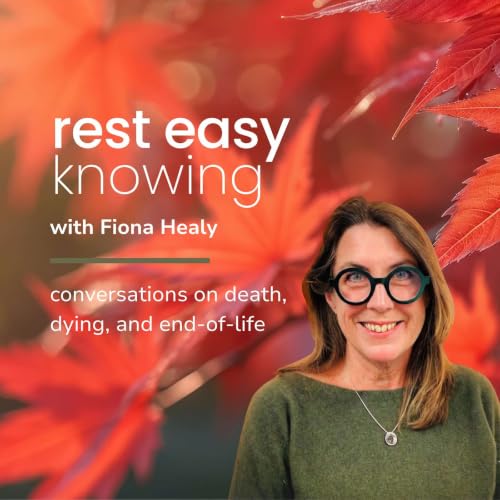
Rest Easy Knowing Titelbild

Rest Easy Knowing

Rest Easy Knowing

Von: Fiona Healy
Jetzt kostenlos hören, ohne Abo

Conversations with experts to help people better understand death, dying and end-of-life.


We talk with professionals working in end-of-life matters, and ask them the questions you might have been wondering about, but were not prepared to ask.

© 2026 Rest Easy Knowing
Hygiene & gesundes Leben
  • If you lose capacity: power of attorney explained
    Sep 15 2026

    Who’s in Charge When You Can’t Be - with de Groots Wills & Estates Lawyers, Senior Associate Julia Tutt

    We often think about planning for what happens after we die — making a Will, choosing an executor and deciding who should receive our assets.

    But what if you’re still alive and you’re no longer able to make decisions for yourself?

    That’s where powers of attorney and guardianship come in.

    In this episode of Rest Easy Knowing, Fiona talks with Julia Tutt, Senior Associate at de Groots Wills and Estate Lawyers, about the documents that can determine who manages your financial affairs, makes decisions about your health and wellbeing, and steps in when you can no longer make those decisions yourself.

    And there’s a serious warning: giving someone power over your finances is a significant decision. The conversation explores the risks of financial elder abuse, why choosing the right person matters, and the checks and balances you can consider putting in place.

    In this episode

    We talk about:

    • The difference between a Will and a power of attorney
    • What a power of attorney allows someone to do while you are alive
    • What happens to a power of attorney when you die
    • The difference between financial decision-making and decisions about health, medical treatment and where you live
    • The distinction between a general power of attorney and an enduring power of attorney
    • Why choosing an attorney requires careful thought and absolute trust
    • How financial elder abuse can occur through powers of attorney
    • Why keeping proper accounts and records matters
    • How relationships and financial circumstances can change over time
    • What happens if an attorney is suspected of misusing someone’s money
    • What “loss of capacity” actually means — and why it isn't as straightforward as a diagnosis such as dementia
    • The relationship between guardianship and advance healthcare planning
    • Whether an independent professional can be appointed instead of a family member
    • What to think about before seeing a lawyer to put your estate and incapacity planning in place

    The practical takeaway

    Julia's advice is simple: think carefully about who you appoint.

    Before meeting with a lawyer, consider who you would trust to represent you if you lost capacity, whether that person should also be your executor after your death, and what arrangements might provide appropriate checks and balances.

    It is also worth getting your affairs organised: make a summary of your bank accounts, property, lawyers, accountants and other advisers, keep that information somewhere safe, and make sure the people who may need it know where to find it.

    Most importantly, don't assume that putting these documents in place once means you can forget about them. Your relationships, finances and circumstances can change significantly over the years.

    Meet Julia Tutt

    Julia Tutt is a Senior Associate at de Groots Wills and Estate Lawyers, a specialist firm focusing on Wills and Estate Planning, Estate Administration and Estate Litigation.

    de Groots has offices in Brisbane, Sydney and Melbourne and specialises exclusively in Wills and Estate law.

    Visit de Groots Wills and Estate Lawyers: degroots.com.au

    A note about legal advice

    This episode is intended to provide general information and is not a substitute for legal advice. Powers of attorney, guardianship, advance healthcare planning and estate planning arrangements differ between Australian states and territories.

    If you are considering putting these documents in place, changing them, or are concerned about someone acting under a power of attorney, speak with a suitably qualified lawyer about your individual circumstances.

    Rest Easy Knowing

    Rest Easy Knowing is about making conversations around death, dying and end-of-life planning a little less daunting — and helping you understand the practical things that can make a difficult time easier for you and the people you love.

    Recorded at Emerald Hill Heritage Centre on the traditional lands of the Boonwurrung people of the Kulin Nation. Fiona pays respects to Elders past and present and to all First Nations people listening.

    Music by Sapiros.


    Mehr anzeigen Weniger anzeigen
    24 Min.
  • End of life clinical care: palliative care
    Sep 1 2026

    We discuss clinical care with CEO of Palliative Care Victoria, Violet Platt

    Many Australians associate palliative care with the final days of life—but that's one of the biggest myths surrounding end-of-life care.

    In the first episode of Rest Easy Knowing, Fiona Healy sits down with Violet Platt, CEO of Palliative Care Victoria, to explore what palliative care really is, when it should begin, and why understanding it can transform the experience of living with a life-limiting illness.

    Violet dispels common misconceptions, explains how palliative care focuses on quality of life rather than giving up hope, and offers practical insights into what families can expect as someone approaches the end of life. Together, they discuss the natural dying process, why advance planning matters, and how honest conversations can help people make informed decisions about the care they want.

    Whether you're supporting a loved one, planning for the future, or simply curious about one of life's universal experiences, this episode provides reassurance, practical advice and a compassionate introduction to palliative care.

    In this episode:

    • What palliative care is—and what it isn't
    • Why palliative care isn't just for people with cancer or the final days of life
    • The biggest myths surrounding palliative care
    • How palliative care improves quality of life
    • Signs that someone may be approaching the end of life
    • What families can expect during the natural dying process
    • How pain, agitation and other symptoms can be managed
    • Supporting family members through difficult decisions
    • Why planning ahead creates more choice, comfort and peace of mind
    • Why, as Violet says, "dying is natural... it isn't something to fear, but it is something to plan for."

    About our guest

    Violet Platt is the Chief Executive Officer of Palliative Care Victoria, the peak body representing palliative care services across Victoria. With decades of clinical and leadership experience, Violet is a passionate advocate for improving access to quality palliative care and helping Australians better understand what compassionate end-of-life care looks like.

    Resources

    Palliative Care Victoria
    https://www.pallcarevic.asn.au

    Advance Care Planning Australia
    https://www.advancecareplanning.org.au

    Palliative Care Australia
    https://palliativecare.org.au

    About Rest Easy Knowing

    Rest Easy Knowing is a podcast helping Australians better understand death, dying and grief through conversations with recognised leaders in palliative care, grief, law, funeral care and advance care planning.

    Hosted by Fiona Healy, each episode asks the questions many Australians don't know to ask—until they're faced with one of life's most challenging moments.

    If you found this episode valuable, please follow the podcast, leave a review and share it with your family and friends. Together, we can help normalise conversations about death and empower more Australians to make informed end-of-life decisions.

    Mehr anzeigen Weniger anzeigen
    32 Min.
  • After a death: living with grief
    Aug 25 2026
    Understanding Loss, Love and Life that Continues with Grief Australia CEO Christopher HallGrief is something every one of us will experience, yet many of us feel completely unprepared when it arrives.In this episode of Rest Easy Knowing, Fiona speaks with Christopher Hall, Chief Executive Officer of Grief Australia, psychologist and one of Australia's leading voices in grief and bereavement education.Christopher has spent almost three decades helping Australians better understand grief. Together, they explore why grief is so misunderstood, why there is no universal roadmap through loss, and how simply being present can be far more meaningful than finding the perfect words.This is a thoughtful conversation about grief, love, memory and the ways we continue our relationship with someone after they die.In this episodeWhy our society still struggles to talk openly about grief.Why fear of saying the wrong thing often leads people to withdraw instead of reaching out.What genuinely helps someone who is grieving — and why listening matters more than fixing.Why saying "I don't know what to say" can sometimes be more compassionate than offering clichés.The truth about the so-called five stages of grief and why they were never designed as a model for bereavement.Why grief is deeply individual and can involve thoughts, identity, physical experiences and emotions — not just sadness.How grief can resurface years later through anniversaries, places, smells and everyday experiences.Why grief doesn't end a relationship; instead, our relationship with the person who died changes over time.Whether grief can lead to growth, wisdom and changes in how we see the world.How rituals, letters and imagined conversations can help when someone never had the opportunity to say goodbye.The differences between grief and depression, and how they can sometimes coexist.When it may be helpful to seek additional grief support.Supporting children through bereavement with honesty, age-appropriate language and informed choice.Why euphemisms such as "they slipped away" or "they're in a better place" can unintentionally close down meaningful conversations.Talking honestly and respectfully about deaths by suicide.Supporting colleagues, friends and family members from different cultural backgrounds, including understanding the importance of curiosity rather than assumption.What happens when someone contacts Grief Australia for bereavement support.A conversation about grief, not getting over itOne of the most powerful ideas Christopher shares is that grief is not about saying goodbye and letting go. While death ends a life, it does not necessarily end our relationship with the person who died. We continue to carry them through memories, conversations in our minds, family traditions and the legacy they leave behind.For many people, grief is not something to complete. It is something we gradually learn to live alongside.The practical takeawayIf someone you care about is grieving:Turn up.Listen more than you speak.Don't worry about finding perfect words.Acknowledge that you may not know what to say.Share memories of the person who died if appropriate.Remember that grief often continues long after the funeral.Check in again weeks, months and years later.And if you're grieving yourself, Christopher reminds us that there is no correct timeline, no universal sequence of emotions and no single way that grief should look.Your experience is your own.About Christopher HallChristopher Hall is the Chief Executive Officer of Grief Australia, a psychologist specialising in grief and bereavement, and a leading educator in the field of grief literacy.Across his career he has trained thousands of health professionals, contributed to grief research and education, and continues to advocate for a more compassionate and grief-literate Australian community.About Grief AustraliaGrief Australia provides education, resources, counselling and bereavement support to help individuals, families, communities and organisations better understand and respond to grief.For information, resources and support, visit: Grief Australia https://www.grief.org.au/Please noteThis episode discusses death, bereavement, suicide and grief. Please listen with care if these topics are particularly sensitive for you.The conversation provides general information and education about grief and bereavement. It is not intended as a substitute for individual psychological or medical advice.If you would like to learn more about grief support and available resources, visit Grief Australia. Rest Easy KnowingRest Easy Knowing is a podcast about death, dying and the practical conversations that help us live, and prepare for end-of-life. Recorded at the Emerald Hill Heritage Centre on the traditional lands of the Boonwurrung People of the Kulin Nation. Fiona pays respect to Elders past and present and to any First Nations people listening.Music by Sapiros.
    Mehr anzeigen Weniger anzeigen
    45 Min.
adbl_web_anon_alc_button_suppression_t1
Noch keine Rezensionen vorhanden