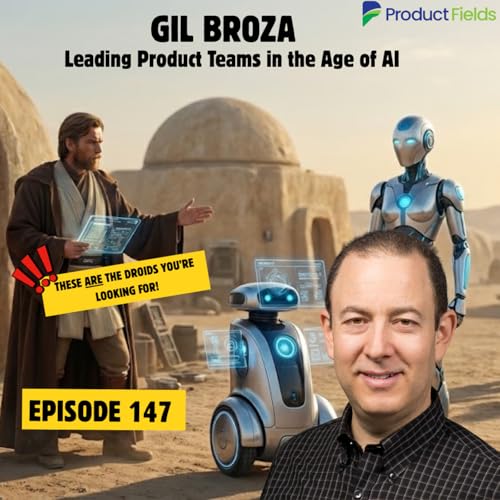
• #147 Leading Product Teams in the Age of AI - With Gil Broza
    Jan 15 2026

    Gil Broza joins our hosts, Jim Sammons and Rich Visotcky, for the first episode of the Product Fields podcast in 2026! In this conversation, we discuss the evolving landscape of agility and product management in the age of AI. Together, we explore how AI has transformed product delivery, the importance of accountability, and the need for leaders to adapt their strategies to ensure effective team dynamics. Too often, we have seen companies go full-on into AI without any strategy or understanding of the consequences. Through our discussion, we dive into the balance between leveraging AI for efficiency while maintaining critical thinking and human oversight, and the need for a thoughtful approach to integrating AI into work processes.

    00:00:00 Intro

    00:02:04 Agility Beyond Tech: Adapting Principles for Non-Tech Teams

    00:03:44 The Relevance of the Agile Manifesto, Values, and Principles

    00:08:44 AI's Impact on Product Delivery and Management

    00:12:15 Going Back to Principles in the Age of AI

    00:16:52 Accountability in the Age of AI

    00:28:03 The AI Industrial Revolution: Trust and Human Connection

    00:33:58 The Atrophy of Skills in the Age of AI

    00:35:07 The Impact of AI on Communication and Authenticity

    00:45:38 The Dangers of Over-Reliance on AI

    00:47:27 Fundamentals in the Age of AI

    00:50:45 The Danger of Agency and AI

    00:53:01 The Future of Work and AI Integration

    00:57:46 Quantity vs. Impact

    01:01:20 Closing

    Connect with Product Fields:

    📢 Follow the podcast for more inspiring stories
    💬 Join the conversation on LinkedIn - linkedin.com/company/mastering-agility
    📩 Contact us for trades or sponsorships

    👉 If you enjoyed this episode, leave a review and share it with someone who needs to hear it!

    Connect with our guests:

    Gil Broza: https://www.linkedin.com/in/gilbroza

    Subscribe to Gil’s newsletter: https://3pvantage.com/subscribe-newsletter/

    Attend Gil’s course, “Leading AI-Enabled Product Teams”: https://3pvantage.com/leapt/


    Check out our sponsors:

    www.xebia.com

    www.wiserbees.com

    www.jointinsights.com

    www.productfields.com

    Mehr anzeigen Weniger anzeigen
    1 Std. und 5 Min.
  • #146 Can Mindset be Quantified? - With Dr. Karen Eilers and Christiaan Verwijs
    Jan 6 2026

    Join hosts Rich Visotcky and Jim Sammons as they delve deep into the agile mindset and its significance in team dynamics from a research-backed perspective. Joining them in this episode are Dr. Karen Eilers and Christiaan Verwijs who are leading studies exploring the agile mindset from the individual and team level. Through their research and the help of Columinity, they describe how to factors like motivation, morale, collaborative exchange, value focus, and management support improve team effectiveness. Together, we discuss the development of reliable measurement scales, the importance of data in understanding team effectiveness in order to take action, and the challenges of selection bias and trust in survey data. We also dip our toes into the pools of dynamic reteaming and its effects on team cohesion and team outcomes.

    Whether you’re a manager looking to help your teams hit their stride, a team member trying to understand how to improve yourself to improve those around you, or a research and data junkie curious about people and teams, this episode has you covered!

    Want to learn more about your team and the research?

    Participate (and get immediate actionable feedback!): https://questionnaire.columinity.com/setup/model/agilemindset

    Preliminary findings: https://blog.columinity.com/how-a-team-level-agile-mindset-shapes-team-effectiveness/

    Scientific paper on Agile Mindset: https://www.sciencedirect.com/science/article/pii/S0040162522001822

    Contact Columinity: https://columinity.com/research

    Connect with our guests:

    Karen Eilers: linkedin.com/in/dr-karen-eilers/

    Christiaan Verwijs: linkedin.com/in/christiaanverwijs/

    Connect with Mastering Agility:

    📢 Follow the podcast for more inspiring stories
    💬 Join the conversation on LinkedIn - linkedin.com/company/mastering-agility
    📩 Contact us for trades or sponsorships

    👉 If you enjoyed this episode, leave a review and share it with someone who needs to hear it!

    Check out our sponsors:

    www.xebia.com

    www.wiserbees.com

    www.jointinsights.com

    www.productfields.com

    Find more at www.masteringagility.org

    Mehr anzeigen Weniger anzeigen
    53 Min.
  • S07 E01 Gojko Adzic on Specification By Example
    Apr 3 2024
    SummaryIn this episode, Goiko shares his experiences and insights on visualizing specifications, writing Specification by Example, and solving communication problems in software development. He discusses the challenges and patterns in the adoption of Spec by Example and the importance of identifying bottlenecks and visualizing problems. Goiko also talks about causing organizational change and the evolution of software development solutions. He concludes by discussing the promise and reality of no-code tools and sharing his recent work and projects. The conversation explores various themes related to software development and its impact on organizations and society. It discusses the power of expressing human knowledge in software and the role of visualization tools in increasing shared understanding. The shift from specialists to generalists in the software industry is examined, as well as the potential for smaller organizations and general-purpose work. The conversation also delves into the role of AI in minimizing political games in organizations and the responsibility of software professionals in creating good software. The need for spending more time on edge cases and negative use cases is highlighted, along with the societal impact of bad software and the potential for IT to become a profession. The conservation and shifting of complexity in software development is explored, and the conversation concludes with a discussion on the impact of shoddy software on people's lives.TakeawaysVisualizing specifications can help improve understanding and reduce rework in software development.The adoption of Spec by Example and other agile practices can be hindered by organizational politics and resistance to change.Identifying bottlenecks and visualizing problems can lead to effective solutions and improvements in software development processes.No-code tools have the potential to democratize software development and empower non-technical users to create automation. Visualization tools like FigJam and Zeppelin increase shared understanding in organizations.The software industry is shifting towards smaller organizations and general-purpose work.AI cannot eliminate political games in organizations, as they are driven by cultural factors.There is a need for more focus on edge cases and negative use cases in software development.The responsibility of software professionals is to create good software and address the societal impact of bad software.Gojko's booksCheck out our sponsors:www.xebia.comwww.wiserbees.comwww.scrummatch.comwww.masteringagility.orgSound BitesChapters00:00Introduction01:21Visualizing Specifications03:04Early Experiences with Software Quality04:09Solving Communication Problems05:31Validating Real-World Usage of Spec by Example06:29Getting Permission from Companies for Case Studies08:28Persistent Challenges and Positive Patterns09:49Adoption of Given-When-Then and Consolidation of Tools11:42Identifying Bottlenecks and Visualizing Problems13:01Causing Organizational Change14:09The Challenge of Change Resistance16:30The Evolution of Software Development Solutions26:48Goiko's Recent Work and Projects35:26The Power of Expressing Human Knowledge in Software36:03Visualization Tools and Increased Shared Understanding37:27Specialists vs. Generalists in the Software Industry38:49The Shift Towards Smaller Organizations and General Purpose Work41:49The Role of AI in Minimizing Political Games in Organizations42:54The Responsibility of Software Professionals in Creating Good Software51:01The Need for Spending More Time on Edge Cases and Negative Use Cases53:31The Societal Impact of Bad Software and the Role of Governments57:41The Potential for IT to Become a Profession01:01:29The Conservation and Shifting of Complexity in Software Development01:04:43The Impact of Shoddy Software on People's Lives
    Mehr anzeigen Weniger anzeigen
    1 Std. und 9 Min.
  • DocDur Agile #1
    Jul 12 2022

    DocDur Agile is an open office where Agile Practitioners can ask any question they encounter in practice situations and would like to have some advice or a different perspective. Think of it as seeing a regular doctor have a physical check-up.

    If you have questions or requests that you would like the Doc to have a check on, please drop a message on LinkedIn or join the Mastering Agility Discord community!

    Sander Dur (host)


    Scrum Master, Agile Coach, trainer, and podcast host for ‘Mastering Agility”

    Sander Dur is a Professional Scrum Trainer at Scrum.org, podcast host of Mastering Agility, Professional Scrum Master and Lead Agile Consultant, and trainer at Xebia. Besides this, he's an avid writer for predominantly Serious Scrum on Medium.com. Sander has a major passion for the human side in complex domains. Ensuring a high level of psychological safety, therefore, is a critical part of his work. Organizations in complex domains can only survive when innovating. Innovation can only take place with the right balance between low social friction and high intellectual friction. While most organizations now understand how to apply Agile frameworks, they struggle with the delivery of value. Psychological safety is the next step in this evolution and Sander has a huge drive to help organizations reach that step.

    He gained experience as a Scrum Master, Agile Coach, and Leadership consultant in many different top-tier organizations, including Nike and ASML.

    Sander is enthusiastic, open-minded, and ambitious. He finds interpersonal relationships and intrinsic motivations very important in team dynamics. Besides his work, Sander loves to spend time with his family, enjoys sports and eating healthy, barbecuing, riding his motorcycle, and traveling.

    Let’s connect! Sander is always up for new connections and discussions!

    Masteringagility.org
    https://xebia.com/academy/nl/trainers/sander-dur
    https://sander-dur.medium.com/

    Additional resources:

    Discord community:https://discord.gg/6YJamBJxUV

    Support the show

    Contact us at:

    Masteringagility.org
    https://xebia.com/academy/nl/trainers/sander-dur

    https://www.linkedin.com/in/jamessammons/
    https://www.linkedin.com/in/sanderdur/


    Hosted on Ausha. See ausha.co/privacy-policy for more information.

    Mehr anzeigen Weniger anzeigen
    19 Min.
  • S05 E03 A New Hope .... For Dependencies
    May 8 2023

    For questions or requests that you would like us to check on, please drop a message on LinkedIn or join the Mastering Agility Discord community!

    Participate as an audience member
    Mastering Agility Mural

    Sander Dur

    Sander Dur is a Professional Scrum Trainer at Scrum.org, podcast host of Mastering Agility, Professional Scrum Master and Lead Agile Consultant, and trainer at Xebia. Besides this, he's an avid writer for predominantly Serious Scrum on Medium.com. Sander has a major passion for the human side in complex domains. Ensuring a high level of psychological safety, therefore, is a critical part of his work. Organizations in complex domains can only survive when innovating. Innovation can only take place with the right balance between low social friction and high intellectual friction. While most organizations now understand how to apply Agile frameworks, they struggle with the delivery of value. Psychological safety is the next step in this evolution and Sander has a huge drive to help organizations reach that step.

    Sander is enthusiastic, open-minded, and ambitious. He finds interpersonal relationships and intrinsic motivations very important in team dynamics. Besides his work, Sander loves to spend time with his family, enjoys sports and eating healthy, barbecuing, riding his motorcycle, and traveling.

    Jim Sammons

    My passion is helping people to:

    • Do more of the right work (and less of the wrong work).
    • Create more actual teams than just groups of people who work together.
    • Learning how to improve themselves, their team, and their organization incrementally.
    • Understand that less, not more, is usually part of the answer to some of the hardest questions we all face.
    • See their workplaces, teams, and their sphere of influence as something that is evolving, which requires an evolution of all of its parts to adapt.

    Throughout my career, I have worked with clients of all sizes, industries, and technologies. Whether it’s leading a transformative strategy at a Fortune 100 or helping a new startup understand its unique value proposition the common focus I bring to each role is “making people better.”

    Support the show

    Contact us at:

    Masteringagility.org
    https://xebia.com/academy/nl/trainers/sander-dur

    https://www.linkedin.com/in/jamessammons/
    https://www.linkedin.com/in/sanderdur/


    Hosted on Ausha. See ausha.co/privacy-policy for more information.

    Mehr anzeigen Weniger anzeigen
    40 Min.
  • S01 E15 Adding Playfulness with Carsten Lutzen
    Jun 21 2021

    Working environments can benefit greatly by having playful environments. But to have playful environments, you need those frontrunners that will take you there. Carsten Lutzen is the right guy for the job. His LinkedIn page and YouTube channel (see for details below) radiate creativity and he helps you get there. Working at the LEGO group, he is constantly surrounded by playful, but serious products. Let’s listen to his experience as the Playful Agile Coach.

    And, we’re giving away a LEGO set! Go to http://masteringagility.org/index.php/give-aways/ to found out how you can enter!

    What you’ll discover in this show:

    - Humor breaks the tension

    - Liberating Structures and icebreakers are great for starting and fostering collaborative discussions

    - LEGO is still hiring!

    Speakers:

    Carsten Lutzen

    Agile Coach in The LEGO Group

    I like motivating people and helping them achieve their goals and to make sure that the team performs well. I love to look at processes and try to improve them using the tools in my (agile) toolbox. I don't believe that one methodology exists that will work on all projects, hence we need to tweak the tools for every single project and take the things that works and skip the things does not.

    Another love of mine is making software that needs to be performant using clever software architecture combined with heavy computer science theory within the field of performance and optimization techniques.

    Combining these two things it is possible to create user-centric software and experiences.

    I have facilitated a lot of different workshops on agile thinking, agile mindset/behavior and how to find the balance between agility and a plan oriented apporaches.
    I have taught more than 300 people in different sessions where we have worked on mindset, when to use agile tools and when not to use them.


    Contact Carsten Lutzen:
    https://www.youtube.com/c/CarstenLutzen

    https://www.linkedin.com/in/carstenlutzen/

    Sander Dur (host)

    Scrum Master, Agile Coach, trainer, and podcast host for ‘Mastering Agility”

    Sander Dur is business agility enthusiast, with a passion for people. Whether it’s healthy product development, agile leadership, measurement or psychological safety, Sander has a drive to enable organizations to the best of their abilities. He is an avid article writer, working on a book about Scrum Mastery from the Trenches and is connecting listeners with the most influential people in the industry.

    https://www.linkedin.com/in/sanderdur/
    https://agilitymasters.com/en
    https://sander-dur.medium.com/

    Additional resources:

    https://www.lego.com/aboutus/careers

    Support the show

    Contact us at:

    Masteringagility.org
    https://xebia.com/academy/nl/trainers/sander-dur

    https://www.linkedin.com/in/jamessammons/
    https://www.linkedin.com/in/sanderdur/


    Hosted on Ausha. See ausha.co/privacy-policy for more information.

    Mehr anzeigen Weniger anzeigen
    39 Min.
  • #115 Hosts against Humanity: A tale of Scrum, Smurfs & big decisions - Part 1
    Oct 22 2024

    This episode features an interview with the hosts of Mastering Agility who discuss their personal and professional journeys into Agile. Sander and Jim share how they transitioned into the Scrum Master role from various career paths. Both highlight the importance of adaptability, continuous learning, and servant leadership in their Agile work.


    Jim initially worked in a tech company as a vice president managing multiple roles but shifted to Agile after being recruited by someone who saw potential in his leadership style. He explains that his previous experience prepared him for the Scrum Master role by teaching him to focus on value and relationships. Sander’s Agile journey began with a course on Scrum, which helped him rethink how to approach work, particularly after recovering from burnout. He reflects on how his burnout changed his perspective on success, leading him to focus on what gives him energy and purpose.


    They also dive into common challenges in Agile transformations, with both hosts mentioning frequent client questions like “How long does it take to become Agile?” or “What metrics should we use?” They emphasize that Agile success depends on adaptability, calculated risk-taking, and fostering an environment where teams can figure out what works for them, much like Spotify did. They criticize organizations that fear risk and avoid change, likening them to companies like Blockbuster and Blackberry, which failed to adapt and ultimately lost their market positions.


    In discussing work-life balance, Jim and Sander reflect on the impact their careers have had on their personal lives. Jim opens up about struggling with anxiety in the past, while Sander discusses the mental shift he experienced after his burnout, learning to prioritize happiness over traditional markers of success. They also stress the importance of creating space for self-care and setting boundaries in their work, noting that personal well-being is critical to professional success.


    The episode ends on a lighter note, where each of the hosts shares something personal. Sander reveals that he was once a ballroom dancer, while Jim talks about how he dealt with anxiety. They discuss hypothetical alternative careers if they didn't need to work for money, with suggestions ranging from running a sustainable farm to being a professional helper, tying back to their values of service and learning.


    Check out our sponsor:
    www.xebia.com

    www.scrummatch.com

    www.wiserbees.com

    www.masteringagility.org


    Hosted on Ausha. See ausha.co/privacy-policy for more information.

    Mehr anzeigen Weniger anzeigen
    34 Min.
  • #100 Denise Tilles on Product Operations
    May 28 2024

    Summary


    Denise discusses the concept of product operations and its role in helping product managers make faster and better quality decisions. Product operations involves providing PMs with the necessary inputs and support to set strategy, prioritize, create roadmaps, and collaborate effectively with stakeholders. It differs from traditional agile approaches by focusing on the system around teams rather than just the teams themselves. Denise also highlights the importance of defining the product and understanding the problem to be solved. She emphasizes the need for buy-in from leadership and the importance of clear communication and stakeholder management in implementing product operations. In this part of the conversation, Denise discusses the challenges of stakeholder discussions and balancing strategic decisions with short-term opportunities. She also talks about the relationship between strategy and incentives in a product organization. The conversation then shifts to the topic of Denise's book on product operations and why she decided to write it. She emphasizes the importance of understanding what product operations is and how it can be implemented in different areas of a company. The chapter ends with a discussion on scaling challenges and the role of go-to-market alignment and data in product operations. In this conversation, Yuval and Jim discuss various topics related to agile portfolio management and OKRs. They explore the challenges and benefits of implementing agile practices in traditional project management offices (PMOs) and the importance of aligning goals and strategies at different levels of the organization. They also delve into the use of OKRs as a tool for setting and measuring goals, emphasizing the need for outcome-oriented goals and collaboration in their development. Throughout the conversation, they highlight the importance of continuous improvement and adaptability in managing portfolios and achieving organizational success.


    Takeaways


    Product operations helps PMs make faster and better quality decisions by providing the necessary inputs and support.

    Product operations focuses on the system around teams, rather than just the teams themselves, setting it apart from traditional agile approaches.

    Defining the product and understanding the problem to be solved are crucial for effective product operations.

    Buy-in from leadership is essential for implementing product operations.

    Clear communication and stakeholder management are key to successful product operations. Balancing stakeholder discussions and strategic decisions can be challenging, especially when short-term opportunities arise.

    The relationship between strategy and incentives in a product organization is complex and can lead to conflicting goals.

    Product operations is a key function in a company and understanding its role and potential is crucial.

    Implementing product operations requires considering areas of deficit and opportunity within the organization.

    Denise's book on product operations provides actionable tips and real-life experiences to help companies navigate these challenges. Agile practices can be challenging to implement in traditional PMOs, but they offer benefits such as increased alignment and adaptability.

    OKRs are a useful tool for setting and measuring goals, but they should be outcome-oriented and developed collaboratively with the people doing the work.

    Continuous improvement and adaptability are key to managing portfolios effectively and achieving organizational success.

    Experimentation and learning are crucial for driving innovation and differentiation in portfolio management.


    Check out our sponsor:
    www.xebia.com

    www.scrummatch.com

    www.wiserbees.com

    www.masteringagility.org


    Hosted on Ausha. See ausha.co/privacy-policy for more information.

    Mehr anzeigen Weniger anzeigen
    48 Min.