Folgen

  • Episdoe 53: Air War Vietnam, 1965 - 1973
    Jan 19 2026

    Air War Vietnam explores one of the central paradoxes of modern warfare: how the United States achieved overwhelming airpower dominance in Southeast Asia yet failed to secure strategic victory.

    In this episode of Mil History Talk, Hope and Brian examine the Vietnam air war from Rolling Thunder (1965–1968) through Arc Light, Linebacker I, and Linebacker II in 1972, explaining why massive bombing campaigns and advanced technology did not translate into political success. Hope drives the conversation with sharp questions, humor, and pop-culture comparisons, while Brian provides clear, grounded analysis of escalation, coercion, and strategic misalignment.

    Together, they unpack the critical difference between tactical and operational success on the battlefield and true strategic decision at the political level. The episode also explores how North Vietnam adapted, endured punishment, and turned time into a strategic advantage—highlighting the enduring relevance of Clausewitz’s insights on war, will, and passion.

    Air War Vietnam is not a critique of airpower itself, but a reminder that airpower only works when it is anchored to a coherent strategy and achievable political goals.


    See the more detailed written article on our substack: Air War Vietnam - by Louis DiMarco - Mil History Talk


    Mehr anzeigen Weniger anzeigen
    14 Min.
  • Episode 52 — The Gulf of Tonkin: When a Blip on Radar Became a War
    Jan 13 2026

    n this episode of Mil History Talk, Hope and Brian unpack one of the most consequential moments in modern U.S. military history—the Gulf of Tonkin. What began as a tense naval encounter, followed by a phantom attack that likely never occurred, quickly became the legal and political foundation for a massive expansion of war. With sharp analysis, accessible storytelling, and their signature blend of wit and rigor, the hosts explore how ambiguous intelligence, rushed decision-making, and broad language handed the executive branch sweeping war powers. More than a history lesson, this episode is a cautionary examination of how democratic systems behave under pressure, how authority quietly shifts in moments of crisis, and why asking hard questions early matters. It’s a timely, thoughtful look at war powers, credibility, and the enduring lessons of history for today’s leaders and citizens alike.For a more detailed look at the Gulf of Tonkin issue see the article on the Mil History Talk substack:

    n this episode of Mil History Talk, Hope and Brian unpack one of the most consequential moments in modern U.S. military history—the Gulf of Tonkin. What began as a tense naval encounter, followed by a phantom attack that likely never occurred, quickly became the legal and political foundation for a massive expansion of war. With sharp analysis, accessible storytelling, and their signature blend of wit and rigor, the hosts explore how ambiguous intelligence, rushed decision-making, and broad language handed the executive branch sweeping war powers. More than a history lesson, this episode is a cautionary examination of how democratic systems behave under pressure, how authority quietly shifts in moments of crisis, and why asking hard questions early matters. It’s a timely, thoughtful look at war powers, credibility, and the enduring lessons of history for today’s leaders and citizens alike.

    Mehr anzeigen Weniger anzeigen
    11 Min.
  • Episode 51: Nuclear War at the Movies
    Jan 12 2026

    In this special movie-review episode of Mil History Talk, Hope launches the podcast’s new film review feature and takes on her role as the show’s official (and very unofficial) Hollywood liaison. With wit, skepticism, and historical depth, she explores how Hollywood has portrayed nuclear war—and how those portrayals shaped public understanding far more than doctrine ever could.

    From the confident professionalism of Strategic Air Command, through the chilling systemic failure of Fail Safe, to the dark satire of Dr. Strangelove, this episode traces the evolution of Cold War nuclear anxiety on screen. The second half confronts the human aftermath and institutional doubt shown in The Day After, By Dawn’s Early Light, and the modern unease of A House of Dynamite.

    Each film is rated using Mil History Talk’s 1–5 service-based system, blending cultural analysis with strategic insight. Serious subject, sharp humor, free popcorn—this is nuclear war as Hollywood taught us to fear it.

    Mehr anzeigen Weniger anzeigen
    21 Min.
  • Episode 50: The Republic of Korea Army in the Korean War
    Jan 10 2026

    The Korean War is often remembered as a Cold War clash between the United States and China—but that memory overlooks the force that carried most of the fighting on the Allied side: the Republic of Korea Army.

    In Episode 50 of Mil History Talk, Hope and Brian explore how the ROK Army transformed from a shattered force in 1950 into a capable, battle-hardened army by 1952–53. We examine reforms in training and leadership, the integration of artillery and coalition support, and the brutal hill battles where Korean units increasingly held the line themselves.

    This episode also explains how growing ROK capabilities shaped the final phase of the war and influenced the armistice talks in 1953. The end of the conflict was not just a diplomatic decision—it reflected battlefield realities created by Korean soldiers.

    Blending operational analysis, cultural context, and sharp insight, Hope and Brian explain why this story still matters for alliance warfare, indigenous force development, and how wars are actually won.

    Related article is available on our Substack—link below:

    The Republic of Korea Army in the Korean War


    Mehr anzeigen Weniger anzeigen
    11 Min.
  • Episode 49: Strategic Air Command: Deterrence, Discipline, and the Nuclear Age
    Jan 4 2026


    In this episode of Mil History Talk, Hope and Brian explore Strategic Air Command, the Cold War force built to prevent World War III by being ready to fight it. From its origins after World War II to Curtis LeMay’s ruthless focus on readiness, SAC became the backbone of American nuclear deterrence. The episode examines the rise of the nuclear triad, SAC’s role during the Cuban Missile Crisis, and the human pressure carried by those on constant alert. As SAC transitioned into U.S. Strategic Command, its culture and logic continued to shape modern deterrence—and still matter today.

    For a detailed short history of the SAC see the article in our substack site: The Strategic Air Command: Deterrence, Discipline, and the Nuclear Age


    Mehr anzeigen Weniger anzeigen
    10 Min.
  • Episode 48: The Red Ball Express
    Dec 10 2025

    In Episode 48 of Mil History Talk, Hope and Brian take you inside one of the most demanding logistics operations of World War II—the Red Ball Express. When the breakout from Normandy outran every sustainment assumption, thousands of trucks, overworked drivers, and improvised supply routes became the only lifeline for U.S. forces racing across France.

    We break down how the crisis formed, what the Red Ball Express actually accomplished, and the staggering statistics behind the effort: fuel deficits, maintenance backlogs, port shortfalls, and the human endurance that kept the campaign alive.

    Then, in our final segment, we explore what this WWII emergency teaches modern planners about Large-Scale Combat Operations—why improvisation can’t replace railroads and pipelines, how specialized logistics units matter more than ever, and why LSCO will always be limited by fuel, infrastructure, and friction.

    It’s a fast-moving episode about the trucks that kept victory possible.

    For more history shorts and visual breakdowns, visit the Mil History Talk YouTube channel:
    https://www.youtube.com/@MilHistoryTalk

    In particular look at the video short on the CCKW 2 1/2 truck: US Army GMC CCKW 2 1/2 Ton Truck

    Mehr anzeigen Weniger anzeigen
    20 Min.
  • Episode 47 — “The Fighter Sweep: How the P-51D Mustang Broke the Luftwaffe”
    Dec 7 2025

    In late 1943, the U.S. Eighth Air Force was losing the air war over Europe. Bomber losses were soaring, doctrine was failing, and the Luftwaffe still controlled the initiative. Everything changed with the arrival of Maj. Gen. Jimmy Doolittle — a World War I fighter pilot and innovator who had zero patience for outdated dogma.

    In this episode, Hope and Brian break down how Doolittle shattered the bomber-centric culture of the Air Corps Tactical School, unleashed a new offensive doctrine built around fighter sweeps, and paired it with the perfect aircraft at the perfect moment: the P-51D Mustang. With long range, high altitude performance, and unmatched agility, the Mustang helped deliver the blow that the strategic bombing campaign alone could not — the destruction of German fighter strength.

    We walk through the collapse of Pointblank, the Mustang’s rise, the mechanics of a fighter sweep, and the brutal turning point of Big Week.
    This is the story of how leadership, doctrine, and technology combined to flip the air war — and why fighter tactics, not bombers, ultimately broke the Luftwaffe.

    Shorts on the P-51 and B-17 on our Mil History Talk Youtube Channel:

    https://youtube.com/shorts/0unZbpXrpBQ?feature=share

    https://youtube.com/shorts/SQKGPFD1HS4?feature=share

    Mehr anzeigen Weniger anzeigen
    14 Min.
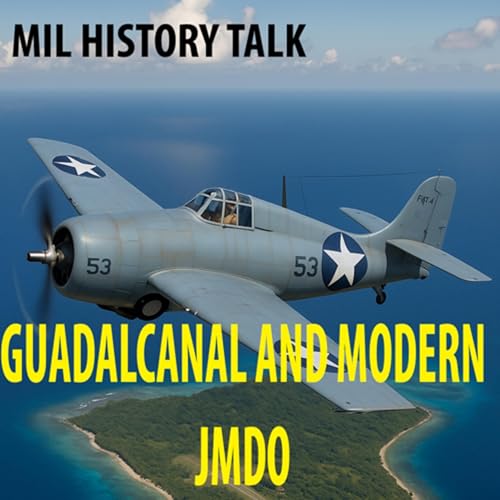
  • Episode 46: The Campaign for Guadalcanal and Modern Multi-Domain Operations
    Dec 1 2025

    Guadalcanal, Henderson Field, the Cactus Air Force, and the brutal Pacific War take center stage as Hope and Brian unpack one of World War II’s most decisive campaigns. This six-month fight for the Solomon Islands pitted U.S. Marines, sailors, and airmen against Japan’s best forces in a desperate struggle for airpower, logistics, and control of key terrain. From the Tenaru River and Edson’s Ridge to Cape Esperance, Santa Cruz, and the Naval Battle of Guadalcanal, the hosts break down the tactics, decisions, and leadership that shaped the campaign.

    Hope brings sharp humor and vivid storytelling; Brian tackles the operational art, contested logistics, and joint air-sea coordination that made Guadalcanal a blueprint for modern Multi-Domain Operations (MDO) and today’s Indo-Pacific planning. Clear analysis, dramatic narrative, and lively banter show why this battle still matters for 21st-century warfare.


    Also, the Mil History Talk Youtube channel is now live -- it carries all of our full library of audio only podcasts as well as video shorts relevant to the various podcast episodes. It will be updated from now on on a weekly basis. You can find it at:

    ⁠MIL HISTORY TALK - YouTube

    Keywords: Guadalcanal, Pacific War, Henderson Field, Cactus Air Force, Solomon Islands, U.S. Marines, Imperial Japanese Navy, MDO, JADC2, island-hopping, air-sea battle, WWII strategy.

    Mehr anzeigen Weniger anzeigen
    15 Min.