Learning Bayesian Statistics Titelbild

Learning Bayesian Statistics

Learning Bayesian Statistics

Von: Alexandre Andorra
Jetzt kostenlos hören, ohne Abo

Are you a researcher or data scientist / analyst / ninja? Do you want to learn Bayesian inference, stay up to date or simply want to understand what Bayesian inference is?

Then this podcast is for you! You'll hear from researchers and practitioners of all fields about how they use Bayesian statistics, and how in turn YOU can apply these methods in your modeling workflow.

When I started learning Bayesian methods, I really wished there were a podcast out there that could introduce me to the methods, the projects and the people who make all that possible.

So I created "Learning Bayesian Statistics", where you'll get to hear how Bayesian statistics are used to detect black matter in outer space, forecast elections or understand how diseases spread and can ultimately be stopped. But this show is not only about successes -- it's also about failures, because that's how we learn best.

So you'll often hear the guests talking about what *didn't* work in their projects, why, and how they overcame these challenges. Because, in the end, we're all lifelong learners!

My name is Alex Andorra by the way. By day, I'm a Senior data scientist. By night, I don't (yet) fight crime, but I'm an open-source enthusiast and core contributor to the python packages PyMC and ArviZ. I also love Nutella, but I don't like talking about it – I prefer eating it.

So, whether you want to learn Bayesian statistics or hear about the latest libraries, books and applications, this podcast is for you -- just subscribe! You can also support the show and unlock exclusive Bayesian swag on Patreon!

2025 Alexandre Andorra
Wissenschaft
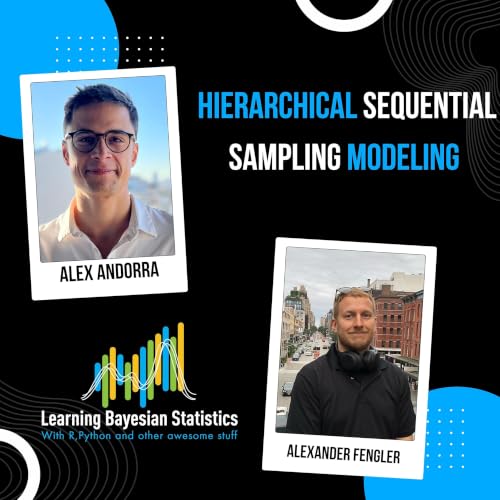
  • #165 Hierarchical Sequential Sampling Modeling, with Alex Fengler
    Sep 18 2026

    Support & Resources
    → Support the show on Patreon
    → Bayesian Modeling Course (first 2 lessons free)

    Our theme music is « Good Bayesian », by Baba Brinkman (feat MC Lars and Mega Ran). Check out his awesome work!


    Takeaways:

    Q: What is HSSM and how does it relate to HDDM?
    A: HSSM stands for hierarchical sequential sampling models, a generalization of HDDM (hierarchical drift diffusion models), the older toolbox for the same class of decision-making models, but HSSM is built from the ground up on simulation-based inference. That's what lets it handle any variation of the underlying process model, not just the ones with a tractable closed-form likelihood.

    Q: What is the drift diffusion model and why has cognitive science relied on it so heavily?
    A: The drift diffusion model treats a decision as a random walk that accumulates evidence until it crosses one of two boundaries, with parameters controlling boundary separation, starting bias, and drift rate. It's been used in thousands of published papers largely because it has a closed-form likelihood, which makes standard Bayesian and maximum-likelihood inference fast. Small variations on the model are often just as scientifically motivated, but if their likelihoods aren't analytically convenient, the literature using them stays sparse.

    Q: What is a likelihood approximation network (LAN) and what does it actually learn?
    A: A LAN is a neural network trained to take in a process's parameters and a trial's outcome and output how likely that outcome was, learned purely from repeated simulation rather than derived analytically. Once trained, it functions as a fast, reusable likelihood you plug directly into Bayes' rule, in place of a closed-form solution that may not exist for the model you actually want to fit.

    Q: What's the difference between amortizing the likelihood and amortizing the posterior?
    A: Amortizing the likelihood, HSSM's approach, means training a network once to approximate the likelihood, then reusing that same network across arbitrarily many downstream models: different priors, hierarchical structures, or regression backends, with no retraining. Amortizing the posterior directly, the approach tools like BayesFlow take, gives near-instant inference once trained, but locks the network into the specific scenario it was trained for.

    Chapters:
    00:00:00 What is HSSM and how does it fit into the Bayesian inference landscape?
    00:12:09 How did HSSM evolve from HDDM, and what does it apply to?
    00:30:25 How do neural networks learn likelihoods for Bayesian inference?
    00:37:01 What makes amortized Bayesian inference so flexible?
    00:41:04 What are the real computational costs of amortized inference?
    00:55:16 How does HSSM integrate with libraries like BayesFlow?
    00:58:57 What does a live demo of HSSM and BayesFlow look like?
    01:18:33 What is Bayesify and how does it score a paper's Bayesian workflow?
    01:23:12 What new model classes are coming to the HSSM ecosystem?
    01:30:12 How is AI reshaping development in the HSSM ecosystem?
    01:38:42 How should society incentivize keeping hard cognitive skills alive?

    Thank you to my Patrons for making this episode possible!

    Links from the show.

    Mehr anzeigen Weniger anzeigen
    1 Std. und 48 Min.
  • Bayesian Principal Stratification: Modeling Treatment Effects
    Sep 11 2026

    Today's clip is from Episode 164, featuring Andrew Gelman, Aki Vehtari & Richard McElreath. In this conversation, Andrew explains how Bayesian principal stratification can be used to reason about treatment effects when there is an intermediate treatment or outcome that is only partially observed.

    He discusses how latent variables can represent whether someone would take a stage-two treatment, and how pre-treatment characteristics such as age, location, and past spending can help build a model for this process.

    Richard connects the problem to the broader distinction between per-protocol and intent-to-treat analyses, and they discuss how standard approaches such as instrumental variables can be understood as special cases of more general Bayesian models. It's a useful example of how Bayesian modeling can represent the full process behind a causal question rather than relying on simplifying assumptions.

    Full discussion here

    Support & Resources
    → Support the show on Patreon
    → Bayesian Modeling Course (first 2 lessons free):
    Our theme music is « Good Bayesian », by Baba Brinkman (feat MC Lars and Mega Ran). Check out his awesome work!

    Mehr anzeigen Weniger anzeigen
    5 Min.
  • Why a Bayesian Workflow Goes Beyond Fitting Models
    Sep 2 2026

    Today's clip is from Episode 164, featuring Andrew Gelman, Aki Vehtari & Richard McElreath. In this conversation, Andrew explains why a Bayesian workflow goes far beyond simply fitting a model.

    He discusses the importance of building, fitting, and checking models, and why moving between simpler and more complicated models can reveal insights that a single model might miss.

    He also explores how simulation and generative modeling can help researchers evaluate new models and gain confidence in their results, even when there isn't an established method or published study to rely on. It's a look at why good statistical practice isn't just about getting an answer, but knowing how much you can trust it.

    Full discussion here

    Support & Resources
    → Support the show on Patreon
    → Bayesian Modeling Course (first 2 lessons free):
    Our theme music is « Good Bayesian », by Baba Brinkman (feat MC Lars and Mega Ran). Check out his awesome work!

    Mehr anzeigen Weniger anzeigen
    4 Min.
adbl_web_anon_alc_button_suppression_t1
Noch keine Rezensionen vorhanden