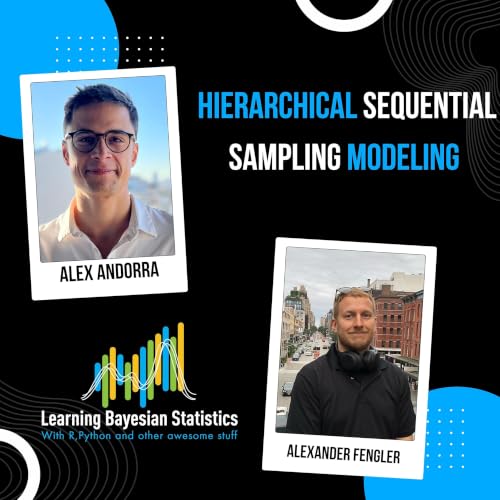
• #165 Hierarchical Sequential Sampling Modeling, with Alex Fengler
    Sep 18 2026

    Support & Resources
    → Support the show on Patreon
    → Bayesian Modeling Course (first 2 lessons free)

    Our theme music is « Good Bayesian », by Baba Brinkman (feat MC Lars and Mega Ran). Check out his awesome work!


    Takeaways:

    Q: What is HSSM and how does it relate to HDDM?
    A: HSSM stands for hierarchical sequential sampling models, a generalization of HDDM (hierarchical drift diffusion models), the older toolbox for the same class of decision-making models, but HSSM is built from the ground up on simulation-based inference. That's what lets it handle any variation of the underlying process model, not just the ones with a tractable closed-form likelihood.

    Q: What is the drift diffusion model and why has cognitive science relied on it so heavily?
    A: The drift diffusion model treats a decision as a random walk that accumulates evidence until it crosses one of two boundaries, with parameters controlling boundary separation, starting bias, and drift rate. It's been used in thousands of published papers largely because it has a closed-form likelihood, which makes standard Bayesian and maximum-likelihood inference fast. Small variations on the model are often just as scientifically motivated, but if their likelihoods aren't analytically convenient, the literature using them stays sparse.

    Q: What is a likelihood approximation network (LAN) and what does it actually learn?
    A: A LAN is a neural network trained to take in a process's parameters and a trial's outcome and output how likely that outcome was, learned purely from repeated simulation rather than derived analytically. Once trained, it functions as a fast, reusable likelihood you plug directly into Bayes' rule, in place of a closed-form solution that may not exist for the model you actually want to fit.

    Q: What's the difference between amortizing the likelihood and amortizing the posterior?
    A: Amortizing the likelihood, HSSM's approach, means training a network once to approximate the likelihood, then reusing that same network across arbitrarily many downstream models: different priors, hierarchical structures, or regression backends, with no retraining. Amortizing the posterior directly, the approach tools like BayesFlow take, gives near-instant inference once trained, but locks the network into the specific scenario it was trained for.

    Chapters:
    00:00:00 What is HSSM and how does it fit into the Bayesian inference landscape?
    00:12:09 How did HSSM evolve from HDDM, and what does it apply to?
    00:30:25 How do neural networks learn likelihoods for Bayesian inference?
    00:37:01 What makes amortized Bayesian inference so flexible?
    00:41:04 What are the real computational costs of amortized inference?
    00:55:16 How does HSSM integrate with libraries like BayesFlow?
    00:58:57 What does a live demo of HSSM and BayesFlow look like?
    01:18:33 What is Bayesify and how does it score a paper's Bayesian workflow?
    01:23:12 What new model classes are coming to the HSSM ecosystem?
    01:30:12 How is AI reshaping development in the HSSM ecosystem?
    01:38:42 How should society incentivize keeping hard cognitive skills alive?

    Thank you to my Patrons for making this episode possible!

    Links from the show.

    Mehr anzeigen Weniger anzeigen
    1 Std. und 48 Min.
  • Bayesian Principal Stratification: Modeling Treatment Effects
    Sep 11 2026

    Today's clip is from Episode 164, featuring Andrew Gelman, Aki Vehtari & Richard McElreath. In this conversation, Andrew explains how Bayesian principal stratification can be used to reason about treatment effects when there is an intermediate treatment or outcome that is only partially observed.

    He discusses how latent variables can represent whether someone would take a stage-two treatment, and how pre-treatment characteristics such as age, location, and past spending can help build a model for this process.

    Richard connects the problem to the broader distinction between per-protocol and intent-to-treat analyses, and they discuss how standard approaches such as instrumental variables can be understood as special cases of more general Bayesian models. It's a useful example of how Bayesian modeling can represent the full process behind a causal question rather than relying on simplifying assumptions.

    Full discussion here

    Support & Resources
    → Support the show on Patreon
    → Bayesian Modeling Course (first 2 lessons free):
    Our theme music is « Good Bayesian », by Baba Brinkman (feat MC Lars and Mega Ran). Check out his awesome work!

    Mehr anzeigen Weniger anzeigen
    5 Min.
  • Why a Bayesian Workflow Goes Beyond Fitting Models
    Sep 2 2026

    Today's clip is from Episode 164, featuring Andrew Gelman, Aki Vehtari & Richard McElreath. In this conversation, Andrew explains why a Bayesian workflow goes far beyond simply fitting a model.

    He discusses the importance of building, fitting, and checking models, and why moving between simpler and more complicated models can reveal insights that a single model might miss.

    He also explores how simulation and generative modeling can help researchers evaluate new models and gain confidence in their results, even when there isn't an established method or published study to rely on. It's a look at why good statistical practice isn't just about getting an answer, but knowing how much you can trust it.

    Full discussion here

    Support & Resources
    → Support the show on Patreon
    → Bayesian Modeling Course (first 2 lessons free):
    Our theme music is « Good Bayesian », by Baba Brinkman (feat MC Lars and Mega Ran). Check out his awesome work!

    Mehr anzeigen Weniger anzeigen
    4 Min.
  • #164 Bayesian Workflow, with Andrew Gelman, Aki Vehtari & Richard McElreath
    Aug 31 2026

    Support & Resources
    → Support the show on Patreon
    → Bayesian Modeling Course (first 2 lessons free)

    Our theme music is « Good Bayesian », by Baba Brinkman (feat MC Lars and Mega Ran). Check out his awesome work

    Takeaways:
    Q: What is the "Bayesian Workflow" book about, and who is it for?

    A: It covers what the three authors know that isn't already in Bayesian Data Analysis (BDA3) or Statistical Rethinking, organized around case studies that walk through full analyses end to end rather than just giving a recommendation. It's not an introduction to Bayesian inference -- it assumes you already know the basics -- but a guide to making theoretically informed, professional decisions at the many branching points a real analysis involves that source books rarely acknowledge.

    Q: What's a concrete way to report Bayesian results without just handing over a posterior distribution?

    A: Report a few named scenarios from the distribution, such as pessimistic, median, and optimistic. This is easier to discuss than a full posterior and helps shift the conversation toward what would move outcomes from the median toward the optimistic case.

    Full takeaways


    Chapters:
    00:18:22 What is the elevator pitch for the Bayesian Workflow book?
    00:20:12 Where does workflow sit between statistical theory and case studies?
    00:27:21 Why express your scientific background in a generative model?
    00:36:43 How is a Bayesian workflow different from a pipeline?
    00:39:03 What is reverse Bayes, and how does it help with prior sensitivity?
    00:43:53 How do Bayesians reinterpret non-Bayesian methods?
    00:45:02 How is the Bayesian Workflow book structured?
    00:48:49 How do you model bat mortality at wind farms from zero-inflated carcass counts?
    00:52:24 When does a hierarchical model stop being an innocuous assumption?
    00:58:17 Can multilevel regression and poststratification pool detection across sites?
    00:59:32 Why start with a big generative simulation before the statistical model?
    01:02:05 What is the "secret weapon" of comparing shrinkage to fixed-effects estimates?
    01:11:02 How do you detect which assumptions are actually driving your inference?
    01:15:24 How do you get regulated industries to accept a posterior instead of a score?
    01:22:04 Should statisticians soften uncertainty for decision makers?
    01:23:11 Why report three scenarios instead of a single number?
    01:27:51 How do you handle a leaky instrument in causal inference?
    01:29:16 What is a principal stratification model?
    01:34:47 What are the three authors working on next?

    Thank you to my Patrons for making this episode possible!

    Full show notes

    Mehr anzeigen Weniger anzeigen
    1 Std. und 44 Min.
  • Making Gaussian Processes Easier to Use
    Aug 25 2026

    Today's clip is from Episode 154, featuring Thomas Pinder. In this conversation, Thomas shares what he sees as the next steps for GPJax and how the project could become easier to use beyond its original research-focused audience.

    He discusses creating a higher-level interface that could make fitting Gaussian processes possible in just a few lines of code, while still keeping the flexibility and infrastructure that GPJax provides. He also talks about making the documentation more engaging by moving beyond synthetic examples and showcasing real-world applications, such as modeling ocean currents with Gaussian processes.

    It's a look at how GPJax could evolve from a powerful research tool into something that's even more accessible and practical for a wider range of users.

    Full discussion here

    Support & Resources
    → Support the show on Patreon
    → Bayesian Modeling Course (first 2 lessons free):
    Our theme music is « Good Bayesian », by Baba Brinkman (feat MC Lars and Mega Ran). Check out his awesome work!

    Mehr anzeigen Weniger anzeigen
    5 Min.
  • The Future of Faster MCMC
    Aug 21 2026

    Today's clip is from Episode 163, featuring Eliot Carlson and Adrian Seyboldt. In this conversation, Eliot and Adrian look beyond current approaches to HMC adaptation and preconditioning and share the ideas they're most excited to explore next.

    Eliot discusses new ways of parallelizing MCMC by solving for an entire trajectory at once rather than computing every step sequentially, a potentially powerful direction for expensive, high-dimensional problems. Adrian, meanwhile, talks about exploring non-adjusting methods and going beyond first-order information by investigating how higher-order autodiff and second-order derivatives could open up new possibilities for sampling.

    It's a glimpse into some of the ideas that could help make MCMC faster and more scalable as computational hardware continues to become increasingly parallel.

    Full discussion here

    Support & Resources
    → Support the show on Patreon
    → Bayesian Modeling Course (first 2 lessons free):
    Our theme music is « Good Bayesian », by Baba Brinkman (feat MC Lars and Mega Ran). Check out his awesome work!

    Mehr anzeigen Weniger anzeigen
    4 Min.
  • #163 How to make your models sample faster, with Adrian Seyboldt & Eliot Carlson
    Aug 13 2026

    Support & Resources
    → Support the show on Patreon
    → Bayesian Modeling Course (first 2 lessons free)

    Our theme music is « Good Bayesian », by Baba Brinkman (feat MC Lars and Mega Ran). Check out his awesome work


    Takeaways:

    Q: What is mass matrix adaptation, in plain terms?
    A: Mass matrix adaptation is best understood as an automatic, fairly dumb, but very effective reparameterization of your model. The simplest version, the diagonal mass matrix, just rescales each parameter so its posterior standard deviation becomes one, which is exactly what you'd do by hand if you had the patience. Every time you sample a PyMC or Stan model, this kind of reparameterization is happening under the hood.

    Q: How does Nutpie's approach to mass matrix adaptation differ from Stan and PyMC's default?
    A: Stan and PyMC's default sampler only use one source of information for diagonal mass matrix adaptation: the posterior standard deviation estimated from warm-up draws. Nutpie also uses the gradients of the log density, which HMC is already computing at every step to build its trajectory. For a standard normal distribution, the covariance of the gradients is exactly the inverse covariance of the draws, so Nutpie takes the geometric mean of the two resulting standard deviations. There's no guarantee it's always better, but in practice it usually is.

    Q: What problem does "Preconditioning Hamiltonian Monte Carlo by Minimizing Fisher Divergence" actually solve?
    A: Preconditioning HMC means transforming your target distribution into one that's friendly to sample, but doing that well requires knowing things about the distribution, like its covariance, that sampling itself is supposed to discover. This chicken-and-egg problem is usually handled by sketching a rough estimate from a handful of early warm-up draws, which can burn a large share of total sampling time. Adrian and Eliot's paper formalizes how to make better use of a second signal, the score function, that HMC already computes for free but that Stan-style preconditioning ignores.


    Chapters:
    00:00:00 What is HMC preconditioning?
    00:09:03 A more robust low-rank mass matrix
    00:11:58 What is mass matrix adaptation?
    00:18:06 What does preconditioning HMC mean?
    00:20:57 What is normalizing flow adaptation, and when does a linear mass matrix fall short?
    00:23:50 When does normalizing flow adaptation actually help, and when is classic mass matrix adaptation enough?
    00:27:13 What is Fisher divergence?
    00:30:10 Why is HMC's trajectory, not its density, the right target for preconditioning?
    00:33:04 What are the diagonal, dense, and low-rank-plus-diagonal versions of mass matrix adaptation?
    00:46:25 How much faster is low-rank-plus-diagonal adaptation?
    00:51:07 What's the practical recommendation for using Nutpie and its mass matrix adaptation?
    00:54:31 Why does low-rank adaptation sometimes fail spectacularly?
    01:01:35 Where does this research fit in the bigger picture of HMC?
    01:12:12 How could centered vs. non-centered parameterization be chosen automatically?

    Thank you to my Patrons for making this episode possible!

    Links from the show here

    Mehr anzeigen Weniger anzeigen
    1 Std. und 24 Min.
  • Bayesian Statistics vs. Epistemology
    Aug 13 2026

    Today's clip is from episode 160, featuring Vaden Masrani. In this conversation, Vaden explores the tension between Bayesian statistics and Bayesian epistemology, and why he sees them as fundamentally different.

    He explains why Bayesian epistemology can run into problems when trying to explain where hypotheses themselves come from, and argues that an emphasis on finding supporting evidence can encourage confirmation bias rather than genuine scientific inquiry. He also discusses Hempel's paradox, Popper's idea of falsification, and why these philosophical problems don't necessarily undermine Bayesian statistics itself.

    Full discussion here

    Support & Resources
    → Support the show on Patreon
    → Bayesian Modeling Course (first 2 lessons free):
    Our theme music is « Good Bayesian », by Baba Brinkman (feat MC Lars and Mega Ran). Check out his awesome work!

    Mehr anzeigen Weniger anzeigen
    5 Min.