Folgen

  • Day 8 | ANCHORED: The Permanent Rhythm of Rest - A Christian Experience: Celebrating the Feast of Tabernacles
    Oct 23 2026
    ANCHORED - The Permanent Rhythm of RestDay 8 - A Christian Experience: Celebrating the Feast of TabernaclesOctober 3, 2026Welcome to the closing day of my eight-day journey celebrating the Feast of Tabernacles, also known as Sukkot, the Feast of Booths, and the Feast of Ingathering.What began as a personal experience of honoring a feast established by the Lord became an extraordinary journey through Scripture, worship, obedience, preparation, and learning to rest in the presence of our Heavenly Father.On this eighth day, a sacred assembly, I return to Numbers 29 to examine the offerings the Lord instructed Israel to bring before Him. As Christians, we do not sacrifice animals today. Instead, I examine the significance of these offerings and what they have taught me about how I approach the Lord.What does it mean to bring the Lord a bull, a ram, seven lambs, and a goat as a sin offering? What about the grain and drink offerings? How do these instructions help us examine our praise, spiritual maturity, childlike faith, willingness to learn, and accountability before God?Throughout this study, I share how I came to understand the bull as representing the weight of my praise and worship, the ram as the responsible adult who is growing and maturing in faith, and the lambs as the childlike humility, curiosity, and willingness to learn that I must never lose.The grain and drink offerings brought my attention to the Word of God and the joy of bringing His words before Him. The sin offering reminded me of the importance of taking responsibility for my mistakes rather than placing blame, and of the grace made available through Jesus Christ.But our journey does not stop with the offerings.During the seven days preceding this sacred assembly, I followed the declining number of bulls prescribed in Numbers 29. Beginning with thirteen on Day 1 and decreasing by one each day until reaching seven on Day 7, I began examining the significance of each number in relation to what I was learning throughout this feast.In this episode, I revisit that journey, including the connections I explored between thirteen and inheritance, twelve and divine order, eleven and transition, ten and stewardship, nine and hidden preparation, eight and new beginnings, and seven and completion and rest.Then comes the eighth day.One bull. One ram. Seven lambs. One goat as a sin offering.And something else caught my attention: the way this particular celebration began and ended with a Sabbath.Rest at the beginning. Rest at the conclusion.As I considered everything I had studied, experienced, and learned, one message became increasingly clear to me: I do not have to live in a constant state of striving.I can remain faithful, continue learning, take responsibility for what has been entrusted to me, and trust the Lord to lead me through each day.That is where the title of this study comes from.ANCHORED - The Permanent Rhythm of Rest.This episode also includes individual section markers throughout the video presentation, identifying the offerings and the numbers examined during the study. These sections were included to make it easier to return to particular portions for additional reflection and Scripture study.Some of the Scriptures explored throughout this journey include Numbers 29, Leviticus 4, Leviticus 26, Isaiah 59:21, Romans 5:20-21, Hebrews 13:15, and John 7:37-38.I invite you to follow along with your Bible, examine the Scriptures for yourself, and consider what it means to approach our Heavenly Father with praise, humility, accountability, joy, and a willingness to learn.My prayer is that this experience encourages you to continue seeking the Lord, trusting His guidance, and discovering the rest that comes through walking in obedience to Him.STAY. Continue!Written, presented, and narrated by Jodi L. Serino-BarbourThe Artisan's PENABASilence MinistriesBetween a Father and HIS DaughterWebsite: https://TheArtisansPEN.com | https://TheArtisansPEN.orgThank you for joining me for this Christian experience of celebrating the Feast of Tabernacles.May the Lord bless you as you continue growing in His Word.Become a supporter of this podcast: https://www.spreaker.com/podcast/i-am-the-artisan-s-pen--6739385/support.If this message blessed you, please consider liking, sharing, and subscribing so that more people can encounter the Word of God.If you feel led to support the continued growth of this ministry, you may sow a seed to help us continue producing Bible teachings, devotionals, and spiritual encouragement for people around the world.Support the ministry here:Venmo: @TheArtisansPENCash App: $JodiLynnSBOr you can buy me a coffee or tea at Ko-fi.com/TheArtisansPENThank you for being part of this growing community of faith.For more, please visit our websites:TheArtisansPEN.com and/or TheArtisansPEN.orgFollow us on YouTube @TheArtisansPENThis episode includes AI-generated content.
    Mehr anzeigen Weniger anzeigen
    45 Min.
  • Day 7 | The Keys and the Anointment for the Appointment - A Christian Experience: Celebrating the Feast of Tabernacles
    Oct 21 2026
    The Keys and the Anointment for the AppointmentDay 7 - A Christian Experience: Celebrating the Feast of TabernaclesOctober 2, 2026Scripture: Numbers 29:32-34Welcome to Day 7 of A Christian Experience: Celebrating the Feast of Tabernacles.Throughout this Feast, I have been sharing my personal experiences as a Christian honoring the appointed time established by the Lord. Each day has been an opportunity to study His Word, examine the offerings described in Numbers 29, and learn what it means to bring an offering that is pleasing to Him.Today, we arrive at Numbers 29:32-34, where the instructions include seven bulls, two rams, fourteen lambs of the first year, their grain and drink offerings, one goat as a sin offering, and the regular burnt offering.Before examining the seven bulls, however, I returned to the lessons we had already received concerning the other offerings.THE GRAIN AND DRINK OFFERINGS - THE WORD AND THE REJOICINGOn Day 5, we examined the grain and drink offerings.The grain directed our attention to bread, and bread led us to the Word of God.Deuteronomy 8:3 teaches that man does not live by bread alone but by every word proceeding from the mouth of the Lord. King Jesus reaffirmed this truth in Matthew 4:4 and Luke 4:4.The drink offering directed our attention to wine and its association with joy, delight, and rejoicing.Together, these offerings caused me to consider the joy that comes from receiving, studying, understanding, and delighting in God's Word.Psalm 119:162 speaks of rejoicing at God's Word as one who finds great spoil.Psalm 119:111 describes God's testimonies as the rejoicing of the heart.Psalm 119:14 speaks of rejoicing in the way of His testimonies.Psalm 19:8 declares that the statutes of the Lord are right, rejoicing the heart.And Ephesians 5:26 speaks of sanctification and cleansing through the washing of water by the Word.These Scriptures led me to Nehemiah 8.In this account, Ezra read the Book of the Law before the people, and those gathered were helped to understand what they heard.When they understood, they wept.But they were reminded that the day was holy to the Lord. They were instructed to eat, drink, rejoice, and send portions to those for whom nothing had been prepared.Nehemiah 8:12 tells us that the people rejoiced because they understood the words declared to them.There it was again!The Word and the rejoicing.SENDING PORTIONS - SHARING WHAT WE HAVE RECEIVEDThe instruction to send portions caught my attention.When we receive and understand God's Word, we have something valuable to share with others.Those portions may be shared through books, teaching, videos, conversations, and other opportunities to encourage and strengthen people.This brought me to Ezekiel 3:10-11.The Lord instructed Ezekiel to receive His words into his heart, hear them with his ears, and then go speak to the people.Ezekiel was responsible for delivering the message entrusted to him. Those who heard the message were responsible for how they responded.From there, my study led to Isaiah 61:1-3.These verses speak of proclaiming liberty to captives, opening the prison to those who are bound, comforting those who mourn, and giving the oil of joy for mourning.But what is the oil of joy?THE OIL OF JOY AND THE KEYSAs I examined Isaiah 61, I considered the difference between the physical practice of anointing with oil, mentioned in James 5:14, and the oil of joy described in Isaiah 61.My attention returned to God's Word, the joy that comes from receiving and understanding it, and the work of His Spirit.Then came the keys.In Revelation 1:18, King Jesus declares that He possesses the keys of Hades and death.Matthew 16:19 speaks of the keys of the Kingdom of Heaven.And this led me to a simple observation.You cannot open a prison door without keys.King Jesus holds the keys.As we receive His Word, study it, and grow in understanding, we begin to recognize truths that may have previously escaped our attention.When you possess the keys, the Scriptures will unlock for you.But possessing keys also carries responsibility.Are we prepared to carry what has been entrusted to us?Are we willing to serve others with what we have received?THE SIN OFFERING - PERSONAL ACCOUNTABILITYOn Day 6, we examined the goat presented as a sin offering.Our study of Leviticus 4 brought our attention to the offering concerning an individual and the importance of taking personal responsibility for sin and guilt.As Christians, we recognize King Jesus as the Lamb of God who gave Himself for our sins.Through Him, we are invited to repent, receive forgiveness, and walk in the new life made available through God's grace.Additional Scriptures: Romans 5:20-21 and Proverbs 28:13.THE REGULAR BURNT OFFERING - NOTHING WITHHELDThroughout Numbers 29, the regular burnt offering appears repeatedly.It is mentioned in verses 16, 19, 22, 25, 28, and 31, and again in today's passage.Yet this was an offering we had not stopped to examine during our daily ...
    Mehr anzeigen Weniger anzeigen
    39 Min.
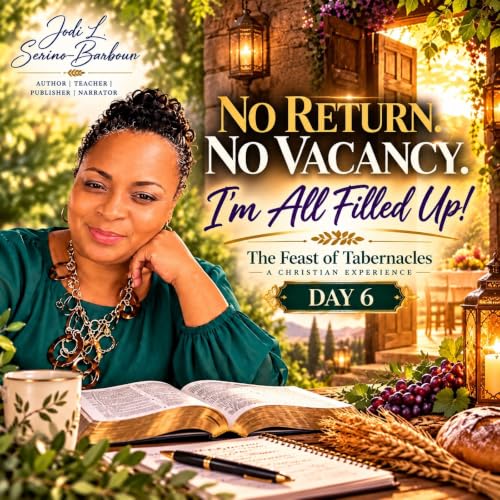
  • Day 6 | No Return, No Vacancy, I'm All Filled Up! - A Christian Experience: Celebrating the Feast of Tabernacles
    Oct 19 2026
    Day 6 | No Return. No Vacancy. I'm All Filled Up!A Christian Experience: Celebrating the Feast of TabernaclesWhat happens when God brings you into a new season, but the old habits, reactions, and ways of thinking try to follow you there?Welcome to Day 6 of A Christian Experience: Celebrating the Feast of Tabernacles.From September 26 through October 3, 2026, I set aside these eight days to honor the Feast of Tabernacles, a time of celebration established by the Lord. Throughout this experience, I have been sharing what these days actually look like for me, what I'm doing, what I'm studying, and what I'm learning as I spend this time with Him.Today's study begins in Numbers 29:29-31, where the Lord gives instructions concerning the offerings for the sixth day of the Feast.Eight bulls. Two rams. Fourteen male lambs. Their accompanying grain and drink offerings. And one goat as a sin offering.The number of bulls has decreased each day, beginning with thirteen on Day 1 and continuing through twelve, eleven, ten, nine, and now eight.I was excited to examine the significance of eight, especially because of what I had already been learning about the numbers and their relationship to the harvest cycle.But yesterday's study, The Breakthrough Hidden in the Specifics, taught me something important. Don't overlook the details just because you think you already understand what you're reading.And that lesson changed the direction of today's study.THE FOUR WORDS I ALMOST LEFT BEHINDI had noticed the goat. I had already been examining what the goat could teach me about my will, independence, and stubbornness.But Scripture didn't merely say that a goat was offered.It specifically identified the goat as being offered "as a sin offering."Those four words sent me back into the Scriptures.Before continuing, I want to make something clear. As Christians, we are not required to sacrifice animals for our sins. Jesus Christ has already offered Himself as the sacrifice for sin, once for all.My purpose in examining these offerings is not to reestablish animal sacrifices. It is to understand what the details God placed in His Word can teach me about my relationship with Him.And sometimes, those details expose something about us that we didn't realize needed attention.NO SHORTCUTS: RETURNING TO LEVITICUS 4During my research for my book Iron Sharpens Iron, I had previously studied the different offerings described in Scripture.That earlier research helped point me back to Leviticus 4, but it didn't eliminate the need for me to do the work.Leviticus 4 describes sin offerings involving four different categories.The priest, Leviticus 4:3-12.The community, Leviticus 4:13-21.A leader, Leviticus 4:22-26.An individual, Leviticus 4:27-35.Because this was my personal study, I followed the instructions concerning the individual.And that brought me face-to-face with unintentional sin.What happens when we violate one of God's commandments without initially realizing what we've done?And what becomes our responsibility once that sin is brought to our attention?The passage made me examine the difference between not knowing and refusing to respond once we know.It also made me examine something deeply personal.Am I willing to acknowledge when my will has gone against God's will?Or will I defend myself, justify my actions, and place responsibility somewhere else?The account of Adam and Eve in Genesis 3 came to mind as I considered the importance of taking responsibility for our actions.And the fact that Leviticus 4 specified a female goat or lamb for the individual's offering became another detail that prompted me to reflect on accountability.Sometimes the most difficult part of laying down our will is acknowledging that we were wrong.But acknowledging sin doesn't mean we must remain trapped in condemnation.Romans 5:20-21 reminds us of the abundance of God's grace.And Proverbs 28:13 reminds us that the one who confesses and forsakes sin finds mercy.Grace gives us the opportunity to acknowledge what God has revealed, lay it down, and continue walking with Him.FINALLY, WE ARRIVE AT EIGHT!After following the sin offering into Leviticus 4, I returned to the eight bulls in Numbers 29.And this is where the study took another turn.Yesterday's study had led me to examine the nine fruits of the Spirit described in Galatians 5:22-23.I began thinking about those fruits as the internal conditions necessary for a healthy spiritual harvest.Love, joy, and peace establish the internal climate.Longsuffering, kindness, and goodness help us endure external pressures without losing the character God is developing within us.Faithfulness, gentleness, and self-control help us remain steady, govern our responses, and bring our conduct into alignment with the Holy Spirit.Then I began examining the significance of eight.In my study, eight became a picture of a new beginning following a completed cycle.Seven completes the week. The next day begins a new week.Genesis 17:12 ...
    Mehr anzeigen Weniger anzeigen
    26 Min.
  • Day 5 | The Breakthrough Hidden in the Specifics - A Christian Experience: Celebrating the Feast of Tabernacles
    Oct 17 2026
    The Breakthrough Hidden in the SpecificsDay 5 | A Christian Experience: Celebrating the Feast of TabernaclesSeptember 30, 2026 | Tishrei 19Scripture Foundation: Numbers 29:26-28What if the breakthrough you have been waiting for is hidden in a detail you almost overlooked?Welcome to Day 5 of A Christian Experience: Celebrating the Feast of Tabernacles.During this eight-day celebration, I am sharing what honoring the Feast of Tabernacles looks like in my everyday life as a Christian. I am sharing what I am doing, what I am studying, what I am learning, and how I am applying God's Word.Today's study begins in Numbers 29:26-28, where the Lord specifies the offerings for the fifth day: nine bulls, two rams, fourteen lambs, one goat, and the accompanying grain and drink offerings.But before I could begin examining the significance of the nine bulls, two details caught my attention.THE IMPORTANCE OF SPECIFICSGenesis 6:22 and Genesis 7:5 both testify concerning Noah's obedience.Twice, Scripture emphasizes that Noah did according to ALL that God commanded him.That double witness caused me to consider the importance of paying attention to God's specific instructions.As I examined the offerings throughout the Feast, I noticed something interesting. On some days, the instructions specified a kid of the goats. On other days, they specified a goat.Why the distinction?A kid is a young goat, full of energy, playfulness, and curiosity. An adult goat has reached maturity and can be associated with strength, capability, independence, stubbornness, and being headstrong.As I considered these differences, I began examining human behavior, including my own.I looked back over the first four days of the Feast and recognized how youthful energy and adult responsibility had appeared in my everyday experiences.From singing and dancing throughout the house to rearranging furniture, facing my fear of spiders, cutting grass, and making lavender lemonade for the first time, I could see practical illustrations of what I was studying.And that matters because studying God's Word should lead us beyond collecting information. We need to understand what we are learning so that we can apply it.THE GRAIN AND DRINK OFFERINGSThe second detail concerned the grain and drink offerings.In 2020, I wrote a book called Iron Sharpens Iron - It's Business, Not Personal. In Chapter 7, I examined the Lord's offerings and what they represent for Christians today.We no longer offer animal sacrifices because Jesus Christ offered Himself once for all, as Hebrews 10:10 explains.But the offerings still provide valuable lessons when we examine their symbolism and the Scriptures surrounding them.This time, I realized that I had overlooked the drink offering in my earlier study.As I considered the grain and drink offerings together, I was reminded of Communion, the bread and the wine.Bread brought me to Matthew 4:4 and Luke 4:4, where Jesus explains that we do not live by bread alone, but by every word that proceeds from the mouth of God.That brought me to Hosea 14:2, which instructs us to take words with us and return to the Lord. The verse also speaks of offering the calves, or bulls, of our lips.And suddenly, I was right back at the bulls!But there was more.Wine carries several meanings throughout Scripture, including joy and blessing.So I began considering the grain as a picture of God's Word and the wine as a picture of joy.Psalm 119:162 speaks of rejoicing at God's Word.Psalm 119:111 describes God's testimonies as the rejoicing of the heart.Jeremiah 15:16 describes finding and eating God's words and discovering that they became the joy and rejoicing of the heart.Psalm 19:8 and Psalm 19:14 also connect God's Word, the rejoicing of the heart, and the words of our mouths.And there it was!In the symbolic application I had been developing throughout the Feast, the bull represented my praise, the ram my adult responsibility, the lambs my childlike curiosity and innocence, the goat my will and character, and the kid of the goats my youthful energy.Now the grain and drink offerings brought me to my joy and delight in reading God's Word.BAM! Mic drop!NINE AND THE HIDDEN HARVESTNow I was ready to examine the nine bulls.Why nine?During the previous day's study, ten had brought me to responsibility, structure, and stewardship.But as I examined nine, I began considering something different.The womb of the harvest.The hidden incubation of a seed.The development that takes place before something is brought forth.Consider what happens when a seed is planted.Once it is covered with dirt, it may appear that absolutely nothing is happening. But beneath the surface, roots can be developing and growth can be taking place.I shared an example from my own backyard, where sweet potatoes continued appearing in an area where we had planted them two years earlier.Something we could not see was still producing.And that brought me to the test of the dark room.MY EXPERIENCE IN THE DARK ...
    Mehr anzeigen Weniger anzeigen
    26 Min.
  • Day 4 | The Unshakeable Promotion via Preparation: Pruning for Greater Fruit - A Christian Experience: Celebrating the Feast of Tabernacles
    Oct 15 2026
    THE UNSHAKEABLE: Promotion via Preparation — Pruning for Greater FruitThe Feast of Tabernacles: A Christian Experience — Day 4Numbers 29:23–25What does it look like for a Christian to honor the Feast of Tabernacles?In this series, I am sharing my personal experience of celebrating this feast that the Lord established as a time of celebration—what I am doing, what I am studying, and what I am learning as I spend these days with Him.On Day 4, my study brings me to Numbers 29:23–25.The offering prescribed for this day included ten bulls, two rams, fourteen male lambs, and one male goat as a sin offering, in addition to the regular burnt offering and its accompanying grain and drink offerings.I have been slowing down and looking carefully at these instructions because God did not simply say, “Bring Me something.”He told them what to bring.And these offerings were presented before Him as a sweet aroma.As a Christian, I am not sacrificing animals today. But I believe there is still something to learn from the details God chose to preserve in His Word. What can these offerings teach me about what I bring before Him now? What does an offering that is pleasing to God look like in my own life?On this fourth day, my study began with something I had not previously considered:Weight.A bull is not a small offering. It is substantial. It is weighty.That caused me to begin examining the weight of what I bring before God.Is my praise merely something coming from my mouth, or does it carry the weight of my heart?What about my prayer?My worship?My obedience?My surrender?Am I bringing Him something that costs me something?But the bull was only the beginning of today's study.There weren't simply bulls.There were TEN bulls.And as I began following the significance of ten through Scripture, the study opened into something much larger: measurement, stewardship, responsibility, testing, ownership, the field, the harvest, and the tithe.A field has to be measured.What has actually been entrusted to me?What belongs to God?What am I responsible for cultivating?What am I doing with the time, resources, opportunities, gifts, and responsibilities He has placed in my hands?And am I trying to carry things He never assigned to me?The study of ten brought me face-to-face with an important distinction:I may be the steward, but I am not the Source.God gives the increase.And before greater weight can be entrusted to a structure, the structure must be able to bear it.That brought me to another part of today's lesson:PRUNING.Interestingly, pruning wasn't merely something I studied that day.I had actually been outside pruning my lavender.Pruning can look like loss when we focus only on what is being removed. But healthy pruning serves a purpose. It redirects resources. It removes what is consuming energy that needs to be directed toward healthy growth. It prepares a plant for what it is supposed to produce.And sometimes what needs to be pruned from our lives isn't necessarily sinful or obviously bad.Sometimes it is simply something consuming resources that belong somewhere else.Time. Attention. Energy. Effort. Capacity.Something can be good and still be taking up space required for what God has actually entrusted to us.That made the question deeply personal:What needs to be pruned so that what remains can bear greater fruit?And as the day unfolded, I discovered that I wasn't merely studying testing, stewardship, responsibility, limits, and weight.I was being given opportunities to walk through them.Before the day ended, I found myself bringing my own heart before Father. I didn't want to carry unnecessary weight forward. I wanted my prayer to have weight. I wanted my praise to have weight.I wanted whatever hindered me to be removed.That is the beauty of these Feast days for me.I am studying Scripture, but I am also living an ordinary day.I am working. I am tending my home. I am caring for what has been entrusted to me. I am pruning lavender. I am praying. I am praising. I am learning.And right in the middle of ordinary life, Father continues teaching me.Day 4 became a lesson in promotion through preparation.Before something can carry greater weight, it must be prepared for that weight.Before a field can produce what it was designed to produce, it must be tended.Before healthy growth can continue, sometimes pruning is necessary.And before I concern myself with what I hope God will place into my hands, I must be willing to let Him examine how I am stewarding what He has already given me.Ten bulls.Weight.Testing.Stewardship.Measurement.Pruning.Preparation.And ultimately, the question that has been guiding this entire Feast study:What can I learn about bringing the Lord an offering that is a sweet aroma to Him?This is Day 4 of the Feast of Tabernacles — A Christian Experience.Today: ten bulls.Tomorrow, the offering changes again:Nine bulls.And I cannot wait to see what I can glean from the significance of nine.Scripture Focus: ...
    Mehr anzeigen Weniger anzeigen
    9 Min.
  • Day 3 | Bringing an Offering with a Sweet Aroma - A Christian Experience Celebrating the Feast of Tabernacles
    Oct 13 2026
    THE JUBILEE FACTORA Christian Experience of Celebrating the Feast of TabernaclesWhat does it look like for a Christian to celebrate the Feast of Tabernacles—and what can the offerings recorded in Scripture teach us today?This teaching grew out of my personal experience celebrating the Feast of Tabernacles and studying Numbers 29. I did not begin this study expecting to uncover everything that unfolded. I simply wanted to understand what I was reading.My question was simple:If I want my offering to be a sweet aroma to the Lord, what do I bring?That question stopped me at Numbers 29:2.One bull.One ram.Seven male lambs.Although Christians are not called to reproduce the animal sacrifices of the Old Testament, Scripture teaches us that the earthly system contained copies and shadows of heavenly realities. If these things were given as copies and shadows, then understanding the copy can help us recognize the spiritual principles it was pointing toward.So I began studying.What was significant about the bull?What could I learn from the ram?Why seven lambs?What did the grain offering represent?What about the drink offering?Why was there a sin offering?What was the significance of the regular burnt offering that continued alongside the additional offerings?And why did the number of bulls change throughout the Feast while other portions remained the same?What began with one verse became a journey through Numbers 29 and beyond.As the Feast continued, I began noticing a pattern:13 bulls.12 bulls.11 bulls.10 bulls.9 bulls.8 bulls.7 bulls.Each day brought another number, another lesson, and another opportunity to examine what Scripture was teaching me.But something else caught my attention.Before entering the Feast instructions, Numbers 29:2 had given me a baseline: one ram and seven lambs.Then, during the Feast, I encountered:Two rams.Fourteen lambs.Double.And unlike the decreasing number of bulls, the two rams and fourteen lambs remained in place throughout the seven days of the Feast.That sent me back into Scripture to examine the significance of something being doubled and the biblical principle of a matter being established.Genesis 41:32 says that Pharaoh's dream was repeated twice because the matter was established by God.Double.Established.Firm.And that word began speaking loudly to something I had already been carrying long before this Feast began:Everything that was lost.Everything that was taken.Everything the enemy stole.I want it all back.That is what I call THE JUBILEE FACTOR.It is restoration.It is the expectation that loss does not have to have the final word.Job experienced devastating loss, but his story did not end in the ashes. Job 42 tells us that the LORD restored Job and gave him twice as much as he had before.Double for the trouble.That restoration theme is deeply connected to why my studies of covenant, obedience, blessing, alignment, harvest, and the appointed times of the Lord have become so important to me.I don't merely want to quote the promises.I want to understand covenant.I want to understand what God has said.I want to examine myself.I want to walk in obedience.I want to understand what it means to bring Him an offering that is pleasing—a sweet aroma.And I want to recognize what He has placed in His Word, even when I have read past it before.This particular Feast became unlike any Feast of Tabernacles I had celebrated previously.The lessons were not confined to the pages of my Bible.Day after day, what I was studying began intersecting with what I was actually living.Praise.Maturity.Childlike trust and curiosity.The surrender of my will.Stewardship.Preparation.Specificity.Sin and forgiveness.Completion.Rest.Harvest.Restoration.The study became an experience.And even the calendar caught my attention.The Feast opened for me with the appointed rest coinciding with the weekly Sabbath, and the Eighth Day again coincided with the weekly Sabbath.Rest upon rest.Another double.I saw it.And I received it.This series documents that journey as it unfolded—not as a theological exercise performed from a distance, but as A CHRISTIAN EXPERIENCE of celebrating the Feast of Tabernacles.You will hear the questions I asked, the Scriptures I followed, the discoveries that stopped me in my tracks, and the practical experiences that caused those Scriptures to move from information on a page into lessons I could actually live.Most importantly, this study is an invitation to open the Scriptures for yourself.Read the passages.Follow the references.Ask questions.Look again.And allow the Word of God to teach you.Because sometimes we think we are simply reading a familiar passage when one verse causes us to stop—and that one verse becomes the doorway into an entire journey.For me, that verse was Numbers 29:2.And I had no idea where it was going to take me.Welcome to THE JUBILEE FACTOR:A Christian Experience of Celebrating the Feast of Tabernacles.Scriptures referenced throughout this study include ...
    Mehr anzeigen Weniger anzeigen
    24 Min.
  • Day 2 | His Will, His Way, My Faith - When the Offering Reveals You - A Christian Experience: Celebrating the Feast of Tabernacles
    Oct 11 2026
    A Christian Experience: Celebrating the Feast of Tabernacles — Day 2 | His Will, His Way, My Faith — When the Offering Reveals YouToday is Day 2 of the Feast of Tabernacles.As a Christian who is honoring this feast that the Lord established as a time of celebration, I’m sharing what these days actually looked like for me—what I did, what I studied, and what I learned as I spent this time in the presence of the Lord.In this message, we continue our journey through Numbers 29, focusing specifically on Numbers 29:17–19 and the instructions God gave for the second day of the Feast of Tabernacles:12 young bulls.2 rams.14 male lambs.And one kid of the goats.Why these particular offerings? Why these numbers? Why were the bulls young? And what could these details teach us as Christians today?This study is NOT suggesting that Christians should offer animal sacrifices. Jesus Christ has already given Himself for us. His sacrifice was sufficient, complete, and once for all.Instead, I approached Numbers 29 asking a different question:What can we learn from the specific instructions God gave concerning an offering that was pleasing to Him?The study begins with the bull and the sacrifice of praise. Hosea 14:2 speaks of offering the “calves” or “bulls” of our lips, while Hebrews 13:15 calls us to continually offer to God the sacrifice of praise—the fruit of lips that confess His name.Then comes the ram: an adult male sheep.For me, the ram became a picture of coming before God as an adult with my whole heart, mind, soul, understanding, and undivided attention.But the offering also included lambs.Jesus taught that unless we become like little children, we will not enter the kingdom of heaven. That childlike posture speaks to humility, dependence, trust, curiosity, and a willingness to learn.So I began to see a picture forming: maturity does not require us to lose our childlike dependence upon God.Then I encountered the number 12.Twelve appears repeatedly throughout Scripture in connection with order, completeness, government, and completed structures: the twelve tribes of Israel, the twelve apostles, and the twelvefold features surrounding the New Jerusalem in Revelation 21.I also began thinking about twelve as a complete cycle—twelve months forming a year—and what that could mean in a harvest context.A harvest cycle is not merely about producing once. It is a rhythm of sowing, producing, reaping, renewing, and producing again.That caused me to think about praise differently.If the bull brought my attention to praise and worship, perhaps the lesson was not simply to praise God occasionally, but to cultivate a life in which praise continues through every season.“Rejoice always.”“Pray without ceasing.”“I will bless the LORD at all times: his praise shall continually be in my mouth.”Then there were 2 rams and 14 lambs—double what I had previously been examining in the ram and seven lambs.That doubling caused me to consider confirmation, witness, and something being firmly established.But there was still one more offering:One kid of the goats.And this is where the offering began revealing something about ME.I started examining the characteristics associated with goats—their independence, resilience, determination, curiosity, and their tendency toward self-direction. Biblically, goats can also appear in contexts involving sin and separation.But this wasn't simply a goat.It was a kid.A young goat had not yet matured into the full strength and hardened independence associated with an adult animal. That distinction caused me to think about vulnerability, innocence, curiosity, playfulness, and something that has not yet become set in its ways.And suddenly my study became personal.What am I bringing before God?My praise.My maturity.My childlike faith and dependence.But also my will.My vulnerability.My curiosity.My tendency to want to do things my own way.All of me.And because of Jesus Christ, I do not come before God carrying an unpaid record of debt. Colossians 2:13–14 speaks of that record being canceled. Hebrews 9:12 points us to the eternal redemption Christ obtained, and 2 Corinthians 5:17 reminds us that anyone in Christ is a new creation.That means I can come before God with a clean slate—not pretending that I have no weaknesses, but knowing that my redemption has already been purchased through Christ.So perhaps the most personal lesson I carried away from Day 2 was contained in three simple statements:His Will.His Way.My Faith.Because sometimes we begin studying what was placed upon the altar, only to discover that God is showing us something about what is happening within our own hearts.Sometimes the offering reveals you.Join me for Day 2 of A Christian Experience: Celebrating the Feast of Tabernacles as we continue studying Numbers 29 one day at a time and discovering what these ancient instructions can teach us about worship, surrender, faith, dependence, and walking with God...
    Mehr anzeigen Weniger anzeigen
    15 Min.
  • Bonus Video 1- Get In The House, The Lessons We Can Learn from Rahab's Story - Feast of Tabernacles (2026)
    Oct 9 2026
    GET IN THE HOUSEA Bonus Teaching from Day 1 of A Christian Experience: Celebrating the Feast of TabernaclesWhat does Rahab's house have to do with dwelling with God?During Day 1 of my Feast of Tabernacles experience, an unexpected teaching emerged from the account of Rahab in Joshua 2.The message was simple:GET IN THE HOUSE.Before Jericho fell, Rahab received very specific instructions. The scarlet cord was to be placed in the window, and her father, mother, brothers, and her father's household were to be gathered into her house.But there was another important part of the instruction.They had to stay inside.Joshua 2:19 makes the distinction clear: if anyone went outside the doors of Rahab's house, the responsibility for what happened to that person would be upon them. The promise associated with the oath concerned those who were gathered with Rahab inside the house.That stopped me.Because I was celebrating the Feast of Tabernacles—a feast that had already caused me to think deeply about dwelling with God, walking with God, and what it means for God to tabernacle with His people.And suddenly I was looking at a house in Jericho.Rahab didn't simply receive a promise for herself. She was given instructions that allowed her to gather others into the place where she had been told to remain.Her family had a decision to make.They could come into the house.And once they were there, they could remain there.This short teaching is not about suggesting that a physical building provides spiritual salvation. Nor is Rahab's house being presented as a replacement for salvation through Jesus Christ.Instead, we are examining the biblical account and the picture it gives us of obedience, remaining where we have been instructed to remain, and understanding the importance of dwelling.There is a difference between hearing the instruction and obeying it.There is a difference between entering and remaining.And there is a difference between being invited into the house and choosing to walk back out the door.That became especially meaningful to me during the Feast of Tabernacles.Throughout Scripture, we find the language of God dwelling among His people, walking among His people, and calling His people to remain with Him.Leviticus 26:12 says:"I will walk among you and be your God, and you shall be My people."The Feast of Tabernacles caused me to look at that relationship differently.This isn't merely about celebrating a feast for several days and then returning to life as though the experience has ended.I want to walk with God.I want to dwell with Him.I want Him dwelling with me.And I want to stay.Rahab's account also caused me to think about the people around us.Who can we encourage to come inside?Who can we pray for?Who can we point toward God?Who needs someone willing to say, "Come in"?Rahab gathered her family.And when Jericho fell, Joshua 6 records that Rahab and those who belonged to her were brought out.The house mattered because obedience mattered.The instruction mattered.Remaining mattered.And that left me with a very simple message:GET IN THE HOUSE.And once you're in, don't be so quick to walk back out.This bonus teaching was recorded during Day 1 of my 2026 Feast of Tabernacles experience on September 26, 2026.It is part of A Christian Experience: Celebrating the Feast of Tabernacles—a journey through Scripture, worship, study, and the lessons I encountered while spending these appointed days intentionally walking with God.Scripture Focus:Joshua 2:18–19Joshua 6:22–25Leviticus 26:12Get in the house.Stay in the house.Keep walking with God.Step by step.Day by day.Jodi L. Serino-BarbourAuthor | Teacher | Publisher | NarratorThe Artisan's PENABASilence MinistriesBecome a supporter of this podcast: https://www.spreaker.com/podcast/i-am-the-artisan-s-pen--6739385/support.If this message blessed you, please consider liking, sharing, and subscribing so that more people can encounter the Word of God.If you feel led to support the continued growth of this ministry, you may sow a seed to help us continue producing Bible teachings, devotionals, and spiritual encouragement for people around the world.Support the ministry here:Venmo: @TheArtisansPENCash App: $JodiLynnSBOr you can buy me a coffee or tea at Ko-fi.com/TheArtisansPENThank you for being part of this growing community of faith.For more, please visit our websites:TheArtisansPEN.com and/or TheArtisansPEN.orgFollow us on YouTube @TheArtisansPENThis episode includes AI-generated content.
    Mehr anzeigen Weniger anzeigen
    11 Min.