I Am The Artisan's PEN Titelbild

I Am The Artisan's PEN

I Am The Artisan's PEN

Von: Jodi Lynn Serino-Barbour
Jetzt kostenlos hören, ohne Abo

Saisonale Sparangebote | 0,99 € pro Monat für die ersten 3 Monate

Danach 6,99 €/Monat. Bedingungen gelten. Monatlich kündbar.
Hi. My name is JodiLynn SB, and I am TheArtisan's PEN. I am an author, publisher, narrator, editor, illustrator, small business owner, content creator, and so much more.

This podcast, shared from the fruits of many of my labors, is designed to be a blessing to others by inspiring faith in God through motivating and encouraging men and women alike to trust in God's Word for every avenue of one's life.

Uploaded will be archived messages that I have shared from 2013 to the present, wherein we are encouraged and strengthened through an in-depth study of God's Word, wherein we are shown how to practically apply God's Word in our lives.

These messages are designed to enhance your personal studies and understanding of God's Word through motivating and inspiring you to dig deeper into the Word of God by unlocking the wealth found within.

We are all one piece of a puzzle, of a bigger picture. We are all members of the body of Christ. By sharing my personal studies, I am making available to the Body my piece of the puzzle.

If you agree that this podcast is worth sharing with others, please consider contributing to our growth by donating via Venmo @TheArtisansPEN.

We greatly appreciate all free will contributions and support.

Become a supporter of this podcast: https://www.spreaker.com/podcast/i-am-the-artisan-s-pen--6739385/support.2025 TheArtisansPEN
Sozialwissenschaften Spiritualität Welt
  • Day 7 | The Keys and the Anointment for the Appointment - A Christian Experience: Celebrating the Feast of Tabernacles
    Oct 21 2026
    The Keys and the Anointment for the AppointmentDay 7 - A Christian Experience: Celebrating the Feast of TabernaclesOctober 2, 2026Scripture: Numbers 29:32-34Welcome to Day 7 of A Christian Experience: Celebrating the Feast of Tabernacles.Throughout this Feast, I have been sharing my personal experiences as a Christian honoring the appointed time established by the Lord. Each day has been an opportunity to study His Word, examine the offerings described in Numbers 29, and learn what it means to bring an offering that is pleasing to Him.Today, we arrive at Numbers 29:32-34, where the instructions include seven bulls, two rams, fourteen lambs of the first year, their grain and drink offerings, one goat as a sin offering, and the regular burnt offering.Before examining the seven bulls, however, I returned to the lessons we had already received concerning the other offerings.THE GRAIN AND DRINK OFFERINGS - THE WORD AND THE REJOICINGOn Day 5, we examined the grain and drink offerings.The grain directed our attention to bread, and bread led us to the Word of God.Deuteronomy 8:3 teaches that man does not live by bread alone but by every word proceeding from the mouth of the Lord. King Jesus reaffirmed this truth in Matthew 4:4 and Luke 4:4.The drink offering directed our attention to wine and its association with joy, delight, and rejoicing.Together, these offerings caused me to consider the joy that comes from receiving, studying, understanding, and delighting in God's Word.Psalm 119:162 speaks of rejoicing at God's Word as one who finds great spoil.Psalm 119:111 describes God's testimonies as the rejoicing of the heart.Psalm 119:14 speaks of rejoicing in the way of His testimonies.Psalm 19:8 declares that the statutes of the Lord are right, rejoicing the heart.And Ephesians 5:26 speaks of sanctification and cleansing through the washing of water by the Word.These Scriptures led me to Nehemiah 8.In this account, Ezra read the Book of the Law before the people, and those gathered were helped to understand what they heard.When they understood, they wept.But they were reminded that the day was holy to the Lord. They were instructed to eat, drink, rejoice, and send portions to those for whom nothing had been prepared.Nehemiah 8:12 tells us that the people rejoiced because they understood the words declared to them.There it was again!The Word and the rejoicing.SENDING PORTIONS - SHARING WHAT WE HAVE RECEIVEDThe instruction to send portions caught my attention.When we receive and understand God's Word, we have something valuable to share with others.Those portions may be shared through books, teaching, videos, conversations, and other opportunities to encourage and strengthen people.This brought me to Ezekiel 3:10-11.The Lord instructed Ezekiel to receive His words into his heart, hear them with his ears, and then go speak to the people.Ezekiel was responsible for delivering the message entrusted to him. Those who heard the message were responsible for how they responded.From there, my study led to Isaiah 61:1-3.These verses speak of proclaiming liberty to captives, opening the prison to those who are bound, comforting those who mourn, and giving the oil of joy for mourning.But what is the oil of joy?THE OIL OF JOY AND THE KEYSAs I examined Isaiah 61, I considered the difference between the physical practice of anointing with oil, mentioned in James 5:14, and the oil of joy described in Isaiah 61.My attention returned to God's Word, the joy that comes from receiving and understanding it, and the work of His Spirit.Then came the keys.In Revelation 1:18, King Jesus declares that He possesses the keys of Hades and death.Matthew 16:19 speaks of the keys of the Kingdom of Heaven.And this led me to a simple observation.You cannot open a prison door without keys.King Jesus holds the keys.As we receive His Word, study it, and grow in understanding, we begin to recognize truths that may have previously escaped our attention.When you possess the keys, the Scriptures will unlock for you.But possessing keys also carries responsibility.Are we prepared to carry what has been entrusted to us?Are we willing to serve others with what we have received?THE SIN OFFERING - PERSONAL ACCOUNTABILITYOn Day 6, we examined the goat presented as a sin offering.Our study of Leviticus 4 brought our attention to the offering concerning an individual and the importance of taking personal responsibility for sin and guilt.As Christians, we recognize King Jesus as the Lamb of God who gave Himself for our sins.Through Him, we are invited to repent, receive forgiveness, and walk in the new life made available through God's grace.Additional Scriptures: Romans 5:20-21 and Proverbs 28:13.THE REGULAR BURNT OFFERING - NOTHING WITHHELDThroughout Numbers 29, the regular burnt offering appears repeatedly.It is mentioned in verses 16, 19, 22, 25, 28, and 31, and again in today's passage.Yet this was an offering we had not stopped to examine during our daily ...
    Mehr anzeigen Weniger anzeigen
    39 Min.
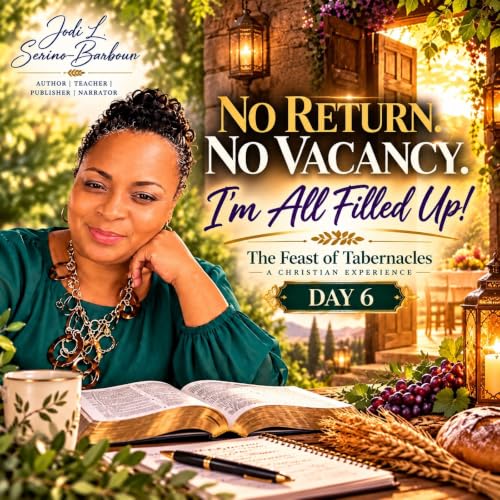
  • Day 6 | No Return, No Vacancy, I'm All Filled Up! - A Christian Experience: Celebrating the Feast of Tabernacles
    Oct 19 2026
    Day 6 | No Return. No Vacancy. I'm All Filled Up!A Christian Experience: Celebrating the Feast of TabernaclesWhat happens when God brings you into a new season, but the old habits, reactions, and ways of thinking try to follow you there?Welcome to Day 6 of A Christian Experience: Celebrating the Feast of Tabernacles.From September 26 through October 3, 2026, I set aside these eight days to honor the Feast of Tabernacles, a time of celebration established by the Lord. Throughout this experience, I have been sharing what these days actually look like for me, what I'm doing, what I'm studying, and what I'm learning as I spend this time with Him.Today's study begins in Numbers 29:29-31, where the Lord gives instructions concerning the offerings for the sixth day of the Feast.Eight bulls. Two rams. Fourteen male lambs. Their accompanying grain and drink offerings. And one goat as a sin offering.The number of bulls has decreased each day, beginning with thirteen on Day 1 and continuing through twelve, eleven, ten, nine, and now eight.I was excited to examine the significance of eight, especially because of what I had already been learning about the numbers and their relationship to the harvest cycle.But yesterday's study, The Breakthrough Hidden in the Specifics, taught me something important. Don't overlook the details just because you think you already understand what you're reading.And that lesson changed the direction of today's study.THE FOUR WORDS I ALMOST LEFT BEHINDI had noticed the goat. I had already been examining what the goat could teach me about my will, independence, and stubbornness.But Scripture didn't merely say that a goat was offered.It specifically identified the goat as being offered "as a sin offering."Those four words sent me back into the Scriptures.Before continuing, I want to make something clear. As Christians, we are not required to sacrifice animals for our sins. Jesus Christ has already offered Himself as the sacrifice for sin, once for all.My purpose in examining these offerings is not to reestablish animal sacrifices. It is to understand what the details God placed in His Word can teach me about my relationship with Him.And sometimes, those details expose something about us that we didn't realize needed attention.NO SHORTCUTS: RETURNING TO LEVITICUS 4During my research for my book Iron Sharpens Iron, I had previously studied the different offerings described in Scripture.That earlier research helped point me back to Leviticus 4, but it didn't eliminate the need for me to do the work.Leviticus 4 describes sin offerings involving four different categories.The priest, Leviticus 4:3-12.The community, Leviticus 4:13-21.A leader, Leviticus 4:22-26.An individual, Leviticus 4:27-35.Because this was my personal study, I followed the instructions concerning the individual.And that brought me face-to-face with unintentional sin.What happens when we violate one of God's commandments without initially realizing what we've done?And what becomes our responsibility once that sin is brought to our attention?The passage made me examine the difference between not knowing and refusing to respond once we know.It also made me examine something deeply personal.Am I willing to acknowledge when my will has gone against God's will?Or will I defend myself, justify my actions, and place responsibility somewhere else?The account of Adam and Eve in Genesis 3 came to mind as I considered the importance of taking responsibility for our actions.And the fact that Leviticus 4 specified a female goat or lamb for the individual's offering became another detail that prompted me to reflect on accountability.Sometimes the most difficult part of laying down our will is acknowledging that we were wrong.But acknowledging sin doesn't mean we must remain trapped in condemnation.Romans 5:20-21 reminds us of the abundance of God's grace.And Proverbs 28:13 reminds us that the one who confesses and forsakes sin finds mercy.Grace gives us the opportunity to acknowledge what God has revealed, lay it down, and continue walking with Him.FINALLY, WE ARRIVE AT EIGHT!After following the sin offering into Leviticus 4, I returned to the eight bulls in Numbers 29.And this is where the study took another turn.Yesterday's study had led me to examine the nine fruits of the Spirit described in Galatians 5:22-23.I began thinking about those fruits as the internal conditions necessary for a healthy spiritual harvest.Love, joy, and peace establish the internal climate.Longsuffering, kindness, and goodness help us endure external pressures without losing the character God is developing within us.Faithfulness, gentleness, and self-control help us remain steady, govern our responses, and bring our conduct into alignment with the Holy Spirit.Then I began examining the significance of eight.In my study, eight became a picture of a new beginning following a completed cycle.Seven completes the week. The next day begins a new week.Genesis 17:12 ...
    Mehr anzeigen Weniger anzeigen
    26 Min.
  • Day 5 | The Breakthrough Hidden in the Specifics - A Christian Experience: Celebrating the Feast of Tabernacles
    Oct 17 2026
    The Breakthrough Hidden in the SpecificsDay 5 | A Christian Experience: Celebrating the Feast of TabernaclesSeptember 30, 2026 | Tishrei 19Scripture Foundation: Numbers 29:26-28What if the breakthrough you have been waiting for is hidden in a detail you almost overlooked?Welcome to Day 5 of A Christian Experience: Celebrating the Feast of Tabernacles.During this eight-day celebration, I am sharing what honoring the Feast of Tabernacles looks like in my everyday life as a Christian. I am sharing what I am doing, what I am studying, what I am learning, and how I am applying God's Word.Today's study begins in Numbers 29:26-28, where the Lord specifies the offerings for the fifth day: nine bulls, two rams, fourteen lambs, one goat, and the accompanying grain and drink offerings.But before I could begin examining the significance of the nine bulls, two details caught my attention.THE IMPORTANCE OF SPECIFICSGenesis 6:22 and Genesis 7:5 both testify concerning Noah's obedience.Twice, Scripture emphasizes that Noah did according to ALL that God commanded him.That double witness caused me to consider the importance of paying attention to God's specific instructions.As I examined the offerings throughout the Feast, I noticed something interesting. On some days, the instructions specified a kid of the goats. On other days, they specified a goat.Why the distinction?A kid is a young goat, full of energy, playfulness, and curiosity. An adult goat has reached maturity and can be associated with strength, capability, independence, stubbornness, and being headstrong.As I considered these differences, I began examining human behavior, including my own.I looked back over the first four days of the Feast and recognized how youthful energy and adult responsibility had appeared in my everyday experiences.From singing and dancing throughout the house to rearranging furniture, facing my fear of spiders, cutting grass, and making lavender lemonade for the first time, I could see practical illustrations of what I was studying.And that matters because studying God's Word should lead us beyond collecting information. We need to understand what we are learning so that we can apply it.THE GRAIN AND DRINK OFFERINGSThe second detail concerned the grain and drink offerings.In 2020, I wrote a book called Iron Sharpens Iron - It's Business, Not Personal. In Chapter 7, I examined the Lord's offerings and what they represent for Christians today.We no longer offer animal sacrifices because Jesus Christ offered Himself once for all, as Hebrews 10:10 explains.But the offerings still provide valuable lessons when we examine their symbolism and the Scriptures surrounding them.This time, I realized that I had overlooked the drink offering in my earlier study.As I considered the grain and drink offerings together, I was reminded of Communion, the bread and the wine.Bread brought me to Matthew 4:4 and Luke 4:4, where Jesus explains that we do not live by bread alone, but by every word that proceeds from the mouth of God.That brought me to Hosea 14:2, which instructs us to take words with us and return to the Lord. The verse also speaks of offering the calves, or bulls, of our lips.And suddenly, I was right back at the bulls!But there was more.Wine carries several meanings throughout Scripture, including joy and blessing.So I began considering the grain as a picture of God's Word and the wine as a picture of joy.Psalm 119:162 speaks of rejoicing at God's Word.Psalm 119:111 describes God's testimonies as the rejoicing of the heart.Jeremiah 15:16 describes finding and eating God's words and discovering that they became the joy and rejoicing of the heart.Psalm 19:8 and Psalm 19:14 also connect God's Word, the rejoicing of the heart, and the words of our mouths.And there it was!In the symbolic application I had been developing throughout the Feast, the bull represented my praise, the ram my adult responsibility, the lambs my childlike curiosity and innocence, the goat my will and character, and the kid of the goats my youthful energy.Now the grain and drink offerings brought me to my joy and delight in reading God's Word.BAM! Mic drop!NINE AND THE HIDDEN HARVESTNow I was ready to examine the nine bulls.Why nine?During the previous day's study, ten had brought me to responsibility, structure, and stewardship.But as I examined nine, I began considering something different.The womb of the harvest.The hidden incubation of a seed.The development that takes place before something is brought forth.Consider what happens when a seed is planted.Once it is covered with dirt, it may appear that absolutely nothing is happening. But beneath the surface, roots can be developing and growth can be taking place.I shared an example from my own backyard, where sweet potatoes continued appearing in an area where we had planted them two years earlier.Something we could not see was still producing.And that brought me to the test of the dark room.MY EXPERIENCE IN THE DARK ...
    Mehr anzeigen Weniger anzeigen
    26 Min.
adbl_web_anon_alc_button_suppression_t1
Noch keine Rezensionen vorhanden