• Does Abdominal EMS Make Your “Breathing-Out” Muscles Contract Strongly?| Published in Journal of Applied Physiology 2018
    Mar 2 2026

    Can electrical stimulation really make your breathing muscles contract strongly? And does electrode placement actually change the result?

    Maybe you’ve felt your core getting weaker lately. Cough feels softer than before. Your abdomen does not engage like it used to. Or you already use EMS and wonder if it truly activates the muscle.

    A 2018 study published in the Journal of Applied Physiology looked at this. Researchers from the University of New South Wales tested abdominal electrical stimulation in healthy adults.

    They measured real muscle pressure during breathing out. Not opinions. Not guesses. Actual pressure inside the abdomen and chest.

    They found that abdominal stimulation showed a measured increase in expiratory pressure. But here is the interesting part. Electrode placement made a big difference.

    When electrodes were placed more toward the side and back, muscle contraction was associated with significantly higher pressure. Front placement produced less pressure.

    In simple terms: The muscles did contract. And placement influenced how strongly.

    Why does this matter?

    Breathing out forcefully helps with coughing. Coughing helps clear the airways. Abdominal muscles play a big role in that force.

    This does not mean EMS replaces natural breathing. It does not promise clinical outcomes. But it shows measurable activation of the muscles involved.

    The study was peer-reviewed and carefully controlled. Small sample, but clear measurements. No dramatic claims. Just physiology.

    If you use EMS, placement matters. If you are considering EMS, understanding mechanism matters. Small details can influence real muscle response.

    There are more details in the full breakdown. Including exact pressure numbers and what they mean.

    Read the full breakdown here → https://bit.ly/4b0JHg3

    Educational content only. Not medical advice.

    Mehr anzeigen Weniger anzeigen
    18 Min.
  • Why do my legs feel weaker now? | Study conducted by University of Burgundy
    Mar 1 2026

    Why do your legs feel weaker lately? What if it’s not just aging?

    You stand up slower now. Stairs feel heavier than before. Long walks leave you tired. You try to stay active, but progress feels small.

    That feeling is common.

    A peer-reviewed study in the International Journal of Sports Medicine examined electrical muscle stimulation, or EMS. Researchers from European universities studied active adults and added EMS for four weeks.

    Both groups continued normal training. Only one group added EMS.

    After four weeks, the EMS group showed improvement in measured strength. Eccentric strength showed a measured increase. High-speed strength also showed improvement. Squat jump performance increased by 14 percent.

    The comparison group showed no meaningful change.

    Why does this matter?

    Strength is not only about muscle size. It also depends on nerve activation. Clearer muscle signals may support stronger contractions.

    For everyday life, that can mean:

    Standing from a chair with more confidence. Walking more steadily. Climbing stairs with less effort.

    This does not promise dramatic change. It does not replace exercise or medical care. Results vary between individuals.

    The study was controlled and randomized. Strength was measured with scientific equipment.

    There are more details in the full article.

    Read the full breakdown here → https://bit.ly/3OJV848

    Educational content only. Not medical advice.

    Mehr anzeigen Weniger anzeigen
    14 Min.
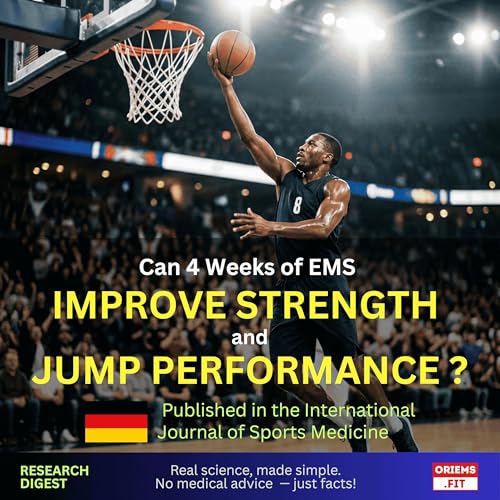
  • Can 4 Weeks of EMS Improve Strength and Jump Performance? | Published in the International Journal of Sports Medicine
    Mar 1 2026

    Can 4 weeks really change your strength? What if your muscles just need clearer signals?

    You train. You walk. You try to stay active. But one leg feels weaker. Your jump feels lower. Your knee feels unstable. Progress feels slow.

    That feeling is common.

    A peer-reviewed study published in the International Journal of Sports Medicine looked at this. Researchers studied competitive basketball players. They added EMS training for 4 weeks.

    Both groups kept normal basketball practice. Only one group added EMS.

    After 4 weeks, the EMS group showed improvement in measured strength. Eccentric strength increased. High-speed strength increased. Squat jump height increased by 14%.

    The control group showed no meaningful change.

    After another 4 weeks of regular practice, the EMS group also showed improvement in countermovement jump. Strength gains were associated with better explosiveness.

    Why does this matter?

    Strength is not just about bigger muscles. It is also about better nerve activation. Clearer signals. Stronger contractions.

    For people with muscle weakness, or slow progress, or feeling “stuck,” this suggests EMS may support strength development when used consistently.

    This does not replace exercise. It does not guarantee results. But it may support muscle activation.

    The study was controlled and randomized. Results were measured with scientific equipment.

    There are more details in the full article.

    Read the full breakdown here → https://bit.ly/3OSeAM1

    Educational content only. Not medical advice.

    Mehr anzeigen Weniger anzeigen
    19 Min.
  • As We Get Older, Can EMS Help Support Back Strength?
    Feb 28 2026

    Is your back feeling weaker lately? Do simple tasks feel harder than before?

    Maybe getting up from a chair feels slower. Maybe standing too long makes your back tired. You used to feel stronger. Now you feel cautious. You wonder if this is just aging.

    A published study from Seoul National University explored this area. It appeared in the Journal of Strength and Conditioning Research. Researchers tested back strengthening with and without EMS. The participants were healthy young men. It was a randomized, controlled pilot study.

    Both groups showed improvement in back strength. Both groups showed improvement in endurance. The EMS group showed a measured increase that was slightly greater. The effect size was moderate. The difference was not dramatic. But it suggested added neural activation.

    What does that mean in simple terms? EMS may help the muscles switch on more fully. Especially in short-term training. Strength early on often comes from better nerve signals. Not just bigger muscles.

    Why does this matter as we get older? Because muscle activation can decline with age. Sometimes the issue is not effort. It is connection. If muscles are not activating strongly, progress feels slow.

    EMS does not replace exercise. It works alongside it. It is not a cure for back pain. It is not a guarantee. But it may support strength when used properly.

    The study was peer-reviewed and controlled. Small, but carefully measured.

    There are more details in the full article.

    Read the full breakdown here →https://bit.ly/4r8a8Gx

    Educational content only. Not medical advice.

    Mehr anzeigen Weniger anzeigen
    17 Min.
  • Can adding EMS make your back stronger?
    Feb 28 2026

    Can adding EMS make your back stronger? Or is it just another fitness trend?

    Maybe you train your back every week. But one side still feels weaker. Or progress feels slower than expected. You try harder. Still, something feels missing.

    A real study from Seoul National University looked at this. It was published in the Journal of Strength and Conditioning Research. They tested 20 healthy young men. Two weeks of back training. One group added EMS. One group did exercise alone.

    Both groups showed improvement in strength. Both groups showed improvement in endurance. But the EMS group showed a measured increase that was slightly greater. The effect size was moderate. The difference was not dramatic. But it was meaningful.

    Researchers suggested this may relate to neural activation. In simple terms, better muscle recruitment. Not magic. Not instant transformation. Just potentially better signal to the muscle.

    Why does this matter?

    Early strength gains often come from the nervous system. Not muscle growth. If activation is your weak link, EMS may support that process. Especially when combined with proper exercise.

    This was a randomized, controlled pilot study. Small. But peer-reviewed. And measured with proper strength testing equipment.

    It does not prove pain reduction. It does not guarantee results. But it shows EMS is not “doing nothing.”

    If you already use EMS, this offers reassurance. If you are considering it, it offers perspective.

    There is more detail in the full breakdown.

    Read the full breakdown here → https://bit.ly/3MX74Pn

    Educational content only. Not medical advice.

    Mehr anzeigen Weniger anzeigen
    10 Min.
  • Training Hard but Not Seeing Enough Progress? What This 2024 EMS Study Suggests
    Feb 25 2026

    Are you training hard but still feel weak in one area? What if position changes how strong your muscles contract?

    You push through sessions. You stretch. You try to activate the muscle. Yet one side still feels underpowered. Or your strength feels stuck.

    A 2024 systematic review published in PLOS ONE examined this closely. Researchers from Brazil and France reviewed 36 studies on neuromuscular electrical stimulation (NMES).

    They looked at how joint angle affects muscle contraction strength.

    They found that when NMES was applied at a mid-range joint angle, muscles produced higher torque. That position was associated with stronger measured contractions. Strength gains were greater when training used that optimal angle. Shortened positions produced more discomfort and less force.

    In simple terms, position mattered.

    If you use EMS for activation or strength support, joint setup may influence how effective it feels.

    This does not replace proper training. It does not guarantee results. But it suggests EMS can support stronger contractions when used thoughtfully.

    Read the full breakdown here → https://bit.ly/4tPxsLK

    Educational content only. Not medical advice.

    Mehr anzeigen Weniger anzeigen
    19 Min.
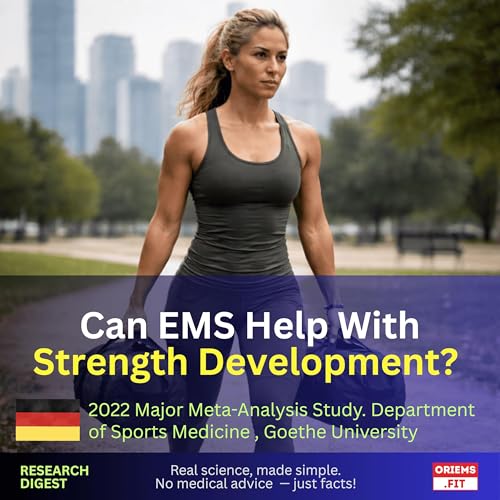
  • Can EMS Help With Strength Development? What a Major 2022 Meta-Analysis Found
    Feb 24 2026

    Can electrical muscle stimulation really build strength? Or is it just another fitness trend?

    Maybe you feel weaker than before. Maybe one muscle never “switches on.” Maybe training feels harder than it should.

    That feeling is frustrating. You try. But progress feels slow.

    A 2022 peer-reviewed meta-analysis looked at this question. It was conducted by researchers at Goethe University, Germany. Published in the Journal of Strength and Conditioning Research.

    They reviewed 19 controlled studies. A total of 319 healthy participants were included.

    The researchers analyzed neuromuscular electrical stimulation, or NMES. This type of EMS creates visible muscle contractions.

    Across studies lasting about 5–6 weeks, NMES training showed improvement in measured strength outcomes.

    When total training work was matched, NMES was associated with strength gains similar to conventional strength training.

    In simple terms: Muscles got stronger with repeated electrical contractions.

    Not magic. Not instant. But measurable.

    Why does this matter?

    Strength improves when muscle fibers are repeatedly activated. NMES directly stimulates motor nerves. That creates structured contractions.

    For someone who struggles to fully activate a muscle, this may provide additional stimulus.

    For someone recovering from time off training, it may support gradual rebuilding.

    For someone already using EMS, this research offers reassurance.

    Consistency matters. Weeks matter. Intensity matters.

    This was not a single experiment. It was a systematic review of multiple controlled studies. That adds weight to the findings.

    EMS is not a replacement for medical care. It is not a miracle solution. But it may support strength development when used properly.

    There is much more detail in the full article. Including how the studies were designed.

    Read the full breakdown here → https://bit.ly/4cIiyAK

    Educational content only. Not medical advice.

    Mehr anzeigen Weniger anzeigen
    21 Min.
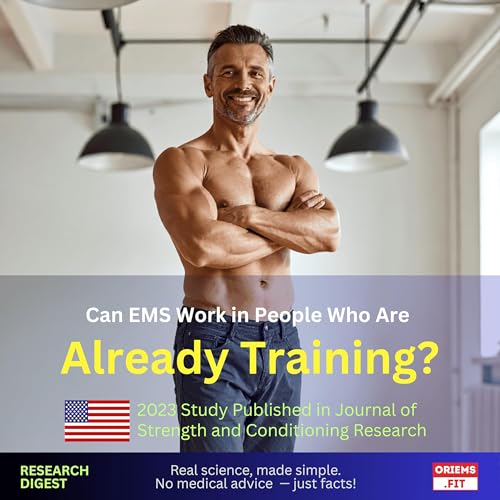
  • Can EMS Work in People Who Are Already Training? 2023 Study Published in JSCR
    Feb 24 2026

    Can EMS really make your muscles stronger? Or is it just a strange buzzing feeling?

    Maybe your legs feel weaker lately. Maybe your back tires easily. Maybe you train hard but still feel one side lagging. You want something extra. But you also want real evidence.

    A 2023 systematic review in the Journal of Strength and Conditioning Research looked at this question. Researchers from universities in Australia, Singapore, and Europe analyzed 10 controlled studies.

    Here’s what they found.

    EMS was associated with improvements in measured muscle strength in healthy adults. Strength tests showed a measured increase in force output. This included both younger and older participants.

    However, sprinting and jumping did not consistently improve. So it helped strength tests. But not automatically performance.

    Why does that matter?

    Because stronger muscles can support daily tasks. Standing from a chair. Climbing stairs. Holding posture longer.

    It suggests EMS can stimulate muscles in a measurable way. But it is not magic. And it does not replace movement practice.

    The review included randomized and controlled trials. It was peer-reviewed and published in a respected strength journal.

    If you are considering EMS, this gives realistic reassurance. If you already use EMS, consistency may matter more than intensity.

    There are more details in the full breakdown.

    Read the full breakdown here → https://bit.ly/4aT8pyP

    Educational content only. Not medical advice.

    Mehr anzeigen Weniger anzeigen
    15 Min.