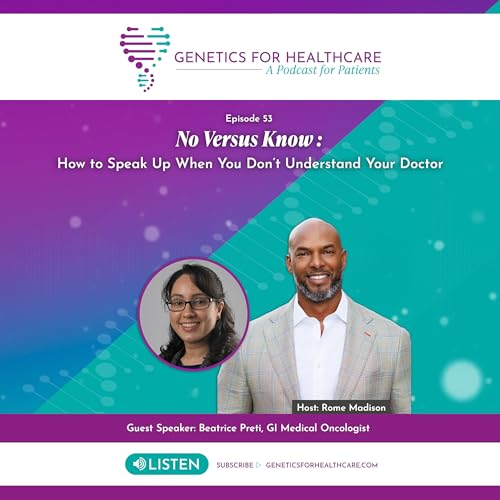
• No Versus Know – How to Speak Up When You Don’t Understand Your Doctor
    May 1 2026

    When doctors speak quickly or use medical terms, patients often leave appointments feeling unsure about what just happened, and that confusion can cost you your life.

    In this episode Dr. Beatrice Preti explains why it’s crucial to build the confidence to ask questions, to insist on clear explanations, and to push for options that fit your values and lifestyle goals.

    They discuss real cases where patients who asked for clarity made different choices—choices that preserved quality of life or avoided unwanted side effects, and why chart notes that label someone as “refusing treatment” can misrepresent a patient who simply didn’t understand.

    She also calls on physicians to take a few minutes to learn who their patients are as people — their goals, work, hobbies, fears — because that context makes it easier to tailor treatments.

    Listen for these useful ways to communicate with your doctor:

    • Name your goals: tell your clinician what matters most (quality of life, work, hobbies, family)
    • Refuse to accept confusing explanations: confusion is not consent.
    • Take time, if possible, to pause making a decision to think, ask more questions, or get a second opinion
    • Bring support: a friend or family member can help ask questions and remember answers.

    This episode makes a clear case: silence or confusion in the clinic isn’t harmless. Speaking up, asking for time, seeking second opinions, and insisting on explanations aren’t rude — they are essential steps to protecting your health and making care fit your life.

    META DESCRIPTION

    What if staying quiet in the doctor’s office cost you the life you want? Dr. Beatrice Preti and host Rome Madison explain why speaking up matters. If medical words make no sense or a treatment plan feels wrong, you must ask questions until you understand. Learn why saying “I don’t get it” is not rude — it protects your health, your goals, and your choices. Hear real stories of patients who changed their care after asking for clarity and learn practical tips for speaking up to make sure you KNOW what’s going on. Doctors also need to listen and spend a few minutes to know who you are beyond the diagnosis. Don’t leave your doctor’s office confused! Your voice shapes your care — use it. Tune in to learn how to build confidence, demand clear answers, and make shared medical decisions with your doctors that fit your life.

    Mehr anzeigen Weniger anzeigen
    40 Min.
  • Don’t Let Your Doctor’s Genetics Blind Spot Kill You – Educate Yourself (and your doctor) On ATM Gene Variants and Cancer Prevention
    Apr 23 2026

    In this eye-opening episode, we sit down with Krista Brown, an oncology nurse navigator whose personal journey dramatically exposes the critical knowledge gaps in modern healthcare regarding genetic variants and cancer risk.

    Despite her professional background, Krista found herself navigating a system where her own ATM variant – a genetic mutation significantly increasing her risk for breast, pancreatic, and ovarian cancers – was largely unknown or misunderstood by her care providers.

    Krista's family history is poignant: her mother, initially negative for BRCA, later discovered an ATM mutation, which Krista subsequently inherited. This propelled Krista into a proactive health journey, including seeking expanded gene testing and making the courageous decision for a preventative mastectomy. Shockingly, it was during this preventative procedure that early-stage breast cancer was discovered in the pathology, underscoring the life-saving impact of her self-advocacy.

    Key Takeaways from This Episode:

    • Genetic Literacy is Life-Saving: Learn why understanding your genetic predispositions, even beyond common variants like BRCA, is crucial for early detection and prevention, and how to advocate for comprehensive testing.
    • The Power of Self-Advocacy: Krista's journey highlights the necessity for patients to educate themselves and challenge healthcare providers when their specific genetic risks are overlooked or misunderstood.
    • Nutrition as a Prevention Tool: Discover why integrating proper nutrition is an empowering and actionable step, especially for individuals with genetic predispositions, to actively reduce cancer risk.

    This episode is a stark reminder that patients can't make informed decisions if doctors aren't educating us on our options. Learn why Krista is now a passionate advocate for genetic literacy in healthcare, emphasizing proactive testing, personalized care, and the often-overlooked role of nutrition in cancer prevention.

    META DESCRIPTION

    Do you know your true cancer risk? Meet Krista Brown, a nurse who had to teach her own doctors about the ATM gene mutation that put her life in danger. This meant she had a much higher chance of getting breast, pancreas, and ovarian cancers. Even though she worked in healthcare, her doctors often didn't know what this specific gene change meant or how to properly help her. Her story exposes a big problem in healthcare: sometimes doctors don't know enough genetics and cancer risks. If they don't have this knowledge, how can they guide you? Learn why it's super important to ask questions, learn about your own genes, and speak up for your health.

    Mehr anzeigen Weniger anzeigen
    37 Min.
  • Genetics, Sleep and Your Brain - Precision Medicine Advancing Early Detection in Neurology
    Apr 17 2026

    Alzheimer’s disease and other neurodegenerative disorders don’t appear overnight—they develop silently in the brain for years. In this episode, we explore how genetics, sleep, and lifestyle combine to shape your brain health, and why precision medicine may be the key to earlier detection and more effective treatment.

    Dr. Kimberly J Hatchett, The Neuro Doc, breaks down, in plain language, how certain genes increase risk for Alzheimer’s disease, Parkinson’s disease, dementia, and other neurological conditions—and what that means for you and your family. We dive into how cutting‑edge brain imaging, genetic testing, and sleep data are coming together to create truly personalized care plans.

    Don’t miss these key takeaways:

    • How genetics influence your risk for Alzheimer’s disease and other brain disorders—and why genes are not destiny.
    • Why sleep quality is emerging as a powerful, controllable standard of long‑term brain health.
    • How precision medicine and personalized neurology are changing early detection, diagnosis, and treatment options.
    • Practical steps you can take now to support brain health, even if you have a strong family history of neurological diseases.

    If you’ve ever wondered whether you should get genetic testing to determine risks for neuro diseases, how to protect your memory, or what sleep for a healthy brain really looks like, this conversation offers an evidence‑based roadmap for proactive brain health.

    META DESCRIPTION

    Are you worried about Alzheimer’s disease or keeping your brain sharp as you age? The Neuro Doc Dr. Kimberly J Hatchett explains brain health in simple, clear language. She talks about how your genes, sleep, and daily habits can raise or lower your risk for Alzheimer’s, dementia, Parkinson’s disease, and other brain problems. You’ll learn what “precision medicine” means and how doctors are starting to use genetics and sleep data to create brain care plans that are personalized for each person. If you want practical ideas to support your brain health today—and better understand your risk for future disease—this episode gives you clear, science-based guidance you can use right away.

    LINKS

    DrKimNeuroDoc on TikTok

    Follow Dr Kim on Instagram

    drkimberlyjhatchett.com

    Mehr anzeigen Weniger anzeigen
    38 Min.
  • 10 Family Cancer Deaths to Zero: The Transformative Impact of Genetic Testing
    Apr 10 2026

    In this monumental 50th episode, we celebrate the remarkable journey and courage of Diane Hardesty, a hereditary cancer awareness advocate and cancer previvor. Diane's story is a powerful testament to the life-saving potential of genetic testing. After losing ten family members to cancer, she took the crucial step to undergo hereditary cancer testing, leading to a transformative shift in her family's health trajectory, resulting in zero cancer deaths after testing.

    We delve into Diane's inspiring path, discussing the importance of awareness, education, and action in the face of hereditary cancer. Diane's powerful message not only emphasizes the significance of genetic testing but also highlights how it can save lives and prevent heartache for generations to come.

    Key Takeaways:

    • Understanding the impact of hereditary cancer and the importance of genetic testing.
    • Diane's personal experience of losing ten family members to cancer and the turning point she faced.
    • How genetic testing empowered Diane to change her family's future and eliminate cancer risk.
    • Practical advice for those considering genetic testing and navigating their own family histories.

    Tune in for an episode filled with hope, resilience, and the undeniable message that knowledge truly saves lives!

    We help you learn the language of precision medicine, and build the confidence to talk to your family and doctors about genetic risks.

    Become a more effective advocate for your wellbeing and turn sick care into true healthcare!

    META DESCRIPTION

    How can you prevent cancer in your family? In this episode, Diane Hardesty shares her powerful story of losing ten family members to cancer before discovering the life-changing benefits of genetic testing. After her testing, she experienced a dramatic shift—there have been no cancer deaths in her family since. This episode emphasizes the critical role of genetic testing in identifying hereditary risks and preventing cancer before it starts. Learn how knowledge of your genetic makeup can inform your choices, leading to early detection, proactive care, and ultimately, saving lives. Diane's journey highlights the importance of awareness and education around genetic testing for families facing cancer risks. Tune in to uncover practical insights on how you can take charge of your health and protect future generations from cancer. Join us for this important discussion on the significant impact of genetic testing in cancer prevention!

    Mehr anzeigen Weniger anzeigen
    54 Min.
  • Trust Your Gut – CDH1 Gene and Preventing Gastric Cancer
    Mar 19 2026

    When Stacey Martin received her mother's stage four uterine cancer diagnosis, she never imagined it would lead to discovering her own genetic time bomb. After her mother tested positive for a CDH1 germline mutation during treatment at Mayo Clinic, Stacey faced a 50% chance of carrying the same variant that dramatically increases gastric cancer risk up to 80%.

    This episode follows Stacey's incredible journey of trusting her instincts at every critical juncture - from advocating for her mother's care, to getting genetic testing herself, and ultimately making the life-saving decision to undergo preventative total gastrectomy. Her brave choice paid off when pathology revealed 17 hidden cancer spots that would have remained undetected through standard surveillance.

    Stacey shares practical insights about navigating genetic counseling, understanding CDH1-related hereditary diffuse gastric cancer, and building the support systems necessary for major medical decisions. Her story demonstrates how genetic testing and preventative surgery can transform a potential death sentence into empowered survival.

    Key Takeaways:

    • CDH1 mutations increase lifetime gastric cancer risk to 70-80% and lobular breast cancer risk to 67%

    • Preventative total gastrectomy can be life-saving when cancer is undetectable through surveillance

    • Genetic testing requires careful planning around insurance coverage and support systems

    • Patient advocacy and seeking centers of excellence are crucial for rare genetic conditions

    META DESCRIPTION

    Do you want to prevent stomach cancer? Meet Stacey Martin — whose mother’s CDH1 test led her to discover she carried the same dangerous gene. This episode follows Stacey’s fight for family, her decision to get genetic testing, and the preventative total gastrectomy that found 17 hidden tumors. A powerful story about the CDH1 gene, gastric cancer risk, cancer prevention, and precision medicine.

    LINKS

    https://hereditarydiffusegastriccancer.org/

    https://lobularbreastcancer.org/

    No Stomach for Cancer

    Mehr anzeigen Weniger anzeigen
    39 Min.
  • Powering Precision Medicine in Primary Care: How Endeavor Health is Lowering Downstream Cost of Cancer Care and Chronic Rare Disease
    Mar 12 2026

    Endeavor Health is proving that precision medicine isn’t just for academic centers or rare-disease clinics. it can be In this episode, Rome talks with Justin Brueck, Vice President of Innovation and Research at Endeavor Health, about how their system has hardwired population genetics into everyday primary care for hundreds of thousands of patients.

    Justin walks through the evolution of Endeavor’s genomics program from its roots in a 1980s vision for medical genetics to today’s scaled “Genetic and Wellness Assessment” embedded in Epic. He explains how they designed guideline-based workflows that allow primary care clinicians—not geneticists—to safely order testing, and how new roles like Genetic Counseling Assistants and dedicated consult clinics keep the system from getting clogged while ensuring patients get appropriate follow-up.

    The conversation also dives into what the data show: high patient acceptance, manageable anxiety, meaningful detection rates, and strong health-economic signals that routine genetic testing can reduce the costs of late-stage cancer and other chronic diseases.

    Justin ends with practical advice for health systems that want to build similar programs, and guidance for patients who want genetic screening but haven’t been offered it by their current providers.

    Key Takeaways for Health System Leaders

    • Guideline-based survey questions and decision support in Epic automatically surface who should be offered genetic testing.
    • The program is designed to be equitable, with targeted outreach to communities (e.g., safety net hospital and the Vietnamese patient population) using trusted local messengers.
    • Routine genetic testing supports earlier detection, guideline-based prevention, and reduced downstream costs, especially as systems move toward value-based care.

    META DESCRIPTION

    Discover how precision medicine is changing cancer prevention and everyday healthcare. Justing Bruek, VP of Innovation and Research at Endeavor Health explains how they were able to move from “wait until you’re sick” care to proactive disease prevention by adding a short genetic and wellness survey to annual checkups can flag patients who may need advanced screening for cancer and other rare conditions. Their publications support how this approach supports early detection, reduces late-stage cancer, improve outcomes, and lower the long-term cost of care—all while giving patients more power over their health.

    Mehr anzeigen Weniger anzeigen
    31 Min.
  • Country Miles to a Clinical Trial – Bridging the Gap to Precision Medicine in Rural America
    Mar 5 2026

    JJ Singleton was a 27-year-old athlete from the small Appalachian town in North Carolina, when he was diagnosed with aggressive colorectal cancer. His story highlights the alarming rise of early-onset colorectal cancer, a disease now the leading cause of cancer death for men under 50.

    Growing up in a rural community where going to the doctor was often avoided and early death was dismissed as "God's will," JJ wasn’t diagnosed with colon cancer until a visible tumor throbbed in his abdomen. His journey from brutal chemotherapy failures to a life-stabilizing immunotherapy clinical trial at Duke is a powerful testament to the promise of precision medicine—turning terminal cancer into a manageable chronic condition.

    Yet, his story also exposes a critical cancer care disparity: the immense difficulty rural patients face in accessing the very trials that could save them. This episode explores how geography, limited resources, and a lack of knowledge about accessing healthcare as a preventative strategy creates an intimidating barrier between rural Americans and cutting-edge care.

    Key Takeaways:

    • Early-Onset Crisis: Colorectal cancer is rising dramatically in adults under 50 and is now a leading cause of cancer death in this age group.
    • Rural Disparity: Where you live is a major social determinant of health, creating significant barriers to screening, specialist care, and life-saving clinical trials.
    • Chronic Disease Potential: Immunotherapy and precision medicine trials are beginning to successfully turn some advanced, active cancers into controllable chronic conditions.

    We amplify Colorectal Cancer Awareness Month with JJ's personal advocacy to a national conversation on prevention, breaking stigma, and the systemic changes needed to bridge the gap to precision medicine for every patient, regardless of their zip code.

    Follow JJ Singleton X Facebook Instagram

    META DESCRIPTION

    This podcast episode shares the incredible journey of JJ Singleton from rural Appalachia diagnosed with aggressive colon cancer at age 27. After struggling through harsh chemotherapy, he found new hope through an immunotherapy clinical trial using Keytruda (pembrolizumab), which has successfully stabilized his cancer and allowed him to live a full, active life for years—showing how modern treatments can turn cancer into a manageable chronic condition. We also tackle the alarming rise of early-onset colorectal cancer in younger adults, and the vital importance of cancer screening and breaking stigma around symptoms. Learn the language of precision medicine and build the confidence to talk to your doctor and family, and become an effective self-advocate for a precision medicine approach to your healthcare.

    Mehr anzeigen Weniger anzeigen
    30 Min.
  • You Bet Your Ass! Don’t Gamble on Colorectal Cancer. Win With Screening and Biomarkers
    Mar 1 2026

    Marianne Pearson, VP of Patient Care and Lindsey Glaspell, Clinal Nurse Navigator at the Colorectal Cancer Alliance, join Rome for a blunt, funny — but deadly serious — briefing on colorectal cancer prevention. Marianne breaks down how knowing your family history and normalizing talking about your poop habits are just as important as timely screening with colonoscopy and stool tests to prevent colon and rectal cancer. She also shares how her dedicated advocacy for others, helped detect her own cancer at an early stage that likely saved her life. Lindsey adds a sharp, practical perspective on everyday prevention: how to prepare for a colonoscopy, when to start screening, and which biomarkers matter for treatment planning and prevention strategies. Tumor biomarker analysis, and genetic screening for hereditary syndromes like Lynch Syndrome that drive earlier detection and better outcomes. Key Takeaways: Colonoscopy saves lives: starting at age 45 guideline-based colon and rectal cancer screening remains the top prevention tool. Biomarkers can change care: tumor and germline biomarkers guide treatment and identify at-risk relatives for targeted surveillance. Genetic testing for Lynch and other hereditary CRC syndromes enables testing of relatives that can prevent cancer in the family tree. Subscribe to Genetics for Healthcare and get our newsletter —bite-sized updates on past episodes delivered monthly. Click Subscribe now and never miss life-saving practical tips to prevent cancer. META DESCRPTION Did you know talking about your poop habits can save your life? This podcast talks about colon and rectal cancer screening, what you don’t wanna do ….. and what you do wanna do. Learn why biomarkers are so important in colorectal cancer, how knowing your family history and genetic testing can prevent colon cancer for your future generations. Don’t ignore your poop! Learn what to ask your doctor, how to get tested, and where to find help. Don’t wait: screening saves lives! We help you learn the language and build the confidence to talk about precision medicine with your doctors and family. This is GENETICS FOR HEALTHCARE—a podcast helping turn sick care into true healthcare! We are dedicated to helping patients and caregivers learn the language and build the confidence to advocate for precision medicine in treatment, survivorship, disease screening, and prevention. 2025 State of Screening Study Why are Biomarkers Important for Colorectal Cancer? Types of Biomarkers for Colorectal Cancer How to talk to your doctor about colorectal cancer screening? Genetics For Healthcare: Spotify: https://open.spotify.com/show/5tvMOrd9RyHLdOEGFNWavq?si=18815af6d1fe4da0 Facebook: https://www.facebook.com/GeneticsForHealthcare Instagram: https://www.instagram.com/geneticsforhealthcare/ TikTok: https://www.tiktok.com/@genetics.for.healthcare LinkedIn: https://www.linkedin.com/company/genetics-for-healthcare-podcast/

    Mehr anzeigen Weniger anzeigen
    35 Min.