• Episode 112: Your Agency's AI Progress Is One Resignation Away from Zero with Ishant Kulshreshtha
    Jun 22 2026

    Most agencies have someone who's figured out AI better than anyone else on the team. They built the custom GPTs. They know the prompts. They're the one everyone asks when something breaks.

    Now ask yourself: what happens if that person leaves tomorrow?

    "If your agency relies completely on one AI champion, the agency's progress is limited to one resignation."

    Ishant Kulshreshtha, AI Strategic Analyst at White Label IQ, joins host Erik Martinez on Episode 112 of the Digital Velocity Podcast to talk about what it actually takes to move AI knowledge out of one person's head and into the organization.

    Ishant shares a practical 30-day process any agency owner can start today, explains why the data your agency has been collecting for years is more valuable than any tool you could buy, and makes the case for why building AI capability is a team sport, not a solo act.

    If you've been relying on one person to drive your AI progress, this is the episode where you find out what you're actually risking.

    Mehr anzeigen Weniger anzeigen
    30 Min.
  • Episode 111: Why 83% of Agency Leaders Know the Strategy and Still Can't Execute It | Agency Core 2026 with Brian Gerstner
    Jun 8 2026

    579 agency leaders were asked what they need to do to succeed. The answers were clear. Then they were asked if they're doing it. 83% aren't.

    Brian Gerstner, president of White Label IQ and co-founder of Agency Core, sits down with host Erik Martinez to unpack what the Agency Core 2026 research found when it studied the gap between knowing and doing across small and mid-sized agencies.

    As Brian puts it: "there was very clear understanding of what needs to be done. And when we ask people, what are you doing? massive gap"

    The research identified three mindsets shaping the industry right now. One group is pulling ahead. The other two are either moving fast without a clear destination or stuck and overwhelmed. The difference between them is not what they know.

    Brian has a specific prescription for every agency still stuck in that gap, and it starts with something most agency leaders have been putting off.

    Mehr anzeigen Weniger anzeigen
    32 Min.
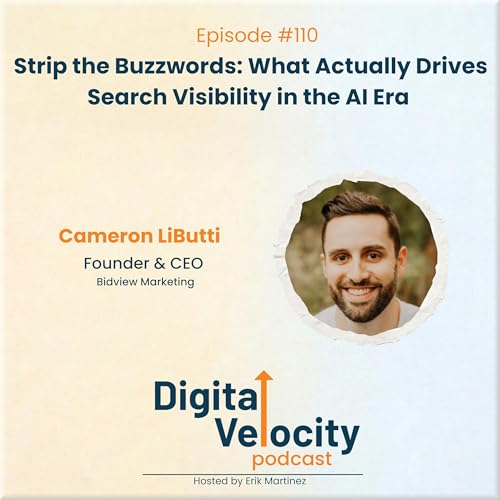
  • Episode 110: Strip the Buzzwords: What Actually Drives Search Visibility in the AI Era with Cameron LiButti
    May 26 2026

    The headlines say AI is changing everything about how businesses get found online. Cameron LiButti says those headlines are missing the point.

    Cameron is the founder of Bidview Marketing, a fourteen-person agency working with medical practices, law firms, and service businesses across the country. He spent four years as a mechanical engineer before finding his way into digital marketing, and that engineering background shapes how he approaches SEO: start with the data, build the structure, and be willing to tell clients what they don't want to hear.

    In this episode, Erik Martinez and Cameron work through what's actually happening inside search — and what isn't. AI Overviews aren't a new algorithm; they're a new interface sitting on top of machine learning that's been running since 2015. LLMs like ChatGPT aren't pulling from an independent database; they're scraping the web and Google's results. And the businesses that tried to game that system in 2024 are seeing the consequences now.

    The conversation covers:

    • Why Cameron's answer to the most important SEO question hasn't changed in eight years

    • How search intent determines whether AI is sending your prospects to you or past you

    • What a tax attorney and a medical practice reveal about where AI leads actually come from

    • The site structure fundamentals that apply equally to traditional crawlers and AI crawlers

    • Red flags to watch for when evaluating an SEO agency or consultant

    Mehr anzeigen Weniger anzeigen
    32 Min.
  • Episode 109: AI Agents - You're Already Using Them. Pat Barry and Erik Martinez on Picking the One Worth Building Next.
    May 11 2026

    There's no agreed definition of an AI agent yet. The people building them, the people selling them, and the people writing about them all mean different things by the term. There's also a real disagreement about how to start.

    The conventional wisdom is to pick a small task and let an agent take it off your plate. That's not wrong. But the small thing you pick should be doing real work for you, or building a real skill you'll need later. Otherwise you're using AI to look busy.

    Pat Barry and Erik Martinez sit down to work through both questions. Pat, a data scientist and AI consultant, opens with the version of the agent definition he's heard most often: a client who literally meant a robot. From there they get into what actually counts, what doesn't, and where most of us should start if we're being honest with ourselves.

    If you've ever asked yourself whether what you're already doing counts, or whether the next thing you build is worth building, this is the one to listen to.

    In this episode:

    · Why nobody in the AI world has settled on what an "agent" actually is

    · What counts as one (and why what you're already doing might already qualify)

    · The simple test for whether the agent you're about to build is worth building

    Mehr anzeigen Weniger anzeigen
    27 Min.
  • Episode 108: "One Person With AI Could Do More Work Than a Whole Team" — Wes Lemos on the Three Levels of AI Most People Never Reach
    Apr 27 2026

    Most of us are using AI to solve a problem once. We polish an email. We summarize a document. We move on. And we tell ourselves we are getting good at this.

    Wes Lemos has been at this longer than most. He runs Roll Digital, founded TIV AI and Vibe Scribe, and has built hundreds of projects across multiple servers. In Episode 108, he sits down with Erik Martinez to talk about why solving a problem once is the entry point, not the destination.

    "One person with AI could do more work than a whole team can."

    There is a shift Wes describes that most people have not made yet. It's about what you do after AI gives you the answer the first time. Wes has a framework for what that looks like, and most listeners have yet to move beyond the first level of it.

    In this conversation, Wes and host Erik Martinez get into what is actually possible right now, why the gap between awareness and capability is widening, and the one shift that takes you from getting value out of AI to building real assets with it.

    Mehr anzeigen Weniger anzeigen
    39 Min.
  • Episode 107: Using AI as a Contrarian Thought Partner: How Ryan Shenefelt Stress-Tests Strategy Before Spending a Dollar
    Apr 13 2026

    Ryan Shenefelt, digital marketing and AI innovation lead at deNovo Marketing, has been in this work for 13 years. Over that time he's watched what happens when agencies and marketing teams use AI the way most people use it: to confirm what they already think, to move faster, to check the box.

    In Episode 107 of the Digital Velocity Podcast, Ryan shares a different approach. He uses AI to argue against himself. When he has a hunch about a decision, he tells the tool where he's leaning and then asks for every reason he's wrong. He separates the "why" and the "why not" into two distinct prompts so the AI fully commits to each side rather than hedging both at once.

    This episode covers:

    ● How to use AI as a contrarian thought partner when evaluating marketing strategy

    ● Why synthetic panels and persona-based focus groups can surface blind spots in a plan before money is spent

    ● The case for stopping new tool evaluation and mastering what you already have

    ● How Notebook LM reduces the risk of hallucinations by keeping AI grounded in your own data

    ● Using AI as a leadership coach to tailor communication across different personality types on your team

    ● What "vibe coding" made possible for someone with a limited development background

    "I will straight up tell it, I'm thinking this. Why not? Give me five reasons. Give me 10 reasons why not. And it's doing that gut check. It's telling me okay, you think this, what about this?"

    Ryan and Erik Martinez also discuss the practical reality of building AI capability inside an agency: why it takes longer than expected to start, how to identify the recurring tasks worth automating, and what it actually feels like to spend 10 hours on something that saves you 15 minutes, and why that's still worth doing.

    Ryan Shenefelt is the digital marketing and AI innovation lead at de Novo Marketing. He leads the agency's AI task force and works across account management, digital advertising, and strategy.

    Mehr anzeigen Weniger anzeigen
    38 Min.
  • Episode 106: Your Digital Chief of Staff: How Joe Newberry Is Helping Leaders use AI to Reclaim Strategic Focus
    Mar 30 2026

    What would happen if you had a version of yourself available every morning that already knew your values, your blind spots, and the two or three things that actually need your attention today?

    In Episode 106 of the Digital Velocity Podcast, Erik Martinez sits down with Joe Newberry, founder of ExecClone.com, to explore how AI is changing the way high-functioning leaders work. Joe brings a background in tech, finance, and sales leadership to a practical question most business owners avoid asking out loud: how much of what I do every day actually requires me?

    Joe tracked his own time and behaviors down to the minute across a 30-day period and found he was only hitting his top three strategic priorities about 40% of the time. The remaining 60% was consumed by what he calls the urgent box, fires, repetitive input requests, and administrative tasks that did not require his level of experience. That data became the foundation for Exec Clone.

    The conversation covers the core concept of building an AI "clone" as a leadership tool, including how the True Mirror operating system onboards a user with over 150 personality and values-based questions to create a digital Chief of Staff anchored in who you are and who you are trying to become. Erik and Joe discuss the difference between an AI that knows your most recent conversations and one that holds your past, present, and 10-year goals in memory at once. They explore the concept of emotional drift.

    The episode also addresses data security and Joe walks through how ExecClone handles sensitive personal data differently than most cloud-based AI agents, including the option to run the system on encrypted hardware shipped directly to the client.

    For agency owners and business leaders who are doing the work alongside their teams, this episode offers a grounded look at what it means to use AI not just as a productivity tool but as a real accountability partner.

    Mehr anzeigen Weniger anzeigen
    32 Min.
  • Episode 105: Building the Personalized Data Layer That Makes AI Work for Your Brand with Brian Gerstner
    Mar 16 2026

    What does an agency actually sell when AI can produce the work? That's the question driving this conversation, and Brian Gerstner has a clear answer.

    In Episode 105 of the Digital Velocity Podcast, host Erik Martinez sits down with Brian Gerstner, President and Owner of White Label IQ, an agency that works exclusively with other agencies. With over 25 years in the marketing industry, Brian brings a uniquely front-row perspective on how AI is reshaping the agency model and what it actually takes to stay relevant when the tools that used to make agencies valuable are now widely accessible to everyone.

    The conversation centers on a fundamental shift: AI has raised the baseline for what "good" looks like across marketing, making ordinary, production-focused work insufficient. As Brian puts it, "AI's just going to beat the mediocrity out of all of us." The real competitive advantage, he argues, is no longer the ability to produce deliverables. It is the ability to orchestrate them through what he calls a Personalized Data Layer: a documented, structured knowledge base that captures brand positioning, ideal customer profiles, product details, proof points, and brand voice.

    Key themes covered in this episode include:

    From tribal knowledge to documented scaffolding: Why relying on individuals to carry institutional knowledge is a structural risk, and how to replace it with a consistent, scalable system that survives personnel changes.

    The MVP of a Personalized Data Layer: Brand positioning, ICPs with real personalities and pain points, detailed product and service descriptions, testimonials and case studies, and a defined brand voice including what words to use and what to avoid.

    Why AI hasn't made work easier: "AI has not made anything easier. It's just made everything faster" — and that speed creates more volume, more threads to manage, and higher expectations across the board.

    The risk of AI slop: Without a documented knowledge layer to constrain outputs, AI will always generate an answer, but it will be generic, inconsistent, and trust-eroding for audiences who can spot it.

    Governance and accountability: How White Label IQ is implementing a matrix structure with pods and guilds, assigning document ownership, running 30-to-60-day verification cycles, and using EOS as a change management framework to hold leadership accountable.

    The human layer as the new premium: "If anything, AI is the thing that's gonna make us human again" — as trust in digital content erodes, showing up in person and maintaining real relationships becomes the differentiator AI cannot replicate.

    While Brian's experience is rooted in the agency world, the implications extend to in-house marketing teams and brand leaders across industries, including direct-to-consumer businesses where audience trust, message consistency, and hyper-personalization are top priorities. As Erik notes, the average U.S. adult now receives over 8,000 messages per day, making the ability to reach and speak to a specific audience with precision not just valuable, but necessary.

    If you're a marketer, agency leader, or brand executive trying to figure out where to focus in an AI-saturated environment, this episode delivers a clear and practical answer: stop chasing tools and start documenting what makes your brand yours. As Brian says, "Without a backbone, you can't stand up." The strategic work of capturing your intellectual property, your positioning, your voice, your audience, is what will separate the agencies and brands that thrive in 2026 and beyond from those that get left behind producing generic output at scale.

    Mehr anzeigen Weniger anzeigen
    28 Min.