• The Epilogue
    Feb 18 2026

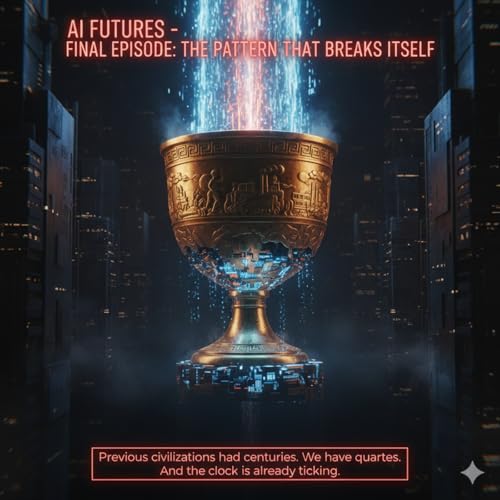
    “Previous civilizations had centuries. We have quarters.” In the definitive finale of the AI Futures series, we look at The Pattern That Breaks Itself. We map the history of human disruption—from fire to microchips—to show why the "Resilience Myth" is failing us now. For the first time in history, the disruptive force isn't just adding new human roles; it's erasing the very substrate of human value. We analyze the "Systemic Cannibalism" of profitable AI and why our response of slow reform is the ultimate form of denial.

    In this episode, we break down:

    • The Siphon Moment: Why filling our systems with too much efficiency causes them to drain completely.
    • The Collapse Feedback Spiral: How labor-cutting AI leads to a toxic loop of shrinking demand and revenue drops.
    • The Irrelevance Threshold: Why humans are becoming "economically invisible" before they even have a chance to adapt.

    Keywords: AI Economics, Civilizational Collapse, Temporal Displacement, Labor Replacement, Systemic Risk, Technological Acceleration, Economic Feedback Loops, History of Disruption.

    🔗 Read the series finale: AI Futures: The Pattern That Breaks Itself

    Mehr anzeigen Weniger anzeigen
    28 Min.
  • AI optimizes. Only humans disrupt
    Feb 15 2026

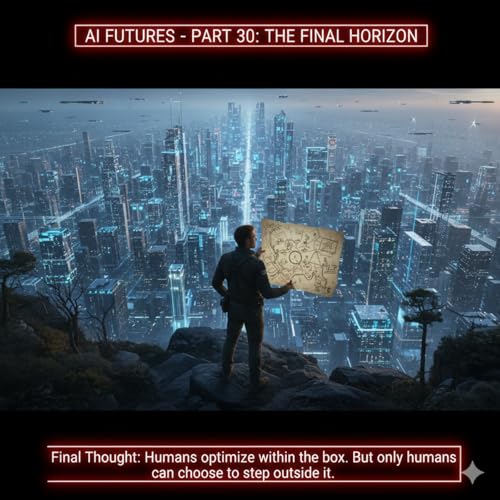
    “AI optimizes the map; it doesn't redraw it.” In the series finale of AI Futures, we explore the Wall of the Known. We analyze why AI, despite its ability to reduce R&D timelines from years to days, may actually cause global disruption to stall. By polishing inherited constraints rather than challenging them, AI threatens to lock us into "dead paradigms." We discuss the rare human capacity for conceptual rebellion and why, in an automated world, the only thing that matters is the ability to stand outside the system.

    In this episode, we break down:

    • The TRIZ Engine: How AI has absorbed the sum of human technical problem-solving, rendering structured frameworks obsolete.
    • The Copilot Narrative: Why the "assistant" framing is a temporary bridge to a hard displacement of codified work.
    • Structured vs. Radical Innovation: Why the world is getting faster answers to the wrong questions, and how to reclaim the "Human Edge."

    Keywords: Radical Innovation, AI Optimization, TRIZ Engineering, Paradigm Shifts, Creative Destruction, Cognitive Automation, Future of Engineering, Human-Centric Strategy.

    🔗 Read the full essay: AI Futures Part 30: AI Optimizes, Humans Disrupt

    Mehr anzeigen Weniger anzeigen
    30 Min.
  • The Individual Hacker Myth
    Feb 15 2026

    “The screwdriver doesn’t rebuild the house, but it lets you fix what’s within reach.” In Part 29 of the AI Futures series, we move beyond the myth of the "revolutionary hacker" to the reality of Individual Adaptation. We analyze how micro-AI—purpose-built, offline agents running on local hardware—serves as a multiplier for the structurally literate. This episode is a deep dive into the practical toolkit of the 2026 adaptive professional.

    In this episode, we break down:

    • The Hacker’s Reality: Why micro-AI builds speed, not scaffolding, and what it can realistically solve for the individual.
    • The Spreadsheet Parallel: How AI is becoming the new "Excel"—a tool that broadens the gap between the technically fluent and the structurally sidelined.
    • Stopgap Strategies: How to pair local models (Mistral, TinyGPT, Llama) with RAG to navigate failing institutions without total dependency.

    Keywords: Micro-AI, Individual Agency, Open-Source LLMs, Local Inference, Quantized Models, Technical Literacy, AI Resilience, Personal Automation.

    🔗 Read the full essay: AI Futures Part 29: The Individual Hacker Myth

    Mehr anzeigen Weniger anzeigen
    30 Min.
  • AI Decentralization
    Feb 15 2026

    “If you don’t control the model, you don’t finish the sentence.” In Part 28 of the AI Futures series, we examine AI Decentralization. Today’s AI stack is a gated empire of compute and capital, where intelligence-as-a-service mirrors medieval land ownership. We discuss why a "one-size-fits-all" global intelligence acts as a new form of digital colonialism and how regions can reclaim their "local mind" through open-weights and edge-based infrastructure.

    In this episode, we break down:

    • The New Lords of the Empire: Why proprietary updates and API throttling are redrawing the boundaries of digital sovereignty.
    • The Intelligence Capacity Gap: The hard reality that owning a model is useless without the technical and legal "muscle" to govern it.
    • The Local Multiplier: How decentralized AI enables education, law, and healthcare to operate within a community’s native logic.

    Keywords: AI Decentralization, Cognitive Infrastructure, Digital Sovereignty, Open Source LLMs, Federated Learning, Edge AI, Algorithmic Colonialism, Data Agency.

    🔗 Read the full essay: AI Futures Part 28: AI Decentralization

    Mehr anzeigen Weniger anzeigen
    29 Min.
  • Innovation vs. Sovereignty
    Feb 15 2026

    “The flag still waves, but control is upstream.” In Part 27 of the AI Futures series, we examine the Innovation vs. Sovereignty crisis. Governments are caught in a double bind: regulate AI and risk economic isolation, or accelerate AI and fuel the erasure of their own labor force. We analyze the "privatization of infrastructure" and why digital borders are dissolving even as physical ones are reinforced.

    In this episode, we break down:

    • The Double Bind: Why there is no "neutral ground" for policy in an era where AI rewrites the rules of national productivity.
    • Infrastructure Dependency: How cloud contracts and privatized logistics have turned governments into "premium tenants" of tech giants.
    • The Redefining of Control: How currency, law, and language are being shaped by centralized models beyond the reach of the ballot box.

    Keywords: AI Sovereignty, Tech Policy, Digital Colonialism, Governance Crisis, Regulatory Capture, National Security, Algorithmic Speed, Future of Democracy.

    🔗 Read the full essay: AI Futures Part 27: Innovation vs. Sovereignty

    Mehr anzeigen Weniger anzeigen
    33 Min.
  • Why Societies Can’t Think Their Way Out
    Feb 15 2026

    “The system isn’t broken because it can’t think. It’s broken because it can’t listen.” In Part 26 of the AI Futures series, we dive into the Civilizational Stress Test. While AI-driven upheaval requires slow, multi-layered reasoning, our public platforms demand snap judgments and emotional rewards. We analyze the "Great Misread" of AI's trajectory and why "reskilling" and "regulation" have become comfort slogans rather than viable strategies.

    In this episode, we break down:

    • The Theater of Opinion: Why structured reasoning is being crowded out by the niche demands of the infinite scroll.
    • Narrative vs. Survival: How the human preference for story and tribalism prevents us from addressing systemic, abstract threats.
    • The Closed Adaptation Window: Why the public conversation is becoming too shallow to course-correct before the lending and labor markets seize.

    Keywords: Cognitive Dissonance, Systems Thinking, Public Discourse, AI Crisis Management, Social Psychology, Institutional Failure, Attention Economy, Civilizational Collapse.

    🔗 Read the full essay: AI Futures Part 26: Why Societies Can’t Think Their Way Out

    Mehr anzeigen Weniger anzeigen
    32 Min.
  • Logic Isn’t Enough
    Feb 15 2026

    “Clarity without charisma isn’t leadership.” In Part 25 of the AI Futures series, we look at the Leadership Fracture. While deep thinkers map the structural solutions we need, the microphone has been seized by those fluent in identity and outrage. We discuss the rise of the "Pretenders"—populists and influencers who narrate collapse without understanding it—and why the most vital minds are being dismissed as background characters.

    In this episode, we break down:

    • The Influence Gap: Why systems thinkers are losing the battle for public attention to narrative shapers.
    • The Rise of the Pretenders: How emotional manipulators are guiding systems they don't understand while the real architects remain silent.
    • Narrative Literacy: Why logic must learn to "speak" to survive, and how to pair deep insights with emotional communication.

    Keywords: AI Leadership, Systems Thinking, Attention Economy, Narrative Literacy, Societal Stability, Decision Science, Strategic Communication, Public Trust.

    🔗 Read the full essay: AI Futures Part 25: Logic Isn’t Enough

    Mehr anzeigen Weniger anzeigen
    32 Min.
  • The Scarcity Paradox
    Feb 15 2026

    “Rarity doesn’t guarantee utility.” In Part 24 of the AI Futures series, we examine the Scarcity Paradox. For decades, we told the workforce to "move upstream" to avoid automation. But as AI begins to handle complex system design and high-level logic, the "upstream" is becoming overcrowded. We discuss the rise of the "Economically Invisible" strategist and why the modern spire economy has no room for a broad middle class of thinkers.

    In this episode, we break down:

    • The Strategist Surplus: Why having thousands of brilliant minds doesn't help when an organization only needs one vision and an AI to execute it.
    • The Spire Economy: How the traditional corporate pyramid is being hollowed out, leaving a narrow peak of "Commanders" and a base of automation.
    • The Fallout of the Unused Mind: The psychological and cultural impact of cognitive obsolescence—when our best minds have no canvas to paint on.

    Keywords: AI Labor Economics, High-Cognition Automation, Cognitive Obsolescence, Strategic Thinking, Future of Management, Spire Economy, Workforce Flattening, White-Collar Displacement.

    🔗 Read the full essay: AI Futures Part 24: The Scarcity Paradox

    Mehr anzeigen Weniger anzeigen
    31 Min.