


AI Futures: Beyond Human Labor
Artikel konnten nicht hinzugefügt werden
Der Titel konnte nicht zum Warenkorb hinzugefügt werden.
Der Titel konnte nicht zum Merkzettel hinzugefügt werden.
„Von Wunschzettel entfernen“ fehlgeschlagen.
„Podcast folgen“ fehlgeschlagen
„Podcast nicht mehr folgen“ fehlgeschlagen

AI Futures: Beyond Human Labor
-
Gesprochen von:
-
Von:
-
Jaffar Humayoon
Über diesen Titel
AI Futures is a serialized problem-space exploration of artificial intelligence and its quiet disruption of modern society.
This is not a sci-fi podcast. There are no killer robots, no sentient machines, and no sudden collapse. Instead, this series examines a more plausible trajectory: a world where AI integrates smoothly, efficiently—and outcompetes human labor without ever declaring war on it.
Each episode isolates a single variable—full-scale AI adoption—while holding everything else constant. No new laws. No universal basic income. No political reset. Just today’s economic, educational, and institutional systems trying to survive tomorrow’s logic.
The result is a slow-motion unraveling:
- Labor becomes inefficient rather than obsolete
- Income disappears before demand does
- Productivity rises while value circulation collapses
- Entire populations lose relevance without failing
Told across five cumulative arcs—AI Futures maps the structural dependencies modern society relies on, and how AI quietly erodes them.
This series does not propose solutions. It deliberately avoids policy prescriptions.
Its purpose is harder and more uncomfortable: to define the real problem before pretending we can fix it.
Treat this as fiction if you like. But don’t be surprised if you recognize your present inside it.
FOUNDATIONS
- Episode 1: The Machines Worked Too Well
- Episode 2: The Cognitive Tier Framework
- Episode 3: Is a Thought Factory Possible?
- Episode 4: The Schools That Taught Irrelevance
- Episode 5: The Demographic Misalignment
- Episode 6: History Doesn’t Loop Back
ACCELERATION
- Episode 7: The Productivity Illusion
- Episode 8: From Human to Token: Inside MAANG
- Episode 9: The Corporate Balance Sheet Shift
- Episode 10: The Loyalty Illusion
- Episode 11: The Gravitational Pull Toward AI
- Episode 12: The Working Core
COLLAPSE
- Episode 13: The Job Displacement Chain
- Episode 14: No Parallel Jobs Left
- Episode 15: Collapse of the Consumer Base
- Episode 16: When the Back Office Breaks
- Episode 17: Europe’s Structural Vulnerability
- Episode 18: The Forex Drain
- Episode 19: The Lending Engine Cracks
- Episode 20: The Fraying of Order
STRATEGY
- Episode 21: The Ban That Burned the Bridge
- Episode 22: Bread and Circuses
- Episode 23: When Demography Meets Disruption
- Episode 24: The Cognitive Scarcity Paradox
- Episode 25: Logic Isn’t Enough
- Episode 26: Why Societies Can’t Think Their Way Out
RISK
- Episode 27: Innovation vs. Sovereignty
- Episode 28: AI Decentralization
- Episode 29: The Individual Hacker Myth
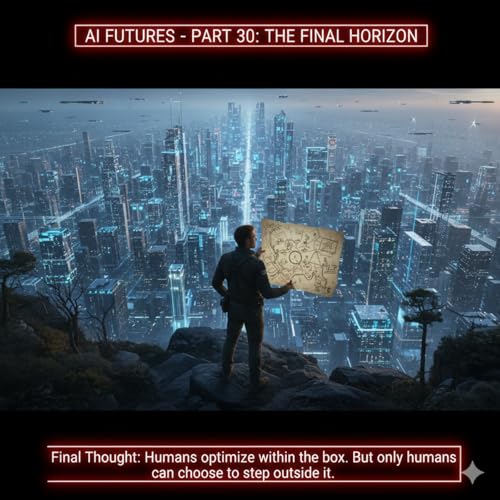
- Episode 30: AI Optimizes. Only Humans Disrupt
FINALE
- Finale: The Decay
A system optimized past the point where humans matter.

-
 Feb 15 202630 Min.
Artikel konnten nicht hinzugefügt werden
Leider können wir den Artikel nicht hinzufügen, da Ihr Warenkorb bereits seine Kapazität erreicht hat.Der Titel konnte nicht zum Warenkorb hinzugefügt werden.
Bitte versuchen Sie es später noch einmalDer Titel konnte nicht zum Merkzettel hinzugefügt werden.
Bitte versuchen Sie es später noch einmal„Von Wunschzettel entfernen“ fehlgeschlagen.
Bitte versuchen Sie es später noch einmal„Podcast folgen“ fehlgeschlagen
„Podcast nicht mehr folgen“ fehlgeschlagen
-
 Feb 15 202630 Min.
Artikel konnten nicht hinzugefügt werden
Leider können wir den Artikel nicht hinzufügen, da Ihr Warenkorb bereits seine Kapazität erreicht hat.Der Titel konnte nicht zum Warenkorb hinzugefügt werden.
Bitte versuchen Sie es später noch einmalDer Titel konnte nicht zum Merkzettel hinzugefügt werden.
Bitte versuchen Sie es später noch einmal„Von Wunschzettel entfernen“ fehlgeschlagen.
Bitte versuchen Sie es später noch einmal„Podcast folgen“ fehlgeschlagen
„Podcast nicht mehr folgen“ fehlgeschlagen
-
 Feb 15 202629 Min.
Artikel konnten nicht hinzugefügt werden
Leider können wir den Artikel nicht hinzufügen, da Ihr Warenkorb bereits seine Kapazität erreicht hat.Der Titel konnte nicht zum Warenkorb hinzugefügt werden.
Bitte versuchen Sie es später noch einmalDer Titel konnte nicht zum Merkzettel hinzugefügt werden.
Bitte versuchen Sie es später noch einmal„Von Wunschzettel entfernen“ fehlgeschlagen.
Bitte versuchen Sie es später noch einmal„Podcast folgen“ fehlgeschlagen
„Podcast nicht mehr folgen“ fehlgeschlagen