Work's Not Working... Let's Fix It! Titelbild

Work's Not Working... Let's Fix It!

Work's Not Working... Let's Fix It!

Von: Sian Harrington
Jetzt kostenlos hören, ohne Abo

Saisonale Sparangebote | 0,99 € pro Monat für die ersten 3 Monate

Danach 6,99 €/Monat. Bedingungen gelten. Monatlich kündbar.

Work’s Not Working… Let’s Fix It is a podcast from The People Space exploring how work is being reinvented – and what that means for HR, leaders and organisations navigating constant change.

Hosted by award-winning journalist Siân Harrington, the show examines why so many traditional ways of working are breaking down, from job design and leadership to performance, culture and the role of AI.

Through conversations with forward-thinking people leaders, innovators and academics, each episode tackles one clear problem facing work today – and surfaces the ideas, evidence and practical thinking needed to build something better.

This is where future fit HR thinking is tested in public, connecting human-centred work, AI-augmented roles and new ways of organising to the realities leaders face now.

Produced by The People Space. Find more insight, tools and analysis at thepeoplespace.com.

© 2026 On and Off Communications t/a The People Space
Management & Leadership Ökonomie
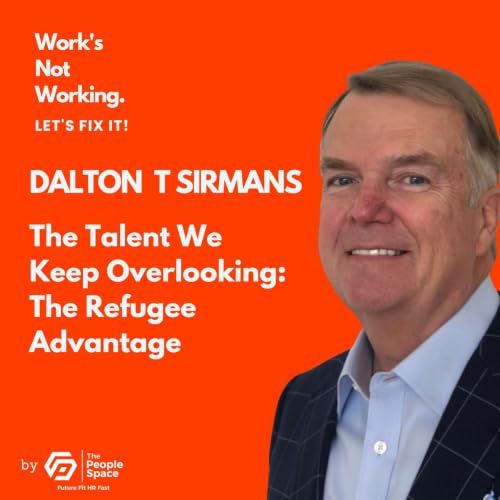
  • The Talent We Keep Overlooking: The Refugee Advantage - Dalton T Sirmans
    Sep 28 2026

    In this episode of Work’s Not Working… Let’s Fix It!, Siân Harrington sits down with entrepreneur, investor and author Dalton T. Sirmans to ask why employers searching for adaptable talent may be overlooking millions of refugees.

    Refugees are usually discussed through the language of humanitarian crisis, politics and cost. Dalton argues that this can obscure another part of the story: people rebuilding their lives as employees, entrepreneurs, business owners and economic contributors.

    Drawing on his research into forced displacement and his experience as an entrepreneur and impact investor, Dalton explores what he calls ‘the refugee advantage’: the resilience, adaptability, persistence and problem solving that can be developed or revealed when people have had to start again.

    But this is not about romanticising displacement. Refugee status tells an employer very little on its own about someone’s ability to do a job. The bigger question is whether the way we recruit and assess people makes some forms of talent almost impossible to see.

    Dalton shares the stories of refugee entrepreneurs who have built substantial businesses, Afghan helicopter mechanics whose skills translated into entirely different jobs and a US manufacturer that redesigned its training for workers who did not speak English – and saw production increase as a result.

    Whether you’re an HR leader struggling with skills shortages, an employer looking beyond conventional recruitment channels or simply interested in how people rebuild their working lives, this episode asks us to look again at who we recognise as talent.

    Key takeaways

    • Refugees can disappear from employers’ view when unfamiliar qualifications, language and conventional recruitment criteria become barriers to recognising capability
    • Adaptability, resilience and problem solving are characteristics employers frequently say they need. Dalton argues that displacement can reveal or sharpen these qualities
    • Refugee entrepreneurship is significant. Dalton points to US research showing refugees are almost twice as likely to become entrepreneurs as native-born Americans and other immigrants
    • Humanitarian framing has an unintended consequence. Seeing refugees primarily through vulnerability and need can make their economic contribution harder to recognise
    • Better inclusion can improve the system for everyone. One manufacturer removed written language from training and used diagrams instead, opening jobs to non-English speakers and increasing production
    • Being a refugee should neither qualify nor disqualify someone for a job. Employers need better ways to uncover what people can actually do
    • Employers do not have to start alone. Refugee organisations, local colleges and other businesses can help them find talent and understand how to support people into work
    • The private sector has a role in a displacement challenge that governments and humanitarian organisations cannot tackle on their own.

    Interested in insights about people leadership, HR and the future of work?
    Seize and shape the future of work with The People Space, a leading digital HR magazine for forward-thinking leaders. We empower you to put people at the heart of work, navigating the evolving intersection of technology, business and human insight. Join us in building a future where people and machines collaborate for a more human-centric workplace

    • Sign up for our free fortnightly newsletter on the future of work, human-centric organisations and people-first leadership
    • Follow Siân on LinkedIn
    • Are you an HR professional seeking to raise your profile? I can help!
    • HR vendor or consultant? Check out how I can help you reach senior HR leaders.
    • Follow The People Space on Facebook
    Mehr anzeigen Weniger anzeigen
    46 Min.
  • Your Brain Isn’t Built For Work: The Faulty Model Behind Modern Management – Bruna De Palo
    Aug 26 2026

    In this episode of Work’s Not Working… Let’s Fix It Siân Harrington sits down with neuroscience-based executive coach and leadership strategist Bruna De Palo to challenge one of the biggest assumptions behind modern management: that people can think rationally, leave emotion at the door, absorb constant change and keep performing under chronic pressure.

    For years leaders have been taught neat stories about the brain: rational versus emotional, left brain versus right brain, the fear centre that hijacks the meeting. But Bruna, author of The Brain Instruction Manual for Leaders, argues that much of this thinking is now out of date. The brain is not simply reacting to events. It is constantly predicting what might happen next and deciding where to spend its energy.

    This changes how we understand resistance, disengagement, procrastination, burnout and silence in meetings. These behaviours may be less about poor attitude and more about a brain spending too much energy on protection.

    Bruna introduces the idea of the brain as the CFO of the body budget, deciding whether energy goes into defence or into the thinking, creativity, collaboration and problem-solving organisations say they need most. She explains why tough leadership can appear to get results while quietly draining performance, why uncertainty is so costly and why leaders need to create the conditions for people’s brains to work well.

    Whether you’re leading change, trying to build trust, dealing with burnout or wondering why your leadership development programme hasn’t shifted behaviour this episode offers a more accurate and practical way to understand people at work.

    Key Takeaways

    • Outdated brain myths are still shaping leadership, HR, wellbeing and change management.
    • The brain’s primary job is survival, which means predicting danger and managing energy.
    • Resistance, defensiveness and disengagement may be signs of protection rather than poor motivation.
    • Tough leadership can get results, but often at a hidden cost to energy, trust and performance.
    • Clarity, structure, predictability, transparency and coherence help reduce the energy people spend on threat.
    • Leaders can use the SCARF model – status, certainty, autonomy, relatedness and fairness – to spot where people may feel unsafe.
    • If we want better creativity, decision-making and collaboration, we need to stop wasting so much human energy on protection.

    Interested in insights about people leadership, HR and the future of work?
    Seize and shape the future of work with The People Space, a leading digital HR magazine for forward-thinking leaders. We empower you to put people at the heart of work, navigating the evolving intersection of technology, business and human insight. Join us in building a future where people and machines collaborate for a more human-centric workplace

    • Sign up for our free fortnightly newsletter on the future of work, human-centric organisations and people-first leadership
    • Follow Siân on LinkedIn
    • Are you an HR professional seeking to raise your profile? I can help!
    • HR vendor or consultant? Check out how I can help you reach senior HR leaders.
    • Follow The People Space on Facebook
    Mehr anzeigen Weniger anzeigen
    47 Min.
  • Your Hidden CV: The Job Search Rule No One Teaches Young People - Susie Thomson
    Jul 17 2026

    In this episode of Work’s Not Working… Let’s Fix It!, Siân Harrington sits down with Susie Thomson, chair-elect of the Professional Background Screening Association, to ask a question every young person, parent, careers adviser and employer should be thinking about: what happens when your digital identity becomes part of the hiring process?

    Most young people know they need a CV. Fewer realise they may already have another one: the posts, comments, photographs, likes and online traces that create an impression before they ever walk into an interview.

    And this matters now. Entry-level jobs are under pressure, AI is reshaping early-career work and competition for graduate and school-leaver roles is fierce. At the same time, social media screening is becoming a more common part of background checks, with employers looking for potential reputational, conduct and safeguarding risks.

    Susie explains what social media screening actually involves, what employers are looking for and where the line sits between legitimate due diligence and unfair judgement. She also explores why context matters, how LinkedIn can help young people show curiosity and potential, and why schools, universities and employers need to do far more to explain the hidden rules of digital employability.

    Whether you’re a student, graduate, parent, educator, HR leader or recruiter, this episode is a practical guide to understanding the digital footprint that may already be shaping someone’s chances of getting hired.

    Key takeaways

    • Social media screening is growing. Employers are increasingly using online checks as part of pre-employment screening, while informal searches by hiring managers still happen in the background.
    • Your online presence can work for or against you. Employers may look for risk signals, but they may also see positive evidence of volunteering, industry interest, communication skills and curiosity.
    • Context matters. A single post can be misleading if it is taken out of context, and good screening should be consistent, transparent and relevant to the role.
    • Young people often do not know the rules. Many students, graduates and school leavers are unaware that their digital footprint may be part of the hiring process.
    • LinkedIn is becoming part of employability. A good profile can help young people build networks, show interest in an industry and present themselves professionally without exaggerating.
    • Digital identity is a social mobility issue. Young people with access to informed parents, relatives or schools may get advice others never receive.
    • Employers need fair processes. Social media screening must avoid bias, protected characteristics and casual judgement by individual managers.

    Listen to the full podcast to pick up other tips!

    Interested in insights about people leadership, HR and the future of work?
    Seize and shape the future of work with The People Space, a leading digital HR magazine for forward-thinking leaders. We empower you to put people at the heart of work, navigating the evolving intersection of technology, business and human insight. Join us in building a future where people and machines collaborate for a more human-centric workplace

    • Sign up for our free fortnightly newsletter on the future of work, human-centric organisations and people-first leadership
    • Follow Siân on LinkedIn
    • Are you an HR professional seeking to raise your profile? I can help!
    • HR vendor or consultant? Check out how I can help you reach senior HR leaders.
    • Follow The People Space on Facebook
    Mehr anzeigen Weniger anzeigen
    30 Min.
adbl_web_anon_alc_button_suppression_t1
Noch keine Rezensionen vorhanden