• Leakonomics (Mukhopadhyay 2026)
    Apr 27 2026

    English Podcast Starts at 00:00:00

    Bengali Podcast Starts at 00:46:52

    Hindi Podcast Starts at 01:05:39

    Danish Podcast Starts at 01:30:29


    Cite As:

    Mukhopadhyay, M. (2026, April 27). Leakonomics: The strange financial life of proprietary software once it escapes. Medium; InsiderFinance Wire. https://wire.insiderfinance.io/leakonomics-the-strange-financial-life-of-proprietary-software-once-it-escapes-905ce3f9733c


    ‌Youtube Channel

    ⁠https://www.youtube.com/@weekendresearcher⁠

    About me

    https://mayukhmukhopadhyay.com/aboutme


    Abstract

    This long-form essay on insiderFinance wire introduces "leakonomics," a framework for evaluating the deep strategic and financial consequences of proprietary software breaches. By drawing parallels to World War II precision bombing, the author argues that institutions often mistake technical secrecy for total control, only to face "friction" when reality intrudes. Beyond immediate legal or PR costs, these sources categorise the damage into eight distinct buckets, including adversarial learning, trust repricing, and the destruction of future options. The analysis moves past simple cybersecurity metrics to examine how leaks reveal an organisation’s true operating model and hidden vulnerabilities. Ultimately, the text suggests that a codebase is less like a static moat and more like a complex irrigation system, where exposure reveals the difference between formal architecture and messy, lived practice.


    References

    Bellamy, A. J. (2008). The ethics of terror bombing: Beyond supreme emergency. Journal of Military Ethics, 7(1), 41–65.

    Biddle, T. D. (1995). British and American approaches to strategic bombing: Their origins and implementation in the World War II combined bomber offensive. The Journal of Strategic Studies, 18(1), 91–144.

    Gladwell, M. (2021). The bomber mafia: A story set in war. Penguin UK.

    Gülay, B., & Yılmaz, C. (2025, June). Mitigating information leakage in large language models: evaluating the impact of code obfuscation on vulnerability detection. In 2025 IEEE European Symposium on Security and Privacy Workshops (EuroS&PW) (pp. 1–8). IEEE.

    Kirby, M., & Capey, R. (1997). The area bombing of Germany in World War II: An operational research perspective. Journal of the Operational Research Society, 48(7), 661–677.

    Mitra, S., & Ransbotham, S. (2015). Information disclosure and the diffusion of information security attacks. Information Systems Research, 26(3), 565–584.

    Mohammad Ali Pour, Fazel, The Claude Code Leak: A Complete Technical & Security Investigation (March 31, 2026). Available at SSRN. DOI 10.2139/ssrn.6504920

    Sridhar, K., & Ng, M. (2021). Hacking for good: Leveraging HackerOne data to develop an economic model of Bug Bounties. Journal of Cybersecurity, 7(1), tyab007.

    Wang, J., Shan, Z., Gupta, M., & Rao, H. R. (2019). A Longitudinal Study of Unauthorized Access Attempts on Information Systems: The Role of Opportunity Contexts1. MIS quarterly, 43(2), 601–622.

    Zook, M., & Graham, M. (2018). Hacking code/space: Confounding the code of global capitalism. Transactions of the Institute of British Geographers, 43(3), 390–404.

    Mehr anzeigen Weniger anzeigen
    1 Std. und 41 Min.
  • Scrolling Through Shock (Mukhopadhyay 2026) | CIEMC 2.0
    Apr 25 2026

    English Podcast starts at 00:00:00

    Bengali Podcast Starts at 00:24:08

    Hindi Podcast Starts at 00:50:32

    Russian Podcast Starts at 01:09:57


    Conference Name: Contemporary Issues in Emerging Markets Conference (CIEMC 2.0)

    Jointly Hosted by IIM Bodhgaya & RUDN University Russia

    Research Title: Scrolling Through Shock: Proximity Panic in Emerging Market Polycrisis

    Author Name: Mayukh Mukhopadhyay

    Author Affiliation: Indian Institute of Management Indore

    Presented on April-2026


    Research Summary

    This research presentation investigates the concept of proximity panic, a phenomenon where digital media transforms local tragedies into immersive, shared experiences of personal vulnerability. Using the example of a flight crash, the study explains how social media engagement can disrupt institutional trust and distract from essential governance reforms during periods of global instability. The author identifies three primary drivers—relational insertion, digital mourning, and coordination fragmentation—that together hinder effective crisis management. To counter these effects, the paper advocates for emotional governance, suggesting that leaders must acknowledge public sentiment while reinforcing factual communication. Ultimately, the work aligns these strategies with Sustainable Development Goals to ensure that emerging markets maintain policy continuity despite digital disruptions. This theoretical synthesis provides a new framework for understanding how online emotional contagion directly impacts large-scale organizational and political stability.


    Cite the work:

    Mukhopadhyay, M. (2026). Scrolling Through Shock: Proximity Panic in Emerging Market Polycrisis. CIEMC 2.0. Jointly Hosted by RUDN University Russia & IIM Bodhgaya.


    References

    Atkins, P. W., & Parker, S. K. (2012). Understanding individual compassion in organizations: The role of appraisals and psychological flexibility. Academy of Management Review, 37(4), 524–546.

    Billore, S., & Anisimova, T. (2021). Panic buying research: A systematic literature review and future research agenda. International Journal of Consumer Studies, 45(4), 777–804.

    Charbonneau, B., & Giguère, A. (2025). The polycrisis and the uncertainty possibility space. Global Sustainability, 8, e4.

    Lawrence, M., Homer-Dixon, T., Janzwood, S., Rockström, J., Renn, O., & Donges, J. F. (2024). Global polycrisis: The causal mechanisms of crisis entanglement. Global Sustainability, 7, e6.

    Leen Al-Rashdan, & Chmouri, O. E. (2025, June 12). Air India Crash Becomes First Hull Loss of Boeing 787 Dreamliner. Bloomberg.com; Bloomberg.

    Marchau, V., Walker, W., Bloemen, P., & Popper, S. (2019). Decision Making under Deep Uncertainty: From Theory to Practice. Springer.

    Peticca-Harris, A. (2019). Managing compassionately? Managerial narratives about grief and compassion. Human Relations, 72(3), 588-612.

    Solomon, S. (2020). The worm at the core: On the role of death in life. Grief Matters: The Australian Journal of Grief and Bereavement, 23(1), 20-24.

    Wolbers, J., Boersma, K., & Groenewegen, P. (2018). Introducing a fragmentation perspective on coordination in crisis management. Organization Studies, 39(7), 797–821.


    ‌Youtube channel link

    https://www.youtube.com/@weekendresearcher

    About me

    https://mayukhmukhopadhyay.com/aboutme/

    Mehr anzeigen Weniger anzeigen
    1 Std. und 33 Min.
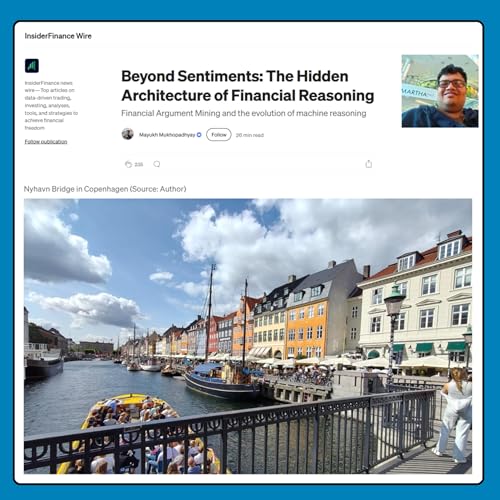
  • The Hidden Architecture of Financial Reasoning (Mukhopadhyay 2026)
    Apr 3 2026

    English Podcast Starts at 00:00:00

    Bengali Podcast Starts at 00:50:44

    Hindi Podcast Starts at 01:10:14

    Danish Podcast Starts at 01:34:33


    How to Cite the Article

    Mukhopadhyay, M. (2026, March 31). Beyond Sentiments: The Hidden Architecture of Financial Reasoning. Medium; InsiderFinance Wire. https://wire.insiderfinance.io/beyond-sentiments-the-hidden-architecture-of-financial-reasoning-2421f64daa87


    ‌Youtube Channel

    ⁠https://www.youtube.com/@weekendresearcher⁠

    Visit my Website

    https://mayukhmukhopadhyay.com/aboutme/


    Abstract

    The insiderfinance article examines the transition from basic sentiment analysis to the more sophisticated field of Financial Argument Mining in machine learning. While traditional tools merely classify text as positive or negative, this new approach seeks to deconstruct the underlying logic, claims, and evidence found in financial reports. By mapping the internal architecture of reasoning, analysts can better understand the duration and validity of market theories rather than reacting to superficial tones. The source further explores the use of multi-agent AI systems to simulate professional deliberation and stress-test investment theses. Ultimately, the article argues that the future of finance lies in quantifying causal explanations and temporal scenarios to improve long-term decision-making. These advancements aim to create a more disciplined institutional memory by holding financial arguments accountable to their original premises.


    References

    Bruner, R. F., & Miller, S. C. (2020). The first modern financial crises: the South Sea and Mississippi bubbles in historical perspective. Journal of applied corporate finance, 32(4), 17-33.

    Cecchini, M., Aytug, H., Koehler, G. J., & Pathak, P. (2010). Making words work: Using financial text as a predictor of financial events. Decision support systems, 50(1), 164-175.

    Chen, C. C., Takamura, H., Kobayashi, I., & Miyao, Y. (2024). Hierarchical organization simulacra in the investment sector. arXiv preprint arXiv:2410.00354.

    Chen, C.-C., & Takamura, H. (2025). Agent AI for Finance. In SpringerBriefs in Intelligent Systems. Springer Nature Switzerland.

    Davis, G. F., Diekmann, K. A., & Tinsley, C. H. (1994). The decline and fall of the conglomerate firm in the 1980s: The deinstitutionalization of an organizational form. American sociological review, 59, 547-547.

    Hamori, S., Hamori, N., & Anderson, D. A. (2001). An empirical analysis of the efficiency of the Osaka rice market during Japan's Tokugawa era. Journal of Futures Markets: Futures, Options, and Other Derivative Products, 21(9), 861-874.

    Harford, J., Jenter, D., & Li, K. (2011). Institutional cross-holdings and their effect on acquisition decisions. Journal of Financial Economics, 99(1), 27-39.

    Kearney, C., & Liu, S. (2014). Textual sentiment in finance: A survey of methods and models. International Review of Financial Analysis, 33, 171-185.

    Lawrence, J., & Reed, C. (2019). Argument mining: A survey. Computational linguistics, 45(4), 765-818.

    Tolbert, J. T. (2007). “Plowing Gold from the Wasteland” Media Portrayal of South Florida's Boom, 1920–25. Journalism History, 33(2), 111-120.

    Mehr anzeigen Weniger anzeigen
    2 Std. und 3 Min.
  • A Quiet Race for Uncertainty (Mukhopadhyay 2026) - InsiderFinance Wire
    Mar 3 2026

    English Podcast Starts at 00:00:00

    Bengali Podcast Starts at 00:34:32

    Hindi Podcast Starts at 00:56:09

    Danish Podcast Starts at 01:17:29


    Reference

    Mukhopadhyay, M. (2026, February 28). A Quiet Race for Uncertainty. Medium; InsiderFinance Wire. https://wire.insiderfinance.io/a-quiet-race-for-uncertainty-dada3ada1e9c


    ‌Youtube Channel

    ⁠https://www.youtube.com/@weekendresearcher⁠

    Connect over linkedin

    https://www.linkedin.com/in/mayukhpsm/


    Abstract

    This article explores how Global Capability Centers (GCCs) in the Global South, particularly in India, are becoming the quiet backbone of the quantum computing revolution. Rather than funding high-risk "moonshots," corporations are utilizing these centers to finance quantum readiness through existing operational budgets for security and analytics. This strategic shift allows organizations to build long-term expertise and infrastructure while navigating the immense financial and technical uncertainties of the field. By framing quantum research as a form of enterprise resilience, these hubs ensure that transformative computation is developed steadily and discreetly. Ultimately, the text suggests that these centers represent a new institutional logic where experimental science is successfully integrated into routine corporate strategy.


    Mehr anzeigen Weniger anzeigen
    1 Std. und 38 Min.
  • Podcast or Perish (Mukhopadhyay 2026) - ICIC 2026 @ IIM Ranchi
    Feb 21 2026

    ICIC 2026 @ IIM Ranchi, 20-21 Feb 2026


    Hindi Podcast starts at 00:00:00

    English Podcast starts at 00:13:43

    Bengali Podcast Starts at 00:27:02


    Paper Title - Podcast or Perish: Long Form Conversations as the New Red Carpet

    Author Name - Mayukh Mukhopadhyay

    Author Affiliation - Executive Doctoral Candidate, IIM Indore


    Conference Name: International Conference on Indian Cinema

    Conference Theme: Social Realities & Managerial Insights

    Conference SubTrack: Film Distribution and Marketing

    Hosted by: IIM Ranchi

    Hosted on: 20-21 February 2026

    Conference Page: https://iimranchi.ac.in/icc/


    Research Summary

    This presentation explores the growing importance of long-form podcasts as a replacement for traditional red-carpet marketing in the modern film industry. The author argues that because human attention is a finite resource, the depth and authenticity of extended conversations are more effective at building audience trust than short trailers. By applying a conceptual ADO model, the research examines how psychological factors like parasocial relationships and source credibility convert passive listeners into committed moviegoers. Examples from Netflix, Marvel, and Bollywood illustrate a strategic shift toward using audio as a tool for world-building and brand loyalty. Ultimately, the sources suggest that the digital intimacy of podcasting has become the new primary infrastructure for movie promotion and cultural influence.

    Mehr anzeigen Weniger anzeigen
    42 Min.
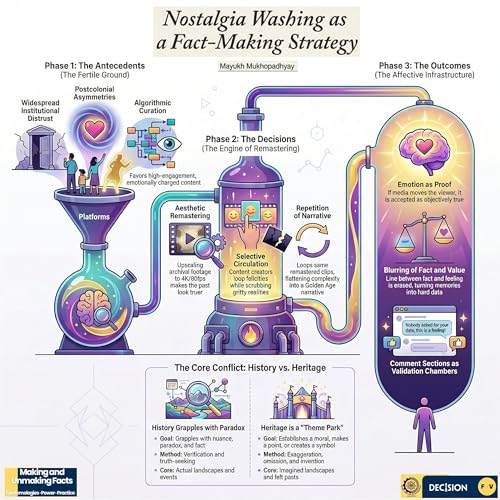
  • Nostalgia Washing (Mukhopadhyay 2026) - MUF 2026 @ IIM Calcutta
    Feb 13 2026

    MUF 2026 @ IIM Calcutta, 13-15 Feb 2026

    Conference jointly hosted by DECISION Journal, IIM Calcutta and "Fact or Value" Forum


    Bengali Podcast starts at 00:00:00

    English Podcast starts at 00:17:37

    Hindi Podcast Starts at 00:33:29


    This research explores the phenomenon of nostalgia washing, where digital platforms transform curated memories into perceived historical truths. By utilizing the ADO framework, the research examines how algorithmic curation and high-definition aesthetic remastering create an idealized version of the past that feels more authentic than actual history. This process is particularly impactful in the Global South, where a lack of trust in formal institutions allows "felt" truths to replace objective data. Ultimately, the source argues that these emotional narratives are weaponized to support claims of social decline, blurring the lines between personal heritage and factual record. The study highlights how the digital past is being re-engineered to shape current moral and political imaginations.

    Mehr anzeigen Weniger anzeigen
    49 Min.
  • Case ID 654 (Mrittika Mukhopadhyay et al 2026)
    Feb 8 2026

    Hindi Podcast Starts at 00:00:00

    Bengali Podcast starts at 00:14:12

    English Podcast starts at 00:27:04


    This teaching case analyzes SIP Abacus, a prominent Indian skill-building organization that utilizes franchise models and mental arithmetic to foster child development. The core focus is a strategic dilemma regarding high student churn during the initial year of training. This attrition stems from a misalignment between the repetitive nature of early manual exercises and the high expectations of parents seeking immediate results. To address this, the case explores modernizing the brand through STEM partnerships and the integration of AI technology for better progress tracking. Ultimately, the sources examine how to balance pedagogical rigor with commercial sustainability in the competitive field of supplementary education.


    2nd IIM Nagpur Case & Research Conference 2026

    Theme: “Advancing Business Transformation through Cases and Research”

    Pre-Conference Workshop: Feb 6th, 2026

    Conference: Feb 07th & 08th, 2026

    Mehr anzeigen Weniger anzeigen
    40 Min.
  • Case ID 69 (Mukhopadhyay 2026)
    Feb 7 2026

    Hindi Podcast Starts at 00:00:00

    Bengali Podcast starts at 00:14:15

    English Podcast starts at 00:27:39

    Odia Podcast starts at 00:47:31

    Kannada Podcast starts at 01:00:34


    Case ID 69

    This teaching case examines the growth of takeUforward, an EdTech startup founded by Raj Vikramaditya to democratize coding interview preparation. The sources trace the platform’s evolution from a YouTube side project into a profitable, bootstrapped business that serves millions of learners. Despite its success, the venture faces a strategic inflection point involving technical infrastructure failures and a heavy reliance on the founder’s personal brand. Management must now decide between focusing on AI-driven product depth or pursuing aggressive international expansion to global markets. The case highlights the operational difficulties of scaling a lean team while maintaining a "learner-first" philosophy without external funding. Ultimately, it explores the challenge of transitioning from a content creator to the leader of a sustainable, professionalized organization.


    2nd IIM Nagpur Case & Research Conference 2026

    Theme: “Advancing Business Transformation through Cases and Research”

    Pre-Conference Workshop: Feb 6th, 2026

    Conference: Feb 07th & 08th, 2026


    Mehr anzeigen Weniger anzeigen
    1 Std. und 14 Min.