Voicemails from History Titelbild

Voicemails from History

Voicemails from History

Von: Mujda Ameen
Jetzt kostenlos hören, ohne Abo

Über diesen Titel

History is created using the evidence that people leave behind, sometimes in documents and photo albums, other times on scraps and footsteps here and there. Each episode will feature a voicemail, an extract from the book I’m reading: it could be a speech, an interpretation, a conversation. Join me, a graduate and teacher of history, as I share and review books covering a range of historical events, people and memories. I’ll be offering my commentary and perspective to create a conversation about the issues and values which affect us in the present.Mujda Ameen Welt
  • The 1963 Iraqi Coup: Exploring tensions in Ba'thism
    Oct 16 2022

    Today's voicemail is taken from page 176 of "Pride and Power: A Modern History of Iraq" by Johan Franzén

    In 1963, 'Aref and the Ba'thists instigated the Ramadan Revolution which toppled Karim Qasim from power, a mere 5 years after the first revolution. What followed after was a brief period in which different factions across the Ba'athist and nationalist factions fought for control in Iraq. Eventually, the Ba'this secured their rise to power and would remain as Iraq's single party until Saddam Hussein's downfall in 2003. In this episode, I delve a bit deeper into the end of Qasim's rule by looking at competing Arab political groups and how eventually, the rise of the 'Aref brothers and then al-Bakr and Saddam Hussein, shifted Iraq's political history forever. I spend some time in the middle discussing tensions between defining Ba'thism and how it is different to earlier pan-Arab thinking.

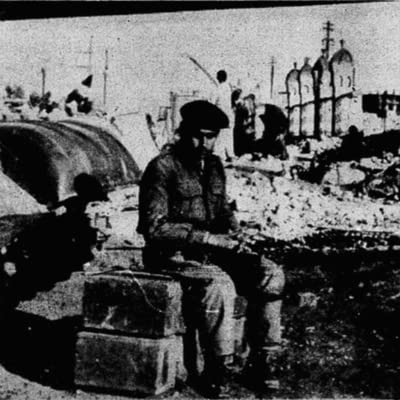
    Episode cover: Soldier in the ruins of the Ministry of Defence, where Qasim made his last stand

    References:
    Johan Franzén's book "Pride and Power: A Modern History of Iraq".

    Achim Rohde's "State-Society Relations in Ba'thist Iraq: Facing Dictatorship"

    Ofra Bengio's "Kurds of Iraq: Building a State within a State"

    Ralph Coury's article titled "The demonisation of pan-Arab nationalism"

    Isaac, Steven. "The Ba ‘th of Syria and Iraq." The International Encyclopedia of Protest and Revolution 2009

    Mehr anzeigen Weniger anzeigen
    30 Min.
  • Navigating the Kurdish-Iraqi Civil War: Barzani, Communists, Aghas & Qasim (1961-63)
    May 8 2022

    Today's voicemail is taken from p.225 of Claire Hollingworth's article in 'World Today'.

    The Iraqi and Kurdish saga continues! I begin with a quick recap of last episode's story and we get right into Barzani's return to Iraq, how the Kurdish Democratic Party and Iraqi Communist Party continued to affect Kurdish-Arab dynamics, and the different approaches Karim Qasim took to navigate the drama of Iraq's ever changing political scene.

    We end by talking about Qasim's depressing downfall, the tentative position the Kurds find themselves in when the 'Arif brothers carry out the Ramadan Revolution in 1963, ushering in a new phase of Iraqi politics. The Kurdish-Iraqi war continues...

    As ever, let me know what you think of the episode!


    References:

    Rubin, Avshalom H. "Abd al-Karim Qasim and the kurds of Iraq: Centralization, resistance and revolt, 1958–63." Middle Eastern Studies 43.3 (2007): 353-382.

    Hollingworth, Clare. "The Ba'athist revolution in Iraq." The World Today 19.5 (1963): 225-230.

    Degli Esposti, Nicola. "Land reform and Kurdish nationalism in postcolonial Iraq." Middle East Critique (2022): 1-17.

    Mehr anzeigen Weniger anzeigen
    40 Min.
  • The making of Iraq and the Kurdish Barzani rebellions: Hope & Discord 1920-1958
    Feb 22 2022

    Today's voicemail is taken from page 1-2 of Quil Lawrence's book, Invisible Nation: How the Kurds' quest for state-hood is shaping Iraq.

    In this episode, I turn to look at the Kurdish situation in Iraq, beginning in 1920 with its establishment under a British mandate and the new monarchy. I begin by recounting the Barzani rebellions from 1931-1945, which began primarily due to economic grievances and then evolved to take a more political outlook. There is also discussion on the broader political movements within the Kurds in Iraq as well as among the Arab Iraqis, who are getting to grips with ruling a new nation-state. A plethora of political parties and clubs emerged, aided by factors such as the printing press, communist ideas, anti-imperialism, the early Cold War and the rise of Gamal Abdel Nassir in Egypt, specifically his calls for pan-Arabism.

    This episode ended up a lot longer than I had planned when I started recording! So, I ended this one by looking at the 1958 Iraqi Revolution, a military coup against the Hashemite monarchy. The result was the rise of the military and the politics of Abd al-Karim Qasim, who would go on to shape Kurdish political life when Barzani returned from exile in Iran. We will continue the Kurdish saga in Iraq in the next few episodes!

    References:
    Lawrence, Quil. Invisible nation: how the Kurds' quest for statehood is shaping Iraq and the Middle East. Bloomsbury Publishing USA, 2009.

    Franzen, Johan. "The problem of Iraqi nationalism." National Identities 13.3 (2011): 217-234.

    Rubin, Avshalom H. "Abd al-Karim Qasim and the kurds of Iraq: Centralization, resistance and revolt, 1958–63." Middle Eastern Studies 43.3 (2007): 353-382.

    McDowall, David. A modern history of the Kurds. Bloomsbury Publishing, 2021.

    Mehr anzeigen Weniger anzeigen
    54 Min.
Noch keine Rezensionen vorhanden