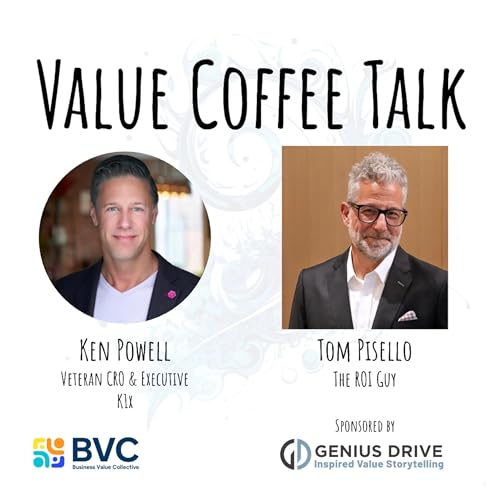
• CRO Spotlight: Leveraging Value for 65% CAGR Growth
    May 14 2026

    In this episode of Value Coffee Talk, host Thomas Pisello speaks with Ken Powell about the remarkable growth journey of K1X and the evolving role of business value in today’s SaaS and AI-driven economy. The conversation explores how organizations can move beyond product-centric selling to focus on measurable outcomes, customer adoption, and long-term value creation in increasingly competitive and rapidly changing markets.

    Ken shares insights on outcome-based buying, AI transformation, and the importance of embedding value into customer workflows to drive engagement, retention, and scalable revenue growth. The discussion also highlights leadership strategies for navigating change, accelerating adoption, and staying adaptable in an era where speed, curiosity, and customer impact are becoming critical competitive advantages.

    Key Topics
    • K1X’s growth journey and SaaS scaling strategies
    • Embedding business value into customer workflows and sales
    • Outcome-based buying and the shift toward measurable value
    • Driving adoption and engagement in SaaS and AI environments
    • Leadership, adaptability, and navigating rapid market change.

    Mehr anzeigen Weniger anzeigen
    22 Min.
  • Mastering Seamless Sales: Strategies for Modern Decision-Making
    May 7 2026

    In this insightful interview, host Tom Pisello interviews sales transformation expert and author Art Fromm, to explore how modern buying decisions are increasingly shaped by risk perception, stakeholder alignment, and the growing complexity of enterprise sales.

    The pair dive into how organizations can create more seamless, collaborative sales experiences that reduce friction, improve buyer confidence, and ultimately drive stronger quota attainment and customer success outcomes.

    Topics include the impact of risk perception on decision-making, engineering influence within the buying process, the importance of cross-functional sales collaboration, and practical strategies revenue leaders can use to improve sales effectiveness in today’s challenging market.

    Key Topics
    • How risk perception shapes modern buying decisions
    • Reducing friction through seamless, collaborative sales experiences
    • The growing complexity of stakeholder alignment in enterprise sales
    • Cross-functional collaboration between sales, engineering, and customer success
    • Practical strategies to improve quota attainment and customer outcomes

    Mehr anzeigen Weniger anzeigen
    29 Min.
  • Beyond the Harbor Tour: How Pre-Sales Wins with Outcomes, Not Features
    Apr 15 2026

    In this episode of the Value Coffee Talk Podcast, Tom Pisello, the ROI Guy, speaks with Michael McDowell, the “Demo-tainer” and author of Demo-tainment, about how pre-sales and solution engineering are evolving in an AI-driven world.

    The pair discuss why human connection still matters, how to avoid boring product demos, why outcomes should lead the conversation, and how sales engineers can expand from proving technical fit to proving business value.

    Highlights
    • Why “Demo-tainment” helps make demos more engaging, memorable, and human
    • How AI is changing pre-sales, and why SEs need to become more human, not less
    • Why the best pre-sales professionals will use AI to amplify their impact, not resist it
    • How to avoid the “harbor tour” and focus demos on what matters most to the buyer
    • Why less is more in demos, because too many features dilute perceived value
    • How outcome-first demos create stronger customer connection than feature-first walkthroughs
    • Why the future of pre-sales combines technical expertise, business acumen, and presentation skill.

    Mehr anzeigen Weniger anzeigen
    32 Min.
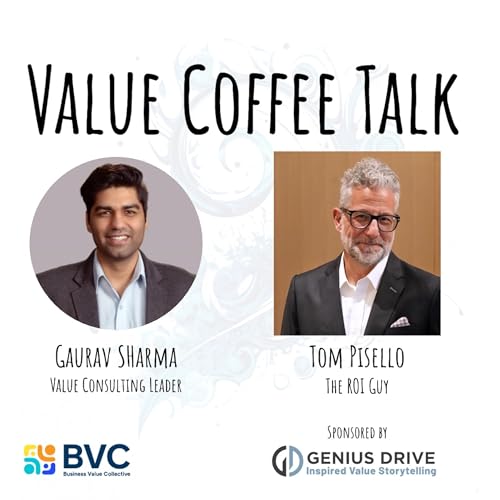
  • From Promised to Proven - Scaling Post-Sales Value Realization
    Apr 8 2026

    In this episode of the Value Coffee Talk Podcast, Tom Pisello, the ROI Guy, is joined by Gaurav Sharma, Product Leader for Value Tools and AI Systems at ServiceNow, to explore one of the most important shifts in go-to-market strategy: post-sales value realization.

    The discussion focuses on how organizations can move beyond selling value to actually proving it, using embedded product telemetry, instrumentation, and data-driven insights.

    Gaurav shares a practical framework for operationalizing value across teams, aligning product metrics to business outcomes, and enabling customer success to tell stronger, outcome-based stories.

    Highlights
    • Why most companies are good at selling value but struggle to prove it post-sale
    • How telemetry and instrumentation enable continuous tracking of realized outcomes
    • Why value realization is a credibility problem, not just a tooling problem
    • The importance of aligning product metrics to business outcomes and success metrics
    • How benchmarking against peers strengthens value conversations and customer engagement
    • Why storytelling is still required, even with dashboards and data
    • How consistent value taxonomy aligns sales, marketing, and customer success

    Mehr anzeigen Weniger anzeigen
    26 Min.
  • Mastering Negotiation: The Four Levers Every Seller Should Know
    Mar 25 2026

    Negotiation in today’s market is no longer about pressure tactics or last-minute discounts. Buyers are more informed, pricing transparency is higher, and trust plays a bigger role in purchasing decisions than ever before. To succeed, sellers must take a more structured and collaborative approach to negotiation.

    In this podcast, host Tom Pisello, the ROI Guy, explores the four key levers of negotiation outlined by sales expert and bestselling author Todd Caponi. These levers help sellers move negotiations away from simple price concessions and toward mutually beneficial value exchanges.

    The four levers are volume, timing of cash, length of commitment, and timing of the deal. Each provides an opportunity to create value for both the buyer and the seller when used thoughtfully. Instead of negotiating only on price, effective sellers use these levers to structure agreements that align incentives, improve predictability, and strengthen long-term partnerships.

    Understanding and applying these negotiation levers can help sales professionals build greater trust with buyers, improve deal outcomes, and avoid common mistakes such as offering discounts without receiving meaningful commitments in return.

    Soundbites
    1. "Transparency and trust build better deals"
    2. "Use the four drivers to reduce discounts"
    3. "Market wisdom determines value pricing"

    Takeaways
    1. Negotiation today requires transparency, collaboration, and a focus on mutual value.
    2. The most effective negotiations move beyond price and leverage multiple dimensions of value.
    3. Volume can justify better pricing when customers commit to larger purchases or broader adoption.
    4. Timing of cash can create value through faster payments or improved cash flow.
    5. Length of commitment provides revenue predictability and can justify pricing incentives.
    6. Timing of the deal helps create planning certainty for both the buyer and seller.
    7. Sellers should avoid giving discounts without receiving something meaningful in return.
    8. Structured negotiation frameworks help build trust and lead to better long-term outcomes.

    Mehr anzeigen Weniger anzeigen
    29 Min.
  • Navigating the Challenges of Selling to Early Stage Companies
    Mar 18 2026

    In this episode of the Value Coffee Talk podcast, host Thomas Pisello speaks with Nate Littlewood, founder of Future Ready CFO, about the unique challenges faced by early-stage e-commerce and CPG companies, and why this makes selling to these firms a unique and sometimes daunting challenge.

    The pair discuss the importance of prioritization, the frameworks for identifying business priorities, and strategies for solution providers selling to startups. Nate shares insights on improving sales conversion rates, building trust with clients, and the emerging outcome economy in business relationships.

    Takeaways
    1. Early-stage companies often struggle with financial outcomes despite significant effort.
    2. Founders frequently have too many priorities, leading to a lack of focus.
    3. It's essential to help founders identify the few priorities that will drive growth.
    4. Solution providers should be patient and understand the founder's perspective.
    5. Using frameworks like ROI and bottleneck analysis can help prioritize business efforts.
    6. Sales conversion rates can improve by educating clients on how to buy services.
    7. Offering guarantees can help de-risk the sales process for clients.
    8. Aligning interests with founders builds trust and credibility.
    9. The outcome economy is emerging, linking compensation to performance.
    10. Understanding the unique challenges of startups is key to successful selling.

    Mehr anzeigen Weniger anzeigen
    31 Min.
  • Is the Future of Solutions Engineering all about Value?
    Mar 11 2026

    In this episode of the Value Coffee Talk podcast, host Tom Pisello engages with Chris Mabry, head of community at iris.ai and long time Sales / Solution Engineering advocate and thought leader with the Pre-Sales Collective, discussing the evolving role of Solutions Engineers, the role they will play in Value Selling, and the impact of AI on SEs and sales.

    The pair explore the shift from reactive support to proactive revenue generation, the importance of building trust and confidence in sales, and the necessity for Solutions Engineers to adapt to new expectations as value engineers.

    The conversation emphasizes the significance of human touch, curiosity, and transparency in fostering successful customer relationships and driving business outcomes. And discusses just how SEs will be taking over more and more value engineering and consulting deal support and customer engagements.

    Takeaways
    1. The title of Solutions Engineer is evolving to reflect a more consultative role.
    2. Sales Engineers are transitioning from reactive support to proactive revenue centers.
    3. AI is reshaping the SE role by enhancing research and demo capabilities.
    4. Building trust and confidence is crucial in the sales process.
    5. Solutions Engineers are increasingly being tasked with proving business value, not just technical capabilities.
    6. Curiosity and asking the right questions can lead to better customer relationships.
    7. Transparency about product capabilities can enhance trust with customers.
    8. Demos should focus on value and outcomes rather than just features.
    9. Sales is often a moment of crisis for buyers, requiring a consultative approach.
    10. Being interesting and engaged makes a significant difference in sales success.

    Mehr anzeigen Weniger anzeigen
    30 Min.
  • Gartner: The Outcome Economy and Shift to Value-Led Growth
    Feb 18 2026

    In this episode of the Value Coffee Talk podcast, host Tom Pisello and Gartner Analyst and Fellow David Yockelson discuss the emerging Outcome Economy, and the importance of focusing on customer outcomes rather than just selling solutions.

    The pair explore the role of AI in shaping this economy, the challenges and benefits of adopting an outcome-focused approach, and the need for effective pricing strategies.

    The conversation also highlights the significance of quantifying value for buyers and the necessity of aligning marketing and communication efforts with customer needs.

    Ultimately, they stress the importance of activating change within organizations to successfully navigate this evolving landscape.

    Takeaways
    1. The Outcome Economy focuses on customer outcomes rather than solutions.
    2. AI plays a significant role in shaping the Outcome Economy.
    3. Companies must avoid simply overlaying new technology on outdated processes.
    4. Pricing strategies need to evolve to reflect outcomes achieved.
    5. Value affirmation is crucial for customer retention and expansion.
    6. Effective communication of value is essential for buyer engagement.
    7. Organizations must activate change to meet evolving buyer habits.
    8. Product-led growth and value-led growth can coexist and complement each other.
    9. Understanding customer usage patterns is key to driving value.
    10. Don't lose hope; the Outcome Economy presents new opportunities.

    Mehr anzeigen Weniger anzeigen
    30 Min.