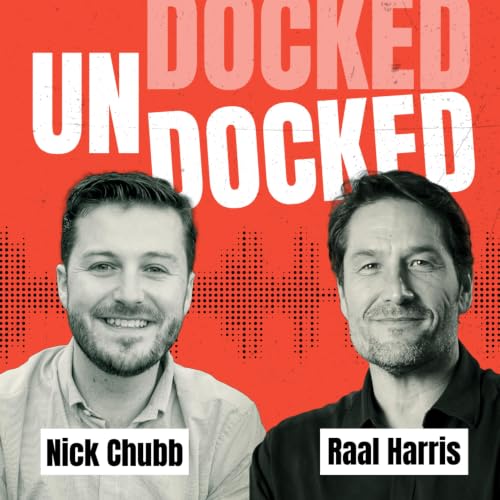
UnDocked: The Maritime Transformation Show Titelbild

UnDocked: The Maritime Transformation Show

UnDocked: The Maritime Transformation Show

Von: Raal Harris and Nick Chubb
Jetzt kostenlos hören, ohne Abo

Das größte Angebot der Saison | 0,99 € pro Monat für die ersten 3 Monate + 15 € Audible-Guthaben

Danach 6,99 €/Monat. Bedingungen gelten. Monatlich kündbar.
Über diesen Titel
Undocked is a weekly podcast where Nick Chubb and Raal Harris explore what’s changing in maritime and technology. Through candid conversations and guest interviews, the show unpacks emerging trends, overlooked stories, and strategic insights, offering a fresh, unfiltered perspective on the evolving future of one of the world’s oldest industries.2026 Raal Harris and Nick Chubb
  • Looking Back at Crew Connect 2026 with Seatrade Maritime’s Marcus Hand
    Nov 12 2026

    Seatrade Maritime’s Marcus Hand joins Nick Chubb and Raal Harris to unpack Crew Connect 2026 in Manila: a crewing agenda reshaped by geopolitical risk, emerging technology and persistent workforce pressures. They explore what the industry’s more candid debates reveal about seafarer safety, training, fatigue and the future of maritime careers.

    CHAPTERS

    • 03:49 What has changed in crewing?
    • 08:31 Geopolitics and seafarer safety
    • 16:09 Alternative fuels and training costs
    • 21:37 AI, digital skills and technostress
    • 28:13 Welfare, fatigue and career progression
    • 35:58 Rethinking the seafarer shortage
    • 40:25 Inclusion and changing career expectations
    • 44:35 Connectivity and ship-shore communication
    • 52:14 Uncertainty and the industry's priorities

    Reflecting on Crew Connect in Manila, Raal Harris and Seatrade Maritime's Marcus Hand bring Nick Chubb up to speed on a conference where geopolitics displaced much of the traditional technical agenda. For the Philippines, conflict-zone risks are not abstract: seafarer safety is both a national priority and a family concern.

    The conversation examines who pays for alternative-fuel training, the growing influence of AI and the uneven digital skills of incoming seafarers. Welfare debates are becoming more practical, with fatigue, career progression and employment models exposing weaknesses in how shipping recruits and retains talent. Even the familiar seafarer shortage narrative faces scrutiny, particularly the distinction between available applicants and experienced officers.

    Finally, the trio consider lessons from cruise-sector employment practices and whether improved connectivity is genuinely helping crews or introducing new workloads and dependencies. The overriding theme is uncertainty, and the importance of more candid industry conversations.

    EPISODE PARTNER

    This episode is sponsored by OneOcean

    On Tuesday 17 November, Nick Chubb will host the next webinar in OneOcean's See Further series, asking: what does effective loss prevention actually look like in practice?

    When something goes wrong on one ship, how do you make sure another crew doesn't face the same problem?

    He will be joined by Christopher Saunders, Chief Maritime Officer at RightShip, and John Hissey from OneOcean, who spent four years working in loss prevention at Britannia P&I.

    The event will use real case studies to explore how operators can recognise risks earlier, learn from incidents and prevent them happening again.

    It's live at 11 am GMT, and you can register using this link: https://zoom.us/webinar/register/5617944785391/WN_d7RP_oc6Rqy2ezufNzjiZg

    Mehr anzeigen Weniger anzeigen
    57 Min.
  • Transitioning to Digital Seafarer Certificates, Baltic SeaSurveillance, and GPS Spoofing
    Nov 5 2026

    Digitalising seafarer credentials sounds straightforward, but replacing paper certificates with PDFs only solves part of the problem. In this episode of UnDocked, Nick Chubb and Raal Harris discuss new Thetius research into making crew qualifications more secure, interoperable and seafarer-friendly. They also cover Baltic maritime surveillance, GPS spoofing, a potential solution to shipping's 'sail fast and wait' problem and robotic hull cleaning.

    CHAPTERS

    • 05:52 – Thetius report: digital seafarer credentials
    • 10:44 – Why scanned PDFs aren't enough
    • 16:00 – The risks of paper certificates
    • 21:44 – Creating a fake certificate with AI in 11 minutes
    • 23:56 – Building trust in digital credentials
    • 30:26 – Offline verification and interoperability
    • 34:04 – Industry standards, seafarer rights and who pays
    • 43:23 – Mysterious surveillance cameras in the Baltic
    • 47:00 – Windward acquires Azimut AI
    • 53:45 – GPS spoofing and navigational resilience
    • 01:01:33 – StormGeo buys Portchain: fixing 'sail fast and wait'?
    • 01:08:36 – Can MAGNETO clean your bottom?

    Nick and Raal begin with Securing Trust: The Transition to Digital Seafarer Credentials, new research from Thetius commissioned by Maritime Passport.

    The report examines how shipping can move beyond fragmented paper-based certification towards a system that allows qualifications to be securely issued, held and independently verified.

    Nick recounts the experience of a master mariner carrying 4kg of certificates and demonstrates how he created a convincing fake training certificate using AI in just 11 minutes.

    They discuss the importance of common standards, protecting personal information, offline verification and ensuring seafarers retain control over their credentials without having to pay for access to their right to work.

    The conversation then moves to an unusual story from the Danish island of Bornholm, where a mysterious request to install coastal surveillance cameras eventually leads to Windward's acquisition of Azimut AI. Nick explains how computer vision could help track vessels operating without AIS.

    Raal raises concerns about GPS interference, prompting a discussion about the vulnerability of interconnected bridge systems and whether traditional navigation skills, including celestial navigation, deserve renewed attention.

    Next, StormGeo's acquisition of Portchain offers a potential route towards better coordination between vessel arrivals and terminal availability, tackling the persistent inefficiency of ships sailing at speed only to wait outside port.

    Finally, Cargill's partnership with Neptune Robotics brings robotic hull cleaning into focus, with Nick and Raal considering the opportunities for safer maintenance and improved vessel efficiency.

    Read the Thetius report:
    https://thetius.com/securing-trust-the-transition-to-digital-seafarer-credentials/

    EPISODE PARTNER

    This episode is sponsored by Insight.

    What if compliance simply happened as your business operated, instead of being chased after the fact?

    That's the advantage of building NIS2 cyber requirements, IMO safety compliance and EU ETS reporting directly into operational workflows from the outset — not bolted on afterwards. Insight and SmartSea make that possible with an integrated digital approach that keeps these requirements running in the background of daily operations, not as a separate compliance project.

    Because when compliance is built into how the fleet runs, it becomes another driver of performance, not a drag on it.

    Protect your maritime estate with Insight.

    Mehr anzeigen Weniger anzeigen
    1 Std. und 1 Min.
  • Path Robotics' Heather Carroll on Robot Dogs That Weld, Welder Shortages and Shipbuilding's Future
    Oct 29 2026

    Does keeping a human in the loop always produce better results? Heather Carroll, Chief Revenue Officer at Path Robotics, joins Nick Chubb and Raal Harris on UnDocked to explore how physical AI is changing robotic welding and what this could mean for shipbuilding, skilled workers and the future of maritime manufacturing.

    CHAPTERS

    00:00 – Heather's journey into robotic welding

    02:53 – Robots, jobs and the shortage of welders

    05:53 – How AI learns to weld through practice

    09:07 – The origins of Path Robotics

    16:01 – Why conventional automation struggles in shipyards

    17:17 – Rove: the robot dog that can weld

    19:16 – How automation could change skilled work

    21:55 – The submarine welder's extraordinary working conditions

    23:55 – Rebuilding American shipbuilding capacity

    34:32 – HII, Path Robotics and the HYPR programme

    41:58 – What tomorrow's shipyards could look like

    48:09 – Weld quality, inspection and costly rework

    53:23 – Could robotic maintenance eventually move onboard?

    56:51 – Challenging the human-in-the-loop assumption

    1:01:24 – How AI operates within welding standards

    1:06:06 – NAVSEA, ABS and accepting robotic welding

    1:09:31 – Resilience, reshoring and future shipbuilding

    Heather's interest in welding is personal. Her husband operated a manufacturing business that struggled to find skilled welders, a problem that eventually contributed to his decision to sell it.

    She explains how Path Robotics trains its Obsidian AI model using real-world welding data, why conventional industrial robots struggle with shipbuilding and how mobile systems such as Rove might offer new possibilities.

    The discussion covers Path's collaboration with Saronic and its work with HII and GrayMatter Robotics. Heather also describes the working conditions faced by a submarine welder, raising difficult questions about safety and how skilled labour is used.

    Later, the conversation turns to an assumption familiar across maritime AI: that a human should always remain in the loop. Heather makes the case for allowing trained models to adapt within approved welding procedures, while acknowledging where human involvement and technical oversight remain essential.

    Nick and Raal also explore the potential for robotic maintenance at sea, the challenges of gaining technical acceptance and what a more automated shipbuilding industry could look like.

    EPISODE PARTNER

    Adding another digital system to the fleet is easy. Getting it to work seamlessly with everything else is where the real work starts.

    Disconnected platforms create duplicate data, manual workarounds and unnecessary complexity across a fleet. Insight and SmartSea bring it together through a common integration layer connecting onboard operations, applications and data into one end-to-end environment — a fleet that's easier to manage, easier to scale, and ready for whatever comes next.

    Because the best technology doesn't work in isolation. It works together.

    Connect your fleet with Insight.

    #UnDocked #Shipbuilding #PhysicalAI #MaritimeTechnology #Robotics

    Mehr anzeigen Weniger anzeigen
    1 Std. und 6 Min.
adbl_web_anon_alc_button_suppression_t1
Noch keine Rezensionen vorhanden