• The Future of Sales: Trust, AI, and Relationship Capital with Drew Sechrist
    Feb 17 2026

    In this episode, I sit down with Drew Sechrist, the former Salesforce veteran who helped take the company from zero to $1 billion. Now the CEO of Connect the Dots, Drew is on a mission to kill the cold call forever.

    We discuss the "Osmosis Deficit" facing remote sales teams, why you can't close enterprise deals over Zoom, and the "LL Bean" lesson on solution selling that I learned in a shoe department. Drew explains why your network is the only moat you have left against AI, and how to transition from being a "contact collector" to a true "connector."

    Key Findings:

    • The "Osmosis" Effect: Junior sellers in remote environments are missing out on the passive learning that created the superstars of the 90s and 00s. Leaders need to manufacture these "hallway moments."

    • The Deposit/Withdrawal Ratio: Successful networking requires a 99:1 ratio of giving help to asking for favors. If you try to "monetize" every interaction, your network will dry up.

    • The "Dinner" Metric: Technology can get you the meeting, but it can't close the 7-figure deal. High-stakes sales still require high-touch, in-person trust building.

    • Network Visibility: The biggest waste in sales is cold calling a prospect that your colleague (or board member) already knows. Tools like Connect the Dots are solving the "visibility" problem of relationship capital.

    Memorable Quotes:

    • "I wouldn't want to start my career now... I survived because of osmosis."Drew Sechrist

    • "I get paid in dopamine hits when I connect two people."Drew Sechrist

    • "You can't sell something you aren't interested in... I wasn't selling shoes; I was selling an experience."Lee Levitt

    • "If you are just an information kiosk, AI will replace you."Drew Sechrist (Paraphrased)

    Resources Mentioned:

    • Connect the Dots: ctd.ai (Free for individuals to map their network)

    • Book: The Third Door by Alex Banayan

    • Book: The Tipping Point by Malcolm Gladwell

    • Concept: "The Jolt Effect" (Dixon/McKenna)

    Call to Action:

    • Map Your Network: Sign up for a free account at ctd.ai to see who you really know.

    • Connect with Drew: Find Drew Sechrist on LinkedIn or email him at drew@ctd.ai.

    • Subscribe: If you want to future-proof your sales career against AI, hit subscribe on Thoughts on Selling.

    Mehr anzeigen Weniger anzeigen
    29 Min.
  • Alex Raymond on Why Your Existing Customers Are Your Biggest Growth Engine
    Feb 10 2026

    I've been saying for years that B2B selling is broken. Alex Raymond — founder of AMplify, author of The Growth Department, and host of Account Manager Secrets — thinks account management is broken too. So naturally we had a lot to talk about.

    Alex has spent the last decade figuring out how companies can grow faster and more profitably through the customers they already have.

    And the data he brings to this conversation is staggering.

    • 73% of revenue comes from existing customers.
    • 52% of net new revenue comes from existing customers.
    • And nearly all profit — sometimes more than 100% — is generated post-sale.

    Yet most companies treat their post-sales teams like the JV squad. An inexperienced coach, ratty uniforms, smelly locker rooms. Then they wonder why things aren't working.

    We get into why "recurring revenue" is a dangerous myth that gives executives a false sense of security, and why the handoff from sales to account management is where customer relationships go to die.

    Alex shares his Keep, Grow, No Surprises framework and makes a compelling case that the real job of account management isn't running QBRs or chasing NPS scores — it's helping your company win.

    One of my favorite parts is Alex's concept of "relentless curiosity" — meeting your customer as a human being, asking great questions without fishing for a specific answer, and staying in the question long enough to find what's really going on. We also get into Greg Daines's research showing that even $1 of measurable improvement is enough to get a customer excited about renewing — and that reporting negative results retains customers twice as long as not reporting at all.

    If you're in sales, account management, customer success, or revenue leadership, this one will make you rethink where you invest.

    KEY TAKEAWAYS

    • The math is wildly lopsided. 73% of revenue and nearly all profit come from existing customers, but most companies pour their investment into new business sales. Every point of NRR increase drives 13-16% in valuation growth over five years. The path to durable growth runs through the customers you already have.
    • Recurring revenue is a myth. Subscription doesn't mean automatic. That assumption leads companies to underinvest in the people doing the hardest work — hiring less experienced people, giving them fewer tools, then wondering why retention suffers. In the early days of SaaS, we knew we had to earn it every month. That mindset needs to come back.
    • Keep, Grow, No Surprises. Alex's framework: keep the customers sales brings in, grow the ones with the most potential, no surprises. NPS and CSAT are trailing indicators. The real job of account management is helping your company win.
    • Relentless curiosity changes everything. Customers are inured to our discovery — they know the checklist is coming and give us the minimum to get off the phone. Instead, figure out what the world looks like through their eyes. What's on their boss's mind? Their board's mind? Ask without fishing. That's where expansion and real risks surface.
    • Show even $1 of improvement. Greg Daines's data shows the threshold for renewal excitement isn't a massive ROI number — it's basically a dollar. Once customers see measurable progress, they imagine the path forward. Be precise about value. Don't let yourself or the customer off the hook with vague statements.

    BOOKS MENTIONEDThe Growth Department — Alex RaymondThe JOLT Effect — Matthew Dixon & Ted McKennaThe Meaning Revolution — Fred KofmanThink Better — Tim HursonThe Four Agreements — Don Miguel RuizThe Fifth Agreement — Don Miguel Ruiz & Don Jose RuizTogether We Win — Lee Levitt (forthcoming)

    FIND ALEXLinkedIn: linkedin.com/in/afraymondWebsite: amplifyam.com

    Share this episode with a coworker. Reach out at podcast.thoughtsonselling.com or book time at meet.aceleragroup.com

    Mehr anzeigen Weniger anzeigen
    34 Min.
  • The "Hot Nerd" of Sales: Neuroscience, Improv, and the "Buyer First" Mindset with Carole Mahoney
    Jan 27 2026

    I recently sat down with Carole Mahoney, a self-described "hot nerd," author of Buyer First, and a woman on a mission to redeem the sales profession. Carole didn't start out loving sales; in fact, she started in marketing specifically to make salespeople obsolete. But she realized that to help small businesses grow, she had to embrace selling—not as a manipulation, but as a mechanism for change.

    In this episode, we explore how she uses neuroscience and psychology to help sellers get out of their own way. We geek out on the similarities between hiking and sales (you can pack all the gear you want, but you still have to pivot when the trail changes), and why she believes the only difference between a good salesperson and a con man is intent.

    Key Highlights & Takeaways:

    • From Sheet Music to Improv: Carole shares her transition from being a musician who needed "sheet music" (a script) to embracing the "Yes, And" mentality of improv. We discuss why being present in the moment is more valuable than having the perfect answer prepared.

    • The "Not About Me" T-Shirt: Carole literally made t-shirts for HubSpot reps that said "Not About Me" upside down, so they would be reminded every time they looked down that the sales call isn't about their product—it's about the buyer.

    • How You Buy is How You Sell: We discuss the "cognitive behavioral" side of sales. If you are a shopper who needs to "think it over" and hunt for discounts, you will inevitably accept those same excuses from your prospects.

    • The Manager Impact: Carole drops a massive stat from her analysis of 500,000 managers: Managers with negative beliefs about sales are 355% more likely to pass those on to their team, while those with supportive mindsets are 1,000% more likely to build high-performing teams.

    • Hiring "Kristen" from the Restaurant: We bond over our shared love of hiring hospitality staff for sales roles. They know how to ask questions, read the room, and (like Kristen at Atlantic Fish Company) confidently recommend the tuna over the salmon.

    Memorable Quotes:

    • "I’m a nerd who likes to see constant growth... I love to leave things in a better state than I found them."Carole Mahoney

    • "The only difference between a good salesperson and a con man is intent."Carole Mahoney

    • "If you buy that way as a salesperson, you will sell that way as a salesperson."Carole Mahoney

    • "We share the sheet music, but we play the jazz."Lee Levitt

    The Bottom Line:Sales isn't about tricking people into doing things; it's about helping them make a change. Whether you are a "hot nerd" reading neuroscience papers or a waiter recommending the special, success comes down to curiosity, authenticity, and the ability to listen.

    Call to Action:

    • Read the Book: Pick up a copy of Buyer First to understand the psychology behind modern selling.

    • Connect with Carole: Find her at UnboundGrowth.com or connect with "Carole (with an E) Mahoney" on LinkedIn.

    • Subscribe: If you enjoyed this conversation, hit subscribe on Thoughts on Selling so you never miss an episode!

    Mehr anzeigen Weniger anzeigen
    46 Min.
  • Manufacturing Leaders: From "Positional" Authority to "Influential" Power w/ Amos Balongo
    Jan 21 2026
    Episode SummaryIn this episode of Thoughts on Selling, Lee Levitt sits down with Amos Balongo—a leadership expert joining us from Hawaii who is in the business of "manufacturing leaders." We dig into a critical failure point in most organizations: the gap between Strategy and Communication. Amos argues that many leaders rely on "Positional Leadership" (people follow you because they have to), which yields the bare minimum effort. The goal is to shift to "Influential Leadership," where collaboration drives results. We also explore the Three Pillars of Transformation (Motivate, Inspire, Transform), why simplicity mobilizes teams better than complexity, and how to apply Situational Leadership to ensure you aren't sending 5:00 AM texts to the wrong people. Memorable Quotes:"The bigger you're thinking, the smaller your problems." — Amos Balongo "Motivation is an outside job; Inspiration is an inside job." "Complexity impresses, but simplicity mobilizes. If your team can't understand the plan, they can't act on it." Three Actionable Takeaways for Leaders:Audit Your Leadership Style: Are you Positional or Influential? Positional leaders issue directives ("I told you to do this"). Influential leaders invite participation. If you find yourself saying, "Didn't I tell you to do this?" too often, you are relying on position, not influence. The "Motivate-Inspire-Transform" Framework: Don't stop at motivation. Amos explains the progression: Motivate (get them interested), Inspire (evoke internal drive), and Transform (give them actionable steps to multiply results). Leaving them just "inspired" without a plan is a wasted opportunity. Be Bold, Brief, & Strategic: If you struggle to get executive buy-in for your ideas (or if people keep stealing them!), change your delivery. Executives are time-poor. Cut the stories and focus on being bold, brief, and strategic to land your message. Key Topics & Timestamps:(00:00) – Introduction: Manufacturing Leaders in Hawaii. (06:30) – Positional vs. Influential: Why authority doesn't equal leadership. (11:00) – Simplicity vs. Complexity: Why complex plans fail to mobilize. (13:30) – The 3 Pillars: Motivate (External) vs. Inspire (Internal). (20:00) – Growth Mindset: Why "Goal-Oriented" thinking limits potential. (26:00) – Situational Leadership: Tailoring your communication style (and medium) to the person. (43:30) – Stolen Ideas: How to handle it when someone else takes credit for your work. About Our Guest:Amos Balongo is a leadership expert, speaker, and author of A Voice Empowered. He helps executives and organizations bridge the gap between "strategy" and "action" by manufacturing leaders who are exceptional communicators. Amos is also the host of the Journeys of Inspiration podcast. About the Host:Lee Levitt is a seasoned sales performance consultant, sales coach and the Principal of The Acelera Group.With decades of experience in Sales, Sales Leadership, Sales Enablement, Revenue Operations, and Sales Performance Management, Lee helps emerging and enterprise organizations build disciplined, replicable sales operating systems.He is the voice behind the Thoughts on Selling™ brand, covering the intersection of deal mechanics and the "Inner Game" of selling.Resources & Links:The Book: Transforming Your Life by Amos Balongo. The Podcast: Journeys of Inspiration. Connect with Amos: Visit AmosBalongo.com. Subscribe: Get the Thoughts on Selling newsletter at thoughtsonselling.com.Keywords:Leadership Communication, Situational Leadership, Amos Balongo, Organizational Strategy, Positional Authority, Growth Mindset, Employee Engagement, Executive Presence, Sales Leadership, Team Motivation.
    Mehr anzeigen Weniger anzeigen
    36 Min.
  • Escaping the Sales Treadmill: Cognitive Load & Deal Risk w/ Pete Smith
    Jan 13 2026
    Episode SummaryAre your enterprise sales reps drowning in tools but starving for insight? In this episode of Thoughts on Selling, Lee Levitt sits down with Pete Smith, founder of SpotLogic and veteran sales leader, to discuss the "Cognitive Load" crisis in modern selling.We explore why 84% of enterprise deals stall after the first meeting and how Sales Enablement leaders can help reps stop "winging it" and start winning. From his days at NCR’s legendary "Sugar Camp" to building deal intelligence software, Pete reveals how to earn the status of a "Trusted Insider" rather than just another vendor.Memorable Quotes:"Customers buy from the reps who understand them best." — Pete Smith"Discovery is the most important part of the job in complex sales... No, it IS the job.""I've got three critical meetings today... and I'm going to have to wing two of them." — The reality of the modern rep.3 Actionable Takeaways for Leaders:Audit Your "Cognitive Tax": Look at your tech stack. If a tool requires data entry but doesn't give the rep immediate insight for their next call, it is a tax, not a tool. Remove or consolidate it to lower burnout.The "Insider" Test: Ask your champion, "If we weren't in the room, how would you describe our value to the CFO?" If they can't answer, you haven't crossed the threshold from "Vendor" to "Partner."Stop "Event-Based" Discovery: Discovery isn't a stage in Salesforce; it's a continuous loop. Train reps to re-validate pain points in every meeting, not just the first demo.Key Topics & Timestamps:(00:00) – Introduction: The crisis of the Sales Treadmill.(03:45) – The Cognitive Load Problem: Why more tools often equal less productivity for reps.(10:20) – The "Insider" Threshold: Moving from "column fodder" to trusted partner.(16:50) – The Goldman Sachs Lesson: Why deals die due to organizational risk, not feature gaps.(24:15) – Discovery as a Mindset: Why treating discovery as a "phase" is a death sentence.(32:30) – The "Pajama" Problem: Navigating the shift from NCR suits to Zoom casual.(39:00) – SpotLogic Demo: How to prep for a critical meeting in minutes, not hours.About Our Guest:Pete Smith is the Founder and CEO of SpotLogic, a deal intelligence platform designed to reduce cognitive load for enterprise sellers. A veteran of the industry, Pete began his career at NCR Corporation (attending the famous "Sugar Camp" sales academy) and has spent decades leading sales organizations. He built SpotLogic to solve his own problem: needing a "force multiplier" to manage complex, multi-stakeholder deals without burning out.About the Host:Lee Levitt is a seasoned sales performance consultant, sales coach and the Principal of The Acelera Group.With decades of experience in Sales, Sales Leadership, Sales Enablement, Revenue Operations, and Sales Performance Management, Lee helps enterprise organizations build disciplined, replicable sales operating systems.He is the voice behind the Thoughts on Selling™ brand, covering the intersection of deal mechanics and the "Inner Game" of selling.Related Episodes You Might Like:Ep 25: When Sales People Do Their Homework w/ Deb Berman: A masterclass in deep preparation and discovery.Ep 76: Who Are You? w/ Gerhard Gschwandtner: Exploring the mindset required to lead in high-pressure sales environments.Resources & Links:Reduce Rep Burnout: See how SpotLogic helps reps prep for meetings in minutes.Connect with Pete: Email pete@spotlogic.com or find Pete Smith on LinkedIn.Subscribe: Get the Thoughts on Selling newsletter at thoughtsonselling.com.Keywords for Search:Sales Productivity, Cognitive Load, Complex Sales, Deal Risk Management, Sales Enablement, Enterprise Selling, Discovery Skills, Buyer Psychology, SpotLogic, Sales Tech Stack, Sugar Camp, B2B Sales Strategy, Revenue Operations, RevOps, Sales Leadership, Mental Health in Sales, Burnout Prevention, SaaS Sales, Pipeline Generation, Account Planning.
    Mehr anzeigen Weniger anzeigen
    39 Min.
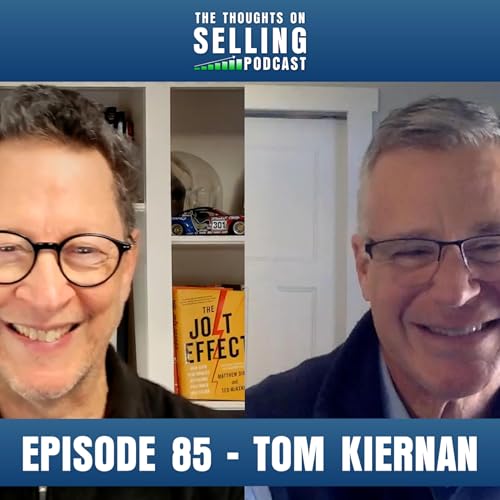
  • Why Sales Training Fails: The Science of Attention & Practice w/ Tom Kiernan
    Jan 7 2026
    Episode SummaryIs your organization guilty of the "T-Word"? In this episode of Thoughts on Selling, Lee Levitt sits down with Tom Kiernan, a veteran sales enablement practitioner (formerly of APC and Schneider Electric), to debate the critical difference between "Sales Training" (an event) and Sales Enablement (a process).We dive into the neuroscience of selling, exploring how the Reticular Activating System (RAS) filters information and how you can trigger it to cut through the noise. Tom also challenges leaders on the "Practice Deficit"—asking why professional athletes spend 90% of their time practicing, while sales reps practice only when they are live in front of a customer.Memorable Quotes:"Motive is transparent. It's written right up on that yellow sticky note on your forehead." — Tom Kiernan"The best swing is the one that I didn't think about... I practiced to get there, but I just hit the ball.""If you don't have a defined process, there's nothing to practice." — Lee Levitt3 Actionable Takeaways for Leaders:Kill the "Event" Mindset: Stop treating enablement as a one-time "bootcamp." Adopt the Toyota Way (Kaizen) approach: small, continuous process improvements integrated into the daily workflow.Hack the Buyer's RAS: Your buyer's brain is designed to ignore you. To trigger their Reticular Activating System, you must shift to "Other Centered Selling." Stop pitching "our solution" and start speaking "their problem."Schedule "Safe Failure": If your reps are only practicing on live calls, you are burning leads. Create safe, internal role-play environments where failure is free. As Tom notes, amateurs play the game; professionals practice the drill.Key Topics & Timestamps:(00:00) – Introduction: The forbidden "T-Word" (Training).(04:15) – Process vs. Event: Lessons from APC and Schneider Electric on building global enablement engines.(11:30) – The Neuroscience of Attention: What is the RAS and why does it block your sales pitch?(19:45) – The Practice Deficit: Comparing the NFL/Broadway preparation model to corporate sales.(27:00) – The "Toyota Way": Applying manufacturing rigor to the sales process.(33:20) – Commission Breath: Why motive is transparent and how to align with the buyer's success.(41:00) – Lumpy Bones: Tom’s "Books as a Service" non-profit for children facing difficult life challenges.About Our Guest:Tom Kiernan is a seasoned Sales Enablement leader with a career spanning major global enterprises like American Power Conversion (APC) and Schneider Electric. Known for his process-driven approach to performance, Tom is also the founder of Lumpy Bones, a 501(c)(3) non-profit. Through "Books as a Service," Lumpy Bones creates and distributes humorous, inspiring books to help children navigate difficult topics like cancer and illness.About the Host:Lee Levitt is a seasoned sales performance consultant, sales coach and the Principal of The Acelera Group. With decades of experience in Sales, Sales Leadership, Sales Enablement, Revenue Operations, and Sales Performance Management, Lee helps enterprise organizations build disciplined, replicable sales operating systems.He is the voice behind the Thoughts on Selling™ brand, covering the intersection of deal mechanics and the "Inner Game" of selling.Related Episodes:Ep 74: Listen, Don’t Think w/ Kevin Hubschmann: Using improv rules to practice active listening.Ep 43: The Inner Game of Selling w/ Jeff Lipsius: How internal coaching drives results.Resources & Links:Tom’s Non-Profit: Visit LumpyBones.com to support "Books as a Service."Connect with the Guest: Find Tom Kiernan on LinkedInSubscribe: Get the newsletter at thoughtsonselling.comKeywords for Search:Sales Enablement, Sales Training, Neuroscience of Selling, Reticular Activating System, RAS, Sales Coaching, Practice Drills, Toyota Way, Kaizen, Process Management, Buyer Psychology, Trust Based Selling, Commission Breath, Lumpy Bones, CSR, Corporate Social Responsibility, B2B Sales Strategy
    Mehr anzeigen Weniger anzeigen
    35 Min.
  • The Accidental Manager Crisis: From Top Performer to Leader w/ Ben Perreau
    Dec 31 2025

    Episode Summary

    Are you part of the 82% of leaders who feel like "Accidental Managers"? In this episode of Thoughts on Selling, Lee Levitt talks with Ben Perreau, a former music journalist turned leadership expert and founder of Parafoil.

    We discuss the most dangerous leap in any career: the transition from Individual Contributor (IC) to Team Leader. Ben explains why companies set new managers up to fail by promoting them for technical skills but ignoring the emotional intelligence required to lead. We also geek out on photography as a metaphor for management (moving from "Auto" to "Manual Mode") and why ignoring the fact that we are all "emotional meat sacks" leads to burnout and high Employee Churn.

    Memorable Quotes:

    • "There's a reason why 82% of early career managers consider themselves accidental... and a reason why a third of their teams leave within a year." — Ben Perreau

    • "We are all just 'emotional meat sacks' trying to be professional."

    • "Never doubt that a small committed group of people can change the world." — Quoting Margaret Mead

    Key Topics & Timestamps:

    • (00:00) – Introduction: The crisis of the Accidental Manager.

    • (04:30)The Promotion Trap: Why high-performing salespeople fail when promoted to management.

    • (12:15)The "Man in the Arena": Lessons on resilience from the BBC newsroom to the boardroom.

    • (18:45)Photography & Leadership: Moving from "Auto Mode" (reacting) to "Manual Mode" (vision and composition).

    • (24:20)Emotional Intelligence (EQ): Why suppressing emotion at work leads to burnout.

    • (31:00)Listening Circles: How Parafoil uses AI-driven peer groups to build psychological safety.

    • (38:50) – The "Manual Mode" Challenge: Practical steps for new managers to take control.

    About Our Guest:

    Ben Perreau is the founder of Parafoil, a leadership development platform designed to stop the churn of new managers. A former music journalist and media executive, Ben has led teams at large organizations and consulted for Fortune 50 C-Suite executives. He specializes in Organizational Behavior, Leadership Development, and the intersection of technology and human connection.

    About the Host:

    Lee Levitt is a seasoned sales performance consultant, sales coach and the Principal of The Acelera Group. With decades of experience in Sales, Sales Leadership, Sales Enablement, Revenue Operations, and Sales Performance Management, Lee helps enterprise organizations build disciplined, replicable sales operating systems.

    He is the voice behind the Thoughts on Selling™ brand, covering the intersection of deal mechanics and the "Inner Game" of selling.

    Resources & Links:

    • New Manager Training: Explore how Parafoil uses AI-driven listening circles.

    • Connect on LinkedIn: Find Ben Perreau here.

    • Subscribe: Get the Thoughts on Selling newsletter at thoughtsonselling.com.

    Keywords for Search:Leadership Development, New Manager Training, Employee Retention, Sales Management, Emotional Intelligence, Corporate Culture, Accidental Manager, Imposter Syndrome, Ben Perreau, Parafoil.


    Mehr anzeigen Weniger anzeigen
    42 Min.
  • The Unicorn Model is Dead: Building the Autonomous Business w/ Amos Bar-Joseph
    Dec 23 2025
    Episode SummaryIs the "growth at all costs" era over? In this episode of Thoughts on Selling, Lee Levitt sits down with Amos Bar-Joseph, a third-time entrepreneur joining from Tel Aviv, to dismantle the broken "Unicorn Playbook."Amos describes himself as an "Anti-Capitalist Capitalist," rejecting the traditional VC model of raising massive rounds to hire bodies. Instead, he is building Swann, an Autonomous Business designed to scale with Artificial Intelligence, not headcount. We explore why Sales is a Zero-Sum Game, why traditional CRMs are becoming obsolete "reporting burdens," and how the next generation of software won't just record data—it will adapt to your workflow to create the 100x Employee.Memorable Quotes:"I’m an anti-capitalist capitalist... The playbook of 'growth at all costs' is not for me." — Amos Bar-Joseph"The future belongs to organizations that turn each person into the 100x version of themselves.""We need to understand... it's not the AI replacing the AE, it's the AI taking the review process... formalizing it and repeating it."3 Actionable Takeaways for Leaders:Stop Hiring for Scale: The old playbook was "raise money, hire 40 reps." The new playbook is "hire 4 reps and give them the AI infrastructure to do the work of 40." Scale intelligence, not payroll.Audit Your "Static" Software: Traditional CRMs are just databases you have to feed. If your software isn't Adaptive (learning your habits and re-tailoring itself to you daily), it is a productivity drain. Demand tools that reduce "system interactions" to zero.Find Your "Zone of Genius": AI should handle 100% of the rote work (research, entry, scheduling) so your humans can focus 100% on the Zero-Sum Game of winning buyer attention. If your humans are doing robot work, you are losing.Key Topics & Timestamps:(00:00) – Introduction: The Anti-Capitalist Capitalist.(05:20) – The Death of the Unicorn: Why raising massive capital before Product-Market-Fit is a broken model.(12:45) – The Autonomous Business: Building a company that scales via code and AI, not bodies.(19:30) – The 100x Employee: How Human-AI Collaboration actually works (augmentation vs. replacement).(26:15) – Sales is Zero-Sum: Why spamming buyers with AI SDRs is a race to the bottom.(34:00) – The End of "Record and Report": Why the future of CRM is adaptive systems that require zero data entry.(41:50) – Swann & The Big Shift: Amos’s vision for the future of work.About Our Guest:Amos Bar-Joseph is a serial entrepreneur, thought leader, and the founder of Swann. Based in Tel Aviv, Amos is a leading voice on the concept of the Autonomous Business. He writes the popular newsletter The Big Shift, where he explores how AI is reshaping the fundamental economics of SaaS and scaling. His digital clone, "Autonomous," is also available in the ChatGPT store.About the Host:Lee Levitt is a seasoned sales performance consultant, sales coach and the Principal of The Acelera Group. With decades of experience in Sales, Sales Leadership, Sales Enablement, Revenue Operations, and Sales Performance Management, Lee helps enterprise organizations build disciplined, replicable sales operating systems.He is the voice behind the Thoughts on Selling™ brand, covering the intersection of deal mechanics and the "Inner Game" of selling.Resources & Links:Join the Movement: Subscribe to Amos’s newsletter, The Big Shift.Try the AI: Interact with Amos’s digital clone, "Autonomous", in the ChatGPT store.Connect with the Guest: Follow Amos Bar-Joseph on LinkedIn (30k+ followers).Subscribe: Get the Thoughts on Selling newsletter at thoughtsonselling.com.Keywords for Search:Autonomous Business, AI Sales, Future of Work, SaaS Growth Strategies, Unicorn Playbook, Venture Capital, Human-AI Collaboration, CRM Trends, Adaptive Software, Sales Productivity, RevOps, Artificial Intelligence in Sales, Swann, Amos Bar-Joseph, 100x Employee.+1+2
    Mehr anzeigen Weniger anzeigen
    38 Min.