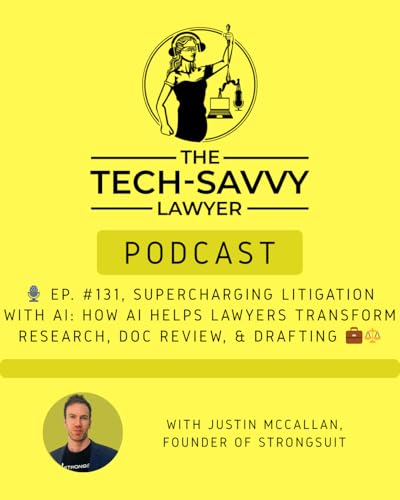
My next guest is Justin McCallan, founder of StrongSuit, an AI-powered litigation platform built to transform how litigators handle legal research, document review, and drafting while keeping lawyers firmly in control. In this episode, Justin and I dig into practical, real-world workflows that solos, small firms, and big-firm litigators can use today and over the next few years to change the economics, pace, and strategy of litigation—without sacrificing accuracy, ethics, or the quality of advocacy. Join Justin and me as we discuss the following three questions and more! What are the top three ways litigators should be using AI tools like StrongSuit right now to change the economics and pace of litigation without sacrificing accuracy, ethics, or quality of advocacy?What are the top three mistakes lawyers make when adopting AI for litigation, and what practical workflows help lawyers stay in the loop and use AI as a force multiplier instead of a risk?Looking ahead to 2026 and beyond, what are the top three AI-driven workflows every litigator should master to stay competitive, and how can platforms like StrongSuit help build those capabilities into day-to-day practice? In our conversation, we cover the following 00:00 – Welcome and guest introductionJustin joins the show and shares his current tech setup at his desk. 00:00–01:00 – Justin's current tech stackLenovo laptop, ultra-wide monitor, and regular use of StrongSuit, ChatGPT, and Gemini for different AI tasks.Everyday tools: Microsoft Word and Power BI for analytics and fast decision-making. 01:00–02:00 – Android vs. iPhone for AI useWhy Justin has been on Android for 17 years and how UI/UX familiarity often drives device choice more than AI capability. 02:00–05:30 – Q1: Top three ways litigators should be using AI right nowUsing AI for end-to-end legal research across 11 million precedential U.S. cases to build litigation outlines and identify key authorities.Scaling document review so AI surfaces relevant documents and synthesizes insights while lawyers focus on strategy and judgment.Leveraging AI for drafting and editing—improving style, clarity, and consistency beyond traditional spelling and grammar checks. 05:30–07:30 – StrongSuit vs. basic tools like Word grammar checkHow StrongSuit aims to "up-level" a lawyer's writing, not just catch typos.Stylistic improvements, clarity enhancements, and catching subtle inconsistencies in legal documents. 06:00–08:00 – AI context limits and scaling doc reviewConstraints of large models' context windows (around ~1M tokens ≈ ~750 pages).How StrongSuit runs multiple AI agents in parallel, each handling small page sets with heuristics to maintain cohesion and share insights. 08:00–09:00 – Handling tens of thousands of documentsHow StrongSuit can handle between roughly 10,000–50,000 pages at a time, with the ability to scale further for enterprise matters. 09:00–11:30 – Origin story of StrongSuitWhy Justin saw a once-in-a-generation opportunity when large language models emerged and how law, with its precedent and text-heavy nature, is especially suited to AI.StrongSuit's focus on litigators: supporting lawyers from intake through trial while keeping them in the loop at every step. 11:30–13:30 – From intake to brief drafting in minutesGenerating full litigation outlines, research, and analysis in about ten minutes, then moving directly into drafting memos, briefs, complaints, and motions.StrongSuit's long-term goal: automating 50–99% of major litigation workflows by the end of 2026 while preserving lawyer control and judgment. 12:00–14:30 – How StrongSuit tackles hallucinationsBuilding a full database of all precedential U.S. cases enriched with metadata: parties, summaries, holdings, and more.Validating citations by checking whether the Bluebook citation actually exists in StrongSuit's case database before surfacing it to the user.Why lawyers should still review cases on-platform before filing, even when AI has filtered out hallucinations. 14:30–16:30 – Coverage and jurisdictionsCoverage of all U.S. jurisdictions, federal and state, focused on precedential cases.Handling most regulations from administrative agencies, and limits around local ordinances.Uploading your own case files and using complaints and prior research as inputs into StrongSuit workflows. 15:00–17:00 – Security and confidentiality for litigatorsSOC 2 compliance and industry-standard encryption at rest and in transit.No model training on user data.Optional end-to-end encryption that can even prevent developers from accessing case content, using local encryption keys. 16:30–20:30 – Q2: Top mistakes lawyers make when adopting AI for litigationMistake #1: Talking about AI instead of diving in with structured experiments and sanitized documents.Using a framework to identify high-impact tasks: high volume, repetitive work, and heavy data/analysis (e.g., doc review, research, contract ...
Mehr anzeigen
Weniger anzeigen


 35 Min.
 Feb 13 202619 Min.
 Feb 3 202617 Min.
 18 Min.
 Jan 20 20261 Std. und 10 Min.
 20 Min.
 33 Min.