The Pressure Proof Creative® Podcast Titelbild

The Pressure Proof Creative® Podcast

The Pressure Proof Creative® Podcast

Von: Matt Follows
Jetzt kostenlos hören, ohne Abo

Saisonale Sparangebote | 0,99 € pro Monat für die ersten 3 Monate

Danach 6,99 €/Monat. Bedingungen gelten. Monatlich kündbar.
Sustainable High Performance For Creative Athletes™ Fusing 25 years experience as an adman turned leadership coach, with candid conversations, practical tips, and no-nonsense advice from multi-award-winning creative leaders, CEO's, performance psychologists, and neuroscientists at the cutting-edge of brain science, this is the show which talks about the good, the bad, and at times ugly effects that the pressure to generate genius-on-demand, can have on the creative brain. And how you, like my guests, can better protect your most vulnerable, and most valuable, tool-of-the-trade.Matt Follows Hygiene & gesundes Leben Seelische & Geistige Gesundheit
  • Steve Street – Chief Creative Office @ Big Spaceship
    Aug 31 2026

    What happens when pressure becomes permanent?

    And the industry you love starts moving faster than humans were ever designed to?

    Steve Street is the Chief Creative Officer of Big Spaceship in New York. Before that came VIA in Portland, Maine, and years across Ogilvy offices in Sydney, Cambodia and Japan.

    So Steve has spent most of his career inside the pressure cooker of advertising.

    But this episode isn't really about advertising.

    It's about what happens to people inside it.

    Because great creative work requires conviction.

    You have to believe in an idea enough to fight for it.

    But when the work is subjective, rejection is inevitable.

    And if you attach your self-worth to what you create, every rejected idea can start feeling like a rejection of you.

    Which is why one of the most important lessons Steve gives younger creatives is simple:

    Your work is not your worth.

    We explore the responsibility leaders have in an industry that increasingly demands more, faster, with fewer opportunities to switch off.

    Steve describes a new level of corporate velocity.

    Slack. Always-on culture. Constant connectivity. The expectation that everything happens immediately.

    Steve believes leaders have to recognise that.

    Not tell people to toughen up.

    Not recreate the tyrannical leadership cultures many of us grew up around.

    But stay human.

    That philosophy runs through almost everything Steve believes about leadership.

    You don't need every answer.

    You don't need your fingerprints on every idea.

    And you don't need people to fear you to produce brilliant work.

    Sometimes your job is to build the right team, set the bar, create the conditions for great work...

    then get out of the way.

    We talk about healthy competition, why disagreement improves creative work, and one of Big Spaceship's most interesting principles:

    "No silent disagreement."

    Then there's AI.

    Steve is bullish about what it can do.

    Big Spaceship is already using it to extend production, prototype ideas and explore new creative possibilities.

    But he draws a clear line.

    AI should expand human creativity.

    Not replace it.

    Because when everyone has access to the same models, tools and instant answers, mediocrity becomes easier to produce.

    Which makes genuinely original human thinking more valuable.

    Your craft.

    Your taste.

    Your lived experience.

    Your curiosity.

    Your point of view.

    But never outsource the thing that made you creative in the first place.

    Your brain.

    We also explore why the creative chaos of a room full of different people may still beat sitting alone with an LLM.

    Because another human can say something you could never have predicted.

    And sometimes the idea comes from the collision.

    Finally, we talk about how to survive a long career in an industry that can easily consume your identity.

    Steve's advice is to keep something outside advertising that belongs entirely to you.

    Paint. Write. Make music. Spend time with the people you love.

    Anything that reminds you there is a human being underneath the job title.

    This is a conversation about creativity, leadership, rejection, AI, identity, pressure and what it takes to keep doing extraordinary work without losing yourself in the process.

    And Steve's philosophy might be the simplest lesson of all:

    Stay in love.

    Stay human.

    Stay curious.

    In this episode:

    Why attaching self-worth to creative work is dangerous
    The pressure of always-on creative culture
    Why great leaders don't need every answer
    Healthy competition and creative excellence
    How AI can expand creativity without replacing thinking
    Why craft becomes more valuable in the age of AI
    Why creative chaos still matters
    How to stay human inside the pressure cooker


    Watch. Listen. Learn. And share.

    Mehr anzeigen Weniger anzeigen
    1 Std. und 27 Min.
  • Barney Robinson – Founder & CEO Orchard
    Aug 17 2026

    What happens when the career you spent decades building suddenly feels irrelevant?

    And the things you called success... stop mattering at all?Barney Robinson is the Founder and CEO of Orchard Creative in New York. Before that, he spent 14 years at BBH in its heyday, eventually joining the global board as President.But this episode isn't just about building a successful agency.Because as Barney was questioning the politics, pressures and future of the industry, his beloved wife Torrey was diagnosed with incurable cancer.Suddenly, building something new wasn't just entrepreneurial ambition.It was personal. Maybe even survival.Barney wanted freedom.Freedom to determine his own future. Freedom from corporate politics. And freedom to prove that you could produce extraordinary creative work without treating people like shit in the process.In this remarkably candid conversation, we explore what building businesses taught Barney about pressure, resilience and success, and what watching the person he loved die taught him about life.Because when you've seen the end, your definition of success changes.The awards disappear. The titles disappear. The houses, money and status disappear.What remains is love.And for Barney, freedom.We also dig into the uncomfortable reality of entrepreneurship.Because talent isn't always the differentiator.Pain tolerance is.Success is on the other side of the pain most people aren't prepared to feel.Then there's what Barney calls the "success tax": the politics, envy, distractions and bullshit that start appearing around the work once you're doing well.And we tackle the existential question facing millions of creatives right now.When technology means everyone can create and everything is content, where does our value come from?Barney's answer is beautifully simple:Quality. Originality. Authenticity.We also explore burnout and why Barney has managed to stay in love with advertising after decades in the business.Which leads us to something I believe deeply:Sometimes it isn't too much work that burns us out. It's too little work that feels meaningful.Finally, for anyone questioning whether to stay in the creative industries or walk away, Barney offers two deceptively simple questions:Who are you?And why are you?Because changing careers won't necessarily solve an identity problem.This is a conversation about creativity, entrepreneurship, grief, identity, pressure, resilience and what happens when life forces you to work out what actually matters.And Barney's conclusion might be the simplest lesson of all:Stay in love. Stay free.In this episode:

    • Why there's always a market for better
    • The painful reality of entrepreneurship
    • The hidden "success tax"
    • Why career security may be an illusion
    • Why quality becomes more valuable in the age of AI
    • Meaningful work, burnout and staying in love with what you do
    • The two questions to ask before leaving your career
    • What grief taught Barney about success, love and freedom

    https://orchardcreative.com

    Mehr anzeigen Weniger anzeigen
    1 Std. und 10 Min.
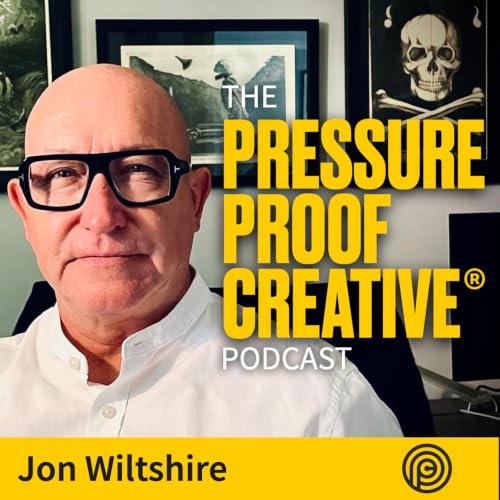
  • Jon Wiltshire – Founder: Create@AddictivePixel
    Jun 26 2026

    In this episode, Matt sits down with creative production pioneer Jon to explore one of the biggest questions facing the creative industries today.

    How do we embrace AI without sacrificing creativity?

    With more than four decades spent helping some of the world's biggest agencies and brands bring ambitious ideas to life, Jon has witnessed every major technological shift the industry has faced.

    From hand-rendered illustration and retouching dyes to digital, CGI and now AI, he's spent his career sitting between creative ambition and production reality.

    What quickly becomes clear is that this isn't really a conversation about technology.

    It's a conversation about time.

    Jon argues the industry isn't losing its creative edge because of AI.

    It's losing it because creativity is no longer being given the time it deserves.

    Instead of using technology to improve thinking, we've used it to demand more output.

    Faster.

    Cheaper.

    More.

    And somewhere along the way, the thinking became secondary.

    That leads to one of the central ideas in the episode.

    Technology should never lead the idea.

    The idea should always lead the technology.

    Jon explains why the best production partners don't simply execute concepts. They help creatives discover what's possible before the work is ever sold. Not by limiting ideas, but by expanding them.

    He calls it discovering "the new possible."

    From there, the conversation turns to AI.

    Not as a replacement for creative people.

    But as another person in the room.

    A collaborator that can accelerate research, production and adaptation while giving something infinitely more valuable back.

    Time.

    Time to think.

    Time to experiment.

    Time to make ideas better.

    Because creativity isn't something you switch on at 9am on a Monday morning.

    It needs space.

    It needs wandering.

    It needs permission to fail before it succeeds.

    The discussion then shifts to something surprisingly human.

    Imperfection.

    Jon explains why audiences instinctively reject work that's too perfect. Whether it's illustration, CGI or AI-generated imagery, perfection rarely feels real.

    Grain.

    Texture.

    Flaws.

    They're what give work its soul.

    From there, the conversation widens into the future of the industry itself.

    As large agency networks continue to struggle, Jon believes a different model is emerging.

    Smaller.

    More agile.

    Creative teams supported by specialist partners instead of massive infrastructures.

    He argues today's independent creatives have opportunities previous generations never had. With the right collaborators around them, they can compete for global work without needing thousands of employees or a marble reception.

    The infrastructure can be shared.

    The creativity can't.

    And that's where the episode lands.

    The future doesn't belong to whoever creates the most content.

    It belongs to whoever protects the quality of the thinking.

    Because AI isn't the enemy.

    Speed isn't even the enemy.

    The real danger is allowing efficiency to become more valuable than imagination.

    If creativity is going to thrive over the next decade, it won't happen because we worked faster.

    It will happen because we used technology to give ourselves permission to think again.

    If you've ever wondered where creativity is heading, how AI fits into that future, or whether the industry has forgotten what made great work great in the first place...

    This one's for you.

    Like, subscribe and share if you want more conversations with the people who built the industry, are reshaping it, and refuse to let creativity become an afterthought.


    Contact Jon here >>> jon.wiltshire@addictivepixel.co

    Mehr anzeigen Weniger anzeigen
    47 Min.
adbl_web_anon_alc_button_suppression_t1
Noch keine Rezensionen vorhanden