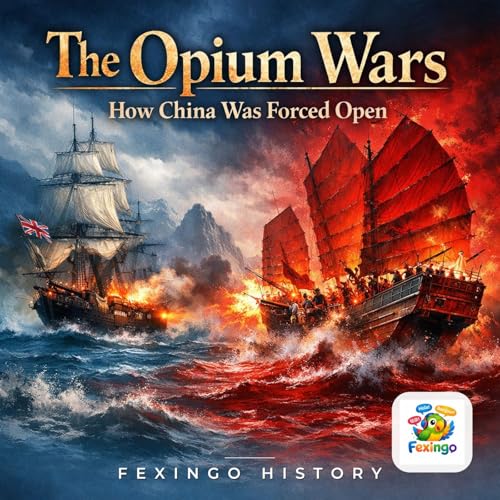
The Opium Wars: How China Was Forced Open — Fexingo History Titelbild

The Opium Wars: How China Was Forced Open — Fexingo History

The Opium Wars: How China Was Forced Open — Fexingo History

Von: Fexingo
Jetzt kostenlos hören, ohne Abo

Über diesen Titel

From 1839 to 1860, two devastating conflicts forced the Qing Empire to open its borders to foreign trade, reshaping East-West relations for centuries. Lucas and Luna unravel the tangled causes: Britain's illegal opium smuggling, Chinese efforts to suppress addiction, and the clash between the Celestial Empire's tributary worldview and British free-trade imperialism. Follow the naval battles along the Pearl River Delta, the fall of Canton, and the burning of the Summer Palace. Meet key figures like Commissioner Lin Zexu, whose anti-opium campaign sparked war; Lord Palmerston, the hawkish British Prime Minister; and Empress Dowager Cixi, witnessing Qing humiliation. Explore the unequal treaties—Treaty of Nanjing (1842) and Treaty of Tianjin (1858)—that ceded Hong Kong, opened treaty ports, and legalized opium. Delve into debates over extraterritoriality, the Taiping Rebellion's rise amid the chaos, and the long-term consequences: China's Century of Humiliation, the erosion of sovereignty, and today's lingering resentment toward Western intervention. This show examines not just the battles, but the cultural misunderstandings, economic desperation, and moral contradictions that still echo in Sino-Western relations.

#OpiumWars #QingDynasty #BritishEmpire #LinZexu #TreatyOfNanjing #HongKong #Canton #TaipingRebellion #SummerPalace #ChineseHistory #Imperialism #OpiumTrade #CenturyOfHumiliation #UnequalTreaties #Palmerston #EastAsia #History #FexingoHistory

Become a supporter of this podcast: https://www.spreaker.com/podcast/the-opium-wars-how-china-was-forced-open-fexingo-history--6985310/support.© 2026 Fexingo. All rights reserved.
Sozialwissenschaften Welt
  • How the Zong Massacre Shaped the Opium Wars — Fexingo History
    Apr 29 2026
    In 1781, the slave ship Zong set sail from Africa to Jamaica, but its infamous massacre — where 132 enslaved Africans were thrown overboard to claim insurance — sent shockwaves through British society and ignited the abolitionist movement. Decades later, the moral arguments and legal precedents from the Zong case directly influenced British debates over the opium trade with China. This episode explores the forgotten link between the slave trade and the Opium Wars, examining how the same abolitionist fervor that ended the slave trade was conspicuously absent when it came to opium. We look at key figures like Olaudah Equiano, Granville Sharp, and Lord Mansfield, whose efforts against slavery would later be cited by Chinese officials like Lin Zexu in appeals to British conscience. Through this lens, we uncover uncomfortable questions about empire, morality, and selective outrage.

    #ZongMassacre #OpiumWars #SlaveTrade #Abolition #OlaudahEquiano #GranvilleSharp #LordMansfield #SomersetCase #LinZexu #BritishEmpire #InsuranceFraud #MoralDebate #18thCentury #19thCentury #EastIndiaCompany #OpiumTrade #History #FexingoHistory #QingDynasty #TreatyOfNanjing

    Become a supporter of this podcast: https://www.spreaker.com/podcast/the-opium-wars-how-china-was-forced-open-fexingo-history--6985310/support.
    Mehr anzeigen Weniger anzeigen
    7 Min.
  • The Opium Wars' Aftermath: Tributary Trade and the Collapse of the Tribute System — Fexingo History
    Apr 29 2026
    In this episode, Lucas and Luna explore the collapse of China's millennia-old tributary trade system after the Opium Wars. They examine how the Treaty of Nanking and the Treaty of Tientsin forced the Qing Empire to abandon its tribute system and accept Western-style diplomacy. The discussion covers the role of the once-powerful Co-hong merchant monopoly, the shift in trade patterns, and the psychological impact on the Qing court. Listeners will learn about the tribute system's origins under the Ming and Qing dynasties, the unequal treaties that dismantled it, and the gradual erosion of Chinese sovereignty. The episode also touches on the broader implications for East Asian international relations, including the loss of influence over Vietnam, Korea, and the Ryukyu Kingdom. Through concrete examples like the Macartney Embassy of 1793 and the Amherst Mission of 1816, the hosts illustrate how China's failure to adapt to a changing world order led to a century of humiliation.

    #OpiumWars #TributeSystem #TreatyOfNanking #TreatyOfTientsin #CoHong #CantonSystem #QingDynasty #CenturyOfHumiliation #MacartneyEmbassy #LordMacartney #EastIndiaCompany #UnequalTreaties #TradeHistory #ChineseHistory #ImperialHistory #19thCenturyHistory #FexingoHistory #History #BritishEmpire #LinZexu

    Become a supporter of this podcast: https://www.spreaker.com/podcast/the-opium-wars-how-china-was-forced-open-fexingo-history--6985310/support.
    Mehr anzeigen Weniger anzeigen
    5 Min.
  • Qishan and the Chuenpi Convention: A Diplomat Scapegoated — Fexingo History
    Apr 28 2026
    In this episode of The Opium Wars, Lucas and Luna look at one of the war's most controversial figures: Qishan, the Manchu diplomat who negotiated the abortive Convention of Chuenpi in 1841. After the Chinese defeat at the Battle of Chuenpi, Qishan was sent to Canton to salvage the situation. He agreed to cede Hong Kong Island and pay a huge indemnity, but both sides rejected his deal: the British complained it wasn't enough, while the Daoguang Emperor stripped Qishan of his rank and paraded him through Beijing in chains. We explore Qishan's background as a Mongol bannerman, his earlier career on the frontier, and the impossible position he found himself in—trying to appease both an inflexible emperor and a determined British force. We also touch on the chaotic aftermath, including the Emperor's declaration of total war and the Battle of the Bogue. Was Qishan a traitor, a realist, or just a scapegoat? Join us as we unravel the politics behind the first 'unequal treaty' that never was.

    #OpiumWars #Qishan #ChuenpiConvention #HongKong #DaoguangEmperor #CharlesElliot #FirstOpiumWar #Manchu #Bannermen #CantonSystem #TreatyOfNanking #UnequalTreaties #BritishEmpire #QingDynasty #History #FexingoHistory #Diplomacy #Scapegoat #LinZexu #TreatyOfNanjing

    Become a supporter of this podcast: https://www.spreaker.com/podcast/the-opium-wars-how-china-was-forced-open-fexingo-history--6985310/support.
    Mehr anzeigen Weniger anzeigen
    6 Min.
Noch keine Rezensionen vorhanden