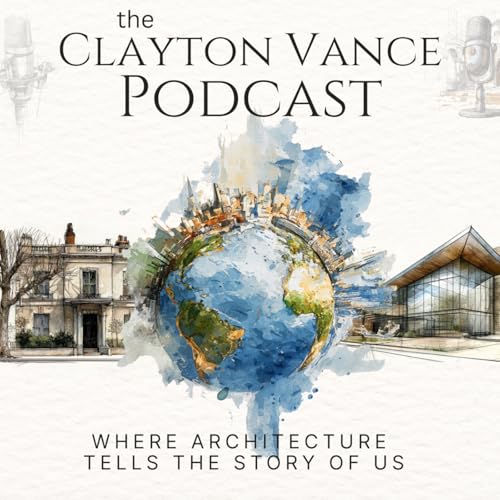
The Clayton Vance Podcast Titelbild

The Clayton Vance Podcast

The Clayton Vance Podcast

Von: Clayton Vance
Jetzt kostenlos hören, ohne Abo

Über diesen Titel

Exploring the art and soul of architecture answering questions why the world looks the way it does and what we can do about it.

Kunst Philosophie Sozialwissenschaften
  • Architectural Education: The How - with Paul Monson
    Feb 16 2026

    Episode 3 of 3 in our Education Series In this final episode of my three-part conversation with Paul Monson, Director of Architecture at Utah Valley University, we turn to the practical question of how. How does a student become better prepared for the profession, and how can any of us become more attentive and informed observers of the built environment. We begin with Vitruvius and his description of what an architect should know. It is a demanding standard, but Paul uses it to make a grounded point. Architecture requires breadth, humility, and lifelong learning. The goal is not to master everything at once, but to steadily develop judgment, skill, and clarity. From there, we discuss:

    • what is missing in many programs when architecture is taught as theory rather than craft
    • how to evaluate an architecture school, including the right questions to ask on a visit
    • why UVU is built around accessibility, affordability, and real-world preparation
    • why hand drawing remains essential and how it supports clear thinking and design freedom
    • how digital tools can shape outcomes if students become limited by software assumptions
    • how non-architects can begin training their eye and building design vocabulary
    • where to start with resources such as the Institute of Classical Architecture and Art
    • and why the built environment is not fate, but choice

    We also talk about curriculum, accreditation, learning through making, community-engaged studios, and the importance of developing both technical competence and a refined sense of proportion and beauty. We close with a larger reminder. Beauty is not a luxury. It is deeply connected to human wellbeing, meaning, and culture. Wherever you are, improvement is possible, and it requires participation from everyone involved in building our world.

    Mehr anzeigen Weniger anzeigen
    51 Min.
  • Traditional Architecture: Why It Still Matters - with Paul Monson
    Feb 9 2026

    Episode 2 of 3 in our Education Series

    In the second episode of this three-part conversation with Paul Monson, Director of Architecture at Utah Valley University, we move from the foundation of education to the deeper question of why traditional architecture matters at all.Paul and I talk about the origins of the UVU architecture program and why it was intentionally built around craft, practicality, and time-tested principles rather than purely conceptual theory. From there, the conversation widens into the cultural, environmental, and moral implications of how we build.To explain it, we begin with a simple idea: sustainability is not about novelty or technology alone, but about durability, repairability, and stewardship. From throwaway buildings to throwaway materials, Paul makes the case that much of what we call “progress” has quietly eroded our built environment and our sense of place.From there, we explore:

    • why traditional architecture is a teachable and learnable language
    • how modernism became the default way of building in the twentieth century
    • what true sustainability looks like when you consider an entire building’s life cycle
    • why local materials and local identity matter more than global sameness
    • how tradition can produce diversity rather than imitation
    • why the accusation that traditional design is “just copying” misses the point
    • and why architects and designers cannot be neutral in shaping the civic realm

    We also discuss processed materials, authenticity, modern construction constraints, and how designers can work toward something better even when budgets and systems are imperfect.This episode asks a difficult but necessary question: Are the places we are building today making life better or worse for the people who inhabit them?If you have ever felt uneasy about the way modern buildings age, or why so much of the built world feels disposable and placeless, this conversation puts language to that intuition and explains why the past still has something to teach us.

    Mehr anzeigen Weniger anzeigen
    1 Std. und 2 Min.
  • Architectural Education: Learning to See Again - with Paul Monson
    Feb 2 2026

    Episode 1 of 3 in our Education Series

    In this first episode of a three-part conversation with Paul Monson, Director of Architecture at Utah Valley University, we start at the foundation: what education is actually meant to do.Paul and I go back nearly twenty years to our time at the University of Notre Dame, and because of that shared background, this conversation is less about credentials and more about transformation. We talk about how architectural education is not just about learning how to design buildings, but about learning how to see the world differently.We begin with Paul’s story, from growing up interested in both art and science, to living in rural Japan, to discovering architecture through craft, construction, and stained glass. Long before he had the language for it, he was absorbing lessons about material, proportion, nature, and beauty.From there, we unpack:

    • What education really means as a process of drawing something out
    • Why the idea that beauty is purely subjective breaks down
    • How Notre Dame challenged modern assumptions about novelty and originality
    • Why craft, tradition, and standards still matter
    • How great buildings permanently change perception
    • Why the environments we live in quietly train us
    • How architectural knowledge is passed down through mentorship and practice

    We also talk about Japan, classical music, Vitruvius, and why learning to design well is inseparable from learning to live well.This episode sets the stage for the rest of the series by asking a simple question: If education shapes how we see, what happens when we stop teaching people how to recognize what is good, true, and beautiful?If you care about architecture, culture, or how the built world shapes us, this is the place to start.

    Mehr anzeigen Weniger anzeigen
    43 Min.
Noch keine Rezensionen vorhanden