• Narcissistic Personality Disorder (NPD), Borderline Personality Disorder (BPD), and Mentalization-Based Treatment (MBT): A conversation with Bob Drozek, LICSW and Brandon Unruh, MD.
    Sep 14 2025

    In this episode, we dive into the often-misunderstood world of personality disorders with a focus on borderline and narcissistic presentations. Rather than simply listing symptoms, our conversation explores what it means to view these disorders dimensionally, how traits show up in real life, blur at the edges, and influence identity, relationships, and emotional regulation. We also examine mentalization, the ability to understand our own and others’ inner worlds, and why it is such a powerful tool in therapy. From rethinking the DSM’s categories to unpacking the role of empathy and vulnerability, this discussion offers a fresh perspective on conditions that are too often oversimplified and stigmatized.

    TUMAT Takeaways:

    • Personality disorders involve instability in emotional regulation, self-identity, and interpersonal relationships.
    • Borderline Personality Disorder (BPD) is characterized by emotional dysregulation and interpersonal hypersensitivity.
    • Narcissistic Personality Disorder (NPD) can be divided into grandiose and vulnerable subtypes, each with distinct characteristics.
    • Mentalization is the ability to understand one's own and others' mental states, crucial for effective therapy.
    • Empathy is a component of mentalizing, involving both cognitive and emotional aspects.
    • The DSM's categorical approach to personality disorders may not fully capture the complexity of these conditions.
    • Therapists must adopt a 'not knowing' stance to encourage patient reflection and insight.
    • Mentalization-based treatment (MBT) has shown effectiveness in treating personality disorders.
    • Understanding the patient's perspective is key to effective treatment.
    • Research supports the idea that mentalizing deficits are common in personality disorders.


    To learn more about Mentalization-Based Treatment, check out MBT Boston, here.

    Check out publications from our guests!

    Mehr anzeigen Weniger anzeigen
    1 Std. und 3 Min.
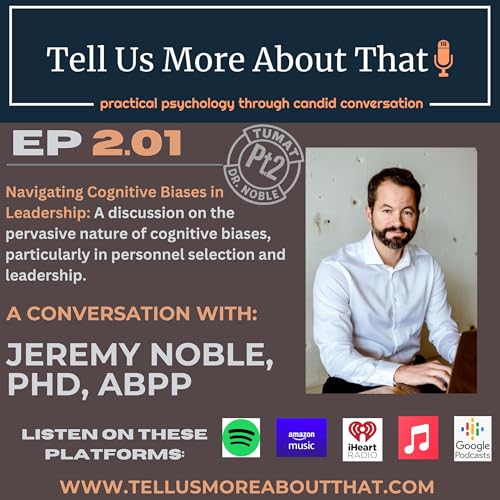
  • Dr. Noble, Pt. 2 - Navigating Cognitive Biases in Leadership: A discussion on the pervasive nature of cognitive biases, particularly in personnel selection and leadership.
    Aug 1 2025

    In this conversation, Dr. Noble discusses the pervasive nature of cognitive biases, particularly in personnel selection and leadership. He delves into the Dunning-Kruger effect, illustrating how individuals often overestimate their knowledge and competence. The discussion also touches on personal career journeys, the challenges of self-awareness in leadership, and the evolving landscape of consulting in psychology, emphasizing the importance of emotional intelligence and the need for reliable data in decision-making.

    TUMAT Takeaways:

    • Cognitive biases are prevalent in decision-making processes.
    • Awareness of biases can help individuals make better decisions.
    • The Dunning-Kruger effect illustrates how confidence does not equal competence.
    • Imposter syndrome is common among high achievers, contrasting with the overconfidence of less knowledgeable individuals.
    • Self-awareness tends to decrease as leaders rise in rank due to fewer honest feedback sources.
    • Narcissistic leaders can sometimes protect their teams but may harm the organization overall.
    • Therapy and coaching can provide valuable support for personal and professional growth.
    • Manipulation and bias are significant factors in how individuals present themselves in leadership roles.


    For more information on Dr. Noble and to learn more about the services offered by Noble Organizational Consulting, visit his website, here.


    Mehr anzeigen Weniger anzeigen
    43 Min.
  • Operational Psychology: Dr. Noble discusses the mission of Op Psych, what it takes to become one, and shares unique firsthand accounts from working in the field.
    Jun 27 2025

    In this conversation, Dr. Jeremy Noble shares his compelling journey as an operational psychologist within the U.S. Army's elite Ranger Regiment. Drawing from first-hand experience, he offers rare insight into the unique role operational psychologists play in selecting, supporting, and safeguarding the mental readiness of our nation’s most capable warfighters.

    Dr. Noble delves into the nuances of operational psychology, emphasizing the importance of sound hiring practices, the ethical challenges of confidentiality in military settings, and the impact of toxic leadership on team performance. He also explores the value of psychometric assessments in personnel selection and how these tools can enhance organizational effectiveness across high-stakes environments.


    TUMAT Takeaways:

    • Operational psychology focuses on enhancing performance in national security contexts.
    • Crisis intervention is a critical aspect of a psychologist's role in the military.
    • Confidentiality in military psychology has specific nuances compared to civilian practices.
    • Proper hiring practices can significantly impact organizational effectiveness and morale.
    • Toxic leadership traits, particularly narcissism, can have detrimental effects on teams.
    • Peer evaluations are valuable for identifying potential toxic leaders.
    • Psychometric assessments provide insights into personality traits relevant to job performance.
    • The military's approach to psychology allows for more flexibility in interventions than the civilian sector.
    • Effective leadership is crucial for employee engagement and organizational success.


    To learn more about Dr. Noble, check him out, here

    Mehr anzeigen Weniger anzeigen
    59 Min.
  • Interviewing Kids: An overview of the field of Child Forensic Interviewing, the training involved and the unique variables present when interviewing children.
    Aug 13 2024

    TUMAT Takeaways:

    • Child forensic interviewing is an investigative interview conducted in a developmentally sensitive, trauma-informed, and legally sound manner within the context of a child abuse investigation.

    • Child advocacy centers are nonprofit organizations that serve as a one-stop shop for services related to child abuse investigations, providing a child-friendly and neutral setting for forensic interviews.

    • Child forensic interviewers are trained professionals who conduct interviews with children who may have experienced abuse or witnessed a crime, and they work closely with law enforcement and child protective services.

    • Techniques like narrative event practice and source monitoring are used to elicit information.

    • Interviewers need to be mindful of potential coaching or contamination of the child's narrative and ask appropriate questions to assess credibility.

    • Forensic interviews are typically video and audio recorded and are conducted in a private and safe environment to ensure the comfort and well-being of the child.

    • Mandated reporting laws vary by jurisdiction, but generally, anyone over the age of 18 is considered a mandated reporter and is legally obligated to report suspected child abuse or neglect.

    • Child forensic interviewers gather information for an active criminal investigation and work closely with investigators and prosecutors to ensure the defensibility and reliability of the information obtained.

    • Caregivers can contact Child Advocacy Centers for assistance and guidance.

    • The forensic interview process is tailored to the child's age and developmental level.

    • Interviewers create a safe and supportive environment for children to share their experiences.

    • Caregivers should avoid discussing concerns directly with the child and provide accurate information about the interview process.

    • The support of non-offending caregivers is crucial in helping children disclose abuse and participate in the investigation.


    A little bit about our guest, Kate Myers, MSW:

    Kate Myers is a seasoned forensic interviewer with over a decade of experience in sexual and domestic violence. She has conducted over 1,600 forensic interviews for various agencies, including the Department of Homeland Security in Miami, FL, and Safe Shores - The DC Children’s Advocacy Center. She has handled cases involving child sexual abuse, violent crime, severe physical abuse and neglect, online child exploitation, human trafficking, and human smuggling, both domestically and internationally. As part of this work, she has testified in civil and criminal court proceedings, as well as provided consultation and training to multidisciplinary teams and other community stakeholders.

    Kate holds an MSW from The Catholic University of America and a BA in Foreign Languages with a concentration in Spanish and a minor in Women & Gender Studies from George Mason University. She is currently the Forensic Interview Program Manager at the Collins Center & Child Advocacy Center in Harrisonburg, VA, where she leads interviews with children, adolescents, and vulnerable adults, addressing cases of abuse and neglect with a victim-centered and trauma-responsive approach. To learn more about the Collins Center CAC, check out their website, here!

    Mehr anzeigen Weniger anzeigen
    55 Min.
  • Mental Health and Law Enforcement: Breaking stigmas, building trust and changing the game. A Conversation with Dr. Katherine Kuhlman.
    Jun 26 2024

    About our guest, Dr. Katherine Kuhlman:


    Dr. Katherine (Katie) Kuhlman, ABPP, is a board-certified psychologist in Police and Public Safety Psychology, and has expertise in the treatment of PTSD, depression, anxiety, and general life stressors. She has worked since 2014 providing services to first responders and their family members, truly understanding the unique stressors inherent in these occupations. She has presented nationally on wellness issues related to law enforcement, as well as threat assessment and management. She served as a subject matter expert on traumatic stress on the Colorado Governor's Expert Emergency Epidemic Response Committee prior to moving to Arizona. Dr. Kuhlman has responded and provided debriefing services to critical incidents including officer-involved shootings, suicides, line-of-duty deaths, and mass shootings. Dr. Kuhlman regularly provides analysis to news organizations, and has provided expert testimony in cases related to psychological assessment and PTSD.


    Check out her website, here!


    TUMAT Takeaways:


    • Law enforcement psychology focuses on the mental health and well-being of law enforcement officers and first responders.

    • Most mental health challenges LE personnel are facing are TREATABLE! If provided with the appropriate support from their agencies, personnel can not only overcome the struggles, but they can thrive.

    • Building trust and establishing rapport with clients is crucial in this field, and authenticity is key.

    • Dr. Kuhlman emphasizes the importance of confidentiality and assures her clients that their information will remain private, except in cases of harm to self or others.

    • Red flag laws can pose challenges for officers dealing with suicidal ideation

    • Some departments are starting to offer treatment options and support for officers struggling with mental health issues

    • Embedding psychologists within law enforcement agencies can provide valuable support and address administrative stress and trauma

    • The field of police psychology is evolving with a focus on prevention and wellness


    Mehr anzeigen Weniger anzeigen
    57 Min.
  • Adult ADHD: Defining, Diagnosing, and Determining Treatment Options. A conversation with Bennett Harris, PA LCMHC
    Jun 7 2024

    This conversation focused on ADHD, its definition, and how it presents in different populations. Our guest, Bennett Harris PA, LCMHC, discussed the observable symptoms of ADHD, such as inattentiveness, hyperactivity, and impulsivity. He also introduced the concept of rejection-sensitive dysphoria (RSD), which is often associated with ADHD.


    The discussion touched on the genetic and environmental factors that contribute to ADHD, as well as the impact of stress on individuals with ADHD. Bennett emphasized the importance of emotional regulation and shared strategies for managing ADHD symptoms, including medication and mindfulness practices.


    The conversation also explored the differences in ADHD presentation between men and women. Women tend to be more inattentive and men tend to be more impulsive or hyperactive in ADHD. The symptoms of ADHD start in childhood, with girls showing more inattentiveness and daydreaming, while boys show more impulsivity and hyperactivity. However, these patterns are not always consistent. The diagnostic criteria for ADHD were originally based on assessments of men.


    Stimulant medications, such as amphetamines, increase dopamine and norepinephrine levels in the brain, improving ADHD symptoms. Long-term use of stimulants can lead to dopamine downregulation and the need for higher doses. Building discipline and healthy habits, such as exercise and a balanced diet, can be effective in managing ADHD symptoms. ADHD coaching can also be beneficial in developing practical skills and strategies. The long-term effects of stimulant medication use and the potential benefits of other medications for ADHD are still being studied.


    TUMAT Takeaways:

    • ADHD is characterized by observable symptoms such as inattentiveness, hyperactivity, and impulsivity.

    • Rejection-sensitive dysphoria (RSD) is a common experience for individuals with ADHD, causing emotional reactivity to stress and criticism.

    • ADHD is influenced by both genetic and environmental factors, and it can be present from a young age.

    • Emotional regulation is crucial for managing ADHD symptoms, and strategies like mindfulness and medication can be helpful.

    • ADHD can present differently in men and women, and women may be more likely to receive a later-in-life diagnosis. ADHD symptoms differ between men and women, with women being more inattentive and men being more impulsive or hyperactive.

    • Stimulant medications increase dopamine and norepinephrine levels in the brain, improving ADHD symptoms.

    • Long-term use of stimulant medications can lead to dopamine downregulation and the need for higher doses.

    • Building discipline and healthy habits, such as exercise and a balanced diet, can be effective in managing ADHD symptoms.

    • ADHD coaching can help individuals develop practical skills and strategies for managing their symptoms.


    Learn more about Bennett, here!

    Learn more about ADDition Coaching and Consulting, here!

    Mehr anzeigen Weniger anzeigen
    1 Std. und 8 Min.
  • Art Therapy: An introduction to the world of research supported Art Therapy Interventions. A conversation with Sarah Balascio, ATR-BC
    May 31 2024

    Sarah Balascio is a nationally board-certified art therapist and adjunct lecturer with over 15 years of experience working with children, adolescents, adults, seniors, families, and groups. Sarah has a master’s degree in Education from Lesley University in Massachusetts and a second master’s degree in Art Therapy from Pratt Institute in New York.

    She has practiced art therapy in hospitals including New York Presbyterian, residential programs for adolescents, eating disorder treatment centers, schools, autism centers, and in private practice. She has helped clients with issues such as anxiety, depression, life transitions, eating disorders, trauma, grief, addictions, developmental and sensory issues, as well as autism spectrum disorders.

    She currently works at the College of William & Mary's McLeod Tyler Wellness Center facilitating groups and individual sessions for students, faculty, and staff as well as teaching undergraduate courses in the field of art therapy under the Wellness Applications Program. She also serves on the Art Therapy Credentials Board Nominating Committee. She recently published a book through Routledge titled "Art Therapy Directives: An Intervention Toolbox."


    TUMAT Takeaways:

    • Art therapy is a field of mental health that uses art and creativity as a way to express and understand emotions.

    • Art therapy can be beneficial for a wide range of issues, including stress reduction, trauma, and eating disorders.

    • Art therapists work in various settings, such as psychiatric hospitals, residential treatment centers, and schools.

    • Art therapy can be integrated into traditional therapy practices and can be helpful for individuals who may not consider themselves artists.

    • Art therapy is not limited to children and can benefit people of all ages.

    • Art therapy has a significant impact on the quality of life for individuals with dementia or Alzheimer's.

    • Art therapy aligns with somatic therapy in exploring and processing trauma through a feeling-based approach.

    • The future of art therapy involves expanding access through state licensing and integrating it into general studies and traditional therapy programs.


    Check out Sarah's book, here!

    Learn more about Tim Robbins Prison Project, here!

    Mehr anzeigen Weniger anzeigen
    57 Min.
  • Evidence Based Policing: The pursuit to make research available, practical and consistent for LE practitioners. A conversation with Dr. Susanne Knabe-Nicol.
    May 24 2024

    Dr. Suzanne Knabe-Nicol, an investigative psychologist and founder of Police Science Dr., discusses the importance of evidence-based policing and the role of investigative psychology in law enforcement. She emphasizes the need for research findings to be accessible to frontline practitioners and advocates for the inclusion of investigative psychologists within police forces.

    Dr. Knabe-Nicol also highlights the lack of awareness and access to research in the field and aims to bridge this gap through her platform, Police Science Dr., which provides easily digestible content and resources for law enforcement professionals.

    In this conversation, we discussed the role psychologists play in law enforcement and the benefits of embedding psychologists within police agencies. We also touched on the need for collaboration between academics and practitioners to establish trust and improve outcomes. The discussion highlighted the changing landscape of police recruitment and the importance of emotional intelligence and empathy in policing. We also discussed the challenges of implementing evidence-based principles in law enforcement and the need for better training and education.

    Overall, our conversation emphasized the importance of using research to inform and improve policing practices.


    TUMAT Takeaways:

    • There is a need for research findings to be accessible to frontline practitioners in law enforcement.

    • Psychologists can play a crucial role in training, advising, and conducting research within police forces.

    • The lack of awareness and access to research in law enforcement is a barrier to implementing evidence-based practices.

    • Police Science Dr. aims to bridge the gap between research and practice by providing easily accessible content and resources for law enforcement professionals.

    • Collaboration between academics and practitioners is critical to establish trust and impact outcomes

    • The changing landscape of police recruitment and the emphasis on emotional intelligence and empathy

    • The challenges of implementing evidence-based principles in law enforcement and the need for better training and education


    Resources:

    • www.policesciencedr.com
    • American Society of Evidence Based Policing
    • Evidence Based Policing Matrix
    Mehr anzeigen Weniger anzeigen
    1 Std. und 6 Min.