Folgen

  • Cave Critters, creepy or cool? Efrain Chavez
    Jan 20 2026

    In this episode of Tech Diving On Air, host Tamara sits down with Dr. Efraín Chávez, a Postdoc, researcher at UMDI Sisal, part of UNAM (National Autonomous University of Mexico), and cave diver who specializes in the ecology of groundwater fauna in the Yucatan Peninsula.

    Together, they dive deep into the super interesting but overlooked world of the fauna in the

    cenotes, challenging the common misconception that caves are lifeless voids. Efraín bridges the gap between rigorous scientific research and technical exploration, revealing the fascinating evolutionary adaptations of "stygobitic" creatures—animals that have evolved to thrive in total darkness. From the evolutionary process and the energy-economic process of losing one's eyes to the critical health state of the aquifer, they discuss why these tiny, blind creatures are the canaries in the coal mine for the region's water quality.

    In this episode, we discuss:

    • ​Life in the dark: Dispelling the myth that caves are boring or dead, and understanding the complex ecosystems thriving beneath our feet.
    • ​Evolutionary biology: How and why species like the blind fish (
    Typhlias pearsei) and blind shrimp lose their sight and pigment over generations.
    • ​The cast of characters: A closer look at the unique inhabitants of the Yucatan cenotes, including the rare blind eel, isopods, and the ancient, centipede-like Remipedes.
    • ​Conservation and threats: The impact of pollution, over-extraction, and climate change on the fragile groundwater systems and the 67 documented species within them.
    • ​Citizen Science: How divers can contribute to research through photography, utilizing tools like iNaturalist and supporting the Cenoteando initiative.
    • ​Practical identification: What to do when you spot a "cave critter" and how to distinguish between different species during a dive.

    About the guest: Efrain lives and works in Merida Yucatán and has developed a thriving technical diving career and professional diving path as a GUE diver among others. He’s passionate about the environment, research and the hands on experience of making science in places most scientists will never reach.


    Connect with Efrain Chavez:

    • ​Website:
    https://cenoteando.mx/
    • ​Facebook:
    https://www.facebook.com/cenoteando.org
    • ​Instagram:
    https://www.instagram.com/el_efracs/
    • ​LinkedIn:
    https://www.linkedin.com/in/efrainchavez/?originalSubdomain=mx
    • ​E-mail:
    chavezsolis.efrain@gmail.com


    If you enjoyed this episode, please subscribe to the show, leave a review and share it with your dive buddy. Changing the culture starts with a conversation.


    Do you know a great speaker that should be on this show? Let me know!

    Mehr anzeigen Weniger anzeigen
    49 Min.
  • Let’s talk about valves! Bernardo Rotzinger
    Jan 13 2026

    In this episode of Tech Diving On Air, host Tamara sits down with Bernardo Rotzinger, the operational heart of Cuzel and the man ChatGPT has officially dubbed "The Valve Wizard."


    Together, they explore Bernardo's journey from fixing compressors as a teenager in his family's business to becoming a leading expert on high-pressure systems in the Mexican cave diving capital. They dive deep into the mechanics that keep divers alive, discussing the crucial engineering differences between valve types and the terrifying consequences of equipment negligence. Bernardo bridges the gap between industrial engineering and diving, explaining why knowing what happens inside your tank valve is just as critical as checking your gas.


    In this episode, we discuss:

    • ​The Valve Wizard's Origin: Growing up in a dive shop, taking over the family business at 18, and blending hands-on mechanics with self-taught engineering.
    • ​DIN vs. Yoke: A technical breakdown of why the industry is (and should be) shifting to DIN, including the safety limits of the clamp system versus the captured O-ring design.
    • ​The Explosion: A harrowing first-hand account of a filling station accident caused by mismatched threads, highlighting a deadly risk often invisible to the average diver.
    • ​Nautec Valves: Why these German valves are considered the gold standard—from lead-free brass alloys to the "non-memory" properties of the internal seats.
    • ​The trends that CCR diving is bringing to Mexico and how the businesses adapt to supply it.
    • ​The Safety Gap: The lack of formal certification for filling station operators and why "I've always done it this way" is a dangerous mindset in technical diving.
    • ​Maintenance: Why your valves need service just as much as your regulators.


    About the guest:

    Bernardo Rotzinger is a 33 years old Mexican engineer, cave diver and filling station manager who grew up at the Cuzel filling station. His father, the founder of Cuzel, started the business to fulfill a higher standard when back in the 80s it was difficult to find good quality air for divers.


    Today, he is one of the most knowledgeable technicians in compressor, filling, tank and valve maintenance in Mexico.


    Connect with Bernardo Rotzinger:

    • ​Website:
    https://dive-nautec.com/
    • ​Facebook:
    https://www.facebook.com/profile.php?id=100054533705791
    • ​Instagram:
    https://www.instagram.com/nautec_mexico/
    • ​E-mail:
    admon@cuzel.com


    If you enjoyed this episode, please subscribe to the show, leave a review and share it with your dive buddy. Changing the culture starts with a conversation.

    Mehr anzeigen Weniger anzeigen
    56 Min.
  • 2025 Wrap-up!
    Dec 26 2025

    In this New Year’s episode of Tech Diving On Air, host Tamara shares three practical tips to help you achieve your goals — from using visualization to make them real and attainable, to understanding the resources your dreams require, and intentionally making time to pursue them.

    Tamara also looks back on the biggest highlights of 2025: launching this very podcast (800 listens, 160 subscribers, 6 episodes!), traveling to Diving Talks Portugal to connect with explorers and creators, committing to a meaningful fitness journey, continuing the Vanilla Farm exploration project with Jack Cleary into its second year, growing a small cave-diving business with the support of students and friends, and completing GUE Fundamentals with Ivo from Third Dimension — a challenging, eye-opening class that helped debunk myths about GUE culture, highlighted flexibility in training, and deepened her understanding of procedures shaped by GUE methodology.

    She also reflects on the year’s biggest challenges — adapting long-built muscle memory, managing mental and physical fatigue after months of teaching, and being pushed (in a good way!) by GUE’s outstanding and detailed e-learning platform.

    Just when she thought the year was over… a brand-new, last-minute project appeared — and she’s hopping on a plane to join it. Which leads to a bonus fourth tip: recognize opportunity, grab it when it arrives, and do what it takes to learn from it.


    Happy New Year — and see you in 2026! Thanks for listening.

    Mehr anzeigen Weniger anzeigen
    18 Min.
  • Why Titanium? Dan Sun
    Dec 19 2025

    In this episode of Tech Diving On Air, host Tamara sits down with Dan Sun, entrepreneur, founder, and driving force behind Dan Sun Titanium—a Hong Kong–based company dedicated to creating titanium tools for divers.

    Together, they explore how Dan has quietly redefined what high-performance titanium dive tools can be, and the challenges of entering manufacturing without a formal engineering background. Obsessed with precision, Dan operates at the rare intersection of innovative tool manufacturing, rigorous problem-solving, and deep respect for the people who rely on this equipment—divers and explorers who simply don’t have time for failure. While creativity opens the door, functionality always remains the top priority.

    In this episode, we discuss:

    • How Dan Sun Titanium was born, including the story behind the “perfect” titanium wrench
    • Why titanium is the perfect material and her love/hate relationship with titanium
    • The realities of manufacturing in the scuba industry: supply chains, production processes, and specialization
    • The design rabbit hole—how to evaluate good ideas, understand why some fail, and turn the right ones into reality
    • The less glamorous side of entrepreneurship, including the less fun but essential work that leads to excellent customer service
    • The production of non-titanium products and the release of a Cenote Girl imited edition item made with Dan Sun especially for exploration. Check it out here!!!

    About the guest:
    Based in Hong Kong, Dan Sun runs her company while spending much of her time traveling and diving. With a background in corporate HR, she made a complete career pivot after investing in her first production run of 30 titanium spanners—and then taking on the challenge of selling them herself.

    A self-taught engineer and entrepreneur, a woman in scuba diving manufacturing, a boat captain, and a rebreather diver, Dan brings a perspective that is both inspiring and refreshingly grounded. Her stories and insights make this episode well worth listening to.


    Connect with Dan Sun:

    • Website: https://www.dansuntitanium.com/
    • Special https://www.dansuntitanium.com/product-page/ocean-tactical-series-explorer-pouch
    • Facebook: https://www.facebook.com/dansuntitanium
    • LinkedIn: https://www.linkedin.com/company/dan-sun-titanium
    • E-mail: info@dansuntitanium.com

    Sponsor: This episode is brought to you by Seaya Underwater Lighting Systems.


    With lights on, we explore more.

    https://seaya.com/en/

    https://www.facebook.com/seaya.dive.lights

    https://www.instagram.com/seaya.dive.lights/


    If you enjoyed this episode, please subscribe to the show, leave a review and share it with your dive buddy. Changing the culture starts with a conversation.

    Mehr anzeigen Weniger anzeigen
    49 Min.
  • Caves and Battlefields, the psychology of diving in extreme environments. Dr. Trey Cole
    Dec 13 2025

    In this episode of Tech Diving On Air, host Tamara sits down with Dr. Trey Cole, a clinical psychologist with a unique background ranging from military service to establishing mental health programs in Antarctica.

    Together, they explore the fascinating, and often misunderstood, intersection between the human mind and extreme environments. Why do some people feel more at peace in a dark, underwater cave than they do in their daily lives? Dr. Cole breaks down the physiology of fear, the allure of "flow states," and the surprising similarities between the psychology of a battlefield and a cave dive. They discuss how high-risk activities can serve as a form of mindfulness, allowing divers to disconnect from the "noise" of the modern world.


    In this episode, we discuss:

    • The Physiology of Fear: Understanding the sympathetic vs. parasympathetic nervous system responses when we enter high-risk environments.
    • Flow States: Why the extreme focus required in technical diving can actually provide a mental break from the stresses of everyday life.
    • Shifting Baselines: How the "normalization of deviance" happens in diving, and why experienced divers might stop perceiving risks that would terrify a normal person.
    • Mental Hydration: The importance of maintaining mental fitness before a crisis occurs, rather than trying to "get hydrated" only when you are thirsty.
    • The Cave as Therapy: Exploring why confined, hazardous spaces can feel like a sanctuary for certain personality types.


    About the Guest: Dr. Trey Cole is a Clinical Psychologist who blends the analytical mind of a scientist with the adventurous soul of a caver. A former military officer turned mental health professional, Trey specializes in trauma, resilience, and helping people navigate the "deep, dark caverns" of their own minds. He is an avid technical and cave diver who applies his professional expertise to understand the unique psychological demands of underwater exploration.


    Connect with Dr. Trey Cole:

    • Website: ⁠https://www.quandarypeakcounseling.com/
    • Facebook: https://www.facebook.com/quandarypeakcounseling
    • LinkedIn: ⁠https://www.linkedin.com/in/trey-cole16/
    • E-mail: trey.cole16@gmail.com

    Sponsor: This episode is brought to you by Seaya Underwater Lighting Systems. With lights on, we explore more.

    ⁠⁠https://seaya.com/en/⁠⁠

    ⁠⁠https://www.facebook.com/seaya.dive.lights⁠⁠

    ⁠⁠https://www.instagram.com/seaya.dive.lights/⁠⁠


    If you enjoyed this episode, please follow the show and share it with your dive buddy. Changing the culture starts with a conversation.

    Contact me: ⁠⁠info@cenotegirl.com⁠

    Mehr anzeigen Weniger anzeigen
    1 Std. und 6 Min.
  • Exercise and Scuba Diving: Is it a bad mix? Dr. Dario Gomez
    Dec 5 2025

    In this episode of Tech Diving On Air, host Tamara is joined by Dr. Dario Gomez, the Medical Director of the Costamed Hyperbaric Clinic and the Divers Alert Network (DAN) Liaison for Mexico.

    Together, they tackle a topic that intrigues many divers: the relationship between physical fitness, exercise, and decompression safety. While being fit is essential for handling the rigors of diving, the timing of your workout can be critical. Dr. Gomez explains the physiological effects of exercise on nitrogen absorption and elimination, debunking old myths while highlighting real risks. They discuss why lifting heavy tanks might be the only workout you should do on a diving day, and how to read your body’s hydration signals before you hit the water.


    In this episode, we discuss:

    • No-exercise interval: Why the old "no exercise 24 hours before diving" rule is evolving, and the current consensus on the 4-6 hour safety window.
    • The bubbles: How physical exertion affects "micronuclei" and changes blood flow, potentially increasing the risk of Decompression Sickness (DCS) if timed poorly.
    • Hydration Hacks: Why thirst is a late sign of dehydration and how to use the "urine color test" to ensure you are ready to dive.
    • Fitness vs. Body Composition: Understanding how nitrogen loads differently in muscle tissue versus fat tissue, and why BMI isn't always the best metric for divers.
    • Post-Dive Risks: Why heavy exercise (including lifting gear) immediately after a dive can trigger bubble formation and should be avoided.


    About the Guest: Dr. Dario Gomez is a specialist in hyperbaric medicine and the Medical Director for the Costamed Hyperbaric Clinic in Cozumel. As the DAN Liaison for Mexico, he is at the forefront of treating diving injuries and educating the community on dive safety. He is also an avid diver who understands the practical challenges of staying fit while diving frequently.


    Connect with Dr. Dario Gomez:

    • Website: ⁠https://world.dan.org/, https://www.costamed.com.mx/servicios/camara-hiperbarica
    • Facebook: https://www.facebook.com/DiversAlertNetwork
    • Instagram: https://www.instagram.com/diversalertnetwork/
    • LinkedIn: https://www.linkedin.com/company/divers-alert-network/
    • YouTube: https://www.youtube.com/@DiversAlertNetworkTV

    Sponsor: This episode is brought to you by Seaya Underwater Lighting Systems. With lights on, we explore more.

    ⁠https://seaya.com/en/⁠

    ⁠https://www.facebook.com/seaya.dive.lights⁠

    ⁠https://www.instagram.com/seaya.dive.lights/⁠


    If you enjoyed this episode, please follow the show and share it with your dive buddy. Changing the culture starts with a conversation.

    Contact me: ⁠info@cenotegirl.com⁠

    Mehr anzeigen Weniger anzeigen
    27 Min.
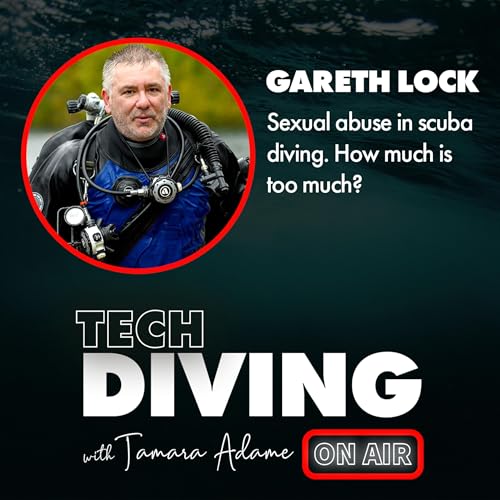
  • Sexual abuse in scuba diving, how much is too much? Gareth Lock
    Nov 28 2025
    In the inaugural episode of Tech Diving On Air, host Tamara is joined by Gareth Lock, the founder of The Human Diver and a globally recognized expert in Human Factors within the diving industry.Together, they take a deep dive into one of the most difficult and often silenced topics in the community: sexual abuse and harassment. Moving beyond the rumors, they analyze the grim reality reflected in the recent Business of Diving Institute community survey. Gareth applies his expertise in Human Factors—typically used to analyze diving accidents—to explain why harassment persists. They explore the dangerous "normalization of deviance," the power dynamics between instructors and students, and the systemic failure of training agencies to protect victims. This is a candid, necessary conversation about why good decision-making isn't just about buoyancy—it's about boundaries, safety, and changing the culture.In this episode, we discuss:The Data: Breaking down the shocking statistics from the recent community survey regarding harassment frequency and the gender gap in reporting.The Human Factor: How concepts like "Psychological Safety" and "Normalization of Deviance" explain why abusive behaviors are often tolerated or ignored in dive centers.Power Dynamics: The complex mix of hierarchy (Instructor vs. Student) and economics (Client vs. Provider) that makes reporting difficult.Systemic Failure: Why the current reporting systems within agencies are failing to protect victims and hold offenders accountable.The Path Forward: How education, calling out bad behavior, and reshaping industry standards can help make diving safer for everyone.To read the results of the survey "Sexual Harassment in the Scuba Diving Industry" by the Business of Diving Institute click on this link: https://www.businessofdiving.com/sexual-harassment-scuba-industryAbout the Guest: Gareth Lock is a former Royal Air Force officer turned technical diver. He founded The Human Diver to bring human factors, non-technical skills, and a "Just Culture" into the diving world. His organization teaches divers how to think, communicate, and manage risk more effectively.Connect with Gareth Lock & The Human Diver:Website: https://www.thehumandiver.com/Facebook: https://www.facebook.com/thehumandiverInstagram: https://www.instagram.com/thehumandiver/LinkedIn: https://www.linkedin.com/company/the-human-diver/posts/?feedView=allYouTube: https://www.youtube.com/@thehumandiver863Email: gareth.lock@thehumandiver.comOther resources: Article by Tamara Adame - InDEPTH Magazine: https://indepthmag.com/how-much-is-too-much-the-reality-of-sexual-abuse-in-the-dive-industry/Girls That Scuba guide to reporting abuse in scuba diving: https://www.girlsthatscuba.com/reporting-sexual-harassment-in-diving/Petition to agencies, please sign and share: https://c.org/QbnQGVpXkZSponsor: This episode is brought to you by Seaya Underwater Lighting Systems. With lights on, we explore more.https://seaya.com/en/https://www.facebook.com/seaya.dive.lightshttps://www.instagram.com/seaya.dive.lights/If you enjoyed this episode, please follow the show and share it with your dive buddy. Changing the culture starts with a conversation.Contact me: info@cenotegirl.com
    Mehr anzeigen Weniger anzeigen
    1 Std.