• How to Scale to 8,000 Merchants with a Sub-70 Person Team | EP 111
    Feb 24 2026

    Scaling to 8,000 merchants sounds like a hiring story.

    It wasn’t.

    In this episode of Scaling Without Breaking, host Roland Siebelink sits down with a founder who built a merchant network of 8,000+ — with a team of fewer than 70 people.

    No bloated org chart. No endless layers of management. No “just hire more people” solution.

    Instead, it was about operational discipline, clear positioning, repeatable systems, and the courage to say no when complexity tried to creep in.

    Because the real challenge of scale isn’t growth.

    It’s staying coherent while you grow.

    In this conversation, we unpack what it actually takes to scale distribution, partnerships, and merchant relationships without fracturing your culture or overwhelming your team.

    Key Discussion Points

    00:00 – Why headcount isn’t the answer to scale 02:10 – Building systems that support 8,000 merchants 04:45 – The hidden operational risks of rapid expansion 07:30 – Standardization vs. customization: where to draw the line 10:15 – Designing internal clarity so teams don’t duplicate work 13:40 – Metrics that matter when scaling merchant networks 17:05 – Partner enablement without losing control of the brand 20:22 – Protecting culture while increasing complexity 24:18 – The inflection point: when scale starts to strain the system 28:50 – Leadership maturity required at 8,000+ merchants 33:12 – What founders get wrong about “lean teams” 37:05 – The mindset shift from hustle to architecture

    If you’re scaling marketplaces, fintech platforms, SaaS ecosystems, or merchant networks, this episode will challenge how you think about growth.

    👍 Like if this changed how you think about scale 🔔 Subscribe for more honest conversations about growth 💬 Comment with your biggest takeaway 🔗 Share this with someone building with a lean team

    #ScalingWithoutBreaking #MarketplaceGrowth #StartupLeadership #OperationalExcellence #FounderMindset #LeanTeams #MerchantGrowth #BusinessArchitecture

    Mehr anzeigen Weniger anzeigen
    28 Min.
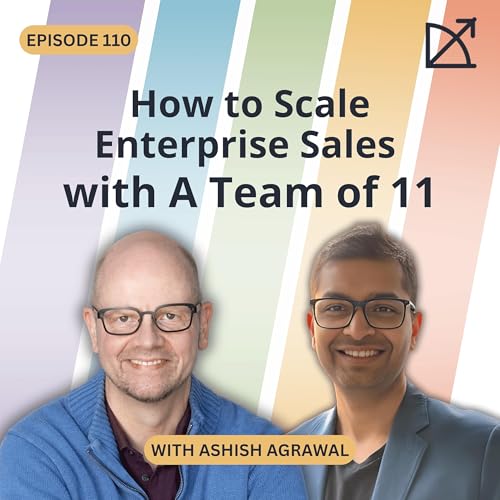
  • How to Scale Enterprise Sales with A Team of 11
    Feb 10 2026

    Scaling looks glamorous until enterprise customers start pulling you in ten different directions.

    Ashish Agrawal built an AI company serving NBC Sports, Comcast, the PGA Tour, WWE, and U.S. Olympic teams—with just 11 people, no outsourcing, and no external funding. The secret wasn’t working harder. It was refusing to fracture the product.

    In this conversation with host Roland Siebelink, Ashish breaks down what it actually takes to scale without breaking: staying product-led while serving enterprise customers, designing workflows that adapt without customization chaos, and building a team that understands customers deeply—not just tickets and specs.

    Key Discussion Points

    00:00 – Why most teams break as they scale 01:40 – Serving enterprise customers with a team of 11 03:15 – One product, many workflows (without customization hell) 05:23 – Why everyone on the team talks to customers 07:58 – Building an advisory board that actually adds value 11:14 – The hidden value trapped in archival content 13:55 – Pricing based on volume, not complexity 15:05 – Owning the full workflow end-to-end 17:17 – Partnerships, awards, and non-exclusive growth 19:54 – The hardest challenge: helping customers see their own value 22:31 – Why staying bootstrapped was a strategic choice 24:09 – Long-term growth and exit thinking 26:12 – Courage, problem-solving, and founder mindset 32:01 – Creating autonomy without chaos inside small teams

    If you’re a founder or operator navigating enterprise complexity, metadata debt, or the pressure to “just make this one exception,” there’s a lot here for you.

    👍 Like if this challenged how you think about scale 🔔 Subscribe for more honest conversations about growth 💬 Comment with your biggest takeaway 🔗 Share this with someone navigating enterprise complexity

    #ScalingWithoutBreaking #StartupLeadership #EnterpriseSaaS #FounderMindset #ProductLedGrowth #Bootstrapped #EonMedia #OperationalExcellence

    Mehr anzeigen Weniger anzeigen
    35 Min.
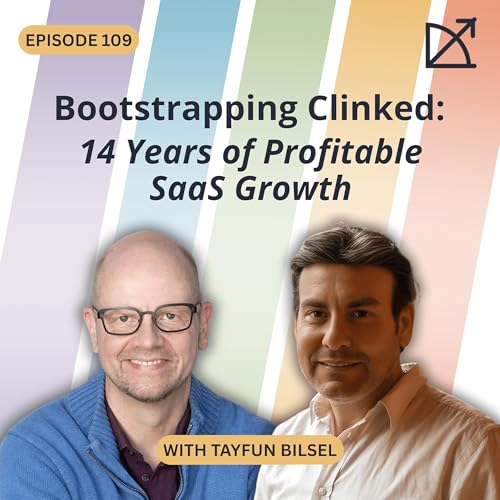
  • Bootstrapping Clinked: 14 Years of Profitable SaaS Growth
    Jan 27 2026

    Some companies are built fast. Others are built to last.

    This conversation is about the second kind.

    Tayfun Bilsel spent 14 years building Clinked.com into a profitable, multi-million-pound SaaS business without venture capital, without chasing growth for growth’s sake, and without losing control of what mattered most: customers, trust, and long-term thinking.

    We talk about what bootstrapping really costs, why white-labeling became a competitive advantage, how founder-led sales shaped the product, and what it actually looks like to scale slowly, intentionally, and sustainably—especially in a world being reshaped by AI.

    If you’re a founder or operator questioning the “faster is better” narrative, there’s a lot here that will challenge your assumptions.

    Key Discussion Points

    • 00:00 – Why midstage companies face a different kind of struggle
    • 01:10 – Introducing Tayfun Bilsel & his work with scaling teams
    • 02:55 – What “midstage” really means (and why founders misjudge it)
    • 04:40 – The early traction trap: success that creates new problems06:35 – Why what worked before stops working now
    • 08:50 – Hiring mistakes that compound complexity
    • 10:45 – Organizational debt and invisible drag on growth
    • 12:55 – When growth exposes broken processes
    • 14:55 – Founder bottlenecks and decision overload
    • 16:45 – Letting go of control without losing accountability
    • 18:40 – Operating without a clear operating model
    • 20:30 – Aligning teams around outcomes, not activity
    • 22:35 – Why midstage teams feel busy but stuck
    • 24:45 – Decision velocity as a leadership signal
    • 26:50 – Cross-functional misalignment and execution gaps
    • 28:55 – Scaling culture while raising standards
    • 31:00 – Metrics that actually matter at this stage
    • 33:05 – Strategy vs. execution: where teams fall apart
    • 35:10 – Why founders resist structure (and why it hurts them)
    • 37:05 – Building systems that support innovation
    • 39:00 – Leadership leverage and focus at scale
    • 40:55 – Moving from intuition to repeatability
    • 42:50 – What sustainable scale really looks like
    • 44:40 – Advice for overwhelmed midstage founders

    If this conversation made you pause, rethink, or reflect:

    • Hit like so more builders find it

    • Subscribe if you care about scaling without chaos

    • Share your biggest takeaway in the comments

    • Pass it along to someone building the long game

    #Bootstrapped #SaaS #FounderStories #StartupLeadership #ScalingWithoutBreaking #B2B #ProductStrategy #CustomerTrust #Entrepreneurship #AIinBusiness #ClientPortalSoftware #VirtualDataRoomSoftware #SecureClientPortal #WhiteLabelProjectManagementSoftware

    Mehr anzeigen Weniger anzeigen
    47 Min.
  • How to Scale Yourself as a CEO Without Breaking
    Jan 13 2026

    What actually breaks when a company scales—and why does it so often happen between 30 and 100 employees?

    This conversation with Matt Blumberg goes straight to the uncomfortable truth: most companies don’t stall because of product or market fit. They stall because the CEO hasn’t scaled yet.

    Matt has built companies from zero to $100M+, served as CEO and executive chair, advised hundreds of founders, and written the go-to books on being a startup CEO, CXO, and board member. In this episode, he shares the moments where he nearly broke himself—and the frameworks he developed to avoid breaking again.

    This is a practical, honest discussion about feedback, coaching, leadership teams, boards, and why scaling yourself is the hardest (and most important) work a founder can do.

    Key Discussion Points

    00:00 – Why companies really break as they scale

    01:40 – What “breaking” looks like for a CEO

    03:00 – Matt Blumberg’s near-breaking moment as a first-time CEO

    04:20 – Why getting a coach changed everything

    07:40 – The real meaning of “scaling yourself”

    09:55 – Why the 30–100 employee stage is so dangerous

    11:40 – The two teams every CEO must scale: leadership & board

    14:05 – How to actually invest in leadership team growth

    16:40 – Coach vs mentor vs peer group (and why all three matter)

    18:00 – How to ask for, process, and act on feedback

    21:00 – Why operating systems become the company’s lifeblood

    23:40 – When leaders must stop telling and start asking

    26:00 – Why boards need to scale too

    28:00 – Why being a student of the craft never stops

    About Matt Blumberg

    • LinkedIn: https://www.linkedin.com/in/blumbergmatt/
    • Email: matt@markup.ai
    • Personal Blog: https://startupceo.com (22 years of CEO insights)
    • Company: https://markup.ai

    Matt's Books on Amazon

    • Startup CEO: https://www.amazon.com/s?k=startup+ceo+matt+blumberg
    • Startup Boards: https://www.amazon.com/s?k=startup+boards+matt+blumberg
    • Startup CXO: https://www.amazon.com/s?k=startup+cxo+matt+blumberg

    Before you go:

    👍 Like this if it resonates

    🔔 Subscribe for more real conversations on leadership and scale

    💬 Comment with the takeaway that hit closest to home

    🔗 Share with someone navigating growth right now

    #ScalingWithoutBreaking #MattBlumberg #StartupLeadership #FounderGrowth #CEODevelopment #ExecutiveCoaching #CompanyBuilding #Leadership

    Mehr anzeigen Weniger anzeigen
    35 Min.
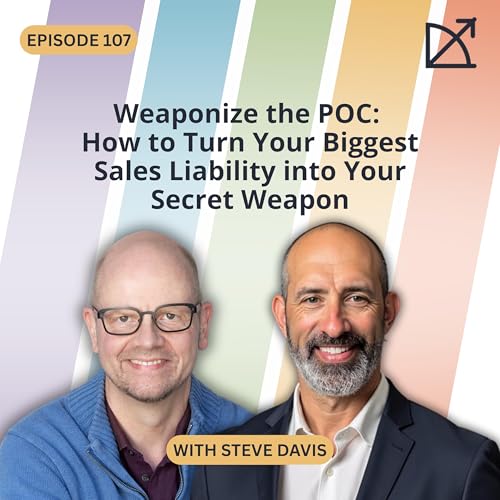
  • Weaponize the POC: How to Turn Your Biggest Sales Liability into Your Secret Weapon | Scaling Without Breaking | EP 107
    Jan 6 2026

    For years, sales leaders were taught to avoid POCs at all costs.

    They slow deals down. They spiral out of control. They kill momentum.

    So what happens when a longtime CRO—who preached that exact advice—becomes CEO of a company built to automate POCs?

    This conversation gets into the uncomfortable truth: POCs aren’t the problem. The way most teams run them is.

    Steve Davis, CEO of Provarity, has spent three decades in Silicon Valley sales—BDR to CRO to CEO. He breaks down why pre-sales has been ignored for years, how manual POC processes quietly destroy win rates, and what changes when you stop trying to avoid technical evaluations and start using them as a competitive advantage.

    If deals keep stalling late, or “technical evaluation” feels like a black hole, this one will hit close to home.

    Key Discussion Points

    00:00 – Why “avoid the POC” became sales dogma

    02:05 – The real reason POCs fail (and it’s not the buyer)

    03:27 – How most teams still run POCs today

    05:34 – Why POCs are no longer optional in modern buying

    07:53 – The hidden revenue cost of unmanaged evaluations

    10:32 – Turning POCs from a liability into leverage

    12:07 – Where POCs actually go off the rails

    15:19 – Why pre-sales were ignored for 30 years

    18:24 – Early-stage vs. mid-stage CEO reality

    20:29 – What lack of focus really does to a company

    23:08 – Making decisions for where you’re going, not where you are

    26:48 – Building a career by following great people

    29:13 – Why most sales engineers struggle as AEs

    30:34 – What true category leadership looks like

    32:49 – Educating a market that doesn’t know it has a problem

    44:55 – Where to learn more about Provarity

    If this conversation sparked something:

    👍 Support the show if it added value

    🔔 Subscribe for more honest conversations about scaling

    💬 Share the takeaway that challenged your thinking

    🔗 Send this to a leader stuck in endless POCs

    #ScalingWithoutBreaking #B2BSales #PreSales #RevenueLeadership #StartupScaling #GoToMarket #SaaSSales #SalesEngineering #TechLeadership #FounderJourney

    Mehr anzeigen Weniger anzeigen
    46 Min.
  • Your Series A Vanishes Because You Build What You Could Have Bought | Scaling Without Breaking | EP 106
    Dec 23 2025

    At some point, every growing company hits the same wall: too many tools, too many decisions, and not enough clarity on what actually matters.

    In this conversation with Sven Sabas, founder of Dragonfly, we get very real about one of the most expensive mistakes scaling teams make—building when they should buy.

    Sven shares a firsthand story of spending millions and 18 months building foundational tech that already existed, why engineers are wired to overbuild, and how opportunity cost quietly becomes the biggest killer of momentum. We also unpack why senior leaders stop chasing clever systems and start focusing on simplicity, integration, and leverage.

    Key Discussion Points

    • 00:00 – Why tech decisions quietly break scaling companies
    • 02:30 – Sven Sabas on the most expensive build-vs-buy mistake he’s seen
    • 06:45 – Why engineers default to building—and why it backfires
    • 09:15 – Opportunity cost: the real price no one calculates
    • 11:00 – Junior vs mid vs senior decision-making patterns
    • 14:20 – The explosion of SaaS tools and “shadow IT”
    • 17:40 – Why most companies don’t actually know what they’re paying for
    • 21:10 – Thinking about your tech stack as a system, not a list of tools
    • 24:00 – Serving customers without becoming a custom software shop
    • 27:30 – Staying unbiased in a pay-to-play software world
    • 30:00 – Productivity, leverage, and managing time as a founder
    • 32:30 – Career lessons from hypergrowth and constant reinvention
    • 40:00 – Mentorship, giving back, and long-term impact

    If you’re scaling a team, drowning in SaaS tools, or questioning whether your tech stack is helping or hurting—this one will feel uncomfortably familiar.

    If this conversation with Sven made you rethink how you’re building:

    👍 Like the video, so more operators see it

    🔔 Subscribe for more honest conversations about scaling

    💬 Share the takeaway that hit closest to home

    🔗 Send this to a founder or leader who’s buried in tool decisions

    #ScalingWithoutBreaking #SvenSabas #TechStack #BuildVsBuy #StartupLeadership #FounderLife #SaaS #Operations #Leadership #StartupPodcast

    Mehr anzeigen Weniger anzeigen
    44 Min.
  • ”While You Sleep, My AI Agents Close Deals in China” | Kaspar Korjus | Scaling Without Breaking | EP 105
    Dec 9 2025

    As startups race to adopt AI, many enterprise leaders quietly admit they’re overwhelmed, underprepared, and unsure how to avoid becoming part of the 95% of failed AI initiatives. Kaspar Korjus isn’t one of them.

    In this conversation, he breaks down how his company scaled AI negotiation agents from an idea to an engine trusted by Walmart, BMW, Rolls-Royce, and global enterprises moving hundreds of billions through automated procurement.

    You'll hear the real story behind landing Walmart as an early customer, how founders should think about ICP discipline, the mechanics of scaling a global org across Estonia, Europe, and the US, and why freeing up mental bandwidth may be the most underrated executive skill in the AI era.

    Kaspar also opens up about fatherhood, burnout-proof leadership, and the unexpected truth about work-life performance when you’re running a 100M-funded scale-up.

    KEY DISCUSSION POINTS

    • 00:00 — Welcome to Scaling Without Breaking
    • 00:39 — The Walmart pitch that changed everything
    • 01:12 — Building AI negotiation agents before it was cool
    • 02:05 — Why 95% of AI initiatives fail—and why it doesn’t worry Kaspar
    • 03:26 — Digital workforces + leveling the supplier playing field
    • 05:16 — How AI is reshaping procurement at scale
    • 06:26 — Founding story: from e-Residency to AI negotiations
    • 08:15 — The Walmart negotiation—and what founders get wrong
    • 10:10 — Non-linear negotiations & the myth of zero-sum deals
    • 12:12 — Managing thousands of parallel negotiations
    • 13:05 — Go-to-market strategy & landing enterprise early
    • 14:45 — ICP discipline and the psychology of sales teams
    • 16:02 — Hunters vs. farmers—when to split the sales org
    • 17:12 — The shocking size of Factum’s marketing team
    • 18:40 — Why the founder still needs to meet customers
    • 20:05 — Avoiding “founder escalation chaos”
    • 21:11 — Product vision: when (and how) to hire a CPO
    • 23:18 — Europe vs. US founders—go-to-market mindsets
    • 24:44 — How much should founders pre-sell?
    • 26:19 — Driving internal AI adoption
    • 27:46 — Creating a culture where people embrace agents
    • 29:08 — The surprising internal use cases
    • 30:03 — Estonia vs. US: building globally
    • 31:22 — Remote culture done right
    • 32:55 — Energy, trust, and the 90-day reset
    • 33:19 — Childhood, Estonia, and early entrepreneurial patterns
    • 35:19 — Family bankruptcy, tech, and resilience
    • 36:28 — Fatherhood, Ironman training & CEO performance
    • 38:11 — Creativity, mental space & leadership
    • 39:56 — Books and influences
    • 40:43 — How to reach Kaspar
    • 41:23 — Closing thoughts

    A masterclass for founders, operators, and anyone trying to scale without breaking.

    Don’t forget to:

    👍 Like if the conversation sparked new ideas

    🔔 Subscribe for more high-caliber founder stories

    🔗 Share this with a founder or operator who needs to hear it

    #AIProcurement #EnterpriseAI #StartupLeadership #ScalingCompanies #Automation #DigitalWorkforce #FounderStories #GoToMarketStrategy #ProcurementTech #AITransformation #LeadershipDevelopment #B2BTech #FutureOfWork

    Mehr anzeigen Weniger anzeigen
    42 Min.
  • Scaling Culture Through Storytelling: Vyntra’s Gerlinde Boback | Gerlinde Boback | Scaling without Breaking | EP 104
    Nov 25 2025

    Most companies treat OKRs like a necessary evil. Gerlinde Boback treats them like a stage—where real people, real ingenuity, and real stories move the company forward.

    In this episode, she breaks down how to turn “boring processes” into shared narratives that teams actually want to rally around.

    From cross-cultural leadership to building “baby values,” navigating layoffs with humanity, and choosing challenge over compensation—this conversation is a reminder that scaling is about people long before it’s about process.

    Episode Breakdown

    • 00:00 – Why storytelling makes OKRs actually work
    • 02:56 – Why spreadsheets aren’t the problem—communication is
    • 04:22 – Getting non-storytellers to tell powerful stories
    • 05:42 – A clash between engineer + PM that turned into a breakthrough
    • 07:47 – The gift of seeing different realities inside one team
    • 09:06 – What being a “professional foreigner” teaches leaders
    • 11:23 – What great HR leaders understand that others miss
    • 13:30 – When founders challenge HR (and why that’s good)
    • 16:56 – Coaching founders through their first reduction-in-force
    • 19:14 – Worst practices during layoffs
    • 20:14 – Building an alumni network after tough moments
    • 21:56 – Why people matter differently in scale-ups
    • 22:46 – Purpose-driven hires vs. corporate hires
    • 24:35 – Burnout, passion, and work-life reality in tech
    • 25:56 – How engineers chose “kindness” as a core value
    • 28:13 – Building a job-description wizard with AI in 90 minutes
    • 32:16 – Volunteering with unhoused jobseekers (and what resilience really looks like)
    • 35:22 – Growing up between worlds
    • 41:17 – The first person who truly needed her help
    • 42:11 – How a boss changed her entire career trajectory
    • 43:51 – What her younger self would think of who she became
    • 45:21 – Where to find Gerlinde + roles Vyntra is hiring for

    Building culture isn’t about adding more processes—it’s about adding more meaning. If this episode helped you rethink how you lead, communicate, or scale, share it with someone shaping a team of their own.

    👍 Show some love with a like

    🔔 Subscribe for more human-centered business conversations

    💬 Share your biggest insight about storytelling or leadership

    🔗 Pass this episode forward to someone building a team or culture

    #CultureLeadership #OKRs #StorytellingInBusiness #ScaleUpLife #PsychologyAtWork #LeadershipDevelopment #TechCulture #FintechLeadership #FoundersJourney #StartupCulture #PeopleAndCulture #BusinessStorytelling #ResilientLeadership

    Mehr anzeigen Weniger anzeigen
    37 Min.