• S10E2 - From Harvard Law to SaaS CEO: Decoding the "Paperless" Future ft Shashank Bijapur, Spotdraft
    Feb 17 2026

    Shashank Bijapur, co-founder and CEO of Spotdraft, explores the transition from the archaic, manual world of legal practice to the high-velocity domain of B2B SaaS. In this episode, we strip away the jargon surrounding "LegalTech" to reveal how Spotdraft powers the invisible infrastructure of global commerce - from airport leases to ride-sharing agreements. Shashank provides a masterclass on finding product-market fit in the mid-market, the reality of AI's role in high-stakes legal workflows, and the strategic pivot from technical perfection to market-driven iteration.

    Key Takeaways

    1. The "Aha Moment": Identifying Stagnation in Essential Industries

    - Digital Lag: While photography (Adobe) and accounting (Intuit) underwent digital revolutions decades ago, legal innovation peaked in 1993 with Microsoft Word's "Track Changes."
    - The Opportunity Gap: Identifying ubiquitous, paper-heavy processes that remain manual despite technological advancements is the strongest signal for a SaaS disruption.
    - Democratic Software: The goal isn't just to replace a lawyer; it's to turn complex legal processes into software that is as accessible and intuitive as a consumer app.

    2. GTM Strategy: The Power of Mid-Market Focus
    - Avoid the "Gambler's Fallacy": Shashank emphasizes the importance of trashing unusable early products rather than doubling down on a failing idea.
    - Homogeneity Matters: The US is the primary target for Indian SaaS due to its massive, homogeneous market, which allows for a repeatable ecosystem and faster flywheels.
    - The Mid-Market Sweet Spot: Avoiding the high-churn "small business" trap and the "unobtainable enterprise" early on leads to a focused GTM where legal teams (the true buyer persona) have decision-making power.

    3. The Founder's Dilemma: Accuracy vs. Speed
    - Legal Training vs. Startup Reality: Lawyers are trained for 100% accuracy; founders must embrace "fail fast." Overcoming the urge to pursue a "perfect product" is essential to gathering user feedback.
    - Technical Maturity: In 2017, the promise of AI exceeded the technology's capability. Spotdraft pivoted to building robust workflows first, capturing the data needed to make today's LLM integrations effective.
    - The Talent Moat: When a founder lacks specific functional knowledge (like GTM or engineering), the solution is "talent density"—hiring highly motivated experts who believe in the mission.

    4. The Future of AI in High-Stakes Legal
    - The End of "Form Filling": UI is shifting from manual data entry to conversational interfaces where users describe an outcome, and the AI configures the workflow.
    - Context is King: General LLMs lack company-specific context. AI's value in SaaS comes from mapping global laws against a company's specific historical data and standards.
    - Humans in the Loop: AI will handle "grunt work" and pattern recognition, but $1M+ deals will still require a human handshake and strategic negotiation for at least the next decade.

    About Spotdraft:
    Spotdraft is an AI-driven, end-to-end contract automation platform designed to clear the "madness from quote to cash." It helps businesses of all sizes—from startups to giants like Uber and Airbnb—create, manage, and analyze contracts seamlessly.

    Chapters:
    00:10 - Introduction
    00:50 - Journey from Lawyer to SaaS CEO
    03:34 - The "Aha Moment" for LegalTech
    07:09 - Spotdraft's Hidden Role in Everyday Life
    11:34 - GTM Strategy: Building from India for the US
    18:24 - Balancing Legal Risk with Founder Speed
    22:56 - How LLMs are Changing Legal Workflows
    30:22 - Lightning Round: Lessons Learned & AI Tools

    Visit our website - https://saassessions.com/
    Connect with me on LinkedIn - https://www.linkedin.com/in/sunilneurgaonkar/

    Mehr anzeigen Weniger anzeigen
    31 Min.
  • S10E1 - Engineering the Super Bowl ft. Catherine Johnson, VP of Global Solutions Engg. at Hydrolix
    Feb 3 2026

    Real-time analytics at a petabyte scale isn't just a technical challenge; it's a business survival requirement. Catherine Johnson, VP of Global Solutions Engineering at Hydrolix, joins the show to deconstruct the "impossible" architecture required to power the 2025 Super Bowl broadcast for Fox Sports. From managing 1.4 petabytes of daily log data to the brutal reality of why traditional auto-scaling fails during mission-critical events, Catherine reveals the strategic framework behind being a "Truth Teller" in the high-stakes world of Solutions Engineering.

    Key Takeaways

    1. Data Architecture as a Competitive Moat

    - Normalization is Non-Negotiable: At a petabyte scale, you cannot afford "dirty" data. Success requires normalizing disparate CDN logs—matching units (ms vs. s) and handling recursive URL encoding—into a single, queryable schema.

    - Indexing vs. Regex: Computational intensity kills performance. Strategic indexing for exact matches must replace regular expressions for high-frequency queries to avoid massive, costly table scans.

    - Schema Flexibility: Implementing multiple schemas on a single table allows for both granular technical deep-dives and high-level executive overviews without duplicating storage.

    2. Scaling Strategies for "High-Intensity" Events

    - The Limits of Auto-scaling: For predictable surges like the Super Bowl, relying on auto-scaling is a risk. Pre-scaling to 3x expected peak ensures availability when AWS regional compute limits are hit.

    - Multi-Region Redundancy: True global scale often exceeds the capacity of a single cloud region. Architecting for multi-region deployment is a requirement, not an option, for Tier-1 broadcast events.

    - Segregated Query Pools: Prevent "compute competition" by isolating resources. Executive dashboards, SRE monitoring, and ad-hoc troubleshooting should never fight for the same compute cycles.

    3. Solutions Engineering as "Truth Telling"

    - The Trust-Based Framework: A Solution Engineer’s (SE) primary role isn't selling—it's building trust through accurate empathy. If the product isn't a fit, say it. Protecting your professional reputation outlasts any single sales cycle.

    - Root Cause Inquiry: When a customer asks for a feature or query optimization, pause. Don't answer the technical question until you've uncovered the business outcome they are trying to achieve.

    - Business Mapping: Every technical requirement must map directly to a business requirement. If it doesn't, it’s just unnecessary complexity.

    4. The "Break-Fast" Learning Philosophy

    - Fearless Experimentation: The learning curve is shortened by breaking things in dedicated environments. If you only follow the "happy path" of a tutorial, you haven't actually learned the system.

    - Bridging Data Realities: There is often a gap between how data is stored for performance and how it looks in the real world. Success in SE requires the ability to bridge these two perspectives for the customer.

    Chapters:

    00:10 - Introduction: Meet Catherine Johnson
    00:50 - The Origins of Hydrolix: Solving the CDN Log Crisis
    06:10 - Deep Dive: Behind the Scenes of the 2025 Super Bowl
    10:14 - When the Path Changes: Adjusting Architecture Mid-Season
    14:25 - Multi-Region Deployment & AWS Compute Limits
    16:51 - Half-Second Query Times: How to Segregate Compute
    25:49 - The Non-Obvious Skills of Top-Tier SEs
    31:32 - The "Farming" Lesson: Understanding How Businesses Make Money
    37:04 - Lightning Round

    Visit our website - https://saassessions.com/
    Connect with me on LinkedIn - https://www.linkedin.com/in/sunilneurgaonkar/

    Mehr anzeigen Weniger anzeigen
    45 Min.
  • S9E8 - Unified Commerce & AI ft. Jigar Dafda, CPTO at Fynd
    Dec 22 2025

    In this episode of the SaaS Sessions podcast, Sunil Neurgaonkar sits down with Jigar Dafda, Chief Technology & Product Officer at Fynd, to unpack how AI is fundamentally reshaping e-commerce in India.

    From conversational commerce and hyper-personalization to autonomous back offices and AI-driven customer support, this conversation cuts through the hype to explain what’s actually changing, what’s overblown, and what founders must build for if they want to survive the next decade of commerce.

    Key Takeaways -
    1. Commerce Is Shifting From Interfaces to Conversations

    -Traditional storefronts and search-driven UX are being replaced by conversational buying surfaces.
    - SEO is giving way to GEO (Generative Engine Optimization) as ChatGPT-like interfaces become the new entry point.
    - Merchants will still own fulfillment and data—but discovery will increasingly happen outside their websites.

    2. Hyper-Personalization Is No Longer Optional—It’s Infrastructure

    - Customer Data Platforms (CDPs) are the backbone for AI-driven personalization across online and offline channels.
    - AI enables real-time personalization without armies of data scientists or analysts.
    - The real win isn’t better targeting—it’s higher conversion with less customer effort.

    3. Dynamic Pricing and Forecasting Are Moving Into the Back Office

    - Pricing, inventory planning, and demand forecasting are becoming autonomous systems.
    - Decisions that once took days (via SQL and dashboards) now happen in real time.
    - AI shifts teams from “executors” to “validators” of system-generated decisions.

    4. Customer Support Is the Lowest-Hanging AI Opportunity

    - 60–80% of customer queries are repetitive and easily automated.
    - AI agents now deliver 24/7, multilingual, context-aware support at scale.
    - The real challenge is no longer conversation—it’s clean integration across OMS, WMS, and logistics systems.

    Lightning Round Insights:

    - Fastest way to learn today: Use ChatGPT as a personalized tutor—summarize, question, and iterate.
    - Hardest leadership lesson: Systems are easy. People are not.
    - Founder advice: Build for where the market is going, not where it is today—today’s solution will expire faster than you expect.

    About Fynd:

    Fynd is one of India’s leading unified commerce platforms, powering brands across online, offline, marketplaces, and quick commerce. From storefronts and PIM to OMS, WMS, and omnichannel integrations, Fynd enables end-to-end retail operations on a single stack.

    Chapters:

    00:10 – Introduction
    00:50 – Jigar’s decade-long journey at Fynd
    05:20 – AI before vs after ChatGPT
    08:10 – Conversational commerce & GEO
    13:40 – Hyper-personalization and CDPs
    19:40 – Dynamic pricing and demand forecasting
    30:30 – AI in customer support
    37:20 – Predictions for the future of e-commerce
    39:40 – Lightning round

    Visit our website - https://saassessions.com/
    Connect with me on LinkedIn - https://www.linkedin.com/in/sunilneurgaonkar/

    Mehr anzeigen Weniger anzeigen
    42 Min.
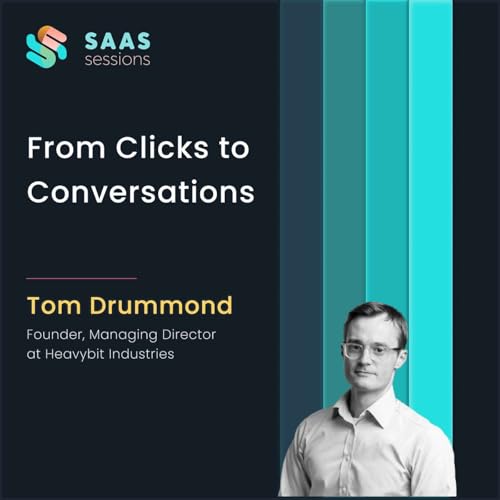
  • S9E7 - From Clicks to Conversations ft. Tom Drummond, Founder & Managing Director at Heavybit Industries
    Oct 6 2025

    Tom Drummond, founder and managing director at Heavybit Industries, dissects the seismic shift from graphical interfaces to conversational AI—and why most SaaS companies are thinking about it wrong. This isn't about adding chatbots to legacy products. It's about fundamentally rethinking what software means when voice becomes the primary interaction mode and agents become your customers. Drummond reveals why rapid execution trumps defensibility, how API-first companies will dominate the agent economy, and why trust—not technology—remains the ultimate bottleneck.

    Key Takeaways:

    1. Large Language Models Are Creating the Biggest Interface Shift Since the GUI

    • The fundamental breakthrough isn't AI intelligence—it's natural language interpretation that frees computing from screens
    • This democratizes access beyond anything the mobile revolution achieved, making software ubiquitous without requiring visual interfaces
    • The transition will be generational: today's builders remain skeptical while the next generation will trust AI as naturally as we trust Wikipedia

    2. Visual Interfaces Won't Disappear—They'll Become Trust Mechanisms

    • GUIs will shift from primary interaction mode to verification and confidence layer for voice-driven commands
    • Humans need visual confirmation not because they're old-fashioned, but because they require ownership and accountability
    • The winning pattern: conversational interfaces for input, visual interfaces for trust and evidence

    3. Software Must Do More When Friction Disappears

    • If you previously delivered value by creating forms to fill out, you've been selling toil—not solutions
    • When a 22-second phone call replaces a 10-minute form, your platform value collapses unless you deliver actual outcomes
    • The new bar: integrate across systems, automate end-to-end workflows, and eliminate entire categories of work

    4. Momentum Is the Only Moat That Matters at Early Stage

    • Defensibility discussions are premature when the entire market is being redefined and expectations reset
    • Investors have shifted to momentum-based evaluation even at seed stage—growth velocity trumps articulated competitive advantages
    • Execute aggressively with AI internally before worrying about competitive positioning: ship faster, operate leaner, reimagine everything

    Lightning Round Insights:

    • Learning accelerator: Experiential over theoretical—don't read about programming, program; don't study sales, sell
    • Career wisdom: Agency and aggressive opportunity capture matter more than perfect strategy in high-change environments
    • Daily AI tool: Continue (Heavybit portfolio company)—enables rapid internal tool development with model-agnostic approach and custom data sources

    Chapters:

    00:00 - Introduction and Heavybit's Investment Thesis
    04:33 - The Language Model Revolution: From Screens to Voice
    12:13 - Rethinking Product Design: Phone Numbers Over Websites
    21:36 - Key Challenges: Trust, Pricing, and Agent Distribution
    30:04 - Differentiation Strategy: Momentum Over Moats
    36:56 - Why Switching Costs Still Matter for Sustainable Growth
    40:04 - Lightning Round and Closing Thoughts

    Visit our website - https://saassessions.com/
    Connect with me on LinkedIn - https://www.linkedin.com/in/sunilneurgaonkar/

    Mehr anzeigen Weniger anzeigen
    44 Min.
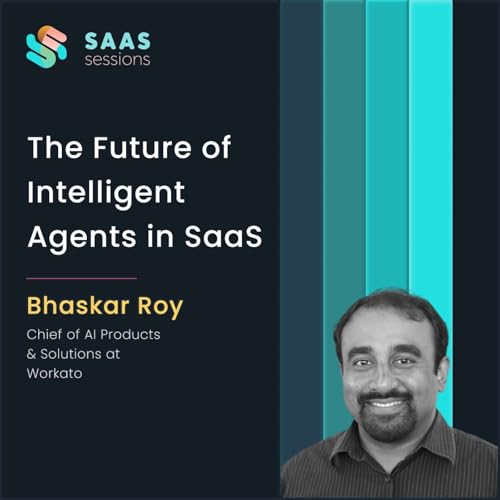
  • S9E6 - The Future of Intelligent Agents in SaaS ft. Bhaskar Roy, Chief of AI Products and Solutions at Workato
    Sep 29 2025

    Bhaskar Roy, Chief of AI Products and Solutions at Workato, breaks down the fundamental shift from app-centric thinking to agent-first architecture. This conversation cuts through the AI hype to reveal how enterprises are moving beyond simple content generation to deploy agents at the core of business processes—from quote-to-cash workflows to IT helpdesk operations. Roy reveals the critical gap between low-agency experimentation and high-value automation, outlines the governance frameworks required for autonomous agents, and explains why getting hands-on is the only way to separate signal from noise in the agentic era.

    Key Takeaways


    1. The Agency Gap: Most Companies Are Stuck in Low-Value Territory

    • Gartner research shows most companies remain in low-agency activities like content creation and email writing, while maximum ROI comes from agents executing core processes like order-to-cash and supply chain management
    • SaaS is deterministic and requires months for customization, while agents adapt and execute in real-time
    • The transformation eliminates bottlenecks where process experts depend on developers for integrations


    2. Purpose-Specific Agents with Enterprise Skills Beat General-Purpose Approaches

    • Agents must be narrowly focused with defined skills—finance agents restricted to finance users, each agent limited to relevant capabilities only
    • Governance controls agent-to-agent collaboration, with supervisor agents coordinating and ensuring compliance
    • Agent authentication ensures agents respect user permissions—only updating data the individual user can access


    3. App Events and Enterprise Acumen Enable Proactive Intelligence

    • Agents listen to events across systems—new hires, leads, tickets—then reason, contextualize, and take autonomous action
    • Enterprise acumen monitors KPIs continuously and proactively recommends actions as metrics fluctuate
    • The shift from reactive to proactive requires human-in-the-loop now, but full autonomy approaches rapidly


    4. The Mindset Shift: From App-Centric to Agent-First Thinking

    • Stop thinking about which app to use—start asking which agent can handle core business processes better
    • When agents become core to business, reliability matters—platforms must provide innovation with enterprise-grade trust
    • Reading about AI isn't learning—build agents, test them, discover what's real versus hype

    Chapters:


    00:00 - Introduction
    00:46 - Journey at Workato: From Integration to Intelligent Agents
    03:40 - The Evolution from SaaS to Agentic Workflows
    07:51 - Best-of-Breed Apps Creating Data Silos and Integration Challenges
    10:54 - Employee Productivity Gains Through Unified Agent Interfaces
    13:20 - The Agency Gap: Low-Value vs. Core Business Process Automation
    17:32 - Real-World Agent Deployments: Quote-to-Cash and IT Helpdesk
    20:12 - Proactive vs. Reactive Agents: Where Does Automation Stop?
    24:42 - Trust, Governance, and Control in Autonomous Agent Systems
    28:42 - Preparing for the Apps-to-Agents Transition
    33:04 - Lightning Round: Getting Hands-On to Shorten Learning Curves

    Visit our website - https://saassessions.com/
    Connect with me on LinkedIn - https://www.linkedin.com/in/sunilneurgaonkar/

    Mehr anzeigen Weniger anzeigen
    40 Min.
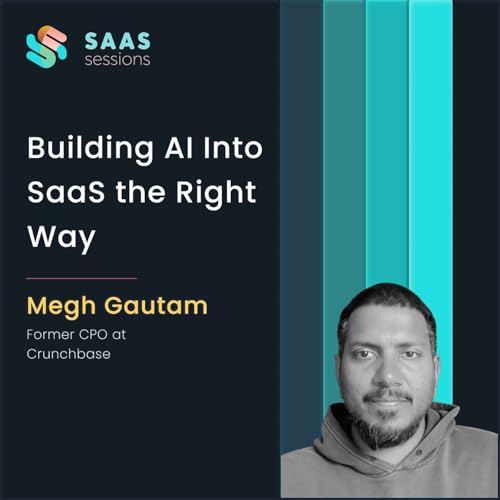
  • S9E5 - Building AI Into SaaS the Right Way: Lessons from Megh Gautam, Former CPO at Crunchbase
    Sep 12 2025

    Every SaaS company is racing to “add AI,” but most are doing it wrong. In this episode, Megh Gautam, Former Chief Product Officer at Crunchbase, reveals the hard truths behind building AI into established SaaS products. From avoiding hype-driven features to building trust through data quality and transparency, Megh shares how Crunchbase rolled out AI-powered capabilities without breaking user trust. He also breaks down the internal alignment, cross-functional execution, and relentless feedback loops required to ship AI features that actually matter.


    Key Takeaways -

    1. Start with Real User Problems
      1. AI should not be an “add-on story” — it must solve a core customer pain.
      2. Crunchbase began with AI in search, a high-usage, high-friction feature.
      3. Prioritize critical workflows over “nice-to-have” gimmicks.
    2. Data Quality Determines Trust
      1. Bad data in = garbage out, especially with AI models.
      2. Crunchbase spent a decade building clean, reliable data pipelines before layering AI.
      3. Trustworthy results require grounding AI outputs in verified “truth sets.”
    3. User Trust Demands Transparency
      1. Customers don’t just want answers — they want to know how those answers were derived.
      2. Explainability and confidence thresholds are essential for adoption.
      3. If unsure, don’t hallucinate — caveat results and suggest alternatives.
    4. AI is a Company-Wide Effort, Not Just a Product Launch
      1. Designers, engineers, PMs, marketing, and GTM must move in lockstep.
      2. Pricing, packaging, and positioning are as critical as the technical build.
      3. Internal discomfort is normal — priorities will shift faster than in traditional SaaS launches.
    5. Continuous Feedback Loops Drive Iteration
      1. Early adopter programs and dense customer feedback cycles are critical.
      2. Patterns of confusion often surface only after repeated customer interactions.
      3. AI workflows blur traditional SaaS team boundaries — ownership must evolve.

    Chapters:
    00:10 - Introduction
    00:50 - Megh’s SaaS journey (Twilio, Dropbox, Crunchbase)
    02:45 - AI hype vs. solving real user problems
    06:05 - Why Crunchbase started with AI in search
    10:17 - Data quality as the foundation for trustworthy AI
    15:07 - Overcoming AI skepticism with transparency
    20:01 - Aligning product, engineering, marketing, and GTM on AI launches
    25:46 - Feedback loops and customer education
    30:32 - Lightning Round: Megh’s favorite AI tools
    36:27 - Closing thoughts and key reminders

    Visit our website - https://saassessions.com/
    Connect with me on LinkedIn - https://www.linkedin.com/in/sunilneurgaonkar/

    Mehr anzeigen Weniger anzeigen
    37 Min.
  • S9E4 - From Community to Capital ft. Max Altschuler, General Partner at GTMfund
    May 21 2025

    In this powerhouse episode, Max Altschuler - founder of Sales Hacker, former VP of Marketing at Outreach, and now General Partner at GTMfund - breaks down what it takes to build and scale B2B SaaS companies with speed and substance. Max shares his journey from being an early-stage operator to becoming a SaaS investor, unpacking the real mechanics behind GTM strategy, community-driven growth, category creation, and what founders often get wrong. This is a masterclass in strategic execution and long-game thinking for SaaS leaders.


    Key Takeaways –

    1. Betting on Founders: What Drives Early-Stage Investing

    • Founder-market fit trumps product perfection - invest in people who are machines.
    • Space matters: Great founders + a growing wave = potential breakout.
    • Outreach wasn’t a spreadsheet decision - it was a conviction bet on Manny Medina's obsession and clarity.

    2. Strategic Distribution Is the New Product

    • Distribution is where the new edge is; AI levels the playing field for building.
    • GTM is the real differentiator - your ability to generate demand at scale will define outcomes.
    • Sales Hacker’s distribution muscle supercharged Outreach’s category dominance.

    3. Acquisitions Are Not Just About Revenue, They’re About Velocity

    • Sales Hacker wasn’t bought for its revenue but to compound Outreach’s strategic value.
    • Community-led growth isn't a tactic; it’s an ecosystem asset.
    • Integration didn’t mean conversion - it meant amplification without breaking trust.

    4. Lessons in SaaS Scale and GTM Execution

    • Don’t underinvest in product expansion; build or buy fast when signals are clear.
    • Self-serve isn’t optional anymore; it’s mandatory for market-wide coverage.
    • Be obsessed, but don’t burn out your team; clarity in communication scales leadership.

    About the GTMfund:
    GTMfund is an early-stage venture fund backed by 300+ of the most respected go-to-market leaders from companies like Salesforce, Zoom, and Snowflake. It focuses exclusively on backing SaaS startups with strong GTM execution and strategic potential.

    Connect with Max Altschuler | Check out GTMfund


    Visit our website - https://saassessions.com/
    Connect with me on LinkedIn - https://www.linkedin.com/in/sunilneurgaonkar/

    Mehr anzeigen Weniger anzeigen
    40 Min.
  • S9E3 - Cracking Early-Stage SaaS Growth ft. Jacob Bank, CEO of Relay.app
    Apr 2 2025

    In this episode of the SaaS Sessions podcast, Jacob Bank, founder of Relay.app, shares his journey from academia to startup founder, discussing the challenges of building a product in the AI space. He emphasizes the importance of validating ideas, finding early customers, and experimenting with various marketing channels. Jacob also highlights the significance of cohort retention as a measure of product-market fit and the need to balance innovation with competition in a rapidly evolving market.

    Key Takeaways –

    1. You’re not failing - your distribution is
    Building is easy; getting customers is the battlefield.
    Early channels (Reddit, network, cold email) only take you so far.
    Most startup advice is outdated or irrelevant to your context - test everything yourself.

    2. Validate with precision, not ego
    The Mom Test changed how Jacob gathered honest feedback.
    10 well-run interviews can kill or greenlight an idea.
    Getting “likes” is not validation - retention and willingness to pay are.

    3. Every growth stage needs a new motion
    0 → 10: Scrappy hustle (Reddit, LinkedIn DMs, direct outreach).
    10 → 100: Partner marketing, SEO, and high-intent blog content.
    100 → 1000: Viral LinkedIn content + YouTube for education + community-led growth.

    4. PMF isn’t hype - it’s cohort retention
    Retention is the only true sign of product-market fit.
    Competitive pressure is a forcing function to build better products.
    Don’t be afraid to pick a fight in a crowded space - just know your edge.

    Connect with Jacob Bank:
    🔗 Jacob Bank - https://www.linkedin.com/in/jacobbank/
    📅 Join his Build an AI Agent with Me sessions - https://events.relay.app
    🌐 Try Relay.app for free: https://relay.app

    Relay.app is an AI agent builder that connects your tools into smart workflows. Designed to bring humans into the loop where automation fails, Relay combines intuitive UX with AI-native capabilities, enabling teams to move faster without drowning in manual ops.

    Chapters:
    00:10 – Introduction
    00:50 – Jacob’s journey from academia to Google to Relay
    02:14 – The pain of early go-to-market and what didn’t work
    06:09 – Using The Mom Test to validate early MVPs
    07:59 – Breaking through with traction experiments
    10:52 – Reddit, Product Hunt, and the weak links in early GTM
    13:49 – From 10 to 100: What channels actually scaled
    15:18 – Facing the 100 → 1000 wall
    16:37 – Cracking virality with LinkedIn
    21:29 – Mid-funnel levers: YouTube and email
    27:13 – Competing in a mature category and why it’s a good thing
    33:15 – Defining and validating PMF the hard way
    38:27 – Retention is king—no tricks, just product
    40:28 – Lightning round
    42:41 – Final thoughts + how to join Jacob’s live AI agent sessions

    Visit our website - https://saassessions.com/
    Connect with me on LinkedIn - https://www.linkedin.com/in/sunilneurgaonkar/

    Mehr anzeigen Weniger anzeigen
    43 Min.