Procurement Legends Titelbild

Procurement Legends

Procurement Legends

Von: Procurement News and Insights for Digital Procurement Pros
Jetzt kostenlos hören, ohne Abo

Nur 0,99 € pro Monat für die ersten 3 Monate

Danach 9.95 € pro Monat. Bedingungen gelten.

Über diesen Titel

Welcome to "Procurement Legends," the go-to podcast for professionals seeking invaluable insights in the realms of Procurement, Supply Chain, and Contract Management. If you're looking to gain a competitive edge, you've come to the right place. What Sets Us Apart: Deep Dives: We don't just skim the surface. We delve into the intricacies of current trends, technologies, and legislation that are revolutionising the industry. Best Practices: Our experts shed light on proven strategies and methods, covering the A to Z of sourcing, negotiations, and contract management, equipping you with practical tools to excel. Global Perspectives: Real-world case studies and actionable examples from across the globe give you a well-rounded understanding of how to adapt and thrive in varying market conditions. Personal Branding: Your career isn't just about technical know-how; it's about standing out. We'll guide you through building a compelling personal brand to become a key player in your field. Building a Procurement Second Brain: Information overload is a real challenge. Learn how to construct a 'Procurement Second Brain' to efficiently capture, organise, and implement knowledge, streamlining your decision-making process. Business Implementation: Get ready to take notes, because you'll want to start implementing our tips and tactics within your own organisation as soon as you've finished listening. Tune in for thought-provoking discussions, compelling interviews, and actionable advice, all aimed at transforming you into a bona fide Procurement Legend. We speak with the most Senior and the most Junior people within Business, as everyone has a perspective and fresh ideas that can really help you operate within your business.

worldofprocurement.substack.comDaniel Barnes
Management & Leadership Ökonomie
  • 6 AI Procurement Capability Pillars You Need
    Aug 26 2025
    The AI Procurement Blueprint is a reader-supported publication. To receive new posts and support my work, consider becoming a free or paid subscriber.The "AI Procurement Blueprint" is presented as a practical guide for integrating artificial intelligence into procurement processes, catering to professionals at all experience levels. It outlines six key capability pillars necessary for success, including strategic vision, AI fluency, governance, data storytelling, ecosystem innovation, and AI-augmented negotiation. The source emphasises that AI's role is not to replace human jobs but to elevate capabilities and redefine responsibilities, leading to more strategic, technology-enabled, and outcomes-focused procurement. It further details how various procurement roles are evolving into hybrid, tech-enabled positions, providing actionable steps for individuals and organisations to develop these crucial skills and implement AI pilots effectively.How is AI transforming the procurement profession, and what is its impact on existing roles?AI is fundamentally reshaping procurement by elevating capabilities and redefining responsibilities, moving the profession towards a more strategic, technology-enabled, and outcomes-focused approach. It is not about replacing people but about augmenting their abilities. Existing roles are evolving into hybrid, tech-enabled positions where AI handles repetitive, rules-based tasks, freeing up professionals to focus on higher-value work. For instance, category managers are now designing supplier ecosystems and co-innovation programmes, sourcing analysts are managing AI-driven sourcing waves, and contract specialists are overseeing AI-assisted contract creation. New senior roles like AI Procurement Manager and Head of Digital Procurement & AI are also emerging to orchestrate AI operating models and platform strategies.What are the six key capability pillars essential for procurement professionals in an AI-driven future?The six essential capability pillars for procurement professionals in an AI-driven future are:* Strategic Vision and Systems Leadership: Aligning AI adoption with broader business goals like growth, resilience, and sustainability, and building connected systems.* AI Fluency and Prompt Craft: Confidently using AI tools, guiding them with clear instructions, checking their accuracy, and transforming outputs into actionable insights.* Governance, Ethics, and Assurance: Ensuring compliance with regulations (e.g., EU AI Act), applying strong controls, performing bias checks, and maintaining human oversight for transparent and auditable AI-assisted decisions.* Data Storytelling and Influence: Presenting AI-driven insights as compelling narratives that demonstrate clear business impact (e.g., cost reduction, risk mitigation, sustainability improvements).* Ecosystem Innovation and Platform Thinking: Working collaboratively with suppliers to share data in real-time, leveraging supplier network data as a strategic asset for better AI decisions.* AI-Augmented Negotiation and Behavioural Dynamics: Understanding when to automate routine negotiations with AI and when human judgment is crucial for complex or sensitive deals.How can organisations practically implement AI in procurement, particularly concerning pilot projects?Organisations can implement AI by linking AI opportunities directly to their organisational goals (OKRs) and running small-scale, low-risk pilot projects. The blueprint suggests identifying high-impact opportunities across the procure-to-pay lifecycle, selecting one clear pilot tied to a key result, and designing it with success metrics, guardrails, and human oversight. A "first-month plan" example is an autonomous tail-spend buying pilot to streamline low-risk purchases, minimise manual effort, reduce costs, and maintain compliance. The focus is on building a plain-language leadership case that quantifies benefits, clarifies risks and controls, and secures approval.What is the role of data in AI-driven procurement, and how does "data storytelling" come into play?Data is a strategic asset in AI-driven procurement. Real-time data sharing with suppliers enables AI models to make better decisions. "Data storytelling" is crucial for translating AI-driven insights into narratives that resonate with stakeholders. It moves beyond static reporting, presenting data in a way that clearly demonstrates business impact, whether it's reducing costs, cutting risk, or improving sustainability. This skill helps procurement professionals influence decisions and showcase the tangible value derived from AI applications.How can procurement professionals improve their AI fluency and prompt craft?Procurement professionals can improve their AI fluency and prompt craft by actively experimenting with AI tools in a safe, sandboxed environment. Practical steps include using vendor-provided trial accounts, following prompt design guides, and regularly practising the creation of multi-step ...
    Mehr anzeigen Weniger anzeigen
    13 Min.
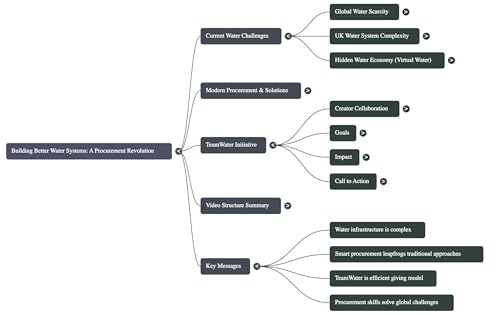
  • Water Systems: Procurement's Transformative Power
    Aug 21 2025
    The AI Procurement Blueprint is a reader-supported publication. To receive new posts and support my work, consider becoming a free or paid subscriber.🔗 JOIN TEAMWATER RIGHT NOW: Campaign ends August 31 - every day counts! Donate/Join: TeamWater.orgA different episode today. This is all about raising awareness in collaboration with Team Water!The provided sources primarily discuss the complexities of existing water infrastructure, exemplified by the UK's extensive yet leaky network, and contrast this with innovative, modern procurement strategies for establishing new water systems. They highlight how "leapfrog" approaches, such as modular, solar-powered water solutions and mobile payment-enabled water ATMs in East Africa, offer a more efficient and cost-effective way to provide clean water. The texts emphasise the critical role of smart procurement and supply chain management in these projects, advocating for practices like framework agreements, local assembly, and digital monitoring to optimise delivery and ensure sustainability, ultimately linking these methods to philanthropic efforts like the TeamWater campaign.Q1: What is the main problem with existing water systems, and how does it compare to building new ones?Existing water systems, like the one in the UK, are incredibly complex and expensive to maintain. The UK, for example, has 800,000 km of water pipes, and it's projected to invest £50 billion over the next 15-20 years just for maintenance [1, 5]. Despite this massive investment, 3 billion litres of water are lost daily to leaks, accounting for 19-22% of the total water input [6, 7]. Lead times for essential equipment, such as ductile iron pipes, can be as long as 18 months, compared to 3 months previously [1]. Surprisingly, the sources suggest that building a new, modern water system from scratch can be easier and more efficient than constantly repairing and upgrading an outdated, vast network.Q2: What is "virtual water," and why is it relevant to water resource management?"Virtual water" refers to the hidden water used in the production of goods and services. Essentially, when you buy products like jeans, smartphones, or steel, you are indirectly purchasing a significant amount of water that was consumed during their manufacturing processes [1, 5]. For instance, a pair of jeans uses 3,781 litres of water, and a smartphone requires 13 tonnes of water cradle to grave [1]. This concept highlights that every supply chain decision is, in effect, a water decision, making it crucial for procurement professionals to consider the water footprint of products and processes.Q3: How do modern procurement and supply chain thinking offer a solution to water scarcity, especially in developing regions?Modern procurement and supply chain thinking enable a "leapfrog revolution" in water provision, especially in areas starting from scratch. Instead of replicating traditional, large-scale infrastructure, these approaches focus on modular, scalable, and digitally-enabled solutions [1, 24, 25]. For example, in Kabati, Kenya, a solar-powered reverse osmosis (RO) system costing under $40,000 was operational in 12 weeks, providing 6-7 cubic meters of WHO-standard drinking water daily to 1,500 residents [1, 9, 10]. This contrasts sharply with traditional water mains extensions, which can take years and cost hundreds of thousands [1].Q4: What are the key features of these "leapfrog" water systems?The "leapfrog" water systems are characterised by:* Modularity: Often contained within standard shipping containers, making them easy to transport and install [1, 12].* Renewable Energy: Primarily powered by solar panels, reducing reliance on expensive and unreliable fossil fuels [1, 9].* Advanced Filtration: Incorporate technologies like reverse osmosis and UV sterilisation to provide hospital-grade water [1].* Digital Integration: Utilise water-vending "ATMs" and mobile payment systems (e.g., M-Pesa in Kenya) for transparent transactions and revenue collection, often with cloud monitoring [1, 13, 14].* Localisation: Prioritise local sourcing of up to 70% of components and local assembly, cutting lead times by 40% and fostering local job creation [1, 18, 19].Q5: Can you provide examples of these modern water solutions in action?* Kabati, Kenya: A solar-powered RO system provides 6-7 cubic meters of water daily to 1,500 residents via water ATMs, significantly improving access to clean water and replacing costly diesel pumps [1, 9, 10].* Nzokani, Kenya: A water-ATM sells 13 cubic meters of water daily through the M-Pesa mobile money system, demonstrating increased revenue collection compared to traditional methods [1].* WaterKiosk Africa (East Africa): This organisation and its partner, Boreal Light, have installed over 100 solar-powered desalination and purification systems in hospitals, schools, and communities, serving over 6 million beneficiaries annually and proving the speed and flexibility of the plug-and-play model,...
    Mehr anzeigen Weniger anzeigen
    17 Min.
  • The AI Procurement Blueprint: Trends and Strategic Implications
    Aug 19 2025
    The AI Procurement Blueprint is a reader-supported publication. To receive new posts and support my work, consider becoming a free or paid subscriber.The sources discuss emerging trends and strategic implications of Artificial Intelligence (AI) in procurement. They highlight geopolitical shifts impacting AI procurement landscapes, such as new regulations requiring federal agencies to procure AI systems based on "Unbiased AI Principles" and promoting US AI technology exports. The texts also address the challenges in generative AI adoption within procurement, noting a "trough of disillusionment" due to fragmented data, integration issues, and inconsistent return on investment (ROI). Finally, the sources emphasise the importance of workflow redesign for realising significant business value from AI, explaining that simply adopting AI tools without deeper integration and upskilling the workforce leads to an "impact gap."1. How is the "American AI Exports Program" reshaping the global procurement landscape for AI systems?The "American AI Exports Program," established by President Trump's Executive Order 14320, is creating a two-tier AI procurement landscape. Firstly, it mandates that US federal agencies only procure AI systems from vendors adhering to new "Unbiased AI Principles," requiring models to be free from ideological bias and pursuing objective truth. Secondly, the Department of Commerce will actively promote "full-stack AI export packages" (including hardware, models, software, applications, and standards) to allied countries through federal financing. This means multinational companies will face increased complexity, as AI systems from non-US origins may be restricted or deemed ineligible for procurement in national security-critical sectors. Conversely, US-based AI vendors will receive significant government support for international expansion, potentially altering negotiation leverage in procurement discussions. Organisations will need to audit their AI supplier base and consider geographic diversification strategies.2. Why is generative AI in procurement currently experiencing a "trough of disillusionment," and what are the main challenges?Generative AI in procurement is currently in a "trough of disillusionment" because the initial excitement is being tempered by the realities of implementation. While some early adopters report efficiency gains, many organisations are encountering significant barriers. These include fragmented and low-quality data across existing procurement systems, complex integration challenges with current platforms, concerns around job security, and high, unpredictable costs. Despite 53% of supply chain and procurement executives reallocating funds to support GenAI initiatives, many are struggling with the technical specifications required to make these initiatives work effectively.3. What are "smart teams" doing to overcome the challenges of generative AI adoption in procurement?"Smart teams" are successfully navigating the generative AI "trough of disillusionment" by focusing on specific, measurable use cases rather than pursuing broad transformation promises. Examples include automated supplier recommendations, streamlining contract management workflows, and generating RFx documents. A key insight for these successful adopters is the critical importance of investing in clean, integrated data architecture before deploying AI capabilities. Organisations with well-integrated data systems have reported achieving AI implementation timelines that are three times faster.4. What is the "AI Workforce Impact Gap" identified by BCG, and why is it significant for procurement?The "AI Workforce Impact Gap" refers to the disparity between AI adoption rates and the actual business value being captured by companies. A BCG study of over 10,600 workers revealed that while 72% regularly use AI, only a small proportion of companies are realising significant business value. The critical difference lies in whether companies are merely deploying AI tools or fundamentally redesigning entire workflows to leverage AI. For procurement teams, this is significant because it suggests that simply introducing AI tools will not yield substantial returns. Instead, the winning strategy involves deep implementation in specific, high-impact areas like contract analysis, supplier risk management, and spend analytics, rather than a broad proliferation of AI tools across all processes. Less than one-third of companies have effectively upskilled even 25% of their workforce to use AI, further contributing to this gap.5. What are the key findings from the BCG "AI at Work 2025" report regarding AI integration and frontline adoption?The BCG "AI at Work 2025" report highlights several critical findings: three-quarters of respondents believe AI agents are vital for future success, yet only 13% report these agents are broadly integrated into workflows, and just one-third understand how they function. Furthermore, ...
    Mehr anzeigen Weniger anzeigen
    15 Min.
Noch keine Rezensionen vorhanden