Water Systems: Procurement's Transformative Power Titelbild

Water Systems: Procurement's Transformative Power

Water Systems: Procurement's Transformative Power

Jetzt kostenlos hören, ohne Abo

Details anzeigen

Nur 0,99 € pro Monat für die ersten 3 Monate

Danach 9.95 € pro Monat. Bedingungen gelten.

Über diesen Titel

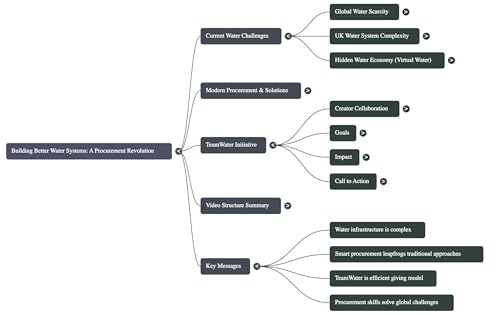
The AI Procurement Blueprint is a reader-supported publication. To receive new posts and support my work, consider becoming a free or paid subscriber.🔗 JOIN TEAMWATER RIGHT NOW: Campaign ends August 31 - every day counts! Donate/Join: TeamWater.orgA different episode today. This is all about raising awareness in collaboration with Team Water!The provided sources primarily discuss the complexities of existing water infrastructure, exemplified by the UK's extensive yet leaky network, and contrast this with innovative, modern procurement strategies for establishing new water systems. They highlight how "leapfrog" approaches, such as modular, solar-powered water solutions and mobile payment-enabled water ATMs in East Africa, offer a more efficient and cost-effective way to provide clean water. The texts emphasise the critical role of smart procurement and supply chain management in these projects, advocating for practices like framework agreements, local assembly, and digital monitoring to optimise delivery and ensure sustainability, ultimately linking these methods to philanthropic efforts like the TeamWater campaign.Q1: What is the main problem with existing water systems, and how does it compare to building new ones?Existing water systems, like the one in the UK, are incredibly complex and expensive to maintain. The UK, for example, has 800,000 km of water pipes, and it's projected to invest £50 billion over the next 15-20 years just for maintenance [1, 5]. Despite this massive investment, 3 billion litres of water are lost daily to leaks, accounting for 19-22% of the total water input [6, 7]. Lead times for essential equipment, such as ductile iron pipes, can be as long as 18 months, compared to 3 months previously [1]. Surprisingly, the sources suggest that building a new, modern water system from scratch can be easier and more efficient than constantly repairing and upgrading an outdated, vast network.Q2: What is "virtual water," and why is it relevant to water resource management?"Virtual water" refers to the hidden water used in the production of goods and services. Essentially, when you buy products like jeans, smartphones, or steel, you are indirectly purchasing a significant amount of water that was consumed during their manufacturing processes [1, 5]. For instance, a pair of jeans uses 3,781 litres of water, and a smartphone requires 13 tonnes of water cradle to grave [1]. This concept highlights that every supply chain decision is, in effect, a water decision, making it crucial for procurement professionals to consider the water footprint of products and processes.Q3: How do modern procurement and supply chain thinking offer a solution to water scarcity, especially in developing regions?Modern procurement and supply chain thinking enable a "leapfrog revolution" in water provision, especially in areas starting from scratch. Instead of replicating traditional, large-scale infrastructure, these approaches focus on modular, scalable, and digitally-enabled solutions [1, 24, 25]. For example, in Kabati, Kenya, a solar-powered reverse osmosis (RO) system costing under $40,000 was operational in 12 weeks, providing 6-7 cubic meters of WHO-standard drinking water daily to 1,500 residents [1, 9, 10]. This contrasts sharply with traditional water mains extensions, which can take years and cost hundreds of thousands [1].Q4: What are the key features of these "leapfrog" water systems?The "leapfrog" water systems are characterised by:* Modularity: Often contained within standard shipping containers, making them easy to transport and install [1, 12].* Renewable Energy: Primarily powered by solar panels, reducing reliance on expensive and unreliable fossil fuels [1, 9].* Advanced Filtration: Incorporate technologies like reverse osmosis and UV sterilisation to provide hospital-grade water [1].* Digital Integration: Utilise water-vending "ATMs" and mobile payment systems (e.g., M-Pesa in Kenya) for transparent transactions and revenue collection, often with cloud monitoring [1, 13, 14].* Localisation: Prioritise local sourcing of up to 70% of components and local assembly, cutting lead times by 40% and fostering local job creation [1, 18, 19].Q5: Can you provide examples of these modern water solutions in action?* Kabati, Kenya: A solar-powered RO system provides 6-7 cubic meters of water daily to 1,500 residents via water ATMs, significantly improving access to clean water and replacing costly diesel pumps [1, 9, 10].* Nzokani, Kenya: A water-ATM sells 13 cubic meters of water daily through the M-Pesa mobile money system, demonstrating increased revenue collection compared to traditional methods [1].* WaterKiosk Africa (East Africa): This organisation and its partner, Boreal Light, have installed over 100 solar-powered desalination and purification systems in hospitals, schools, and communities, serving over 6 million beneficiaries annually and proving the speed and flexibility of the plug-and-play model,...
Noch keine Rezensionen vorhanden