Folgen

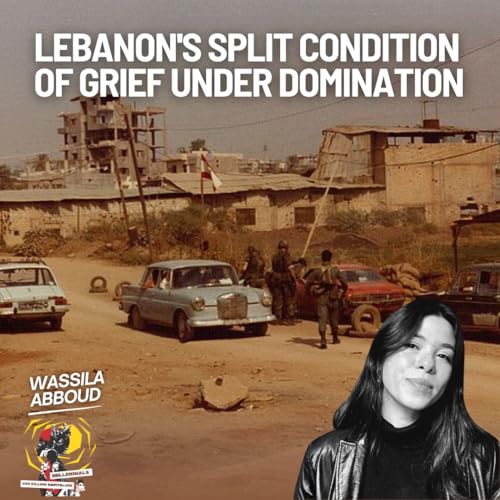
  • Lebanon's Split Condition of Grief Under Domination with Wassila Abboud
    Jan 11 2026

    In this episode we are joined by Wassila Abboud to discuss her essay, "The Dining Table and the Drone." Our conversation begins with her meditations on grief in Lebanon. We explore how people often name today's grief through the language of past griefs — and what this transference between past and present reveals about the psyche under domination.

    From there, we turn to Walter Benjamin's "angel of history" and why Abboud argues this analogy fails to capture Lebanon's relationship to catastrophe. We discuss why so many returns cluster around 1982, how that year fractured grief itself, reshaping collective memory, political imagination, and the vocabulary of resistance. We examine the paradoxical meaning of ceasefire, the choreography of repeated displacement, and the temporal logic of domination that ensures catastrophe is always waiting just beyond its declaration.

    Our conversation also situates Lebanon's grief in relation to Gaza's present devastation, asking what it reveals about the impossibility of stability in a regional order sustained by capital accumulation and the extraction of life. We trace the sequence of events between 1978 and 1982 — from Operation Litani to the Camp David Accords and Israel's full-scale invasion of Beirut — not simply as military maneuvers but as the crystallization of a regional order that fractured Lebanon's political landscape and redefined resistance.

    Wassila Abboud is a cultural worker and writer researching between Beirut and Amsterdam. Her work engages with critical theory, philosophy, and culture and takes on both a speculative and materialist approach, examining the conditions of past and present historical struggles. (Follow her on IG: @wassila_)

    If you like what we do and want to support our ability to have more conversations like this. Please consider becoming a Patron. You can do so for as little as a 1 Dollar a month at patreon.com/millennialsarekillingcapitalism

    Mehr anzeigen Weniger anzeigen
    41 Min.
  • Rootedness and the Black Commune with Austin Cole
    Dec 29 2025
    In this episode, we're joined by Austin Cole to discuss the three-part series Black/African Liberation & Grassroots Economies, beginning with part one: "Rootedness for our people, our economies, our liberation."

    We start with Toni Morrison's concept of rootedness and how it informs urban planning and economic development. From there, we'll dig into Strategies of Counter-war—how fascists are shaping local policy, and how BAP-Baltimore is building alternatives from the ground up. We examine the threat of elite capture and the strategic use of municipal power: how can engagement with the state enable collective self-determination rather than dilute it? Can it do such a thing?

    We also explore expanded notions of self-defense, the Black commune as theorized by George Jackson and Orisanmi Burton, and the four principles guiding grassroots efforts toward that vision.

    Finally, we'll sit with the question of mass consciousness—what it demands of us now, and how we might cultivate it together. Austin Cole was raised in Springfield, Ohio, and his people come from the Mississippi Delta and Birmingham, Alabama. He is an organizer, writer, and community development planning practitioner. His professional work focuses on environmental/climate justice, transforming economic systems, and Black/African liberation. He is a member of and currently serves as National Co-Coordinator for the Black Alliance for Peace (BAP) and co-coordinates of BAP's Haiti/Americas Team. Support our work via patreon! Black/African Liberation & Grassroots Economies PT. I: "Rootedness" for Our People, Our Economies, Our Liberation Black/African Liberation & Grassroots Economies PT. II: Situating 'Economy' and Ourselves in the Struggle from the Internal (Neo)Colony

    Additional writings (not yet released as of the recording of this episode in late 2024)

    Black/African Liberation & Grassroots Economies PT. III: Constructing the Counter-War That Our Liberation Demands

    Black/African Liberation & Grassroots Economies PT. IV: Collective Struggle Is Our past and Future

    Mehr anzeigen Weniger anzeigen
    2 Std. und 6 Min.
  • Give Warmth To Gaza with Hala Sabbah of The Sameer Project (Live Audio)
    Dec 4 2025

    This is the audio from a livestream video we hosted with Hala Sabbah from The Sameer Project on December 3rd, 2025. Hala returned to the program to talk about life in Gaza nearly two months into the so-called "ceasefire." We spoke about the realities on the ground and the needs of people in Gaza right now, what is getting into the strip and what is not, and how the Sameer Project is working within the current conditions in Gaza. We also talk about the need for continued organizing, boycotts, and direct action against the zionist entity. And we spoke about creative ways people can fundraise for Sameer Project and other local groups operating on the ground in Gaza.

    RETURN HOME x The Sameer Project

    Sameer Project's linktree

    Mehr anzeigen Weniger anzeigen
    1 Std. und 23 Min.
  • From Phosphate Mining to Forever Chemicals With the Lowcountry Action Committee
    Dec 4 2025

    In this episode, we are joined by organizers from the Lowcountry Action Committee to discuss climate justice in South Carolina's Lowcountry. We begin with a discussion about climate reparations and the state's unfortunate priorities. We go on to explore the history of phosphate mining and its exploitation of newly emancipated Africans, the ecological destruction it caused, and its legacy of environmental racism.

    We then turn to hurricane season and the anxiety it provokes in vulnerable working-class and poor Black communities, followed by the toxic legacy of military pollution and "forever chemicals" in North Charleston. Finally, we reflect on political consciousness, the fight against capital, and whether the Gullah Geechee are punished for their self-determination—echoing Haiti's revolutionary legacy.

    Lowcountry Action Committee is a Black led grassroots organization dedicated to Black liberation through service, political education, and collective action in the Lowcountry of South Carolina.

    If you like what we do want to support our ability to have more conversations like this, please consider becoming a patron for as little as one dollar a month at patreon.com/millennialsarekillingcapitalism, you can also support via a one-time donation at BuyMeACoffee.com/MAKCapitalism

    The piece the conversation is based on this issue of Surge: Lowcountry Climate Magazine

    Lowcountry Action Committee's Website, LinkTree, Youtube

    Mehr anzeigen Weniger anzeigen
    1 Std. und 2 Min.
  • Lowcountry Takes Action! with the Lowcountry Action Committee
    Dec 3 2025

    In this episode, recorded in the summer of 2024, Josh interviewed two organizers from the Lowcountry Action Committee.

    Lowcountry Action Committee is a Black African grassroots organization dedicated to Black liberation through service, political education, and collective action in the South Carolina Lowcountry.

    Our conversation centers around their 2024 piece on environmental racism, where they trace the climate catastrophe, threatening to wash away Gullah Geechee homelands back to the phosphate mining industry of the eighteen sixties.

    We discuss how today's disproportionate exposure of Black communities to hazardous waste sites, landfills, incinerators is inseparable from the region's history of chattel slavery and why Black people must be at the vanguard of the environmental movement.

    We then situate the crisis within the broader context of the Black Belt, a historical homeland of Africans trafficked to North America. Now among the most vulnerable regions to climate change, drawing on Kali Akuno's prediction that large portions of the Black Belt may be underwater by 2050. We explore what displacement, housing costs, and organized abandonment mean for Black communities in the Carolinas and beyond.

    The conversation also turns to international frameworks, particularly Cuba's model of sustainable development and the parallels between Cuban soil erosion and sea level rise and the ecological challenges facing Gullah Geechee communities. We discuss how the Lowcountry itself lives under a kind of economic blockade, how this juxtaposition illuminates environmental racism, neocolonialism, and anti-Blackness.

    If you like what we do want to support our ability to have more conversations like this, please consider becoming a patron for as little as one dollar a month at patreon.com/millennialsarekillingcapitalism, you can also support via a one-time donation at BuyMeACoffee.com/MAKCapitalism

    Lowcountry Action Committee's Website, LinkTree, Youtube

    Crisis in the Carolinas: Racial Disparities, the Climate Catastrophe and Environmental Racism in the Lowcountry

    Cuba's Life Task: Combatting Climate Change (Tarea Vida)

    Organizing to Free the Land with Kali Akuno

    Mehr anzeigen Weniger anzeigen
    1 Std. und 18 Min.
  • The Return of Operation Condor
    Nov 28 2025

    In this conversation we speak with a labor organizer and people's historian who covers Latin American movements with connections to Ecuador, Colombia, and Cuba. Folks may know her by the twitter handle @SovietwithSazon.

    In this conversation she discusses recent struggles and developments in Ecuador. In particular a recent 38 day general strike, and the popular rejection of a recent referendum including measures which would have allowed the US to build military bases in Ecuador and cut public funding for political parties.

    Our guest contextualizes the current US-backed narco-military regime lead by Daniel Noboa. And she talks about the broader revenge campaign against former Pink Tide governments like Ecuador and Bolivia, now led by right wing forces.

    She discusses how the tactics we're seeing across Latin America against left-leaning governments, and the disappearances and assassinations of organizers, mark a return of the CIA's Operation Condor tactics. And she discusses how the capitalist class colludes with cartels to create crises that manufacture consent for the state of war decree that Ecuadorians are currently under.

    We'll include links to follow our guest on twitter, where she will be increasing her reporting on developments in Latin America, and to other episodes where we discuss recent developments with regard to Venezuela, Ecuador, Colombia, and on the topic of general strikes, the general strike Italian workers led a couple months ago. Link to Black Alliance for Peace's Week of Action.

    As we approach the year end. We're offering up a 40% discount on yearly memberships, or 40% off the first month on monthly memberships for MAKC if you join at the $5 a month level or higher. Buy one for a friend, comrade, or relative. Support our work, help us continue to do more. Use code EOY25. Reminder, if you purchase a yearly subscription for as little as $10.80 per year, you gain access to study groups for all of 2026, our first study group next year won't start until February, but we will have at least 3 study groups you can take advantage of if you are a member. Join now at patreon.com/millennialsarekillingcapitalism

    Mehr anzeigen Weniger anzeigen
    1 Std. und 21 Min.
  • Prison Death-Worlds, COVID-19, and the Fatal Convenience of Crisis with Dalton Lackey and Teagan Murphy
    Nov 2 2025
    In this episode, we are joined by Dalton Lackey and Teagan Murphy, co-authors of the article "The COVID-19 Murders": Prison death-worlds and the fatal convenience of crisis. Their work offers a piercing critique of how carceral institutions weaponized the pandemic—not as an unprecedented emergency, but as a tactical opportunity to deepen control, dehumanization, and death. We'll begin by hearing from Dalton and Teagan about their political motivations, the methodologies they employed, and the intellectual scaffolding behind their analysis. From there, we'll unpack their challenge to the dominant narrative of "failure"—a framing that presumes the prison system was simply overwhelmed by crisis. Instead, they argue that the pandemic revealed not incompetence, but calculated cruelty. We'll also examine how disaster operates as a tool of tactical evolution within prisons. As the authors write, "Rather than revealing entirely new challenges, our findings demonstrate how the pandemic instead exacerbates what the literature has suggested are the preexisting goals of carceral punishment." We'll discuss how incarcerated people themselves narrated these shifts—how they recognized the charade of "safety" and named the degradation that exceeded even the brutal norm. From psychic death and coerced docility to the punitive treatment of those living with HIV/AIDS, we'll trace the historical continuities and contemporary parallels that shape this death-world. We'll ask how social distancing protocols, meant to protect, instead expanded estrangement—and how preexisting conditions of confinement intensified the crisis. Teagan Murphy (any/all) is a PhD candidate in the Department of Sociology at the University of Maryland, College Park. Their research, conducted primarily through qualitative interviews, ethnography, and content analysis, focuses on institutional and carceral logics and the reproduction of inequities via narratives of deservingness. Their dissertation, which draws on data collected from their time as an active courtwatcher in Prince George's County, presents a critique of the distinction courts draw between criminalized defendants and "the community," resulting in a pretrial system where Black bodies are deemed public safety risks that antagonize the moral sanctity of white civil society. They also argue for a literary reframing of "courtwatching," moving from reformist interpretations to an antifascist one aligned with broader abolitionist goals. IG: @veganmurphy Dalton Lackey (they/them) is a PhD candidate in Sociology at the University of Maryland, College Park. Their research broadly concerns structural anti-blackness, carcerality and punishment, revolutionary social movements, and Fanonian psychopolitics. Dalton is currently working on their dissertation project, which explores the complexities of invention and signification that emerge in the haze of radical collective action against the anti-black social order. IG: @daltonjared American Prison Writing Archive The COVID-19 Murders": Prison death-worlds and the fatal convenience of crisis Some related/referenced MAKC conversations: Joshua Myers discussion on Robinson's rebuttal to "Social Death" Conversations with Andrew Krinks Orisanmi Burton on Black Masculine Care Work Under Domestic Warfare Charlie Frank on AIDS & COVID-19 From the Free Alabama Movement to The Alabama Solution featuring Renee Johnston "Everybody Changes In The Process Of Building A Movement" - Ruth Wilson Gilmore on Abolition Geography (responding to the question of the 13th Amendment & prison conditions) Dylan Rodriguez on Domestic Warfare & prisons
    Mehr anzeigen Weniger anzeigen
    1 Std. und 30 Min.
  • A History of the Puerto Rican Independence Movement (1800-1958) with Francisco A. Santiago Cintrón & Sebastián Castrodad Reverón
    Oct 30 2025

    This episode is part of a two part project covering the Puerto Rican Independence Movement from the beginning of the 19th Century until the present. For this conversation our guests are Francisco A. Santiago Cintrón and Sebastián Castrodad Reverón.

    Francisco A. Santiago Cintrón was born in Guayama, Puerto Rico. He is an activist that currently forms part of Democracia Socialista and works as a labor lawyer. He is also the founder of the journal "Critica: Cuaderno de Discusión Política"

    Sebastián Castrodad Reverón, born in San Juan, Puerto Rico, is an organizer, documentarian, activist, and writer currently working out of Moca, Puerto Rico.

    Mehr anzeigen Weniger anzeigen
    2 Std. und 37 Min.