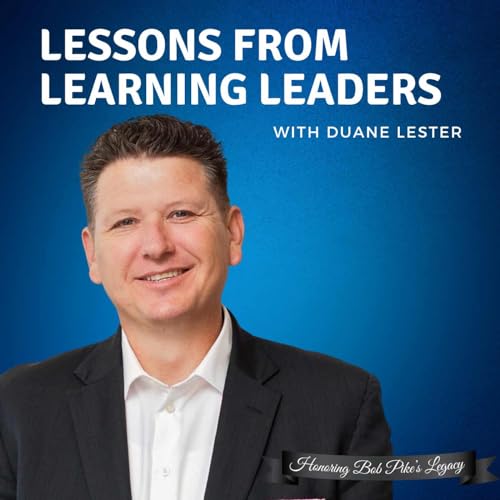
Lessons from Learning Leaders Titelbild

Lessons from Learning Leaders

Lessons from Learning Leaders

Von: Duane Lester
Jetzt kostenlos hören, ohne Abo

Über diesen Titel

Continuing the legacy of his partner, Bob Pike, Duane Lester talks with leaders in the performance improvement industry about lessons they learned in decades of training.

lessonsfromlearningleaders.substack.comDuane Lester
Ökonomie
  • Episode 33: Katrina Kennedy on the Crucial Art of Learning Transfer
    Nov 7 2025

    In this episode of Lessons from Learning Leaders, we chat with Katrina Kennedy—consultant, facilitator, and author of the new book, Learning That Lasts: Reflection Activities for Trainers and Designers.

    Katrina shares her accidental start in L&D, which began when her manager at the District Attorney’s office needed someone to train new staff for a reorganization: “Katrina, you can talk,” she was told. Over the past 28 years on her own, she discovered her passion for helping new trainers and subject matter experts (SMEs) design and facilitate powerful learning experiences.

    The Monumental Shift: It’s Not About You

    Katrina reflects on her journey from unknowingly “telling” to intentionally facilitating. Like many trainers, she initially had the mindset of an empty vessel ready to be filled. The monumental shift came during a conference session where she witnessed participants deeply interacting. She realized, “This is about them”.

    She reinforces that the number one rule of training is “It’s not about you”. This realization is freeing for SMEs, reducing their nervousness because they know the focus isn’t entirely on their performance. Instead, the goal is to impress the participants with their own discoveries.

    The Critical Failure Point: Learning Transfer

    Katrina joins the host in preaching the absolute importance of learning transfer. The host notes that training often fails after the classroom because the trainer considers their job done, and the manager assumes the training worked. If the training isn’t transferred to the field, performance isn’t improved.

    Katrina emphasizes that transfer success begins before the training, by ensuring the learning is aligned with organizational needs and securing buy-in from managers and participants.

    Common Transfer Failures:

    * Running Out of Time: Trainers pack too much content and neglect the vital time needed for reflection.

    * No Support: Pushing people out the door without follow-up, supportive nudges, or an accountability partner.

    The Phlebotomist Test: Practice Over Content

    To shake the mental model that training is only about the transfer of information, Katrina uses a memorable story:

    If you are going to have blood drawn, do you want the phlebotomist to have a lot of content knowledge, or do you want them to have practiced and reflected on what they’re doing?

    The clear answer (practice!) reinforces the need to give people time to practice and receive feedback.

    Katrina’s book, Learning That Lasts, is a practical reference guide with research-backed reflection activities that help ensure learning transfers to the workplace.

    Key Takeaways

    * Rule #1: It’s not about you: The most profound shift for a trainer is realizing the job is to facilitate their learning, not show off your knowledge.

    * Transfer is a Trainer’s Responsibility: If you slack on the transfer strategy, the entire training fails because you haven’t improved performance.

    * Reflection is Not an Afterthought: Time must be intentionally designed into the session for practice and reflection.

    * Practice is Paramount: Use the phlebotomist test to prove that practice and reflection are superior to content volume.

    Katrina Kennedy’s Book and Contact:

    * Book: Learning That Lasts: Reflection Activities for Trainers and Designers

    * Contact: Connect on LinkedIn or visit katrinakennedy.com.


    Get full access to Lessons from Learning Leaders at lessonsfromlearningleaders.substack.com/subscribe
    Mehr anzeigen Weniger anzeigen
    27 Min.
  • Episode 32: An Apology and an Essential Lesson: Don’t Fall into the Expert Trap
    Oct 31 2025
    A Note from the Host: Please accept my sincere apology for the audio quality on my end of this recording. Despite buying new equipment to improve the audio quality, I made a rookie mistake. I didn’t look at my own audio levels before recording and didn’t notice my four-year-old maxed out the volume on my mixer. Despite my best efforts to fix it in post-production, my audio is unfortunately quite distorted. Justin Hunsaker’s audio is perfect, and that is where the real value lies. I ask you to forgive my technical error and embrace the fantastic communication insights Justin shares. The lesson he delivers on clarity and audience focus is one I clearly need to re-learn!The Expert Trap: How Your Knowledge Can Sabotage Your TrainingHow do you go from being a software engineer to an executive communication coach? For Justin Hunsaker, it was realizing that the through-line of all success is communication.Justin, the author of Presentation Pitfalls, joins us to discuss his upcoming presentation at the Training Conference and Expo: “The expert trap: how knowing too much can sabotage your training and presentations”.The “expert trap” is defined as when presenters focus on their expertise rather than what their audience needs to learn, resulting in a message that never completely gets conveyed. Justin emphasizes that in communication, your audience comes first.Spock vs. Kirk: The Emotional vs. Logical VoiceJustin suggests everyone has two voices in their head: the Mr. Spock (logical, sequential, data-oriented) and the Captain Kirk (emotional, storytelling). The expert trap is relying solely on Mr. Spock.To avoid this, Justin recommends:* Start with a story to get emotional engagement (Captain Kirk).* Introduce facts and logic (Mr. Spock) to provide credibility and confidence that you’ve done the expertise work.* End with the story.This approach works because people buy with emotion and justify with logic. Storytelling is much more primal to the human experience than a sequence of facts, making information stickier.The Signal to Noise Ratio: Cutting the FatExperts often feel everything they know is important and needs to be included, but this creates noise that distracts the audience from the three most important facts they should remember.Justin and his partner’s four-part presentation framework includes Reduce Noise. If an expert can’t explain when a piece of information will be valuable to the learner, it becomes noise that should be put in a handout or an appendix. He advises using the military’s BLUF (Bottom Line Up Front) framework to flip a history-lesson approach upside down and lead with the most important answer.Tools for the Modern CommunicatorJustin is excited about how AI (Large Language Models) can help experts communicate better. He suggests asking a large language model to generate 10 analogies for a complex topic, allowing the expert to quickly select the most resonant one for their audience.The Platinum Rule of PresentationsJustin teaches that presentation design is a function of your audience, your purpose, and your setting—the presenter is not included. This reinforces the number one rule of training: It’s not about you.The 3F Framework for Instant PresenceAs a final tip, Justin shares the 3F Framework for leveling up your communication in just three minutes before any important conversation:* Facts: Write down the three facts you want your audience to remember.* Feelings: Write down the feelings you and your audience have going into the conversation.* Follow-ups: Write down what you promise to do after the conversation, and what you want your audience to promise to do.Key Takeaways* Audience First: The expert trap is focusing on what you know instead of what the audience needs to learn. The design of your training should focus on the audience, purpose, and setting—not the presenter.* Embrace Emotion: People make decisions based on emotion and justify them with logic. Start with a story (emotion/Captain Kirk) before providing data (logic/Mr. Spock).* Reduce Noise: Cut extraneous information that is only a “history lesson” of your journey. Use the BLUF (Bottom Line Up Front) approach to prioritize the most important answer.* The 3F Level Up: Spend three minutes before any meeting writing down the three desired Facts, the related Feelings, and the planned Follow-ups to increase your leadership presence.Justin Hunsaker’s Book and Contact:* Book: Presentation Pitfalls* Contact: Find Justin on LinkedIn (he’s the one with the book in the background!). Get full access to Lessons from Learning Leaders at lessonsfromlearningleaders.substack.com/subscribe
    Mehr anzeigen Weniger anzeigen
    31 Min.
  • Episode 31: The Gift of the Pebble in Your Shoe
    Oct 24 2025

    What if the most annoying part of a long hike—a pebble in your shoe—was actually your greatest asset as a trainer?

    On this episode of Lessons from Learning Leaders, we welcome Jeff Weaver—director of training at J.J. Taylor Companies for 15 years and now founder of A Pebble in Your Shoe Consulting. Jeff is sharing his philosophy (and presentation title) that challenges how we think about behavior change and learning.

    Jeff’s journey started at Polk County schools and took him through Disney and Target, experiences that shaped his unique approach to L&D. He argues that to get people to change their behavior, you need a catalyst for change—something that can’t be ignored. That, he explains, is the gift of the pebble.

    Tune in to discover:

    * The Power of Pleasant Uncomfortableness: How to intentionally design moments that force learners to stop and fix a problem.

    * The Disney First Impression: Jeff shares a brilliant training technique he learned at Disney that uses a seemingly unprepared start to create a lasting, emotional lesson on preparation.

    * Marketing Your Learning: Why L&D professionals should think of training like product marketers, using branding and jingles to create cultural touchstones that stick.

    * The CEO Question: Are you worried about being “too silly” in front of executives? Jeff has a perfect answer for why you should facilitate for fun and effectiveness, no matter who’s in the room.

    Don’t miss Jeff’s session, “The gift of the pebble in your shoe,” at the 2026 Training Conference and Expo, where he’ll also be running the Podcasting Lab.

    Key Takeaways

    * Pebble = Catalyst: A “pebble in your shoe” is a metaphor for a necessary, uncomfortable catalyst that forces behavior change.

    * Emotion Drives Memory: Memorable training is often emotional and action-oriented, hitting a place beyond just logic.

    * Branding Works: Use advertising and marketing techniques—like jingles and catchphrases—to make core concepts un-ignorable cultural touchstones that stick long after training ends.

    * Challenge Traditional L&D: Broaden your view of training beyond traditional adult learning theories to incorporate the powerful tools of entertainment and marketing.

    Jeff Weaver’s Consulting:

    * A Pebble in Your Shoe Consulting


    Get full access to Lessons from Learning Leaders at lessonsfromlearningleaders.substack.com/subscribe
    Mehr anzeigen Weniger anzeigen
    30 Min.
Noch keine Rezensionen vorhanden