Kinwise Conversations in AI Titelbild

Kinwise Conversations in AI

Kinwise Conversations in AI

Von: Lydia Kumar
Jetzt kostenlos hören, ohne Abo

Über diesen Titel

Artificial intelligence is here: powerful, fast-evolving, and reshaping how we learn and teach. But how do we integrate these tools with intention? How do we ensure they amplify our humanity rather than overshadow it?

Kinwise Conversations dives into these questions every week with educators, principals, district leaders, and learning innovators. We explore real stories: the wins, wake-up calls, ethical crossroads, and practical strategies for using AI wisely in education.

Season 1 focused on AI and the future of work. Season 2 spotlights AI and education—how teachers and students are engaging with AI, how schools are rethinking learning, and how we can prepare students for an AI-powered future while keeping education deeply human.

If you’re an educator, school leader, or simply curious about using technology with more intention, this podcast is for you. Subscribe now and explore more at kinwise.org.Copyright 2025 All rights reserved.
Philosophie Sozialwissenschaften
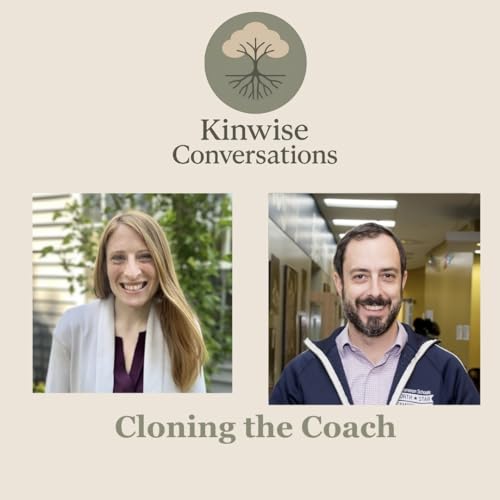
  • Cloning the Coach: Friction, Feedback, and the 22% Jump
    Feb 18 2026

    Scott Kern, a veteran AP US History teacher at North Star Academy, didn't enter the AI world looking for a shortcut. Instead, he sought a way to solve the "great sadness" of teaching: the fact that there is only one of him and thirty students who all need a mentor at the exact same moment. By building custom "feedback bots" that mirror his own instructional voice, Scott managed to do what was previously impossible. He scaled his presence, leading to a career-high pass rate on the AP exam.

    In this episode, we dive into the vital distinction between "logistical friction" (the stuff we want to automate) and "academic friction" (the productive struggle where learning actually happens). Scott shares the philosophy behind his school's new "AI Driver’s License" pilot and explains why the first week of an AI literacy course should involve no technology at all. This is a conversation about maintaining agency in an automated world and ensuring that when we "flip the AI switch," it’s to illuminate the path, not to walk it for our students.

    Key Discussion Points:

    • The "Cloned" Educator: How Scott used custom bots to provide 1-on-1 coaching to every student simultaneously, resulting in a 22% increase in AP pass rates.

    • Process Over Product: Moving the grading focus from the final essay to the number of meaningful revisions a student makes alongside an AI coach.

    • The AI Driver’s License: Why North Star Academy is teaching seniors to be "drivers rather than passengers" by focusing on ethos and agency over specific prompting tools.

    • The Historian’s Perspective: Looking at the exponential pace of AI change through the lens of human history and previous technological pivots.

    Mehr anzeigen Weniger anzeigen
    40 Min.
  • The Pocketbook Problem: Why We Need Diverse Architects in the Age of AI
    Feb 4 2026

    If you walked into a high school classroom and saw a teacher running daily stand-ups and communicating via Slack, you might think you’d stumbled into a tech startup. For Ivanna Gutierrez, that blur between education and industry is exactly the point. A former software consultant turned educator, Ivanna experienced a surreal "full circle" moment when she returned to teach at the very high school she graduated from, even finding her own name scribbled in the textbooks. Now, as the Director of High School & Career Related Programs at the Dottie Rose Foundation, she is on a mission to ensure that girls and underrepresented students don't just survive computer science classes, but thrive in them.

    In this episode, we explore the tension between "vibe coding" and rigorous logic, and why knowing why code works matters more than ever in the age of ChatGPT. Ivanna shares how she uses AI not as a cheat code, but as a bridge to build confidence for students who often decide as early as fifth grade that "math isn't for them." From the "pocketbook problem" in car design to the necessity of personal branding, this conversation is a masterclass in moving students from being passive consumers of technology to becoming the active creators of our future.

    Key Discussion Points:

    • The "Pocketbook Problem" in Design: Ivanna uses the lack of storage for purses in cars as a prime example of why we need diverse creators: if you aren't at the table, your needs, and your perspective, aren't in the product.

    • Corporate Realism in the Classroom: Why treating students like employees (using Slack, stand-ups, and "Googling it") prepares them for the workforce better than traditional rote memorization.

    • Bridging the Confidence Gap: Addressing the heartbreaking reality that many girls opt out of STEM by 5th grade, and how mentorship can interrupt that narrative.

    • AI as a "Soundboard," Not a Solution: How to teach students to use generative AI for debugging and brainstorming without sacrificing the development of deep logical thinking skills.

    • Beyond the Code: The critical importance of "soft skills," networking, personal branding, and portfolio building, in an era where technical skills are increasingly automated.

    • Consumer vs. Creator: The vital shift students must make to ensure they are shaping the tools of tomorrow rather than just being shaped by them.

    Mehr anzeigen Weniger anzeigen
    39 Min.
  • Re-Architecting Education for a Pro-Human AI Future with Babak Mostaghimi
    Jan 28 2026

    Join us for an inspiring conversation with Babak Mostaghimi, Founding Partner at LearnerStudio and the former Assistant Superintendent who led Gwinnett County Public Schools' pioneering AI readiness initiative. Babak guides us through the necessary shift from using AI merely to make broken systems faster, to using it as a tool that unlocks human potential. He shares LearnerStudio’s "Three Horizons" model of innovation, explaining why schools are stuck in an industrial past and how we can re-architect them for a future focused on life, career, and democracy.

    We dive into practical strategies, like the difference between "snorkeling" and "scuba diving" in AI literacy, and why we must "Marie Kondo" our curriculum to make space for what truly matters: our shared humanity. From 7th graders using AI to tackle food insecurity to teachers building their own feedback bots, this episode offers a compelling vision for how we can ensure technology serves the human experience rather than replacing it.

    Key Discussion Points:

    • Pro-Human AI: Babak’s argument against using AI solely for efficiency, "Nobody likes the current system. Why are we making it faster?" and the case for using tools to unlock creativity and connection.

    • The Three Horizons Model: A framework for understanding education's evolution from the industrial model (Horizon 1) to the efficiency/equity movement (Horizon 2), and finally to a learner-centered ecosystem (Horizon 3).

    • Marie Kondo-ing the Curriculum: The necessity of clearing out antiquated content standards to create the psychological safety and time for relationship-driven, real-world learning.

    • Snorkeling vs. Scuba Diving: Why AI readiness cannot be a niche magnet program but must be a universal skill set that allows every student to navigate ("swim"), explore ("snorkel"), or deeply master ("scuba dive") the technology.

    • Agency in Action: Real-world examples of students and teachers taking control, including a 7th grader using the Inkwire tool to investigate food insecurity and educators designing bespoke feedback agents with PlayLab.The Three Horizons of Learning: A Conversation with Babak Mostaghimi

    Mehr anzeigen Weniger anzeigen
    42 Min.
Noch keine Rezensionen vorhanden