History Has a Voice Titelbild

History Has a Voice

History Has a Voice

Von: Smile and Learn
Jetzt kostenlos hören, ohne Abo

Über diesen Titel

Hop aboard our time machine and join us on an impossible mission: to have face-to-face interviews with people who changed the world. From Frida Kahlo to Miguel de Cervantes, Cleopatra to the genius Da Vinci. But we don't just talk to celebrities; we also give a voice to those who have been forgotten. What did a Neanderthal think? How did a Roman woman live in Hispania? What did a medieval knight play as a child? In this 12-episode season, you'll discover their childhoods, their best-kept secrets, and hilarious anecdotes that don't appear on school exams. Press play and begin the journey.Smile and Learn
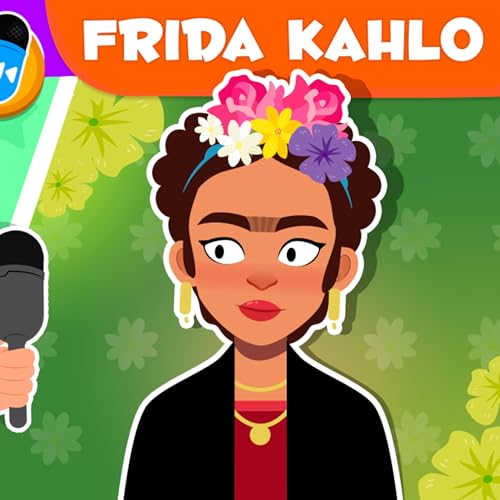
  • Frida Kahlo 🌺 History for Kids 🎙️ Episode 12
    Jan 26 2026

    Funded by the Spanish Ministry of Culture - European Union - NextGenerationEU.
    An educational podcast for children in which we travel to early 20th-century Mexico, specifically to the Blue House in Coyoacán, to meet one of the world's most iconic artists: Frida Kahlo. In this episode of “History Has a Voice,” we will discover how she turned her life and pain into works of art full of color and strength.
    Frida was a woman with a rebellious spirit who, despite suffering from polio as a child and a serious bus accident that forced her to stay in bed for a long time, never gave up. Thanks to a mirror placed above her bed and a special easel, she began to paint self-portraits, capturing her emotions and demonstrating that creativity can heal the soul.
    Proud of her roots, she brought Mexican culture to the world (from Paris to New York) through her traditional clothing and her paintings, which often featured animals such as monkeys and parrots. She will explain the meaning of her famous phrase: “Feet, why do I need them when I have wings to fly?”
    In this episode, we will understand why she claimed to have been born in 1910 (the year of the Revolution) instead of her actual date of birth, meet her spider monkey Fulang-Chang, and learn to see the beauty in difference. An emotional journey to understand the value of authenticity and resilience.
    A very useful and interesting resource for children. It is perfect for introducing 20th-century art in primary education, working on emotional intelligence and coping with adversity, and appreciating the richness of Mexican culture.

    Mehr anzeigen Weniger anzeigen
    11 Min.
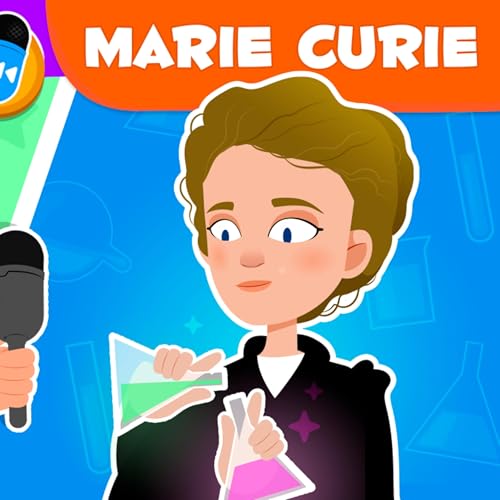
  • Marie Curie 🧪 History for Kids 🎙️ Episode 11
    Jan 26 2026

    Funded by the Spanish Ministry of Culture - European Union - NextGenerationEU.
    An educational podcast for children in which we travel back in time to 1920, to a laboratory full of formulas and test tubes, to meet the most important scientist in history: Marie Curie. In this episode of “History Has a Voice,” we'll put on our white coats to discover how her brilliant mind revolutionized physics and chemistry.
    Marie Curie, born Maria Skłodowska in Poland, had to face great injustices, as women in her country were not allowed to go to university. She will tell us how she studied in secret at a “clandestine university” and the pact she made with her sister to be able to travel to Paris, where she finally graduated from the Sorbonne and met Pierre Curie.
    Together with her husband, she researched mysterious minerals and discovered two new elements: polonium and radium, coining the term “radioactivity.” She was the first woman to win a Nobel Prize (and the first person to win two in different disciplines!), although her unprotected experiments put her health at risk.
    In this episode, we will learn what radioactivity is, discover the legacy of her daughter Irène (also a Nobel Prize winner), and reflect on her famous quote: “Nothing in this world should be feared, only understood.” An inspiring journey to encourage boundless curiosity.
    A very useful and interesting resource for children. It is perfect for introducing modern science in primary education, encouraging STEM vocations (especially in girls), and working on values such as effort, perseverance, and equality.

    Mehr anzeigen Weniger anzeigen
    10 Min.
  • Velázquez 🖌️ History for Kids 🎙️ Episode 10
    Jan 26 2026

    Funded by the Spanish Ministry of Culture - European Union - NextGenerationEU.
    An educational podcast for children in which we travel back in time to 1656 to visit the Spanish Golden Age and meet one of the greatest painters in Spanish history: Diego Velázquez. In this episode of “History Has a Voice,” we will land in the court of Madrid to talk to the creator of "Las Meninas."
    Velázquez was born in Seville in 1599 and began training in the art of painting at the age of 11. His talent was so extraordinary that he became the official painter of King Philip IV. But he didn't just paint portraits of royalty; he also painted jesters, ordinary people and even slaves with great dignity, encouraging the world to see them in a more favorable light.
    In this episode, we will delve into the secrets of "Las Meninas," an immense work in which he painted to assert that artists are not mere craftsmen, but creators. He will explain how he achieved that effect of “reality” that makes the viewer feel part of the scene.
    We will also learn the moving story of Juan de Pareja, his assistant and slave, whom Velázquez granted his freedom and painted with great nobility. An inspiring journey to learn how to find beauty in everyday life and look at others with respect.
    A very useful and interesting resource for children. It is perfect for introducing Baroque art in primary education, fostering artistic appreciation, and working on values such as human dignity and equality.

    Mehr anzeigen Weniger anzeigen
    11 Min.
Noch keine Rezensionen vorhanden