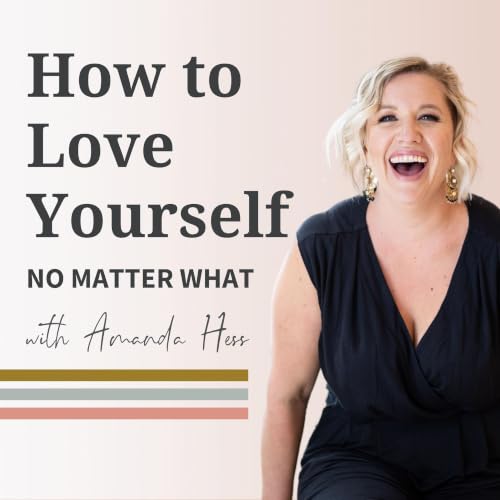
How To Love Yourself No Matter What Titelbild

How To Love Yourself No Matter What

How To Love Yourself No Matter What

Von: Amanda Hess: Certified Life Coach for women ready to heal past hurt and finally thrive
Jetzt kostenlos hören, ohne Abo

Saisonale Sparangebote | 0,99 € pro Monat für die ersten 3 Monate

Danach 6,99 €/Monat. Bedingungen gelten. Monatlich kündbar.
You're still replaying that conversation from six days ago. The one where you said the wrong thing, or said nothing at all, and you've been rewriting it in your head ever since. You've read the books. You've listened to the podcasts. You've taken the advice, and you're still lying awake at 11pm running the tape back. Here's what nobody tells you — you can't think your way out of overthinking. Not when your nervous system is still convinced that if you just analyze it hard enough, you'll finally get it right and nobody will be disappointed in you. You learned that somewhere. You were probably very young. And it worked, which is exactly why it's so hard to put down. This podcast is for overthinkers who are done holding it all together and ready to feel at home in their own skin. The women who are smart and capable and self-aware, and still can't shake the feeling they're surviving instead of living. Each week, Amanda Hess, Certified Life Coach and straight-talking deep-feeler, shares honest coaching, personal stories, and practical tools to help you: Get out of your head and into your life Stop managing your emotions like a full-time job Quiet the replay without white-knuckling it Build self-trust that lasts Live on your terms — without apology You're not broken and you're not behind. You've just been doing it alone, with a brain that never shuts off and nobody showing you what to do with it. Come listen. You'll hear yourself in every episode — and find out how to love yourself no matter what. 📅 New episodes every Thursday.2025 How To Love Yourself No Matter What Alternative & Komplementäre Medizin Hygiene & gesundes Leben Persönliche Entwicklung Persönlicher Erfolg Seelische & Geistige Gesundheit
  • S2 E3. Overthinking Your Teens and Adult Kids? Let Go, Grieve, and Love Them Anyway
    Oct 22 2026

    Letting go of your kids is a skill, and nobody teaches it to you. When they’re small, their survival is your job, so you learn to watch everything, manage everything and fix everything. Then they grow up, the job changes slowly, and your brain keeps doing the old one anyway.

    In this episode I talk about why your teenagers and adult children take up so much space in your head, and what to do about it. Seven women told me this week that their relationship with their adult kids is the heaviest thing on their mind. I walk through the two things that have to happen at the same time: learning to let go of what they do and how they do it, and learning to grieve the role you’re losing. I also talk about why the overthinking is really just fighting the feeling, and why unconditional love is a renewable resource with no downside, even when you’re holding a boundary.

    I have a 19-year-old and a 16-year-old, so this isn’t theory for me. I still remember bringing my first baby home and realizing there was no quitting this job. My kid was up at the crack of dawn, so I was up at the crack of dawn, even after feeding him all night. Becoming a mom is what cracked me wide open and sent me looking for a different way to deal with my emotions. Learning to let go of that role has been just as big as taking it on.

    Key Takeaways:

    Letting go is a skill you build, not something you should already know how to do.

    You grieve the role you had with your kids, and that grief is yours to feel, not theirs to fix.

    Overthinking is your brain fighting a feeling it doesn’t want to feel.

    Your kids are not a reflection of you. They’re their own people with their own brains.

    What you think and the energy you bring matter more than what you say.

    Unconditional love doesn’t mean letting anyone walk all over you.

    If this one hit home, come to my free class, Stop Overthinking. I run it every week and show you exactly how to stop the replaying. And if you want to talk about what’s going on with your own kids, book a free discovery call with me. We’ll look at your situation, put a plan together, and see if coaching is the right fit.

    Links referenced in this episode:

    https://amandahess.ca/overthink

    https://amandahess.ca/bookacall

    Mehr anzeigen Weniger anzeigen
    27 Min.
  • 334. You Don’t Need to Calm Down. Your Brain Needs a Different Job.
    Oct 15 2026

    If you’re an overthinker, you’ve probably been told to calm down, think more positively, or learn to meditate. I don’t think that’s what’s missing. Your brain is a workhorse. It wants to work, and if you don’t give it something to do, it’s going to go find problems. And it will always find them.

    In this episode I talk about why your survival brain goes looking for danger when there isn’t any real danger in your day-to-day life, and how it ends up locking onto the dirty look, the text your kids didn’t answer, the thing you said 20 years ago, and every what-if about the future. I talk about why taking everything off your plate isn’t the answer, and the counterintuitive approach I use with my clients instead: giving your brain a hard job to do that has nothing to do with anything.

    I also share a conversation I had with my husband about the fact that some people don’t have a voice in their head. He doesn’t. He was shocked to find out that some of us have a narrator running all day long. And I talk about why I lift heavy, why I figure skate as an adult, and why I’m learning to play the guitar this fall.

    Key Takeaways:

    Your brain is built to look for danger, and when it can’t find real danger, it creates problems to solve.

    There is no version of taking everything off your plate. The complexity in your life is also the richness of your life.

    Seeing more bad news doesn’t mean the world is more dangerous. It means your input has gone up.

    You don’t need to think the right thing. You need to give your brain a better job to do.

    A hard job that has nothing to do with your kids, your husband, or your work lets your brain put everything else down for a while.

    When your brain gets that rest, you’re more regulated and you have more logic available to deal with the real problem.

    I’m teaching a live class every week called Stop Overthinking, where I walk you through this along with every other piece of the process for stopping that anxious looping. Go to amandahess.ca/overthink to register. Come live if you can, you’ll get the most out of it. If you can’t, you’ll get the recording. And this week, pick one hard thing that has nothing to do with anything, and go do it.

    Links referenced in this episode:

    https://amandahess.ca/overthink

    Mehr anzeigen Weniger anzeigen
    13 Min.
  • 333. Why You Can't Control Your Emotions (and How to Be Their Boss Instead)
    Oct 8 2026

    A few weeks ago I got a no. I applied for something I really wanted, something that would have been a big deal for me and my business, and I didn't get picked. I'm not going to tell you what it was because it doesn't matter. What matters is what happened in the 4 seconds after I read the email, when my brain was off and running with every reason I wasn't good enough and every argument for making myself smaller so it would never happen again. That moment is what this episode is about. Not the no. What you do with the feeling that shows up right after it.

    In this episode I talk about the lie we've all been told, that emotions are something you can control, and what to do instead. I walk you through the reframe that landed for me driving in my car: your emotions are employees you don't get to fire. They show up to every meeting whether you hired them or not. You're their boss, but being the boss has never meant getting rid of them. It means respecting them, knowing them by name, understanding where they're coming from and what they feel like in your body, and then deciding what you're going to do with what they're offering. I also talk about why your capacity for this will be lower when life is hard, and what being a good boss to your emotions actually requires of you.

    I use figure skating to show you how this works in real time, because I just competed less than a month ago and the adrenaline dumped into my body exactly the way it always does. Fear showed up and told me to run. I didn't argue with her and I didn't pretend she wasn't there. I said, of course you're here, let's go, and I used that energy for my jumps. Shaky arms, shaky legs, brain trying to devolve, and me in the middle of it going, no baby, dig in, where's the music, what's next. That's what being the boss looks like. It's the same thing my clients go through when they're dating and terrified of liking someone who won't like them back. Same emotion, same body, same job.

    Key Takeaways:

    You don't control your emotions. Nobody does. Every plan that starts with "I just need to stop feeling this" fails, and then you make the failure mean something about you.

    Your emotions are employees you can't fire. They're always on the team. Being the boss means leading them, not getting rid of them.

    Respect comes first, and respect means acknowledgement. You can't acknowledge a feeling you can't name, so get an emotions wheel and move past "anxious, sad, mad."

    Understand where it comes from (the thought or belief underneath) and what it feels like in your body. You can't lead someone you don't understand.

    Then decide. Is what this feeling is offering what we're going to use, in the way it's offered? If not, how are we going to redirect it? Fear becomes fuel. You go anyway.

    Being a good boss to your emotions means sleep, regulation, things that ground you, and getting support where you need it. Your capacity will be lower when life is hard, and nothing is going wrong when it is.

    If you're exhausted from overthinking and stress, come to my free weekly class. I'll teach you this concept and several others so you can start feeling at home in your own brain. Sign up at amandahess.ca/overthink. And come find me on Instagram at theamandahess and message me what you took away from this one. I'd love to answer your questions.

    Links referenced in this episode:

    https://amandahess.ca/overthink

    https://www.instagram.com/theamandahess

    Mehr anzeigen Weniger anzeigen
    22 Min.
adbl_web_anon_alc_button_suppression_t1
Noch keine Rezensionen vorhanden