• Christopher Dummitt on Canadian history in the Age of AI
    Feb 19 2026

    In this episode of History Matters, Allan Williams speaks with Professor Christopher Dummitt of Trent University about the events leading to Ontario’s 1954 Fair Accommodations Practices Act. The discussion examines the leadership of Hugh Burnett, the organized campaign against racial discrimination in Dresden, and the broader pre-Charter human rights movement in Canada. This period is frequently overshadowed by the 1982 Charter of Rights and Freedoms.

    The conversation also explores Professor Dummitt’s documentary series, Well, That Didn’t Suck!, including Episode 5, “The Right to Be Served,” which presents Burnett’s story for contemporary audiences. The episode reflects on the development of civil rights legislation in Canada, the influence of public advocacy on policy change, and the evolving tools historians use to communicate the past.

    Listeners interested in Canadian history, civil rights, and the historical foundations of present-day legal protections will find this discussion particularly relevant.

    Subscribe to History Matters for further conversations on the people, events, and ideas that have shaped Canada.

    Christopher Dummitt

    https://cihe.ca/

    Mehr anzeigen Weniger anzeigen
    36 Min.
  • Charlotte Gray on Canada’s national archives and ‘popular’ history.
    Jan 8 2026

    In this episode of History Matters, Allan is joined by Charlotte Gray, one of Canada’s best known and most prolific popular historians, for a wide-ranging conversation about how Canadian history is preserved, told, and understood today. We begin with the urgent and pressing issue of the future of Library and Archives Canada, which has experienced deep funding cuts, and now labours under privacy and access to information legislation so much more restrictive than in almost all other countries, that it has led to “the most unbelievable bureaucracy” such that access to government records and other documents can take months.

    The situation is so dire, says Charlotte, that it is actively preventing new Canadian history from being written: “The core purpose of Library and Archives Canada, which is to preserve our history, is really faltering.” From there, we explore Charlotte’s career as a biographer and storyteller. We explore her quest to tell stories from diverse perspectives and why she chose to foreground women’s lives, how popular history differs from academic history, and what we can learn about important figures like Mackenzie King, Winston Churchill, and Franklin D. Roosevelt, for example, by looking at the lives of their mothers. In answer to the question, what book would you recommend to our listeners? Charlotte cited The Valley of the Birdtail: An Indian Reserve, A White Town, and the Road to Reconciliation, by Andrew Stobo Sniderman and Douglas Sanderon (Amo Binashii).

    https://www.charlottegray.ca/

    https://cihe.ca/

    Mehr anzeigen Weniger anzeigen
    38 Min.
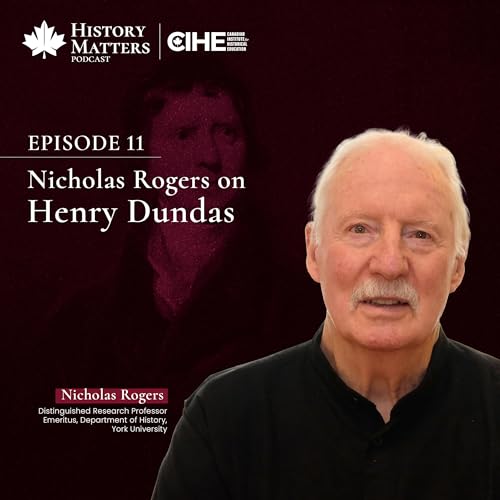
  • Nick Rogers on Henry Dundas
    Dec 24 2025

    In this episode of the Canadian Institute for Historical Education podcast, host Allan Williams speaks with distinguished historian Nicholas Rogers, Research Professor Emeritus at York University and author of numerous works on eighteenth-century Britain and the Atlantic world. The conversation centers on Rogers’s recent article in the Canadian Historical Review, “Toronto’s Dundas Imbroglio,” which examines the historical debates surrounding Henry Dundas, slavery, and public memory in Canada. (A free copy of the article is available upon request) The episode opens with a powerful moment from July 26, 1833, when news reached William Wilberforce that Britain had passed legislation to abolish slavery across much of the British Empire—just days before his death. Using this event as historical context, Rogers examines the complexities of abolition, Dundas's role, and how historical figures are remembered and contested today. This thoughtful discussion invites listeners to consider how history, commemoration, and contemporary values intersect.

    Nicholas Rogers

    https://www.linkedin.com/in/nick-rogers-21aab165/?originalSubdomain=ca

    https://cihe.ca/

    Mehr anzeigen Weniger anzeigen
    38 Min.
  • Christopher Dummitt on Responsible Government
    Dec 18 2025

    What if one of the most defining moments in Canadian democracy wasn’t Confederation, but a riot that burned Parliament to the ground in Montreal? In this episode of History Matters, I’m joined by Christopher Dummitt, professor of Canadian history at Trent University and host of the acclaimed podcast 1867 and All That.

    Together, we dive into the dramatic political turning points of the 1830s and 1840s, including the Rebellion Losses Bill, the rise of responsible government, and the tensions that erupted into the 1849 burning of Canada’s Parliament. Chris explains why the path to Canadian self-government wasn’t forged through rebellion alone, but through a hard-won shift toward Westminster-style democracy, political coalition-building, and the real test of whether elected leaders could govern without imperial interference.

    You’ll also hear unforgettable stories and key figures behind the era, Joseph Howe in Nova Scotia, Baldwin and Lafontaine in the Province of Canada, and Governor General Lord Elgin, whose decision to sign a deeply controversial bill helped define what democracy would mean in Canada.

    If you want to understand how Canada learned to govern itself, and why this period may matter more than Confederation, this episode is for you.

    Subscribe for more episodes of History Matters on YouTube, and check out Chris Dummitt’s work on 1867 and All That for a deeper dive into the story.

    Christopher Dummitt

    -------------------------------

    https://cihe.ca/

    Mehr anzeigen Weniger anzeigen
    38 Min.
  • Nigel Biggar and Margaret MacMillan in Conversation on Colonialism
    Dec 11 2025

    This episode is the second of two taken from a CIHE event held in March 2025 with Oxford Professor Nigel Biggar, recently appointed to the UK House of Lords, and Margaret MacMillan, Companion of the Order of Canada.

    This second part features the conversation between Lord Biggar and Professor MacMillan that followed his opening statement. They examined the moral complexity of empires, especially the British Empire, and the modern push to revise or erase elements of Canadian history. Margaret MacMillan calls for rigorous historical thinking, warning against using history as a political weapon or reducing it to moral judgment.

    https://cihe.ca/

    Mehr anzeigen Weniger anzeigen
    28 Min.
  • Nigel Biggar on Colonialism: A Moral Reckoning
    Dec 4 2025

    This episode is the first of two taken from a CIHE event held in March 2025 with renowned historians Professor Nigel Biggar, recently appointed to the British House of Lords and author of the 2023 book, Colonialism: A Moral Reckoning, and Professor Margaret MacMillan, Companion of the Order of Canada, and author of The Uses and Abuses of History, among many other books.

    In the first of two parts, Lord Biggar presents key arguments from his book Colonialism: A Moral Reckoning, challenging one-sided narratives that portray the British Empire as purely destructive. He outlines both the harms and the contributions of empires — including the abolition of slavery, legal institutions, and protection for minority groups — and urges a more balanced, evidence-based view of history.

    https://cihe.ca/

    Mehr anzeigen Weniger anzeigen
    31 Min.
  • Allan Levine on Canada’s ‘Dollar a Year Men’ in World War Two
    Nov 27 2025

    Did you know that in World War II, Canada’s “best business brains” traded Bay Street boardrooms in support of the country's war effort?

    In this episode of History Matters, I sit down with Winnipeg-based historian and author Allan Levine to talk about his new book, The Dollar a Year Men: How the Best Business Brains in Canada Helped to Win the Second World War (Barlow Books, 2025).

    We open with a gripping story from December 1940: C.D. Howe, E.P. Taylor, and other Canadian industrialists crossing a U-boat–infested Atlantic, only to see their ship torpedoed and still pressing on to London to negotiate urgently needed munitions for Britain.

    From there, Allan and I trace how a small, mostly agrarian country of just over 11 million people became the fourth-largest industrial power in the Allied war effort. We explore the rise of C.D. Howe as Minister of Munitions and Supply, the “dollar-a-year men” who left lucrative private-sector careers to serve, the creation of Crown corporations, and the “bits and pieces” subcontracting system that turned refrigerator and bicycle factories into producers of tanks, guns, and Lancaster bombers. Along the way, we talk about labour tensions, accusations of war profiteering, and how Mackenzie King’s cautious political genius coexisted with Howe’s bulldozing efficiency.

    We also zoom out to ask bigger questions: What does this wartime experiment in state–business partnership tell us about Canadian political culture, emergency powers, and the limits of parliamentary accountability? Why has this story been so neglected in mainstream Second World War histories? And what lessons—good and bad—might it hold for governments facing crises today?

    If you enjoy historically grounded conversations about Canadian politics, World War II, economic history, and the people behind the policy, this episode is for you.

    Allan Levine

    https://www.linkedin.com/in/allan-levine-90284869/?originalSubdomain=ca

    Mehr anzeigen Weniger anzeigen
    40 Min.
  • Sean Conway on Separate School Education in Ontario
    Nov 20 2025

    In this episode, host Allan Williams welcomes historian and former Ontario cabinet minister Sean Conway for a wide-ranging discussion that connects contemporary political decisions to their deeper historical roots.

    Conway reflects on the Ontario provincial election of 1985, which brought an end to the 42 year PC dynasty, and the unusual circumstances that led to his receiving official briefings on the “Separate School Funding” issue as much as six weeks before the Frank Miller government fell and Conway was sworn in as Minister of Education in the David Peterson government. The conversation also explores the longer constitutional backdrop, from the Union period in the 1840s to Confederation, and how denominational school rights shaped provincial and national politics well into the twentieth Century.

    Conway closes by sharing the family influences that led to his interest in Canadian history and recommending two books by Christopher Moore for listeners eager to learn more about Canada’s founding moment.

    Sean Conway is part of our Advisory Council.

    https://share.google/G9az9o9u3gliqKmoC

    https://cihe.ca/

    Mehr anzeigen Weniger anzeigen
    47 Min.