• Why AI exposes your Broken Organisations Language - Semantics is the new Software
    May 17 2026

    Brief: In this episode, we dive deep into a provocative argument: the most critical layer of your AI strategy isn't the software you buy, but the language your organization speaks. While most leaders are caught in a "technological weather event," paralyzed by which LLM or platform will dominate, author Moses Sam Paul argues that they are looking at the wrong layer.

    We explore the "Babel Incident" as a modern systems analysis, revealing how semantic divergence—where different departments use the same words to mean different things—acts as a silent cost center that triggers coordination collapse. We’ll discuss the vital distinction between a System of Record (which merely stores data) and a System of Vocabulary (which stabilizes what that data actually means).

    The episode outlines how AI acts as an amplification engine; it doesn't fix broken communication, it scales it. Listeners will learn about the eight-layer Vocabulary Stack—a structural framework to move from "linear leverage" (simple automation) to "compounding leverage" (true organizational coordination). If you want to build a durable moat in the age of AI, it starts by stabilizing your symbolic substrate: shared meaning.

    Mehr anzeigen Weniger anzeigen
    30 Min.
  • The Math of Management: Decoding the Hybrid Organization
    May 16 2026

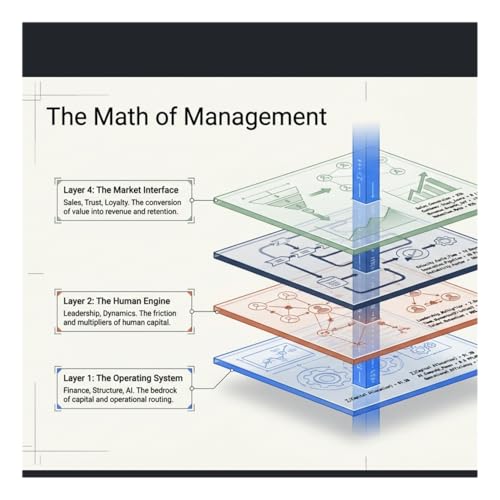
    This series explores a comprehensive "playbook" of 100 strategic equations designed to transform abstract organizational challenges into quantifiable tools for executive decision-making. Rather than treating leadership and culture as purely intuitive, the discussion dives into the "organizational physics" of the modern workplace, utilizing formulas to identify bottlenecks and maximize team impact.

    Key themes covered in the episodes include:

    • Quantifying the Intangible: How formulas like the Trust Multiplier and the Trust Equation can calculate the "dividend" or "tax" that credibility and reliability place on execution speed.
    • The Physics of Workflow: Applying Little’s Law and Flow Efficiency to manage work-in-progress (WIP), reduce lead times, and prevent process saturation in product development.
    • Managing Human Dynamics: Decoding the compounding power of Grit (Achievement = Talent × Effort²) and the quadratically increasing burden of Communication Overhead as teams grow.
    • Strategic Growth and Efficiency: Analyzing the financial health of hybrid firms through the Burn Multiple, SaaS Magic Number, and the 3M New-Product Revenue Ratio to ensure innovation translates into sustainable revenue.
    • The Future of Operations: Assessing AI Readiness and Automation ROI to gauge how effectively an organization is integrating emerging technologies into its core processes.

    The podcast serves as a guide for leadership off-sites, org-design audits, and strategic planning, emphasizing that these equations are not just math problems but heuristics for building high-leverage, resilient organizations

    Mehr anzeigen Weniger anzeigen
    19 Min.
  • The Architecture of Ambition: Why Culture is the Final AI Moat
    May 15 2026

    In a world where AI models are converging and product advantages can collapse in mere months, the visible parts of company-building—interfaces, features, and even technical velocity—have become cheap to imitate. The real battlefield has shifted from what you build to how you are built.

    This episode explores the concept of “Organizational Invention,” the idea that the most enduring companies aren't just vehicles for profit, but new kinds of institutions that make new kinds of people possible. We dive into how trailblazers like OpenAI and Palantir created unique organizational "shapes" that allowed specific types of talent to express themselves in ways traditional corporate structures never could.

    Key topics we cover:

    • The Identity War: Why the best companies don’t just compete on salary, but on identity, offering ambitious people a language for their own potential.
    • The Shape of the Moat: How the way you distribute authority, concentrate judgment, and organize ambition becomes a compounding system that no competitor can reproduce.
    • Emotional vs. Structural Promises: A critical look at the "dangerous promises" made to high performers—and why there is a massive difference between being “chosen” (feeling special) and being “seen” (having real structural power and ownership).
    • The Founder’s Ultimate Question: It’s no longer about the product roadmap; it’s about asking, “What kind of person can only become themselves here?”.

    Join us as we break down why the next generation of legendary companies won't be defined by their algorithms, but by the unique human structures they build around them

    Mehr anzeigen Weniger anzeigen
    13 Min.
  • The Intelligence Layer: Jack Dorsey’s Blueprint for the AI-First Organization
    May 14 2026

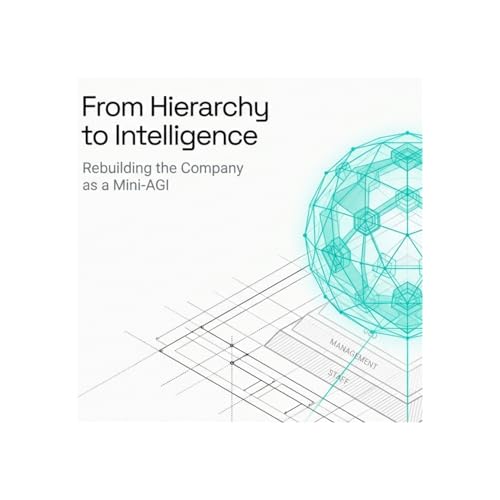
    Brief: In this episode, Jack Dorsey breaks down his radical manifesto, "From Hierarchy to Intelligence," which outlines a fundamental shift in how organizations should be structured in the age of AI. Dorsey argues that traditional corporate hierarchies were originally designed as a "lossy" way to manage information flow at a human scale, but today, every digital artifact a company creates—from Slack messages to code—can be synthesized into a central intelligence layer. By placing a model on top of this data, a company can operate as a "mini-AGI," making the entire organization completely legible and searchable for everyone from the CEO to the newest hire.

    The discussion explores Block’s transition toward this "circular" model, which involves stripping away layers of middle management to reach a maximum depth of only two or three people. Dorsey defines a new, leaner structure consisting of only three roles: Builders/Operators (ICs) who use AI agents to 10x their reach, DRIs who own customer outcomes and strategy, and Player Coaches who build human capacity by doing the work alongside their teams.

    A central theme is the removal of the product roadmap as a limiting factor; Dorsey envisions a system where customers can query for features that don't yet exist, and the company’s "intelligence" composes them in real-time. This shift moves the CEO's role away from "manager mode" and toward architecting the company’s intelligence and applying human judgment, taste, and creativity to ensure the system remains aligned with the company's values and customer needs.

    Mehr anzeigen Weniger anzeigen
    24 Min.
  • The Great Interface Collapse: Navigating the Convergence Thesis
    May 13 2026

    Podcast Brief

    Overview: This episode explores the core findings of the report, "The Convergence Thesis in the AI Age," which argues that we are entering a period where the boundaries defining our work, our institutions, and our financial systems are structurally dissolving. We move beyond the hype to examine where these "convergences" are actually happening—backed by measurable data—and where they remain speculative "noise".

    Key Discussion Segments:

    • Segment 1: The End of the Silo. We dive into why organizations are merging marketing, sales, and finance into "Revenue Operations" (RevOps). We discuss "role compression," where AI doesn't just replace workers but turns them into "generalists with AI," and why "platform engineering" is replacing the old "full-stack" developer dream.
    • Segment 2: Money and Identity at Machine Speed. Forget the crypto-versus-fiat debate. We look at the "hybrid settlement architecture" where regulated tokenized deposits and stablecoins are becoming the new rails for moving value. We also explore the "Live Identity Graph"—the move toward portable, verifiable digital wallets that could replace everything from your passport to your university degree.
    • Segment 3: The Rise of "Community" Institutions. The traditional line between the state and the market is blurring. We look at "Digital Public Infrastructure" (DPI) and how community-governed data cooperatives and "polycentric" governance are becoming the new way to manage shared resources like identity and payments.
    • Segment 4: The 2035 Timeline. A practical look at the transition path ahead. What becomes standard by 2028, and why "governance" will be the scarcest resource in an automated world.

    Target Audience: Founders, CTOs, policymakers, and organizational designers looking to understand the structural shifts in the global economy over the next decade.

    Key Takeaways:

    • Convergence is about boundary reconfiguration: Tasks and governance are being integrated into fewer interfaces and continuous feedback loops.
    • Hybrid Agency is the New Default: Humans and AI will operate as interdependent team members, requiring new models for trust and accountability.
    • Signal vs. Noise: Real convergence requires more than a narrative; it needs operational advantage, infrastructure readiness, and institutional compatibility.

    Closing Thought: "If interfaces are collapsing, your organization’s story and its governance model are no longer 'soft' skills—they are your most critical infrastructure

    Mehr anzeigen Weniger anzeigen
    23 Min.
  • Significance of Labour Day in the age of AI - Debate!
    May 1 2026

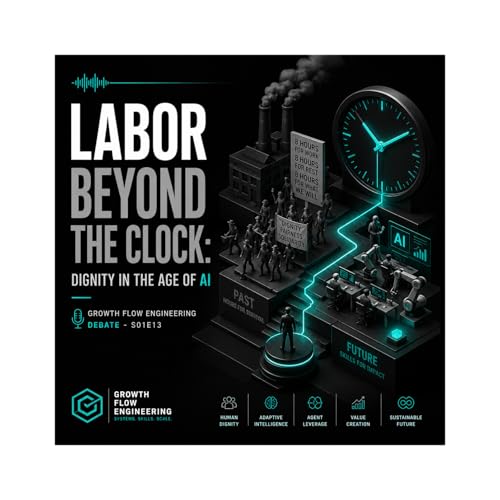
    The 19th century fought for the 8-hour day. The 21st century is fighting for the sovereignty of the human mind.

    Labor Day was born out of a brutal fact: industrial capitalism once ran on 16-hour shifts and child labor. The original movement wasn't just a lifestyle choice—it was a fundamental argument about what a human life is for.

    Today, the battlefield has shifted from the factory floor to the algorithm.

    We are moving into an era where the classic unit of labor—hours supplied by a human body—is being challenged by a new unit: human judgment amplified by machine execution. AI is no longer just replacing hand motions; it is invading the white-collar sentence and reshaping tasks within almost every occupation.

    As we look beyond the clock, the core conflict is no longer just labor versus capital. It is:

    • Operator vs. Algorithm: Who controls the workflow?
    • Architect vs. Executor: Who designs the systems we all live in?
    • Agency vs. Surveillance: Are we "agent bosses" or just data points for management telemetry?

    The future of work isn't just about "using AI." It’s about building a labor identity centered on diagnostic skill, workflow design, and human dignity.

    We’ve put together a deck exploring how we move from "time theft" to "task leverage" and why the struggle for dignity in the age of AI is the most important conversation of our time.

    Read more: https://www.linkedin.com/posts/mosessampaul_labour-day-in-the-age-of-ai-ugcPost-7455923577968820224-onuA?utm_source=share&utm_medium=member_desktop&rcm=ACoAAAH71PEB-YyDe8Qo-X795jUEtrdnz6y-29c

    #FutureOfWork #AI #LaborDay #GrowthFlowEngineering #DigitalDignity

    Mehr anzeigen Weniger anzeigen
    22 Min.
  • 12. KPI Architecture - The Language of Enterprise AI Transformation.
    Mar 14 2026

    This podcast introduces KPI Architecture, a rigorous framework designed to transform business metrics from vague narrative opinions into mathematical truths. By drawing parallels to historical navigational disasters and the precision of a mechanical chronometer, the author argues that effective metrics must be built upon standardised formulas, verifiable data sources, and clear ownership. This system eliminates the costly ambiguity of "vanity metrics" by enforcing a formula-first constitution where every tactical measure must explicitly predict a strategic outcome. Ultimately, the source serves as a guide for leaders to replace "forecast theatre" with a version-controlled schema that ensures measurement remains accurate, live, and immune to interpretive drift.

    Book: The Language of Enterprise AI Transformation.

    Author: Moses Sam Paul

    Partner at Growth Flow Engineering

    Contact: Content@GrowthFlowEngineering.xyz

    Mehr anzeigen Weniger anzeigen
    17 Min.
  • 11. Dual-Repository Architecture - The Language of Enterprise AI Transformation.
    Mar 13 2026

    This podcast describes the Dual-Repository Architecture, a structural method for protecting an organisation's core logic from the distorting influence of external communication. Drawing on historical and philosophical parallels like the Magna Carta and Vedic traditions, the author argues that truth must be structurally separated from authority to prevent the corruption of essential definitions and metrics. This is achieved by maintaining two distinct repositories: a private "Church" containing immutable mathematical truths and a public "State" dedicated to market-facing authority and lead generation. Information flows strictly in one direction through an automated hydration pipeline, ensuring that public-facing content remains a perfect, unalterable reflection of the underlying technical specifications. Ultimately, this architecture aims to eliminate semantic drift, ensuring that every internal agent and external stakeholder operates from a single, uncompromised source of truth.

    Book: The Language of Enterprise AI Transformation.

    Author: Moses Sam Paul

    Partner at Growth Flow Engineering

    Contact: Content@GrowthFlowEngineering.xyz

    Mehr anzeigen Weniger anzeigen
    24 Min.