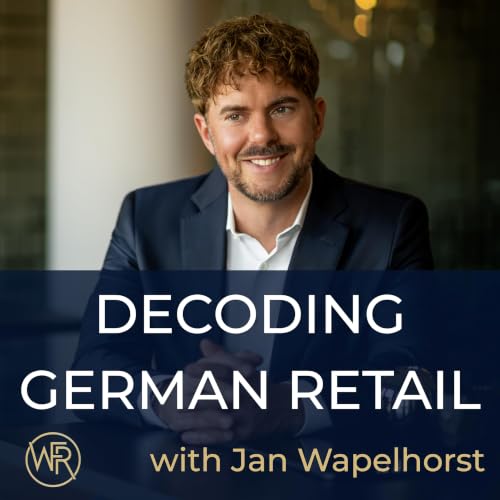
Decoding German Retail Titelbild

Decoding German Retail

Decoding German Retail

Von: Jan Lars Wapelhorst - WFR Advisory
Jetzt kostenlos hören, ohne Abo

How global brands win in European trade.

Starting with Germany's toughest market.

What does it really take to get your product listed in German grocery retail? And what can the German market teach you about winning across Europe?

The German grocery market is worth over 250 billion euros, controlled by five retail groups, and governed by unwritten rules that most international brands never learn — until it's too late.

Decoding German Retail is hosted by Jan Wapelhorst, former buying director at EDEKA, REWE, and Lidl. After 16 years on the other side of the table, he now helps international food manufacturers navigate the complexities of German retail — from Category Management and listing negotiations to pricing architecture and trade spend.

Each episode decodes one specific mechanism of the German market. No theory, no fluff — just the insider perspective that buyers never share openly.

Whether you're planning your market entry, preparing for a buyer meeting, or trying to understand why your product keeps getting rejected — this podcast gives you the answers you won't find anywhere else.

New episodes bi-weekly.

Website: wfr-advisory.com

Contact: info@wfr-advisory.com

LinkedIn: Jan Wapelhorst

Author: Jan Wapelhorst

Language: English

2026 Jan Lars Wapelhorst - WFR Advisory
Marketing & Vertrieb Ökonomie
  • SESSION 01: WAS SPIEGEL UND SPIELFELD EIGENTLICH IST
    Jul 14 2026

    Sommerreihe 2026, Folge 1 von 3

    Beschreibung

    Die Origin Story der Methodik. Frühjahr 2022, ein Termin in einer Handelszentrale mit einem internationalen Markenhersteller, der erstmals in Deutschland listen will. Der Vertriebschef gegenüber legt eine fantastische Präsentation vor. Jan Wapelhorst sitzt dort als Einkaufsverantwortlicher und denkt nur einen Satz. Das ist alles nicht das, was ich sehe. Aus dieser Beobachtung heraus entsteht Jahre später Spiegel & Spielfeld, die Beratungsmethodik, die den deutschen Handel aus vier Perspektiven gleichzeitig anschaut.

    Nach außen. Nach innen. Auf den Punkt. Nach vorne. Vier Fragen, die zusammen ergeben, was im deutschen Handel wichtig ist, wenn eine Marke dort bestehen will. Jede Perspektive wird konkret erklärt, mit den Signalen, die im Einkaufsalltag zählen. Und dann die ehrliche Ansage, warum es genau vier sind. Drei wären zu wenig, weil die Vertriebs-Ebene fehlen würde. Fünf oder mehr wären zu viel, weil der Kunde sie nicht mehr im Kopf sortieren könnte. Vier passen auf eine Serviette.

    Am Ende der Folge steht der Kern der Beratungshaltung. Der deutsche Handel ist kein Markt, er ist ein System. Und wer in einem System bestehen will, muss aus vier Richtungen gleichzeitig auf sich schauen können. Sonst schaut das System auf ihn, und das ist selten angenehm.

    Companion Brief zur Reihe: insights.wfr-advisory.com

    Vernetze dich mit Jan Wapelhorst auf LinkedIn für regelmäßige Einblicke in den deutschen Handel.

    Website: wfr-advisory.com

    E-Mail: info@wfr-advisory.com

    Mehr anzeigen Weniger anzeigen
    16 Min.
  • EDEKA: The Federal Paradox as Overall Strength
    Jul 6 2026

    EDEKA is the largest grocery retailer in Germany. More than eleven thousand stores. Seventy-five billion euros in revenue. Twenty-six percent national market share. And yet, outside of Germany, almost nobody has heard of it.

    EDEKA is, structurally, a cooperative owned by its merchants, organized until July 2026 in seven regional cooperatives and from July onward in six, when EDEKA Nord and EDEKA Rhein-Ruhr merge into EDEKA Nordwest with headquarters in Moers. The central organization in Hamburg formally works for the merchants instead of the other way around. With five years of personal buying experience inside EDEKA in the confectionery and coffee category, with annual buying volumes above two billion euros, Jan Wapelhorst takes the listener inside a system that operates on a logic almost no other major retailer in the world replicates.

    Topics include the mandatory range and the local curation, the structural consequences of moving from seven regions to six (including the new mathematical possibility of a three-three voting deadlock that the system has never had to resolve before), the strategic role of Netto Marken-Discount as the discount counterweight to the EDEKA premium positioning, the consensus-building buying culture that differs sharply from Lidl, and the cost of treating EDEKA as if it were a centrally managed retailer when it is anything but.

    Companion Brief for this block: insights.wfr-advisory.com

    Connect with Jan Wapelhorst on LinkedIn for weekly insights on German retail.

    Website: wfr-advisory.com

    Email: info@wfr-advisory.com

    Mehr anzeigen Weniger anzeigen
    20 Min.
  • Inside the TRADE SHOW CIRCUIT: What I see when I walk the floor
    Jun 22 2026

    Five halls, five climates, five versions of the same human comedy. In the past few months, Jan Wapelhorst walked ISM in Cologne, Alimentaria in Barcelona, Tutto Food in Milan, PLMA in Amsterdam, and THAIFEX Anuga Asia in Bangkok. This is the special episode of Decoding German Retail that steps back from the central offices in Essen, Neckarsulm, Cologne, and walks onto the trade show floor instead.

    This is a BONUS episode, but it is not an episode against trade shows. Trade shows remain, in Jan's view, one of the most efficient ways to scan a market in three days instead of three months of LinkedIn messaging. But the rituals around them, the recurring pavilions, the tear-down that begins long before closing time, the Last Afternoon Hunter with the empty tote bag, and the unscripted conversation that turns a polite twenty minute meeting into something neither party planned for, all deserve to be described with the calm distance of someone who has stood in too many of these halls.

    Topics include the recurring national pavilions and what they reveal about how a country wants to be seen, the perspective shift that comes from walking the same hall with a different passport, the Chinese pavilion that is changing more than any other and what the parallel from the automotive industry suggests, the universal phenomenon of the trade show tear-down that starts at two PM on the final day, the ecology of the Last Afternoon Hunter who arrives with an empty tote bag and a very specific itinerary, and the meetings that should have been nothing but become the reason you flew.

    Closes with three observations for anyone planning their own trade show calendar: trade shows are not interchangeable, the perspective changes with the standpoint, and a calendar booked solid from nine to six produces a lot of business cards and very few new ideas.

    Companion Brief for this block: insights.wfr-advisory.com

    Connect with Jan Wapelhorst on LinkedIn for weekly insights on German retail.

    Website: wfr-advisory.com

    Email: info@wfr-advisory.com

    Mehr anzeigen Weniger anzeigen
    20 Min.
adbl_web_anon_alc_button_suppression_t1
Noch keine Rezensionen vorhanden