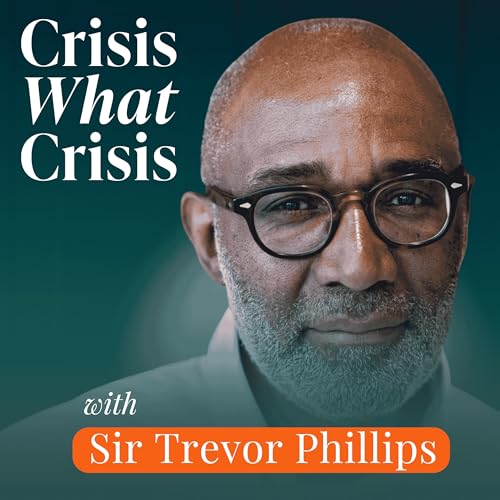
• SIR TREVOR PHILLIPS: Why we are WRONG about mental illness
    Feb 17 2026

    After a 22-year battle with anorexia, Sir Trevor Phillips' daughter Sushila died aged 36 in April 2021. Now he's calling for a radical shift in how we talk about mental illness – and he's not holding back.

    The broadcaster, writer, and equality campaigner joins Crisis What Crisis? to explain why banning social media for under-16s is "preposterous," why celebrity "mental health struggles" make him furious, and what the "seventh circle of hell" really looks like in an eating disorder ward.

    Trevor also talks to us about his remarkable upbringing and career across media, business and politics - all of it etched with resilience.

    ⚠️ Please note: This episode contains frank discussions of anorexia, eating disorders, mental illness, and grief that some listeners may find distressing.

    WHAT YOU’LL HEAR:

    1. The brutal reality of a 22-year battle with severe anorexia
    2. Why mental illness and sadness are NOT the same thing
    3. Trevor's message to celebrities who conflate difficulty with trauma: "F*** off"
    4. Why removing friction from children's lives destroys resilience

    LESSONS YOU'LL LEARN:

    1. Separate mental illness from sadness: stop confusing clinical illness with being "a bit fed up"
    2. Teach resilience, don't remove pain: you can't take friction out of the human condition
    3. The good guys can win: but you have to fight for it
    4. Know what you cannot do: in crisis, understand your limitations
    5. Light a candle: don't curse the darkness

    IN THIS EPISODE:

    00:00 – Introduction: Sir Trevor Phillips' remarkable life

    21:23 – What Britain should learn from its racial progress

    27:10 – What real resilience looks like in a crisis

    31:26 – The Leadership Lesson: knowing what you can't do

    33:06 – Shushila: A 22-year battle with anorexia

    44:39 – How grief changed everything

    49:27 – Mental Illness vs. Feeling Sad: "stop conflating them"

    57:12 – Why banning under-16s from social media Is "preposterous"

    01:04:30 – What immigrants can teach Britain about resilience

    SUPPORT & RESOURCES: If you or someone you know is struggling with an eating disorder: Beat Eating Disorders - www.beateatingdisorders.org.uk

    FOLLOW TREVOR:

    X – https://x.com/TrevorPTweets

    FOLLOW CRISIS WHAT CRISIS?

    Instagram – www.instagram.com/crisiswhatcrisispodcast/

    TikTok – https://www.tiktok.com/@crisispod

    Mehr anzeigen Weniger anzeigen
    1 Std. und 8 Min.
  • GREG JACKSON: A bath is my crisis non-negotiable
    Feb 10 2026

    In 2021, the UK energy market collapsed. More than 30 of the big energy suppliers went under. But, the business Greg Jackson founded, Octopus Energy, didn't just survive, it grew.

    In this bonus Crisis Compass episode of Crisis What Crisis?, Greg shares with us the four anchors he relies on when pressure mounts and uncertainty takes over.

    In this segment, Andy asks Greg for:

    1) A person who shaped his perspective

    2) A piece of advice he returns to

    3) A source of comfort

    4) A daily habit he refuses to give up

    This is Part Two of a longer conversation with Greg. If you enjoyed this episode, you can listen to the full interview on our podcast homepage.

    Follow Octopus Energy

    Instagram: https://www.instagram.com/octopusenergy/

    TikTok: https://www.tiktok.com/@octopusenergy

    Follow Crisis What Crisis?

    Instagram: https://www.instagram.com/crisiswhatcrisispodcast/

    TikTok: https://www.tiktok.com/@crisispod

    Mehr anzeigen Weniger anzeigen
    4 Min.
  • OCTOPUS BOSS: “I became the face of the energy crisis”
    Feb 3 2026

    Greg Jackson, founder and CEO of energy giant Octopus Energy, is perhaps one of Britain’s most innovative CEOs.

    In 2021, the British energy market collapsed. Wholesale gas prices surged six-fold, thirty suppliers went under in months, while millions of families faced impossible bills.

    Rather than sticking his head in the sand, Greg went public, putting his own credibility on the line to explain why prices were rising. He cut his own salary to minimum wage, provided £150 million in bill relief packages, and became the face of the energy crisis when everyone told him not to.

    The result? Octopus became the UK's largest energy supplier during the worst energy crisis in a generation, now valued at over £7 billion.

    Greg is an entrepreneur who's built multiple businesses by doing exactly what everyone else refuses to do – a true lesson in why fortune really does favour the brave.

    LESSONS YOU'LL LEARN:

    1. Character matters more than ability.
    2. When you see something clearly, don't hesitate.
    3. Fortune favors the brave, zig when others zag!
    4. Being smart isn't enough. The combination of being smart and working hard is critical.
    5. Communicate relentlessly, especially in crisis.

    FOLLOW OCTOPUS:

    Instagram – www.instagram.com/octopusenergy/?hl=en

    TikTok – www.tiktok.com/@octopusenergy?lang=en

    FOLLOW CRISIS WHAT CRISIS?

    Instagram – www.instagram.com/crisiswhatcrisispodcast/?hl=en

    TikTok – https://www.tiktok.com/@crisispod

    Mehr anzeigen Weniger anzeigen
    1 Std. und 2 Min.
  • BODEN FOUNDER: How I survive a crisis
    Jan 27 2026

    Johnnie Boden, founder of Boden, reveals how he survives crisis as a business leader.

    In this Crisis Compass bonus episode of Crisis What Crisis?, Johnnie shares the person, piece of advice, the daily habit and comfort that he uses to navigate life under pressure.

    This is the second part of a longer conversation with Johnnie – if you enjoyed this be sure to check out the full episode on our podcast homepage.

    Whether you’re an entrepreneur, CEO or leader, this episode offers a snapshot personal insight into the mindset of one of Britain's most successful fashion founders.

    FOLLOW BODEN:

    Instagram – www.instagram.com/boden/?hl=en

    TikTok – www.tiktok.com/@boden_clothing

    FOLLOW CRISIS WHAT CRISIS?

    Instagram – www.instagram.com/crisiswhatcrisispodcast/?hl=en

    TikTok – https://www.tiktok.com/@crisispod

    Mehr anzeigen Weniger anzeigen
    2 Min.
  • BODEN FOUNDER: The 51% rule that saved my business
    Jan 20 2026

    For three decades, Johnnie Boden has turned cheerful prints, quality fabrics, and unmistakable English charm into one of Britain's most distinctive retail brands – worn by royals, loved internationally, with nearly 2 million active customers and the second-biggest British clothing business in America. But as Johnnie so candidly reveals, his success has been far from linear…

    In this business special of Crisis What Crisis? we delve deep into the challenges of starting and running a multinational fashion label offering lessons that apply to almost every founder, entrepreneur and leader.

    LESSONS YOU'LL LEARN:

    1. Hire people who complement you, not clone you.
    2. Match paranoia about people with confidence about your core idea.
    3. Ask the stupid questions.
    4. Listen intensely.
    5. Admit failure fast.

    FOLLOW BODEN:

    Instagram – www.instagram.com/boden/?hl=en

    TikTok – www.tiktok.com/@boden_clothing

    FOLLOW CRISIS WHAT CRISIS?

    Instagram – www.instagram.com/crisiswhatcrisispodcast/?hl=en

    TikTok – https://www.tiktok.com/@crisispod

    Mehr anzeigen Weniger anzeigen
    48 Min.
  • Sam McAlister's Crisis Compass
    Dec 16 2025

    For over a decade at BBC Newsnight, Sam McAlister secured the interviews others couldn't – Bill Clinton, Elon Musk, Stormy Daniels. But it was six months of negotiation that led to the conversation that changed everything: Prince Andrew discussing his ties to Jeffrey Epstein in 2019.

    Today, Sam teaches negotiation at LSE and is one of Britain's most compelling voices on persuasion, power, and resilience.

    This is Sam McAlister's Crisis Compass

    FOLLOW CRISIS WHAT CRISIS?

    Instagram – www.instagram.com/crisiswhatcrisispodcast/?hl=en

    TikTok – https://www.tiktok.com/@crisispod

    Mehr anzeigen Weniger anzeigen
    3 Min.
  • Sam McAlister: How I got Prince Andrew to do THAT interview
    Dec 9 2025

    For over a decade at BBC Newsnight, Sam McAlister secured the interviews others couldn't – Bill Clinton, Elon Musk, Stormy Daniels. But it was 13 months of negotiation that led to the conversation that changed everything: Prince Andrew discussing his ties to Jeffrey Epstein in 2019. The interview became a global news event, resulted in Andrew stepping back from royal duties, and is still making headlines six years later.

    In July 2021, Sam threw the dice, she gave up her BBC pension and security as a single mother in the middle of a pandemic to write a book. That gamble paid off. Her memoir Scoops became a bestseller and a Netflix film starring Gillian Anderson and Billie Piper. Today, Sam teaches negotiation at LSE and is one of Britain's most compelling voices on persuasion, power, and resilience.

    LESSONS YOU'LL LEARN:

    Don't get bitter, take control - When Sam wasn't getting credit for the Prince Andrew interview, she didn't whine or play victim. She took voluntary redundancy, wrote a book, and ended up with a Netflix deal and 30 million viewers watching Billie Piper play her.

    Imposter syndrome is mostly a crock - When you've worked hard and earned your place, confidence isn't arrogance – it's honesty.

    Build trust through respect, not manipulation - Sam's superpower wasn't sucking up to powerful people. It was treating them with respect while demanding it of herself.

    Know your financial bottom line before taking risks - Sam had three outcomes mapped before leaving the BBC. That clarity gave her the courage to leap.

    No one is dead – If you can't control it, suck it up. If you can, do something about it.

    FOLLOW CRISIS WHAT CRISIS?

    Instagram – www.instagram.com/crisiswhatcrisispodcast/?hl=en

    TikTok – https://www.tiktok.com/@crisispod

    Mehr anzeigen Weniger anzeigen
    57 Min.
  • RELAUNCH RORY STEWART: On his love for risk and a battle with bitterness
    Nov 26 2025

    This is a relaunch of a previous episode, but the lessons contained within it are as important today as they were when we sat down to speak over two years ago.

    Rory Stewart has spent his life running toward gunfire. At thirty, he was governing millions of Iraqis under siege, rockets landing in his compound while insurgents climbed the walls. Years earlier, he'd walked six thousand miles across Afghanistan, Pakistan, Iran and India – surviving on strangers' floors, dodging bullets, and at one point sitting down in the snow ready to freeze to death until his dog Babur barked him back to life. Then he tried to fix British politics from the inside – becoming Prisons Minister, running for Prime Minister, and standing as an Independent for London Mayor before Covid cancelled the election seven weeks out and ended his political career. Today he's the force behind the podcasting phenomenon The Rest Is Politics – currently touring the country giving erudite political commentary.

    While his most recent book, Middleland, launched last month (October 2025), draws on pieces originally written for a local newspaper when he was serving as an MP in Cumbria, it is an urgent and inspiring portrait of rural Britain today.

    LESSONS YOU'LL LEARN:

    1. Permission to fail breeds confidence - Rory's father set impossibly high expectations while making him feel it was okay to fail. That paradox became the foundation for handling extreme crisis without paralysis.
    2. Beware thinking in clichés during crisis - Under siege in Iraq, Rory evacuated civilians into an ambush because he fell into a "women and children first" narrative. When you're living the movie version instead of the real version, you make dangerous decisions.
    3. Animals are crisis teachers - Babur the dog saved Rory's life by refusing to let him give up in the snow. Animals approach the world with courage, presence, and forgiveness.
    4. Bitterness is backwards motion - After being defeated by Boris Johnson, Rory struggled with anger. Whenever you have bitter days, you always go backwards. It's not just bad for you – it's terrible for everyone around you.
    5. Test yourself before crisis finds you - By voluntarily embracing discomfort and risk when you don't have to, you build the capacity to handle it when you must.

    FOLLOW CRISIS WHAT CRISIS?

    Instagram – www.instagram.com/crisiswhatcrisispodcast/?hl=en

    TikTok – https://www.tiktok.com/@crisispod

    Mehr anzeigen Weniger anzeigen
    56 Min.