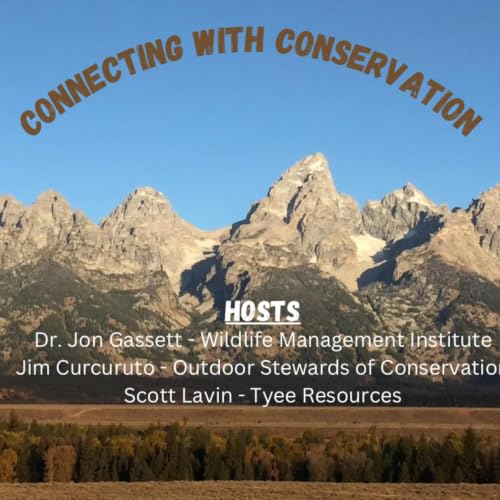
Connecting with Conservation Titelbild

Connecting with Conservation

Connecting with Conservation

Von: Wildlife Management Institute
Jetzt kostenlos hören, ohne Abo

Saisonale Sparangebote | 0,99 € pro Monat für die ersten 3 Monate

Danach 6,99 €/Monat. Bedingungen gelten. Monatlich kündbar.
Do you enjoy angling, boating, hunting, recreational shooting or just getting outdoors and into the backcountry? Connecting with Conservation is the only podcast that delves into the business of conservation. We talk with state wildlife agency and industry experts about how conservation is achieved in the United States along with the tremendous impacts to local economies that driven by the recreational user. Join our hosts as they explore this often unknown or misunderstood aspect of how fish and wildlife conservation works in the U.S.Wildlife Management Institute
  • Season 3: Episode 20: Managing Wildlife Across Two Thirds of a Continent
    Sep 29 2026

    If you've ever wondered what it takes to manage wildlife and fish across two thirds of a continent, this episode has your answer. In Season 3, Episode 20 of Connecting with Conservation, co-hosts Jon Gassett of the Wildlife Management Institute and Jim Curcuruto of the Outdoor Stewards of Conservation sit down with Zach Lowe, Executive Director of the Western Association of Fish and Wildlife Agencies (WAFWA). WAFWA represents 23 states, provinces, and territories stretching from Corpus Christi, Texas, to Banks Island in the Canadian Arctic, encompassing more than 1,500 species and roughly 18,000 fish and wildlife employees. Zach brings a unique perspective to the conversation, having started his career as a prairie habitat specialist and Farm Bill extension biologist before spending 13 years at the McGraw Foundation leading the Conservation Leaders for Tomorrow program, and ultimately landing in the executive director's chair at WAFWA five years ago.The conversation covers the full sweep of what makes western wildlife management genuinely different from the rest of the country, from the scale of federal land ownership and the politics of multi-jurisdictional management to the quirks of shed hunting regulations and the lottery-level odds of pulling a float permit for Hells Canyon. Zach and Jon dig into how harsh western winters drive boom-and-bust cycles in pronghorn, mule deer, and elk populations, why tag quotas are a biological necessity and not a punishment for non-residents, and how WAFWA's big game migration and connectivity initiative is working at a biome scale that most conservation organizations can't match. On the fisheries side, Zach walks through three of WAFWA's fish habitat partnerships, including the Western Native Trout Challenge, the Desert Fish Habitat Partnership, and the newly expanding Great Plains Fish Habitat Partnership, and introduces one of the most innovative fisheries tools in the conservation toolbox: the Trojan Male Fish program, which uses genetically conditioned hatchery fish to crowd out invasive brook trout and, potentially, carp from western watersheds.Whether you're a hunter chasing elk tags in Wyoming, an angler working to check off native cutthroat subspecies, or simply someone who wants to understand how the vast, complicated, and spectacular American West is managed for wildlife, this is a conversation worth your time. WAFWA may not be a household name, but the work it does shapes hunting seasons, fish populations, and habitat conservation across the largest wildlife management jurisdiction on the continent.To learn more, find us at: Wildlife Management Institute: https://wildlifemanagement.instituteOutdoor Stewards of Conservation: https://stewardsofconservation.orgWestern Association of Fish and Wildlife Agencies: https://wafwa.org#wildlife #wildlifeconservation #wildlifemanagement #fishing #flyfishing #hunting #westernwildlife #publiclands #habitatconservation #nativetrout #biggame #muledeer #elkhunting #pronghorn #fishandwildlife #wildlifemanagementinstitute #outdoorstewards #connectingwithconservation

    Mehr anzeigen Weniger anzeigen
    37 Min.
  • Season 3: Episode 19: Wildlife Habitat in the Intermountain West.
    May 29 2026

    Water, fire, sagebrush, and the vast open landscapes of the American West are at the heart of this week's conversation. In Season 3, Episode 19 of Connecting with Conservation, co-hosts Jon Gassett of the Wildlife Management Institute and Jim Curcuruto of the Outdoor Stewards of Conservation welcome two guests from the Intermountain West Joint Venture (IWJV): Hannah Nikonow, Communications and Marketing Coordinator, and Charlie Holtz, Field Delivery Capacity Coordinator. Together, they pull back the curtain on one of the largest, and least talked about, conservation partnerships in the United States, one that spans 11 states, roughly half a billion acres, and three of the West's most critical habitat types: sagebrush rangelands, working water and wetlands, and dry frequent-fire forests.Hannah and Charlie walk listeners through what the IWJV does on the ground, from helping multi-generational ranching families implement conservation practices on their working lands, to placing conservation professionals within BLM, Fish and Wildlife Service, and NRCS offices to deliver habitat programs where they're needed most. The conversation ranges from the mechanics of beaver dam analogs and low-tech stream restoration to the challenges of invasive annual grasses, encroaching conifers, big game migration corridors, and the West's intensifying water scarcity. Hannah also shares the IWJV's innovative approach to public outreach, including hands-on journalist field workshops that take reporters into sagebrush country and along the Bear River corridor to see conservation work firsthand rather than just reading a press release.Whether you're a wildlife professional, a western landowner, a hunter chasing sage grouse and pronghorn across public lands, or simply someone who wants to understand how the vast open spaces of the Intermountain West are being protected and restored, this episode delivers. The IWJV is one of conservation's unsung institutions, and this conversation is a compelling reminder that the people, partnerships, and funding mechanisms behind the work matter just as much as the work itself. Learn more and explore their stories at IWJV.org.For more Information, Visit Us at:• Wildlife Management Institute: https://wildlifemanagement.institute• Outdoor Stewards of Conservation: https://stewardsofconservation.org• Intermountain West Joint Venture: https://iwjv.org#wildlife #wildlifeconservation #wildlifehabitat #conservation #sagebrush #sagegrouse #westernwildlife #hunting #huntingconservation #publiclands #intermountainwest #habitatrestoration #wildlifemanagement #wildlifemanagementinstitute #outdoorstewards #connectingwithconservation

    Mehr anzeigen Weniger anzeigen
    27 Min.
  • Season 3: Episode 18: A Declining Icon: Mule Deer, Public Lands & the Fight to Turn the Tide
    May 19 2026

    What's happening to mule deer, and why should anyone west of the Mississippi care? In this episode of Connecting with Conservation, hosts Jon Gassett of the Wildlife Management Institute and Jim Curcuruto of Outdoor Stewards of Conservation sit down with Greg Sheehan, President and CEO of both the Mule Deer Foundation and the Blacktail Deer Foundation, for a wide-ranging conversation about one of the West's most iconic, and quietly troubled, big game species. Greg brings one of the most distinguished careers in American wildlife and land management to the table. After 25 years with the Utah Division of Wildlife Resources, including five as its director, he served as Principal Deputy Director of the U.S. Fish and Wildlife Service before returning west as Utah State Director for the Bureau of Land Management, overseeing roughly 22.8 million acres of public land. Today, leading both the Mule Deer Foundation and the Blacktail Deer Foundation, he's channeling that experience directly into species he's hunted and cared about his entire life. The conversation covers the multi-decade decline in mule deer populations, an estimated 50 to 60 percent drop across western states, and why there's no single simple answer. Habitat fragmentation, invasive plants like cheatgrass, suppressed fire regimes, migration corridor loss, surging road traffic, predator-prey dynamics, and severe winters all play a role, and Greg makes a compelling case that solutions require the same complexity as the problems themselves. The episode also touches on the North American Model of Conservation and what makes it unique globally, the importance of treating Pittman-Robertson excise tax revenue as an investment rather than a burden, the growing challenge of wildlife ballot initiatives bypassing science-based management, the lesser-known Blacktail Deer Foundation and the species' coastal rainforest habitat from California to Alaska, and why nonprofit conservation organizations can say things in public that government agencies simply cannot. Jon draws a thought-provoking parallel between mule deer declines and the emerging turkey population struggles in the East and raises an important question about whether the wildlife management profession has the right experience base to manage declining species after a century focused almost entirely on restoration success.For more information, reach us at:Wildlife Management Institute: https://wildlifemanagement.institute Outdoor Stewards of Conservation: https://stewardsofconservation.orgMule Deer Foundation: https://muledeer.orgBlack-Tailed Deer Foundation: https://blacktaildeer.org#muledeer #muledeerfoundation #blacktaileddeer #publiclands #wildlifemanagementinstitute #outdoorstewards #conservation #wildlifeconservation #pittmanrobertson #westernwildlife #huntingisconservation conservation

    Mehr anzeigen Weniger anzeigen
    49 Min.
adbl_web_anon_alc_button_suppression_t1
Noch keine Rezensionen vorhanden