College & Career Readiness Radio Titelbild

College & Career Readiness Radio

College & Career Readiness Radio

Von: T.J. Vari
Jetzt kostenlos hören, ohne Abo

Saisonale Sparangebote | 0,99 € pro Monat für die ersten 3 Monate

Danach 6,99 €/Monat. Bedingungen gelten. Monatlich kündbar.

College & Career Readiness Radio with T.J. Vari

A podcast about all things career and college readiness. Brought to you by MaiaLearning.

MaiaLearning Inc. 2024
  • Removing the Red Tape from Paid Internships with Corey Koopmans
    Sep 29 2026

    Our guest for this episode of College & Career Readiness Radio is Corey Koopmans, founder of InternCrew.

    Corey says workers' compensation, liability, age restrictions, payroll requirements, and administrative responsibilities can all become barriers for employers interested in hiring high school interns.

    According to Koopmans, large companies present an additional challenge. A local office may want to partner with a school, only to encounter corporate policies that make hiring high school students difficult.

    Corey describes an employer-of-record model as one way to remove much of that friction by managing screening, onboarding, payroll, insurance, compliance, time tracking, and feedback.

    Paid work-based learning is an important part of the equation for Koopmans. Removing administrative barriers can bring more employers into the process and ultimately create more paid opportunities for students.

    Corey also sees an opportunity to extend internships beyond the traditional school calendar. Year-round management can allow students to continue working during the summer when some industries have even greater demand.

    Authentic work experience requires authentic accountability, according to Koopmans. Students need to understand workplace expectations, receive meaningful feedback, and experience real consequences when those expectations aren't met.

    He views even losing an internship as a potential learning experience. Students can learn about attendance, performance, professionalism, and workplace norms before entering their first full-time job.

    When it comes to internship quality, he argues that students need to actually engage in meaningful work. A welding student, for example, shouldn't spend the experience simply sweeping the floor instead of developing relevant skills.

    Corey suggests that scaling internships may also require employers to rethink how the work itself is structured. Shorter shifts, project-based teams, and “gig-style” arrangements could create paid opportunities for more students while still providing value to employers.

    From an employer perspective, Koopmans sees internships as part of a larger talent strategy. Early exposure can introduce students to careers while helping organizations develop a pipeline of potential future employees.

    Ultimately, Corey believes students shouldn't simply be around the work. High-quality internships should allow them to do the work, build relevant skills, receive feedback, and understand what success looks like.

    His final message captures the value of these experiences: “There's no such thing as success and failure. There's only success and learning, and learning can only occur through experience.”

    College & Career Readiness Radio is brought to you by MaiaLearning, your fully comprehensive college and career planning tool, including the ability to plan and track internship experiences for students. Schedule a demo today.

    Mehr anzeigen Weniger anzeigen
    27 Min.
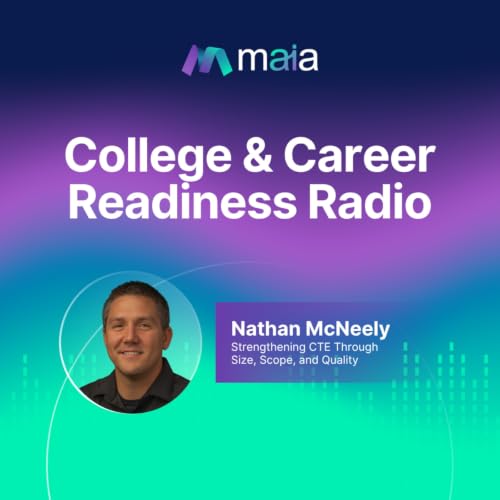
  • Strengthening CTE Through Size, Scope, and Quality with Nathan McNeely
    Sep 15 2026

    Our guest for this episode of College & Career Readiness Radio is Nathan McNeely, CTE Director at Grant Regional Career Center in Marion, Indiana.

    Nate defines size as being about access—whether enough students and schools have access to CTE programs that align with student interest and labor-market demand.

    He explains that scope is about opportunity. Programs should reflect local needs while also preparing students for opportunities regionally, nationally, and even internationally.

    Nate says that quality is about outcomes. Dual credit, credentials of value, work-based learning, and other experiences should produce career-ready graduates, not simply students who completed a CTE program.

    He reports on a problem regarding demand, which can exceed available seats, making partnerships between comprehensive high schools and career centers critical. High schools can provide introductory experiences while career centers offer more advanced, equipment-intensive programming.

    He says that having a pathway isn't enough. Students also need meaningful internships and work-based learning experiences connected directly to that pathway.

    Nate emphasizes that employers often need support understanding how to create high-quality experiences for high school students. Schools and community partners have to educate employers about what meaningful internships should look like.

    He tells listeners that a welding student shouldn't spend an internship sweeping floors. Schools and employers should agree upfront on what the student, school, and employer will each contribute to the experience.

    McNeely recommends using advisory boards as more than a compliance requirement. Employers should actively influence programs, particularly when determining which credentials actually have value in the local workforce.

    Nate says schools may need a both/and approach to credentials—earning credentials required for accountability while also providing additional certifications that employers actually want.

    He clarifies that strong CTE programs prepare students for whatever comes next, not one path or another. Some students may enter the workforce immediately, while others use CTE, dual credit, and credentials to gain an advantage as they continue into postsecondary education.

    Nate emphasizes that a true pathway shouldn't be a dead end. It should connect coursework, credentials, dual enrollment, work-based learning, postsecondary opportunities, and ultimately employment.

    His final message is collaborate! Bring schools, career centers, employers, chambers, higher education, and other stakeholders together because collaboration creates better opportunities for students.

    College & Career Readiness Radio is brought to you by MaiaLearning, your fully comprehensive college and career planning tool, including the ability to plan and track CTE courses and work-based learning, award credentials, and build student portfolios for post-secondary use, and more. Schedule a demo today.

    Mehr anzeigen Weniger anzeigen
    27 Min.
  • Developing a Vision for Postsecondary Success with Tony Dina
    Sep 1 2026

    Our guest for this episode of College & Career Readiness Radio is Tony Dina, founder of Crucial Canvas.

    Tony says people often overlook their own “superpowers” because the things that come naturally to them may not feel particularly special.

    He encourages students to identify behaviors others consistently recognize in them, rehearse how those strengths might show up in different situations, and become comfortable showcasing what they do well.

    Tony cautions against assuming that a passion must become a career. Instead, students can identify the skills and mindsets developed through their passions and apply them to completely different fields.

    He says some of the strongest technologists he has worked with came from fields such as history and evolutionary biology because different backgrounds create different ways of thinking.

    Tony argues that liberal arts experiences are increasingly important in technical fields because philosophy, ethics, psychology, and other disciplines strengthen the human judgment required to use technology responsibly.

    He says schools should help students use AI to improve their own thinking and writing rather than simply allowing AI to create the finished product.

    Tony explains that AI can become a powerful feedback tool when students bring their own ideas and work to it and ask how they can improve.

    He challenges the traditional emphasis on productivity, which is largely about accomplishing more of the same work faster.

    Tony says the emerging workforce requires capacity—the ability to encounter new ideas, learn quickly, integrate different concepts, and bring them into new situations.

    He believes students need opportunities to become comfortable with uncertainty instead of constantly racing toward the correct answer.

    Tony says educators can help students develop this capacity by asking questions that don't necessarily have one answer and giving them space to sit with ideas before solving them.

    He suggests that career readiness should include learning how to identify problems, not simply solving problems that someone else has already defined.

    Tony encourages students to think beyond short-term goals and develop a longer-term vision of who they want to become, what they want their days to look like, and how they want to live.

    He reminds listeners that careers rarely unfold exactly as planned. A strong vision can provide direction without requiring students to know precisely where their careers will eventually take them.

    His final message applies equally to students and the educators preparing them for the future: “You are more capable than you even realize.”

    College & Career Readiness Radio is brought to you by MaiaLearning, your fully comprehensive college and career planning tool, including the ability for students to set goals, write journals, and create their vision of success after high school, and more. Schedule a demo today.

    Mehr anzeigen Weniger anzeigen
    30 Min.
adbl_web_anon_alc_button_suppression_t1
Noch keine Rezensionen vorhanden